
Analyzing the symbiotic relationship between ERP and enterprise development
In today's deeply penetrated digital economy, ERP systems are no longer an "optional configuration" for enterprise digital transformation, but a "symbiotic partner" deeply bound to enterprise development and empowered in both directions. The so-called symbiosis is not simply about "tool adaptation needs", but about ERP relying on enterprise business scenarios to realize value implementation. Enterprises use ERP to break through development bottlenecks and achieve level leaps. The two are interdependent and mutually beneficial, running through the entire life cycle of enterprises from start-up, growth to maturity. This symbiotic relationship not only highlights the core value of digital tools, but also interprets the deep integration of enterprise development and technological empowerment, becoming a key support for enterprises to stand firm in market competition.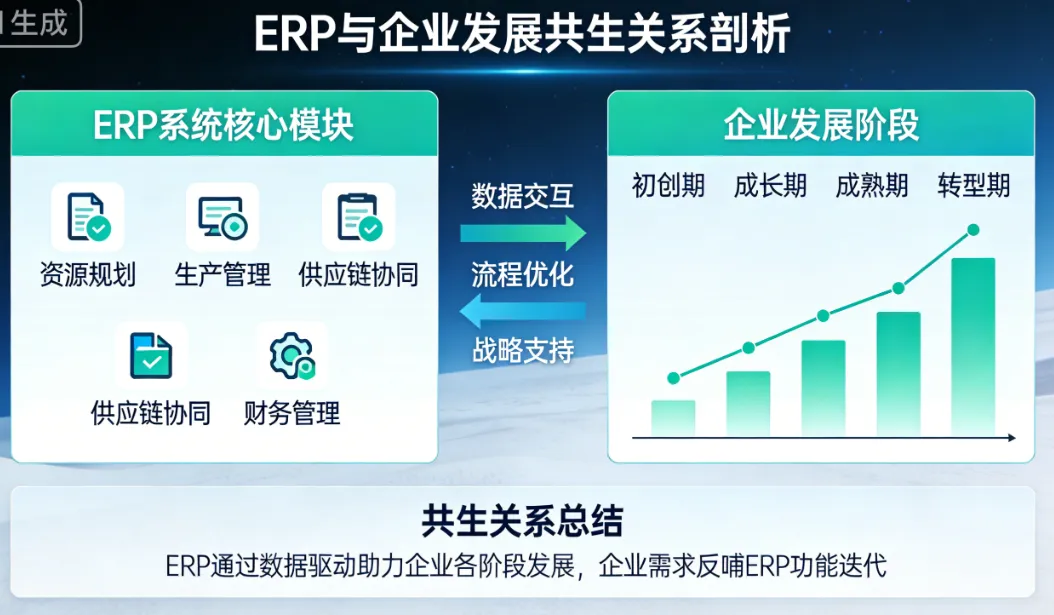
ERP lays a solid foundation for enterprise development and serves as an "enabler" to overcome operational pain points and enhance core competitiveness. This is the core essence of symbiotic relationships. At different stages of enterprise development, there are different focuses on the operational challenges faced. ERP, through its modular architecture and full chain collaboration capabilities, accurately matches the growth needs of enterprises and clears obstacles for their development. For start-up enterprises, the core demand is to standardize processes and control costs. ERP can simplify basic business processes such as procurement, inventory, and finance, achieve standardized data management, avoid operational risks caused by process chaos and data distortion, help enterprises quickly build standardized operating systems, and consolidate their development foundation.
For growing enterprises, the synergy challenges brought by scale expansion and multi-channel layout are becoming increasingly prominent, and the value of ERP is becoming more prominent. At this point, ERP breaks down departmental data barriers and achieves real-time synchronization of data across the entire business chain, including procurement, production, inventory, and sales, solving the dilemma of "each department fighting independently". For example, growth oriented enterprises in the footwear and apparel industry use ERP to achieve multi SKU control and omni channel inventory collaboration, solving the problem of both out of stock and backlog; Manufacturing enterprises optimize production scheduling through ERP, shorten production cycles, improve order delivery capabilities, and support steady expansion of business scale. Data shows that ERP systems with high adaptability can help growth enterprises reduce operating costs by more than 30%, improve collaborative efficiency by 25%, and inject momentum into breaking through growth bottlenecks.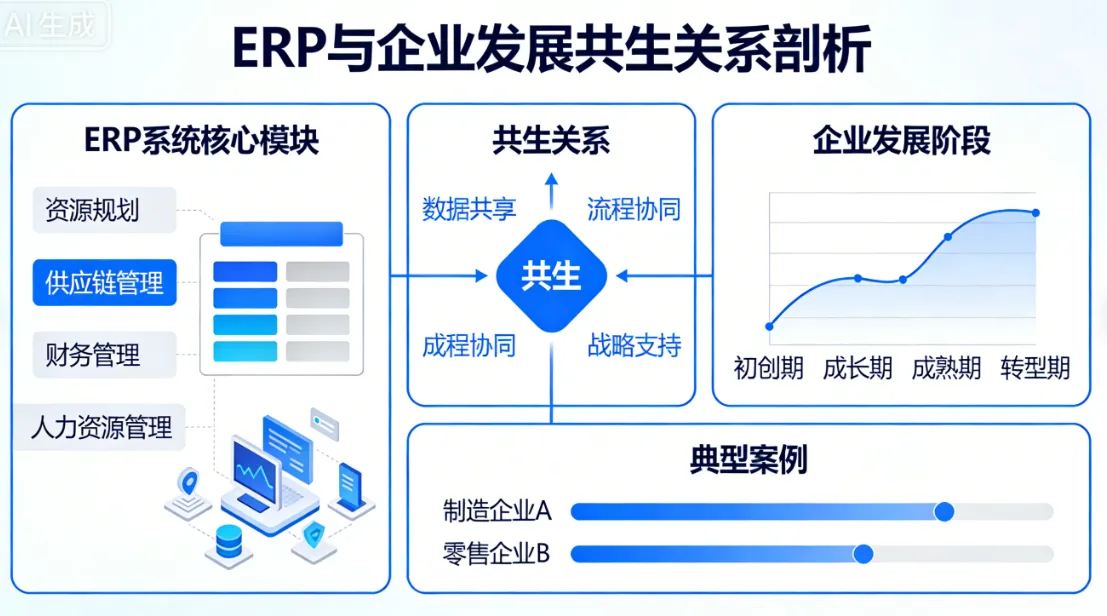
For mature enterprises, the core of digital transformation is refined operation and sustainable development, and ERP plays the role of "data center" and "decision support". Mature enterprises often face complex scenarios of multi brand, cross regional, and full industry chain operations. ERP integrates global data, builds a data analysis system, and intuitively presents the shortcomings and growth opportunities of enterprise operations, providing accurate data support for strategic decisions such as category optimization, capacity adjustment, and market layout. At the same time, ERP can adapt to the diversified development needs of enterprises, and through seamless integration with MES, CRM and other systems, build a collaborative system for the entire industry chain, help enterprises optimize resource allocation, consolidate market position, and achieve the transformation from "scale expansion" to "quality improvement".
The reverse drive of enterprise development for ERP iteration and upgrading is the "core driving force" for ERP to achieve functional improvement and scene adaptation, which is a key extension of the symbiotic relationship. The iteration of ERP has never deviated from the development needs of enterprises, but has always kept up with the pace of enterprise growth, optimizing its own functions and architecture in the process of adapting to enterprise business upgrades. With the expansion of enterprise scale and business scenarios, the single function of traditional ERP can no longer meet the demand. The demand for advanced functions such as omni channel collaboration, intelligent prediction, and flexible production has forced ERP vendors to delve into segmented fields and create customized solutions.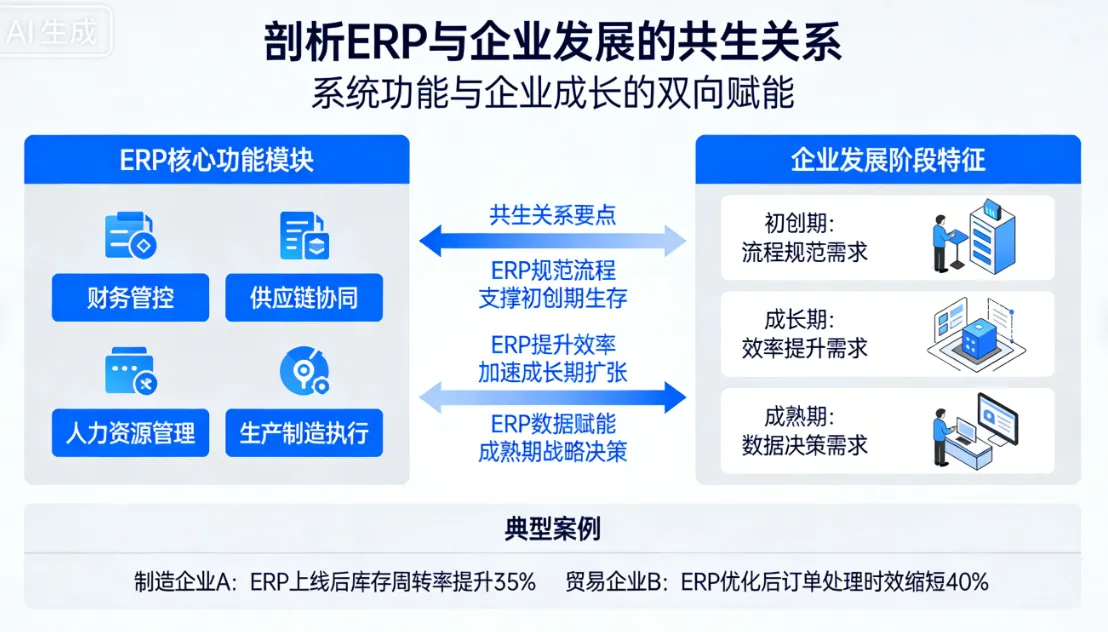
For example, in the era of omni channel retail, enterprises have a demand for cross platform order fulfillment and global inventory allocation, which drives the upgrade of ERP omni channel management modules to achieve online and offline data interoperability; In the context of the development of industrial Internet, the demand of manufacturing enterprises for production process traceability and intelligent scheduling has prompted ERP to be integrated into the Internet of Things, AI and other cutting-edge technologies to achieve intelligent management and control of production links. At the same time, the differentiated needs of enterprises in different industries are driving the transformation of ERP from generalization to specialization - ERP in the footwear and apparel industry strengthens SKU and piece rate management, ERP in the electronics industry focuses on product traceability, and ERP in the service industry optimizes order and service control. This adaptability upgrade makes the binding between ERP and enterprise development more closely.
The symbiotic relationship between ERP and enterprise development is essentially a virtuous cycle of "technology empowering business and business driving technology", and both are indispensable. ERP that deviates from the needs of enterprise development is simply a technical stack that cannot realize its actual value and will ultimately be eliminated by the market; Enterprises that are detached from ERP empowerment find it difficult to break through operational bottlenecks, cope with complex market competition, and achieve long-term development in the digital age. In reality, many successful cases of enterprises have confirmed this symbiotic value: ANTA optimizes full chain control through ERP, supporting brand globalization layout; Shuntong ERP relies on the practice of serving thousands of enterprises, continuously iterating and adapting to the needs of multiple industries, while helping cooperative enterprises achieve management upgrades, forming a virtuous cycle of two-way achievements.
With the continuous development of the digital economy, the symbiotic relationship between ERP and enterprise development will become even deeper. In the future, the development of enterprises will rely more on digital capabilities, and the requirements for the intelligence, scenarization, and integration of ERP will continue to increase. This will promote the continuous integration of cutting-edge technologies such as AI and big data into ERP, achieving a leap from "process control" to "intelligent empowerment". The iterative upgrade of ERP will further empower enterprises to break through development boundaries, achieve refined operations and sustainable growth, and help enterprises achieve a leap in energy level in fierce market competition. Only by recognizing and deeply cultivating this symbiotic relationship can enterprises fully unleash digital value and achieve high-quality development.