
Optimization strategies for ERP systems to enhance operational efficiency of enterprises
In the current era where digital operations have become the core competitiveness of enterprises, ERP systems, as the core carrier for integrating full chain business and connecting various departments for collaboration, directly determine the operational efficiency and development potential of enterprises. Many enterprises have deployed ERP systems, but due to a lack of scientific optimization strategies, they are trapped in the dilemma of "stagnation upon launch" and "functions not yet implemented", unable to fully unleash digital value, and even experiencing problems such as process redundancy and data disconnection, which actually restrict the improvement of operational efficiency. In fact, the optimization of ERP systems is not a single functional upgrade, but a systematic engineering that conforms to the development of enterprise business, takes into account practicality and foresight. Only through precise adaptation, data activation, process simplification, personnel empowerment, and continuous iteration of comprehensive optimization can ERP be deeply integrated with enterprise operations, maximize operational efficiency, and inject strong momentum into high-quality development of enterprises.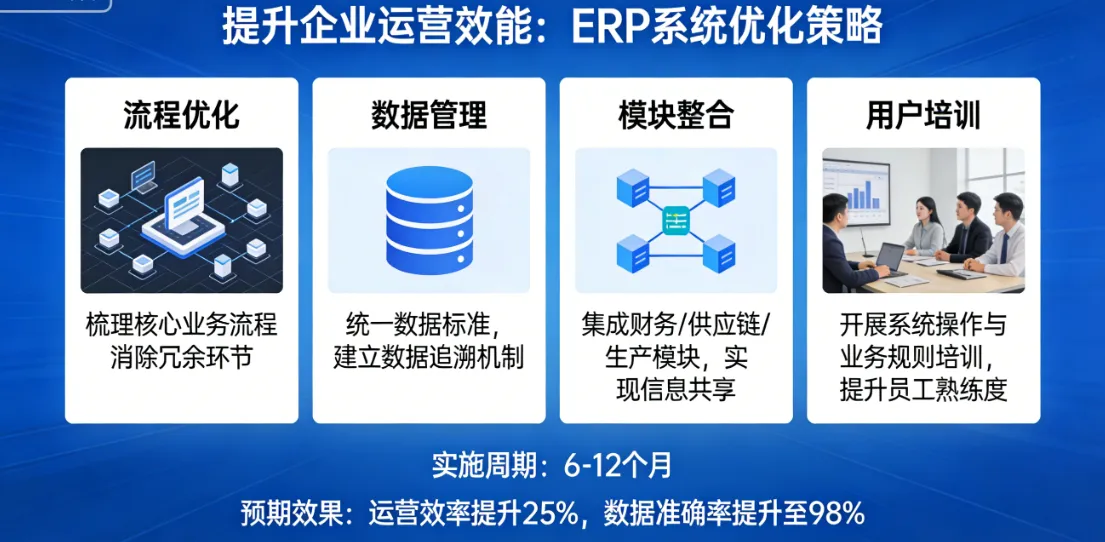
Accurately adapting to business scenarios, building a solid foundation for optimization
The core premise of ERP system optimization is to break free from the constraints of "universal templates" and achieve precise adaptation to enterprise business scenarios and development stages - optimization without business will only become a "formal upgrade" and cannot truly improve operational efficiency. Enterprises of different industries and scales have significant differences in operational pain points and business needs, and optimization strategies need to be designed accordingly: small and medium-sized manufacturing enterprises focus on basic production and inventory control, and optimization should focus on simplifying operations, lowering landing thresholds, and avoiding redundant functions that increase operational burden; Shoe and clothing companies need to focus on inventory control and flexible production needs for multiple SKUs and sizes, optimize SKU coding systems, piece rate accounting, omnichannel inventory linkage, and other exclusive functions; Large chain enterprises need to strengthen their overall collaboration capabilities, optimize data exchange and process connection between headquarters and branch offices, online and offline channels, and adapt to the needs of large-scale operations.
At the same time, ERP optimization needs to be tailored to the development stage of the enterprise and dynamically adjust the functional layout: start-up enterprises focus on standardizing basic processes, optimizing core modules of procurement, finance, and inventory, and building standardized operational frameworks; Growth oriented enterprises focus on enhancing collaborative efficiency, optimizing data linkage and process integration, and breaking down management barriers caused by scale expansion; Mature enterprises focus on refined operations, optimizing advanced functions such as data analysis and intelligent warning to support strategic decision-making. For example, a certain shoe company in Cixi has optimized the inventory coding and piece rate management module of its ERP system to adapt to its own production process, addressing the pain points of chaotic inventory of multiple sizes and cumbersome piece rate accounting. After going online, the accuracy of inventory has been improved to 99%, the efficiency of wage accounting has increased by 60%, and operational efficiency has significantly improved.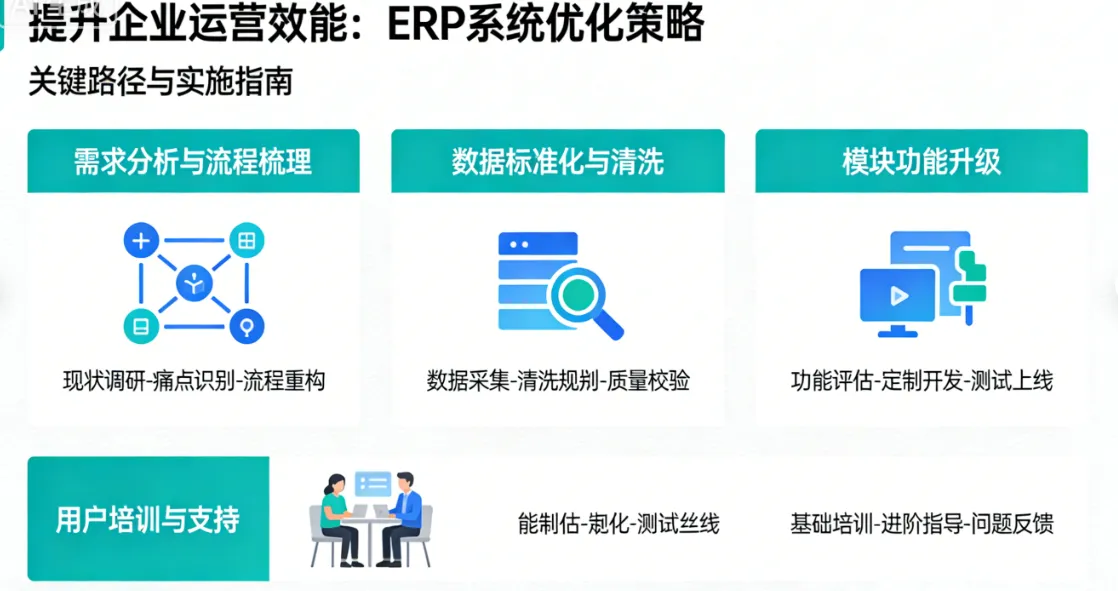
Activate the collaborative value of data and crack data silos
Data is the core asset of ERP systems and a key lever for improving operational efficiency. Most enterprises' ERP systems are trapped in the dilemma of "data idleness" due to inconsistent data standards and unconnected circulation channels, forming data islands that cannot realize the value of data. Therefore, optimization at the data level needs to revolve around the three core principles of "unified standards, interconnected links, and deep reuse", making data the "core engine" driving operational efficiency improvement.
Firstly, unify data coding and standards, sort out the entire chain of business data such as procurement, production, sales, and finance, establish a standardized coding system and data caliber, eliminate the problem of "multiple versions and calibers of the same data", ensure the accuracy and consistency of data, and lay the foundation for data circulation and analysis. Secondly, establish a data flow channel, optimize the data linkage function of the ERP system, achieve real-time synchronization between business data and financial data, production data and inventory data, front-end sales data and back-end production data, avoid errors and efficiency losses caused by manual duplicate input, and reduce cross departmental communication costs. Finally, optimize the data analysis function, build visual reports and BI analysis modules, visually present core operational indicators such as inventory turnover, order fulfillment, and cost control, explore the operational pain points and growth opportunities behind the data, provide accurate data support for process optimization and decision-making, and transform data from "idle assets" to "operational momentum".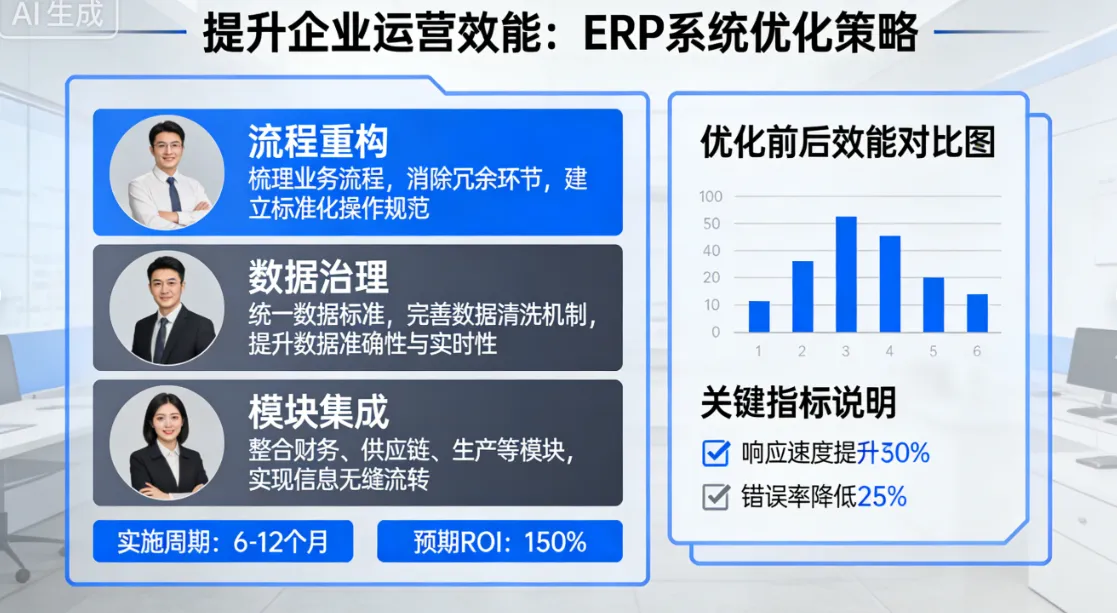
Simplify and optimize business processes to improve operational efficiency
The core value of an ERP system is to simplify operational processes and achieve process standardization. However, many enterprises' ERP processes have problems such as redundancy, unclear responsibilities, and poor connections, which actually reduce operational efficiency. Therefore, the core of process optimization is to "streamline redundancy, clarify responsibilities, and strengthen collaboration", achieving "simplification of complex processes, standardization of fuzzy processes, and high efficiency of standard processes".
On the one hand, streamline redundant processes and approval nodes, streamline existing business processes, eliminate unnecessary approval steps and repetitive operations, and replace traditional multi link offline approvals with online one click circulation to shorten the process cycle. For example, optimize the procurement approval process, simplify multi department level approvals into a three-level process of "application review issuance", and improve procurement approval efficiency by more than 50%; Optimize the monthly settlement process, achieve automatic generation of financial vouchers from business documents, shorten the monthly settlement time by 60%, and significantly reduce the workload of financial personnel. On the other hand, it is necessary to clarify the responsible parties and time nodes of each process, avoid problems such as buck passing and process lag, optimize process connection, and achieve closed-loop management of "business triggering process linkage result synchronization". For example, after a sales order is generated, related processes such as production scheduling, inventory verification, and financial accounting are automatically triggered, reducing communication costs between departments and improving overall operational efficiency.
Strengthen personnel adaptation and empowerment to ensure optimized implementation
The optimization effect of ERP system ultimately needs to be implemented by employees. If employees are not proficient in operation and resist use, even the most perfect optimization plan cannot play its value - insufficient personnel adaptation is an important reason for the difficulty in implementing ERP optimization and the inability to release efficiency. Therefore, personnel level optimization needs to revolve around "training empowerment, establishing feedback, and strengthening identification", enabling employees to proficiently use the optimized system and actively participate in efficiency improvement.
Conduct hierarchical and classified training for employees in different positions: for frontline employees in workshops, warehouses, etc., focus on simplifying operational processes, relying on optimization functions such as scanning code operations and convenient input, reducing learning barriers, and quickly achieving full staff adaptation; For management personnel, focus on training high-level functions such as data analysis and intelligent warning to enhance their ability to apply data and make decisions; For core positions such as finance and procurement, emphasis is placed on training on process integration and standardized data entry to ensure accurate data and smooth processes. At the same time, establish an employee feedback mechanism, collect problems and suggestions from employees during the use process, optimize system operation details in a targeted manner, improve employee experience, and reduce resistance. In addition, strengthening the digital awareness of all employees, enabling them to understand the core value of ERP optimization, actively cooperating with process adjustments, forming an optimization atmosphere of "full participation, co construction and sharing", and ensuring the effective implementation of optimization plans.
Continuously iterating and upgrading to achieve long-term empowerment
The optimization of ERP systems is not achieved overnight, but a long-term process that grows synchronously with enterprise operations - changes in market environment, upgrades in enterprise business, and technological iterations all require continuous optimization of ERP systems in order to always adapt to enterprise operational needs and achieve long-term empowerment. If the optimization stagnates, with the development of the enterprise and market changes, the ERP system will eventually become disconnected from the business again and unable to support the improvement of operational efficiency.
Enterprises need to establish a continuous iteration mechanism for ERP, regularly review business pain points and system operation issues, and dynamically optimize system functions based on industry trends and technological developments. On the one hand, they should track cutting-edge technology applications, integrate AI, IoT and other technologies into ERP systems, optimize advanced functions such as intelligent scheduling, inventory warning, and demand forecasting, and improve the level of system intelligence; On the other hand, in combination with business expansion needs, expand the functional boundaries of the system, achieve seamless integration with MES, CRM, e-commerce platforms and other systems, and build a collaborative system for the entire industry chain. At the same time, relying on system operation data and employee feedback, we regularly optimize operational processes and improve data standards to ensure that the ERP system always fits the rhythm of enterprise operations, achieving a virtuous cycle of "optimization landing review re optimization" and continuously empowering operational efficiency improvement.
Conclusion: The optimization of ERP system is a systematic project that is "tailored to business, focused on efficiency, and continuously iterated". The core lies not in the stacking of functions, but in the deep integration with enterprise operations. From precise adaptation to business scenarios to activating the collaborative value of data; From streamlining and optimizing business processes, to strengthening personnel adaptation and empowerment, to continuous iteration and upgrading, each optimization measure revolves around "improving operational efficiency", forming a comprehensive and multi-dimensional optimization system. In the increasingly fierce era of digital operations, enterprises can only focus on optimizing and upgrading their ERP systems, building a digital operation framework that is tailored to themselves and efficient in collaboration, in order to break through management barriers, reduce operating costs, improve decision-making efficiency, maximize the release of digital value, build core competitiveness through efficient operations, and steadily move forward on the path of high-quality development.