
A Comprehensive Analysis of Common Problems and Countermeasures in ERP Implementation
As the core carrier of enterprise digital transformation, the implementation effect of ERP system directly determines whether the enterprise can achieve full chain collaboration, cost reduction and efficiency improvement. However, in practice, most enterprises encounter various problems such as planning deviations, insufficient collaboration, and poor implementation during ERP implementation, resulting in extended implementation cycles, cost overruns, and even embarrassing situations of "going online and being idle". ERP implementation is a systematic project that takes into account technology adaptation, process reconstruction, and personnel collaboration. It requires precise identification of common problems in each stage of implementation, targeted development of response strategies, in order to ensure the effectiveness of the system, truly unleash digital value, and empower enterprise operations.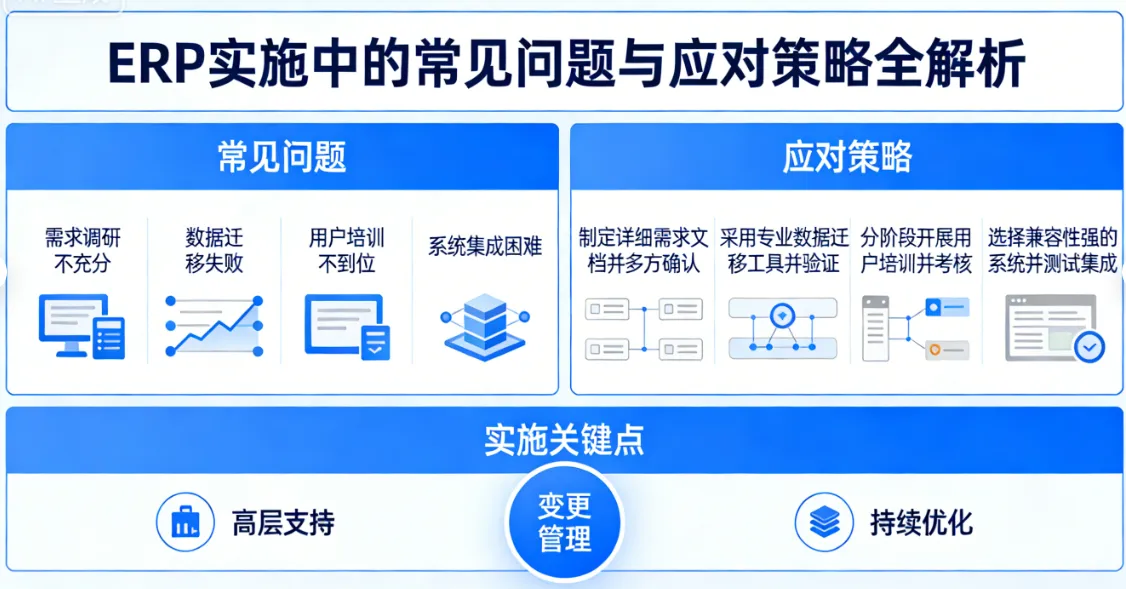
1、 Early planning stage: vague positioning, disconnected needs, building a solid foundation for implementation
Pre planning is the "master switch" for ERP implementation, and most enterprises' implementation difficulties begin at this stage, with core issues focused on positioning deviation and unclear requirements. Some enterprises blindly follow the trend and launch ERP systems, lacking accurate analysis of their own business scenarios and development stages, and blindly copying generic solutions, resulting in a disconnect between the system and the business; Some enterprises' demand sorting is superficial, without clear core demands and priorities, either missing key functions or piling up redundant modules, which not only increases implementation costs but also reduces system adaptability; Some companies neglect resource investment planning and fail to reserve sufficient manpower, funds, and time, resulting in frequent interruptions in the implementation process.
The corresponding response strategy needs to focus on "precise positioning, clear needs, and coordinated resources". Firstly, accurately match the development positioning of enterprises, formulate implementation goals based on industry characteristics and operational pain points. Small and medium-sized manufacturing enterprises focus on standardizing basic processes, shoe and clothing enterprises focus on multi SKU control and flexible production, and large enterprises focus on global collaboration to avoid blind planning of "big and comprehensive"; Secondly, comprehensively sort out business requirements, organize core personnel from various departments to conduct requirement discussions, distinguish between core and non core requirements, clarify the priority of requirements, form standardized requirement documents, and ensure that there are no omissions or redundancies in requirements; Thirdly, coordinate and plan resource investment, calculate the required funds and manpower based on the implementation goals, form a professional implementation team, clarify the project schedule and responsible persons, reserve emergency buffer time, and avoid implementation stagnation caused by insufficient resources.
2、 Mid term implementation stage: data chaos, insufficient collaboration, and overcoming implementation bottlenecks
Mid term implementation is the core link of ERP implementation, and it is also the stage where problems concentrate and erupt. The core pain points include poor data adaptation, weak departmental collaboration, and technical barriers to acceptance. At the data level, the original data encoding of the enterprise is not unified, the caliber is inconsistent, and there is a large amount of redundant or erroneous data. During the data migration process, loss and distortion are prone to occur, resulting in the system being unable to operate normally; At the departmental level, each department lacks a sense of collaboration and is concerned about the impact of process restructuring on their own work. They passively cooperate with data entry and process adjustments, resulting in a situation of "fighting on their own" and unable to achieve full chain data interoperability; On a technical level, the ERP system is not seamlessly integrated with the existing MES, CRM, and other systems of the enterprise, or the hardware equipment cannot support the operation of the system, resulting in the inability to implement functions properly.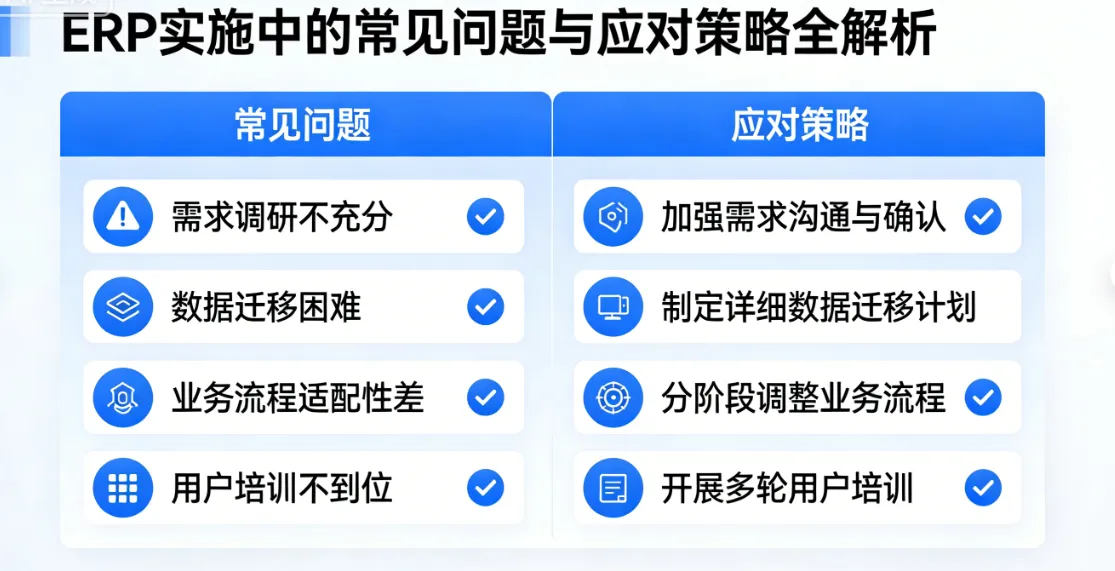
To address such issues, it is necessary to adhere to "data standardization, collaborative efficiency, and technological adaptation". In terms of data processing, first carry out data governance work, establish a unified data coding system and cleaning standards, comprehensively sort and verify existing data, eliminate redundant and erroneous information, complete data standardization transformation, carry out data migration in batches, and check the accuracy of data one by one after migration to ensure "zero error" of data; In terms of departmental collaboration, establish a cross departmental collaboration mechanism, clarify the responsibilities and cooperation nodes of each department, carry out full staff propaganda, make employees understand the implementation significance, reduce resistance, and establish an assessment mechanism to include system operations, data entry and other work in the assessment, forcing departmental collaboration and cooperation; In terms of technical integration, hardware testing and system compatibility testing should be carried out in advance, compatible hardware equipment should be upgraded, professional technical personnel should be arranged to interface with various systems, optimize the integration plan, ensure seamless system linkage, and avoid implementation obstacles caused by technical barriers.
3、 Personnel adaptation stage: Inexperienced operation, weak awareness, and solid implementation foundation
The ultimate implementation of ERP cannot be achieved without the participation of all staff, and insufficient personnel adaptation is an important reason for the system's inability to operate in the long run. Some companies neglect personnel training, and their employees are not proficient in system operation, especially frontline employees in workshops, warehouses, etc., who find it difficult to quickly adapt to digital processes and are prone to operational errors; Some employees have weak digital awareness, are accustomed to traditional manual operation modes, have resistance to system use, deliberately avoid system processes, resulting in untimely and inaccurate data entry, and the system cannot play its actual role; There is also a lack of professional operation and maintenance personnel in enterprises, which makes it difficult to promptly handle system failures after implementation, affecting the normal use of the system.
To address personnel level issues, it is necessary to focus on "training empowerment, awareness enhancement, and operation and maintenance support". Firstly, carry out hierarchical and classified training, customize training content for employees in different positions. Frontline employees focus on basic operation training, management personnel focus on data analysis and process control training, and core position employees focus on data entry standards and troubleshooting training. After training, conduct assessments to ensure that all employees are proficient in system operation; Secondly, strengthen the promotion of digital awareness, through case studies, effectiveness demonstrations, and other methods, to let employees understand the value of ERP in improving work efficiency and reducing work burden, guide employees to actively adapt to digital processes, and abandon traditional operating habits; Thirdly, build a professional operation and maintenance team, either by cultivating internal technical personnel or by coordinating with service providers to provide long-term operation and maintenance services, establishing a rapid response mechanism for faults, timely handling problems in system operation, and regularly conducting system inspections to avoid potential faults.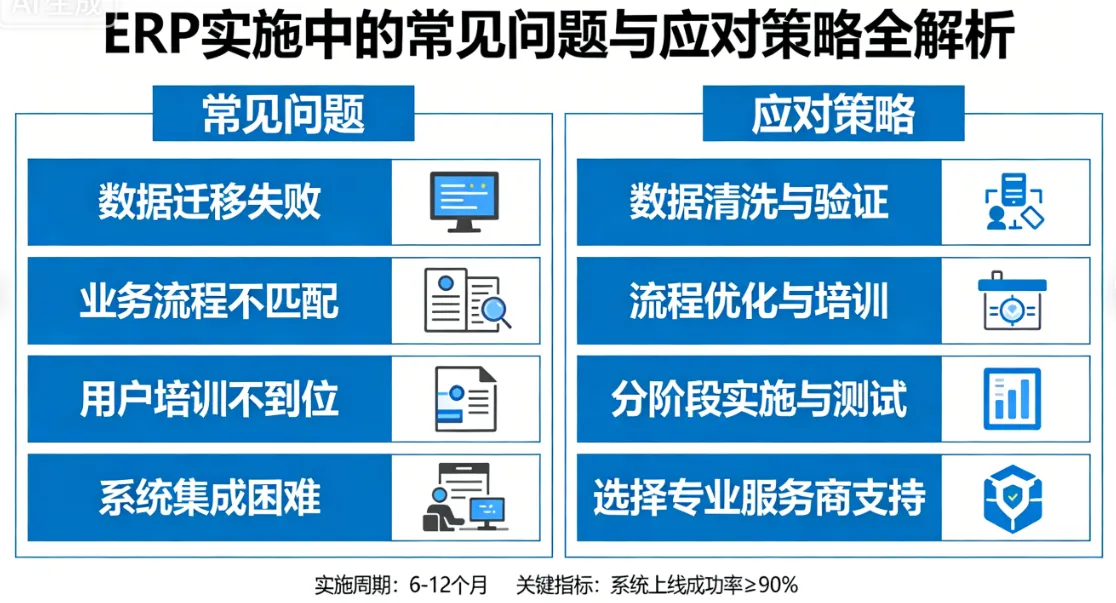
4、 In the later stage of operation and maintenance, there is a lag in iteration and insufficient review to achieve long-term empowerment
Some companies believe that 'the implementation is completed as soon as the system goes live', ignoring the later operation and iteration, resulting in the system gradually becoming disconnected from the business and unable to continuously empower the development of the enterprise. Common problems include: the system has not been iterated for a long time and cannot adapt to enterprise business upgrades and market changes; Lack of a regular review mechanism, failure to track implementation effectiveness, and inability to optimize processes and functions in a timely manner; Insufficient investment in operation and maintenance results in system failures that cannot be quickly resolved, affecting operational efficiency.
The response strategy for later operation and maintenance needs to highlight "continuous iteration, normalized review, and long-term guarantee". Firstly, establish a system iteration mechanism, regularly review changes in enterprise business and new requirements, optimize system functions in a targeted manner based on industry technology trends, expand module adaptability, and ensure that the system always meets the operational needs of the enterprise; Secondly, carry out regular reviews, regularly track implementation effectiveness, compare implementation goals with actual results, analyze existing problems and deficiencies, optimize process connections, data control and other links, and maximize the value of the system; Thirdly, increase investment in operation and maintenance, improve the operation and maintenance management system, regularly conduct system inspections and data backups to prevent data loss and system failures, and establish a demand feedback channel to collect usage suggestions from various departments, forming a virtuous cycle of "implementation landing review optimization iteration".
Conclusion: ERP implementation is not a one-time project, but a long-term practice that runs through the entire process of planning, implementation, and operation. Although common problems in each stage show different manifestations, the core root causes are often demand disconnection, insufficient collaboration, and inadequate adaptation. Enterprises need to base themselves on their own business reality, accurately identify pain points in each stage of implementation, formulate targeted response strategies, and take into account technology adaptation, process reconstruction, and personnel collaboration. They need to not only build a solid foundation for early planning, overcome mid-term implementation bottlenecks, and consolidate personnel adaptation, but also do a good job in later operation and maintenance iterations to ensure the effectiveness of ERP system implementation, truly achieve full chain collaboration, cost reduction and efficiency improvement, and provide strong support for enterprise digital transformation and high-quality development.