
Low code platform empowers ERP customization: a new shortcut for digital transformation of small and medium-sized enterprises
Under the wave of digitalization, digital transformation has become an inevitable choice for small and medium-sized enterprises to break through development bottlenecks and enhance their core competitiveness. ERP system, as the core carrier for integrating the entire business chain of enterprises, is a key support for small and medium-sized enterprises to achieve refined operations. However, the traditional ERP customization model has pain points such as high cost, long cycle, high technical threshold, and lagging iteration, which contradict the core demands of small and medium-sized enterprises such as "limited funds, weak technology, and flexible demand", causing most small and medium-sized enterprises to fall into the dilemma of "wanting to transform but unable to implement". The rise of low code platforms, with the core advantages of "drag and drop development, low threshold adaptation, and high flexibility iteration", breaks through the traditional barriers of ERP customization and becomes a new shortcut to empower small and medium-sized enterprises in ERP customization and break through the "last mile" of digital transformation.
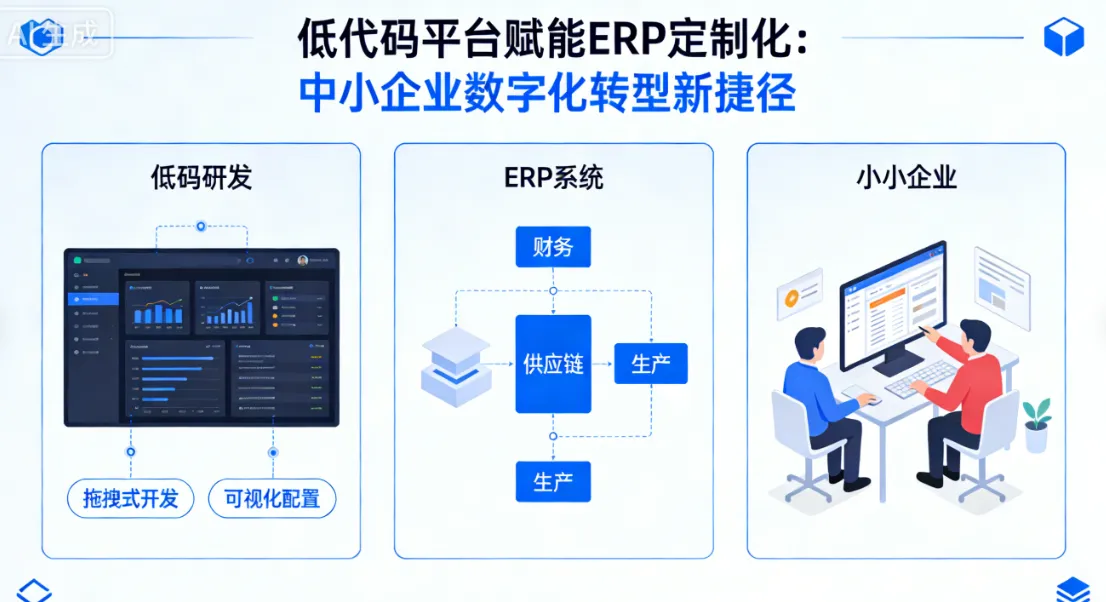
The core pain point of digital transformation for small and medium-sized enterprises lies in the serious disconnect between traditional ERP customization and their own development needs. Compared to large enterprises, small and medium-sized enterprises have limited financial reserves and a shortage of professional IT talents, making them unable to afford the high costs of traditional ERP customization. Under the traditional model, a customized ERP that is suitable for small and medium-sized enterprises usually has a development cycle of 3-6 months, and labor costs and technology investments can easily reach hundreds of thousands of yuan, far exceeding the affordability of most small and medium-sized enterprises. At the same time, traditional ERP customization relies on professional development teams, and subsequent system iterations and troubleshooting also require continuous investment in technical resources. Small and medium-sized enterprises often lack dedicated IT operation and maintenance teams, which makes it difficult to continuously optimize customized ERP after it goes live, ultimately falling into the embarrassing situation of "being idle immediately after going live". In addition, small and medium-sized enterprises have flexible business scenarios and fast demand iteration. Traditional ERP customization is mostly "one-time development", which is difficult to quickly adapt to business adjustments and cannot meet dynamic operational needs.
The core value of low code platforms lies in restructuring the ERP customization model, accurately matching the development needs of small and medium-sized enterprises, and solving the multiple challenges of traditional customization. The low code platform focuses on "visual development" and transforms complex code development into drag and drop component assembly, without the need for professional programming skills. Non technical personnel in enterprises can also participate in the construction and optimization of ERP modules, greatly reducing technical barriers and labor costs. Compared with the traditional customization model, low code empowerment of ERP customization can shorten the development cycle by 60% -80%. Some simple ERP modules can even be implemented within 1-2 weeks, reducing development and operation costs by more than 50%, perfectly meeting the needs of small and medium-sized enterprises for "low-cost and fast implementation".
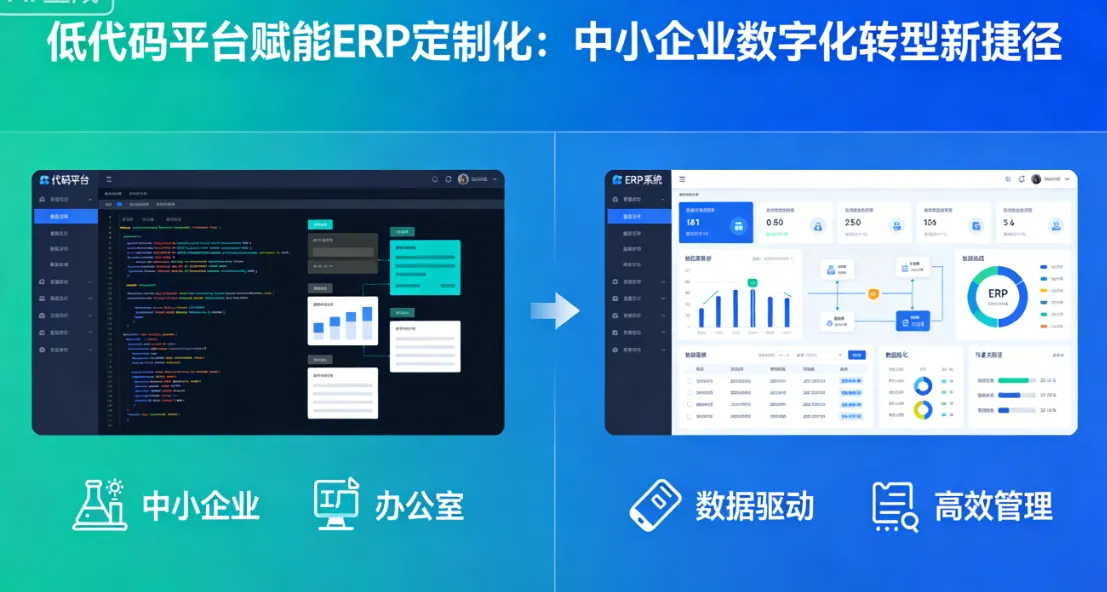
The low code platform achieves deep integration between ERP customization and small and medium-sized enterprise business scenarios through "modular adaptation and flexible iteration", which is the core logic of empowering transformation. The low code platform is equipped with rich standardized components, covering core ERP business modules such as procurement, production, inventory, finance, and sales. Enterprises can flexibly select and combine components according to their own industry characteristics and business needs, and customize exclusive ERP systems. Manufacturing small and medium-sized enterprises can focus on building production scheduling and material control modules, footwear and clothing enterprises can strengthen SKU management and piece rate accounting modules, and retail enterprises can focus on optimizing order fulfillment and inventory linkage modules without paying for redundant functions. At the same time, the low code platform supports "on-demand iteration", which allows for quick drag and drop of components and modification of processes when enterprise business adjustments or new requirements arise, without the need to redevelop the entire system, achieving synchronous upgrades between ERP and business. For example, a small and medium-sized manufacturing enterprise used a low code platform to customize an ERP system that adapts to its own flexible production needs, quickly building two core modules: production scheduling and inventory warning. After going online, the production cycle was shortened by 25%, and the inventory turnover rate was increased by 30%. Without the need for additional IT resources, the scheduling rules could be optimized according to changes in orders, adapting to small batch and multi batch production modes.
Low code platforms can also break down the barriers of "customization and integration", helping small and medium-sized enterprises build a digital operation system with full domain collaboration. The digital transformation of small and medium-sized enterprises is often not the implementation of a single system, but requires seamless integration between ERP and existing office software, e-commerce platforms, logistics systems, etc., to avoid data silos. Low code platforms have powerful interface integration capabilities, which can quickly integrate with various third-party systems, achieve real-time data synchronization, and seamless process linkage - for example, by integrating ERP with e-commerce platforms, orders can be automatically synchronized to inventory and financial modules, reducing manual input errors; Integrate with the logistics system to achieve real-time traceability of logistics information and enhance the order fulfillment experience. This integrated capability can help small and medium-sized enterprises quickly build a fully collaborative digital system without the need for complex secondary development, maximizing the value of ERP.
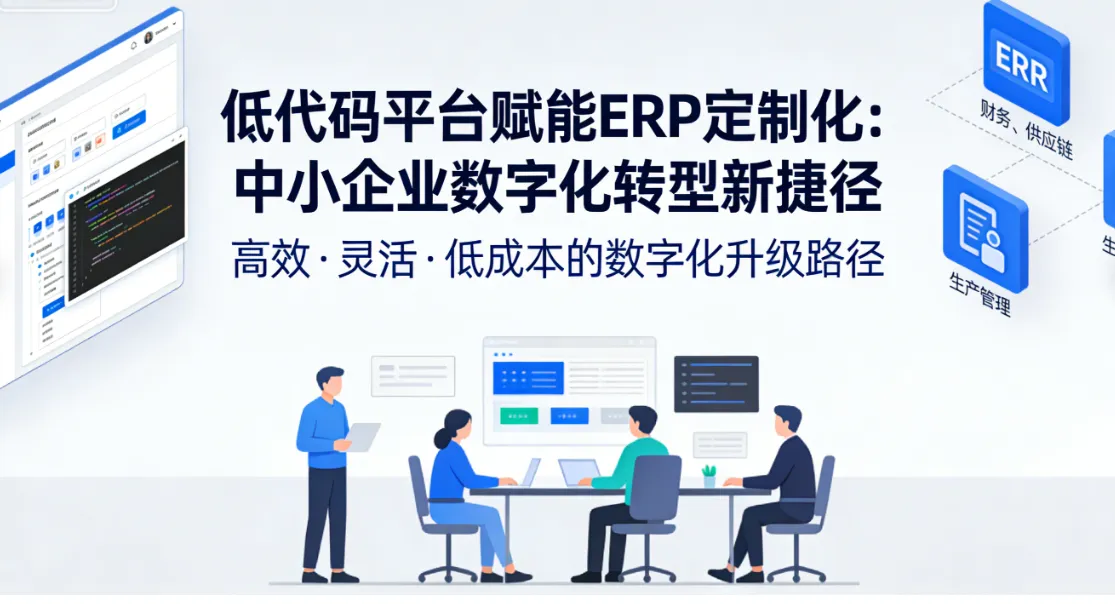
In addition, the advantage of "lightweight operation and maintenance" of low code platforms further reduces the threshold for digital transformation of small and medium-sized enterprises. After the customized launch of traditional ERP, a professional IT team is required to be responsible for troubleshooting, system upgrades, and other operation and maintenance work, and small and medium-sized enterprises often lack relevant talents. The low code platform provides a visual operation and maintenance interface, allowing enterprise employees to quickly troubleshoot simple faults. The platform service provider provides standardized operation and maintenance support, eliminating the need for enterprises to form additional operation and maintenance teams, greatly reducing operation and maintenance costs and difficulties. At the same time, low code platforms often adopt cloud native architecture, supporting cloud deployment and multi terminal adaptation. Enterprises do not need to invest in hardware equipment, and can view ERP data and process business anytime and anywhere through PC and mobile terminals, improving operational flexibility.
It is worth noting that low code empowerment of ERP customization does not replace traditional ERP, but provides a more adaptable transformation path for small and medium-sized enterprises. When small and medium-sized enterprises use low code platforms to customize ERP, they need to base themselves on their own business reality, clarify core requirements, and avoid "blind customization"; At the same time, priority should be given to selecting low code platforms with rich components, complete interfaces, and high-quality services, while balancing customization flexibility and system stability. For small and medium-sized enterprises with complex requirements and long-term digital planning, a "gradual iteration" approach can be adopted, where core business modules are first implemented, and then functions are gradually expanded according to development needs to achieve low-cost and sustainable digital transformation.
In today's accelerated digital transformation, the competition among small and medium-sized enterprises has gradually shifted towards the competition of digital capabilities, and ERP, as the core foundation of digital operations, its adaptability directly determines the effectiveness of transformation. The low code platform breaks down the barriers of traditional ERP customization with the advantages of low cost, fast landing, low threshold, and high flexibility, allowing small and medium-sized enterprises to have exclusive customized ERP systems without having to bear high investment and technical risks. This "on-demand customization and flexible iteration" model precisely fits the development characteristics of small and medium-sized enterprises. It can not only help enterprises solve operational pain points and improve operational efficiency, but also build a basic framework for digital transformation for small and medium-sized enterprises, helping them to break through in fierce market competition. In the future, with the continuous iteration of low code technology, more small and medium-sized enterprises will take advantage of this shortcut to complete ERP customization implementation, open up the path of digital transformation, and achieve high-quality development.