
From tradition to intelligence, ERP leads the path of enterprise management transformation
In the current era of digital economy reshaping the business landscape, enterprise management models are undergoing a deep transformation from traditional manual driving to intelligent data-driven, and ERP systems, as the core carrier of enterprise management, have always been at the forefront of this transformation. From the traditional ERP that only implemented electronic basic processes such as finance and inventory in the early days, to the intelligent ERP that integrates cutting-edge technologies such as AI, big data, and the Internet of Things, its development trajectory is not only an iterative upgrade of technology, but also an important driving force for the transformation of enterprise management concepts, operational models, and decision-making logic. Nowadays, intelligent ERP has surpassed the scope of simple management tools and become the core engine for enterprises to break down management barriers, achieve refined operations, and drive digital transformation, leading enterprise management steadily towards a new direction of intelligence, collaboration, and digitization.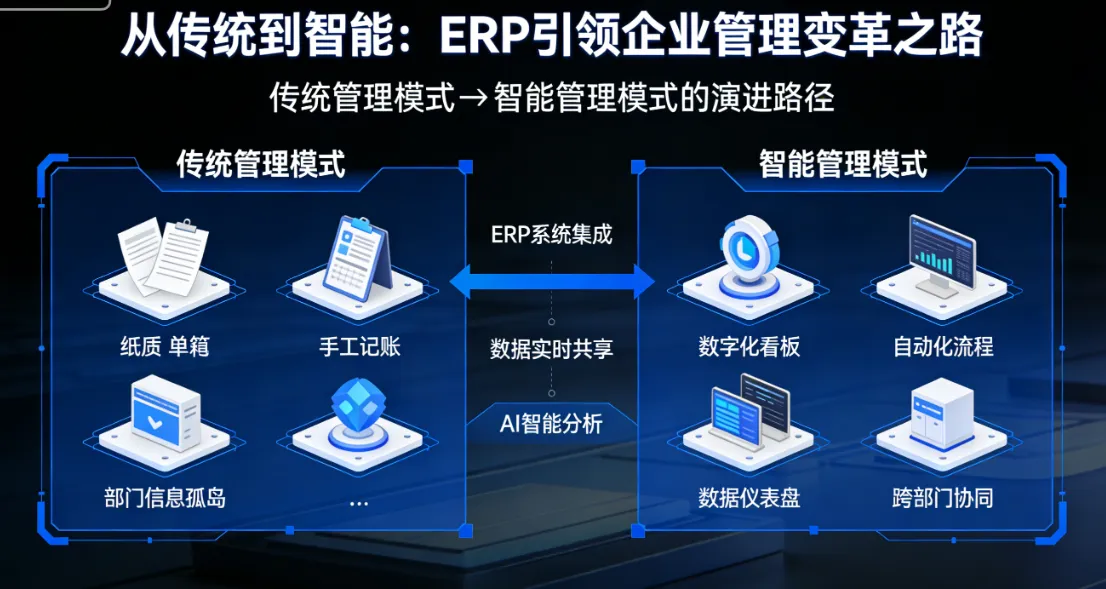
The birth of traditional ERP has freed enterprise management from the inefficient mode of manual bookkeeping and statistics, and achieved the electronicization and standardization of core business processes, becoming an important starting point for the modernization of enterprise management. In the era of industrialization, enterprise operations are centered around large-scale production and standardized processes. Traditional ERP, with its modular functional design, digitally integrates business processes such as procurement, production, inventory, finance, and sales, achieving centralized storage of data and standardized management of processes, effectively solving pain points such as data chaos, process disconnection, and delayed information transmission in traditional manual management. For example, through the inventory management module of traditional ERP, enterprises can query inventory quantities in real time, reducing the risk of stockouts and backlogs; With the help of financial modules, automatic accounting of accounts can be achieved to improve financial processing efficiency.
But with the development of the digital economy, market demand is shifting from standardization to personalization, and enterprise operation scenarios are becoming increasingly complex. Multi channel, multi category, and cross regional operation models have become the norm, and the limitations of traditional ERP are gradually becoming apparent. Firstly, the data processing capability is weak, which can only achieve data recording and simple statistics, and cannot deeply mine massive data, making it difficult to support scientific decision-making in enterprises; Secondly, the process is rigid and inflexible, with insufficient adaptability. Faced with new business scenarios such as flexible production and omni channel retail, it is difficult to quickly adjust the process, and the market response capability lags behind; Thirdly, the scope of collaboration is limited, with a focus on internal enterprise management, making it difficult to achieve seamless linkage with upstream and downstream supply chains and third-party platforms, which can easily lead to data silos; Fourthly, the management mode is passive and can only record business data afterwards, unable to achieve pre prediction and in-process control, making it difficult to cope with complex market risks and operational challenges. These limitations make traditional ERP gradually unable to meet the high-quality development needs of enterprises, and new technological empowerment is urgently needed for enterprise management reform.
AI、 The development of cutting-edge technologies such as big data and the Internet of Things has laid the foundation for the intelligent upgrade of ERP. The emergence of intelligent ERP fundamentally reconstructs the logic of enterprise management and promotes comprehensive and deep level changes in enterprise management. Compared with traditional ERP, the core breakthrough of intelligent ERP lies in achieving a leap from "process electronicization" to "data intelligence", treating data as a core asset, and empowering it through technology to transform from "recording" to "empowering" in enterprise management. Its leading role in the transformation of enterprise management is reflected in the four core dimensions of operation, decision-making, organization, and ecology.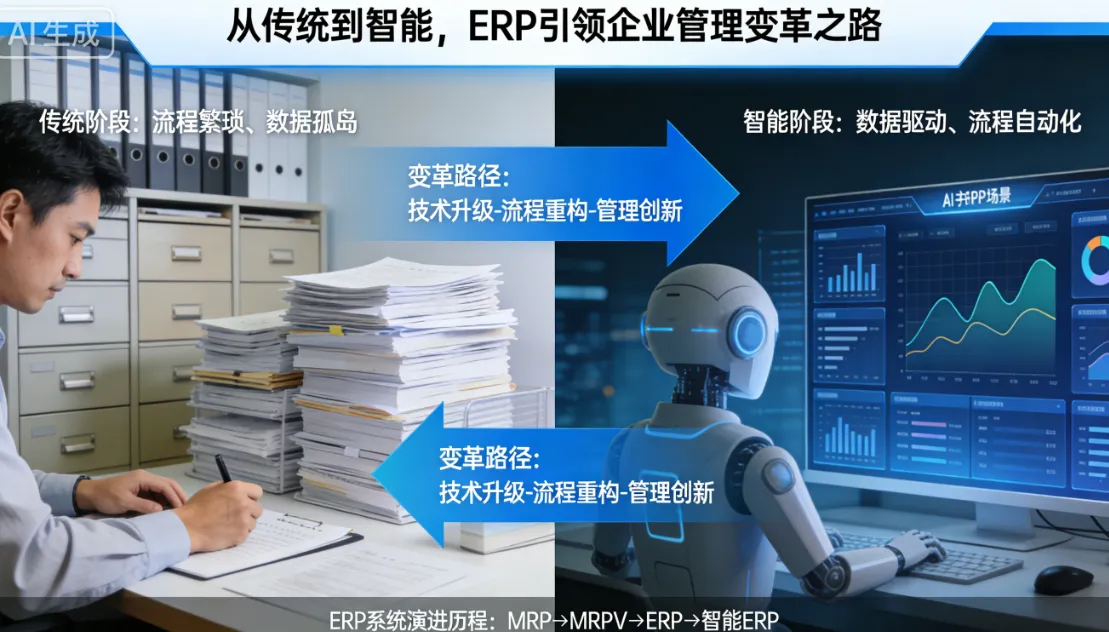
Intelligent ERP promotes the transformation of enterprise operation management from "extensive" to "refined". In the production and operation process, intelligent ERP integrates IoT technology to collect real-time operational data of production equipment, production lines, and materials. Combined with AI algorithms, intelligent scheduling is implemented to dynamically adjust production plans based on order requirements, material inventory, and equipment status, avoiding downtime and waiting for materials, and improving production efficiency; In the inventory operation process, through big data analysis of user needs and market trends, intelligent early warning and dynamic allocation of inventory are achieved, accurate control of inventory levels is achieved, and inventory costs are reduced; In the sales and operation process, integrate omnichannel sales data, analyze customer consumption behavior and preferences, achieve precise marketing and personalized services, and improve customer conversion and repurchase rates. For example, enterprises in the footwear and apparel industry can use intelligent ERP to finely control products with multiple SKUs and sizes, predict popular trends based on market data, optimize production and inventory layout, solve the problem of inventory backlog and shortage in traditional operations, and provide data support for every link of enterprise operation to achieve refined control.
Intelligent ERP promotes the transformation of enterprise decision-making management from "experience based" to "data-driven". Traditional enterprise management decisions rely heavily on the experience and intuition of managers, with strong subjectivity and high risks. However, intelligent ERP builds a complete data analysis system for enterprises through automatic collection, cleaning, and integration of data throughout the entire chain. By relying on AI algorithms to conduct multi-dimensional and deep level mining of massive data, it can intuitively present the operational pain points, profit highlights, potential risks, and development trends of enterprises, providing accurate data support for production plan adjustment, market layout optimization, cost control, strategic formulation, and other aspects of enterprises. From market research on new product development, feasibility analysis of capacity expansion, to optimization and adjustment of the supply chain, every decision is based on real and comprehensive data analysis, enabling enterprises to break free from dependence on experience, achieve scientific, accurate, and efficient decision-making, significantly reduce decision-making risks, and enhance the certainty of enterprise development.
Intelligent ERP promotes the transformation of enterprise organizational management from "departmentalization" to "collaboration". Traditional enterprise organizational management is based on departments, with each department fighting independently, resulting in poor information transmission and low collaboration efficiency. However, intelligent ERP breaks down the information barriers between departments and achieves real-time data synchronization and seamless process connection across all departments within the enterprise. Under the intelligent ERP system, sales orders can be automatically synchronized to departments such as production, inventory, finance, and logistics. Each department can work synchronously according to the order requirements without the need for manual cross departmental communication, achieving an organizational management model of "one data source, whole department collaborative linkage". At the same time, intelligent ERP promotes the development of enterprise organizational structure towards flatness, reducing management levels, improving information transmission and decision-making efficiency, making enterprise organizations more flexible and adaptable, and adapting to the rapidly changing market demands of the digital age.
Intelligent ERP promotes the transformation of enterprise ecological management from "singularity" to "ecologicalization". In the digital age, the development of enterprises is no longer a solitary struggle, but rather in an interconnected and collaborative industrial ecosystem. Intelligent ERP has broken through the limitations of traditional ERP that only focuses on the internal workings of enterprises, becoming the core hub for enterprises to connect with the industrial ecosystem. Through powerful interface integration capabilities, intelligent ERP can achieve seamless integration with third-party entities such as suppliers, distributors, e-commerce platforms, logistics systems, and financial institutions, connecting data channels upstream and downstream of the industrial chain, and realizing full industry chain collaboration from procurement, production, sales to logistics and after-sales. For example, the intelligent ERP of manufacturing enterprises can be linked with supplier systems to achieve automatic material supply; The intelligent ERP of retail enterprises can be integrated with logistics systems to achieve real-time order tracking and efficient fulfillment. This ecological management model allows enterprises to no longer be independent entities, but important nodes integrated into the industrial ecosystem, achieving resource optimization and allocation through collaborative win-win situations, and enhancing the core competitiveness and industrial influence of enterprises.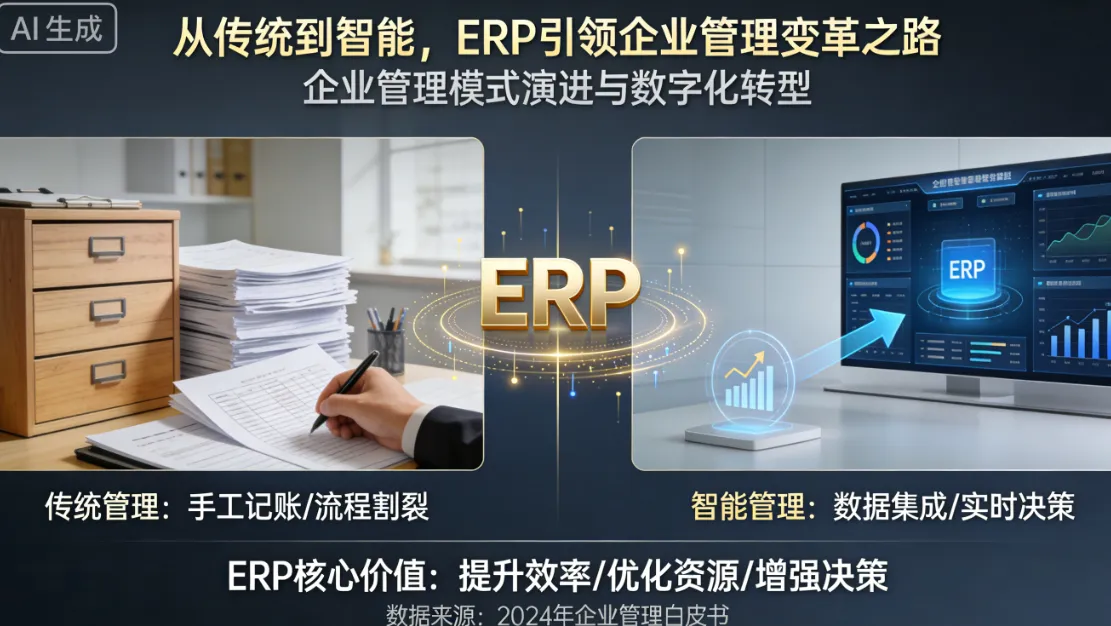
The upgrade of ERP from traditional to intelligent has always been synchronized with the changing needs of enterprise management. Intelligent ERP is not only an upgrade in technology, but also a comprehensive innovation in enterprise management concepts, models, and methods. It frees enterprise management from the constraints of traditional models and uses data as the core and intelligence as the means to achieve comprehensive optimization of operations, decision-making, organization, and ecology. In today's continuously deepening digital transformation, competition among enterprises has gradually evolved into competition for digital management capabilities, and the importance of intelligent ERP as the core carrier of enterprise digital management has become increasingly prominent.
In the future, with the further development of technologies such as big models, cloud computing, and blockchain, intelligent ERP will continue to upgrade, achieving deeper intelligence, wider collaboration, and more precise personalization, providing stronger support for enterprise management transformation. Only by actively embracing intelligent ERP, leveraging technology to empower and reconstruct management systems, and integrating data intelligence into every aspect of management, can enterprises stand firm in fierce market competition and achieve high-quality development. The ERP system will continue to be driven by technological iteration, leading enterprise management to constantly transform towards higher and deeper levels, and drawing a new blueprint for the development of enterprises in the digital economy era.