
ERP System Implementation Process Guide: Requirements Analysis, Selection Evaluation, and Project Management
As the core carrier for integrating the entire business chain of enterprises and connecting data collaboration, the implementation effect of ERP system directly determines the success or failure of enterprise digital transformation. Unlike simple software deployment, ERP implementation is a systematic project that covers "requirement sorting, selection matching, implementation control, and long-term operation and maintenance". Among them, requirement analysis, selection evaluation, and project management are the three core links that run through the entire process, directly affecting project progress, implementation costs, and final effectiveness. Many enterprises, due to neglecting full process control, have encountered problems such as unclear requirements, misplaced selection, and project loss of control, resulting in ERP systems being "idle immediately after going online". This article is based on the practical scenarios of enterprises, dismantling the key points of the entire ERP implementation process, providing practical guidance for enterprises, helping to efficiently complete ERP implementation, and maximizing the release of digital value.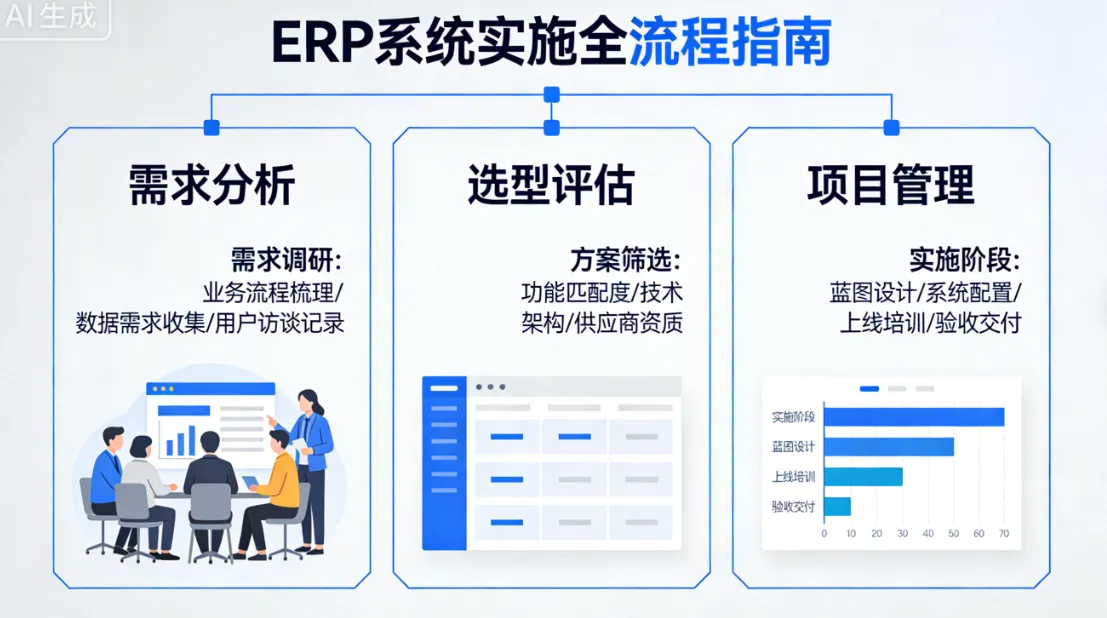
1、 Requirement analysis: Anchor the core and build a solid foundation for implementation
Requirement analysis is a prerequisite for ERP implementation, and the core is to clarify what problems and goals the enterprise needs ERP to solve, in order to avoid blind implementation that is disconnected from requirements. The root cause of ERP implementation failure in most enterprises is that the requirement analysis is superficial, either missing core pain points or piling up redundant requirements, leading to subsequent selection deviations and project loss of control. Scientific demand analysis should follow the principles of "comprehensive research, hierarchical sorting, and document solidification" to achieve precise matching between demand and enterprise business and development stages.
Comprehensive research is the foundation of demand analysis, which needs to cover all departments and business processes of the enterprise, taking into account both grassroots practical operations and management decision-making needs. Establish a cross departmental research team, including core positions such as finance, procurement, production, sales, and warehousing, as well as management. Through interviews, questionnaires, and process analysis, comprehensively identify existing business pain points - for example, manufacturing companies need to focus on issues such as inefficient production scheduling and chaotic material control, footwear and apparel companies need to focus on pain points such as multi SKU management and cumbersome piece rate accounting, and retail companies need to focus on identifying difficulties in omnichannel order coordination. At the same time, combined with the enterprise's medium and long-term development plan, predict future business expansion needs, such as cross regional operations, supply chain collaboration, intelligent decision-making, etc., to avoid demands that only meet the present and cannot adapt to future development.
Hierarchical sorting of requirements is crucial, as it is necessary to distinguish between core requirements, essential requirements, and non essential requirements, and clarify priorities. The core requirements are the key pain points that enterprises must address through ERP, such as standardized financial accounting and real-time inventory control; Necessary requirements are the fundamental functions that support the operation of core businesses, such as order management and supplier management; Non essential needs are features that enhance the user experience but are not essential, such as personalized reports and multilingual adaptation. By prioritizing, avoid the implementation cost increase and cycle extension caused by the pursuit of "big and comprehensive". Finally, the sorted requirements will be formed into a standardized requirements document, clarifying the requirements details and acceptance criteria, making the requirements the core basis for subsequent selection, implementation, and acceptance, and avoiding disputes and deviations caused by verbal requirements.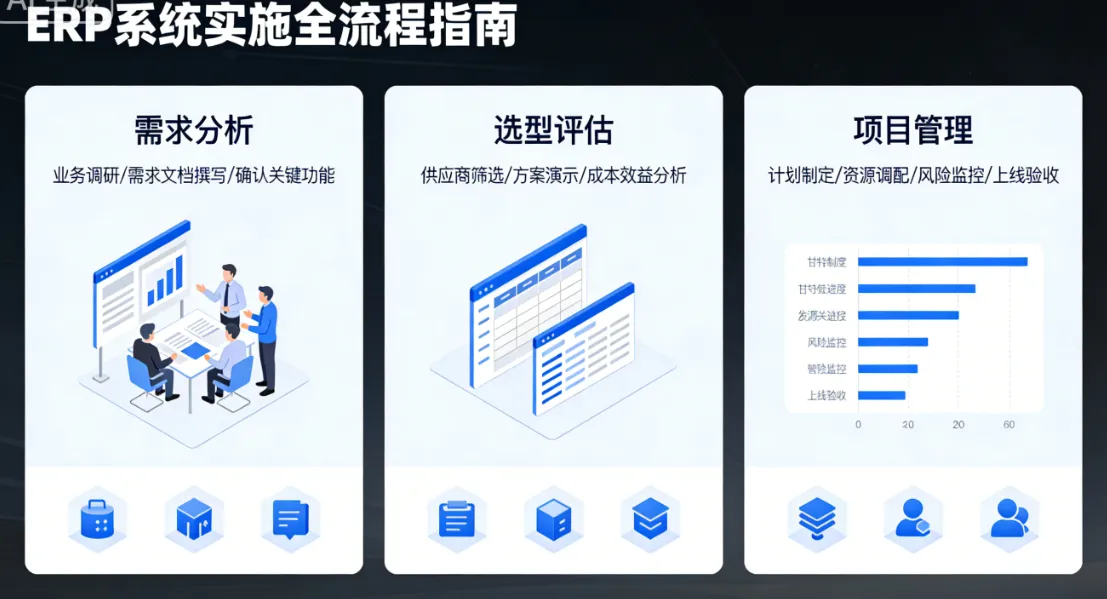
2、 Selection evaluation: precise matching, avoiding selection traps
Selection evaluation is a key step in ERP implementation, with the core being to "choose the right system that suits the enterprise", rather than blindly pursuing the better with more brand and functionality. Enterprises of different industries and scales have significant differences in business needs and resource endowments, and selection deviations can lead to increased implementation difficulties, cost overruns, and even inability to meet core requirements. Scientific selection evaluation needs to be carried out around four dimensions: "demand matching, manufacturer strength, controllable cost, and strong scalability", comprehensively identifying selection risks.
Requirement matching is the core criterion for selection, which requires comparing the functional modules of the ERP system one by one based on the requirement document. Priority should be given to selecting systems with core functions that are highly compatible with enterprise needs, avoiding "functional redundancy" and "functional loss" - for example, small and medium-sized manufacturing enterprises do not need to choose high-end customized systems, but can focus on basic modules such as production, inventory, and finance; Large cross regional enterprises need to prioritize the system's collaborative capabilities and multi terminal adaptability. At the same time, pay attention to the flexibility of the system, whether it can adjust and optimize processes according to enterprise business, adapt to new scenarios such as flexible production and omni channel operation, and avoid subsequent upgrade difficulties caused by system solidification.
The strength and service capability of the manufacturer are important guarantees for selection, and it is necessary to comprehensively examine the manufacturer's research and development strength, industry experience, and operation and maintenance service level. Priority should be given to manufacturers who are deeply involved in the industry where the enterprise operates and have similar implementation cases. Such manufacturers have a better understanding of industry pain points and can provide solutions that meet the needs; Assess the R&D iteration capability of manufacturers to ensure that the system can continuously upgrade in line with technological development and enterprise needs; Key evaluation of operation and maintenance services, including fault response speed, technical support, employee training, etc., to avoid system malfunction caused by insufficient operation and maintenance. In addition, it is necessary to accurately calculate the implementation costs, including software expenses, implementation expenses, training expenses, operation and maintenance expenses, etc., and develop a reasonable budget to avoid hidden costs in the later stage and ensure that costs are controllable.
3、 Project management: closed-loop control to ensure effective implementation
Project management is the guarantee of ERP implementation, with the core being closed-loop control over the progress, quality, risk, and personnel of the entire implementation process, ensuring that the project is implemented according to plan and achieves expected goals. ERP implementation has a long cycle, involves multiple links, and involves a wide range of personnel. It is prone to problems such as delayed progress, substandard quality, and employee resistance. Scientific project management is needed to solve the difficulties and promote the orderly implementation of the work.
Building a professional project team is a prerequisite, with clear team structure and job responsibilities. Establish a project team consisting of core employees, management, and vendor implementation consultants within the enterprise, designate a project leader, and coordinate the implementation work; Clarify the responsibilities of each member, such as business backbone responsible for streamlining processes and cooperating with system debugging, IT personnel responsible for technical coordination and operation preparation, and management responsible for coordinating resources and solving cross departmental problems during implementation. At the same time, establish a sound communication mechanism, regularly hold project promotion meetings, synchronize implementation progress, identify problems, ensure smooth information flow between the enterprise, manufacturers, and various departments, and avoid project delays caused by poor communication.
Progress control and quality control are the core of project management. Develop a detailed project implementation plan, specifying the time nodes, work content, and acceptance criteria for each stage, such as requirement confirmation, system deployment, data migration, employee training, pilot operation, and comprehensive launch. Break down tasks to individuals and implement a responsibility management system. Regularly check the progress against the plan, analyze the reasons for lagging links, optimize solutions, and ensure that the project progresses according to plan. At the same time, strengthen quality control by cleaning and verifying the original data during the data migration phase to ensure its accuracy and correctness; During the system debugging phase, simulate real business scenarios to conduct testing and identify functional vulnerabilities and process integration issues; During the pilot operation phase, collect employee feedback, optimize system operations and processes, and ensure that the system is adapted to the business needs of the enterprise.
Risk response and personnel empowerment are the key to project implementation. Pre sort out potential risks that may arise during the implementation process, such as employee resistance, demand changes, technical failures, etc., and develop targeted response plans - for example, to address employee resistance, conduct full staff promotion and hierarchical training to enable employees to understand the value of ERP implementation and master system operations proficiently; Establish a standardized change process for requirement changes, evaluate the impact of changes on project schedule and cost, and avoid disorderly changes that may lead to project loss of control. At the same time, regular employee training will be carried out, and training content will be customized according to the needs of different positions to ensure that all employees are compatible with the system, laying the foundation for the comprehensive launch and long-term operation of the system. After the system is fully launched, it is necessary to carry out good maintenance and optimization, regularly check system failures, collect employee usage suggestions, continuously optimize system functions and business processes, and achieve a virtuous cycle of "implementation landing review optimization".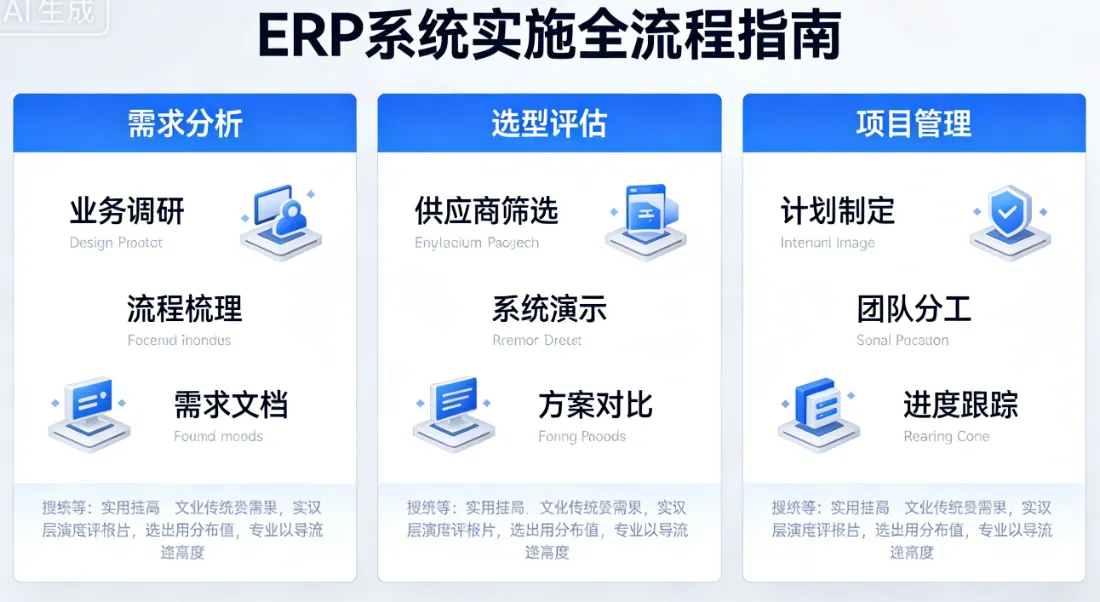
Conclusion: ERP system implementation is a systematic project, and the three major links of requirement analysis, selection evaluation, and project management are interrelated and indispensable - requirement analysis anchoring direction, selection evaluation matching resources, and project management ensuring implementation. Only by focusing on their own business reality, accurately sorting out needs, scientifically selecting, and strictly controlling the entire project process, can enterprises avoid implementation risks, ensure the effectiveness of ERP systems, achieve standardized business processes, intelligent data collaboration, and scientific decision-making, promote enterprise management upgrading and digital transformation, and build core competitiveness in fierce market competition.