
Exploration and Key Element Analysis of ERP Implementation Plan in Printing Industry
Industry Characteristics and ERP Implementation Challenges
The printing industry, as a typical production-oriented service-oriented industry, presents significant characteristics of diversified customer demands, complex production processes, and fragmented order cycles. From traditional publishing and printing to modern packaging and printing, from business printing to special crafts, there are significant differences in the operational management models of enterprises. This industry characteristic determines that the ERP implementation plan of printing enterprises must go beyond standardized system deployment and form a customized path deeply integrated with business processes.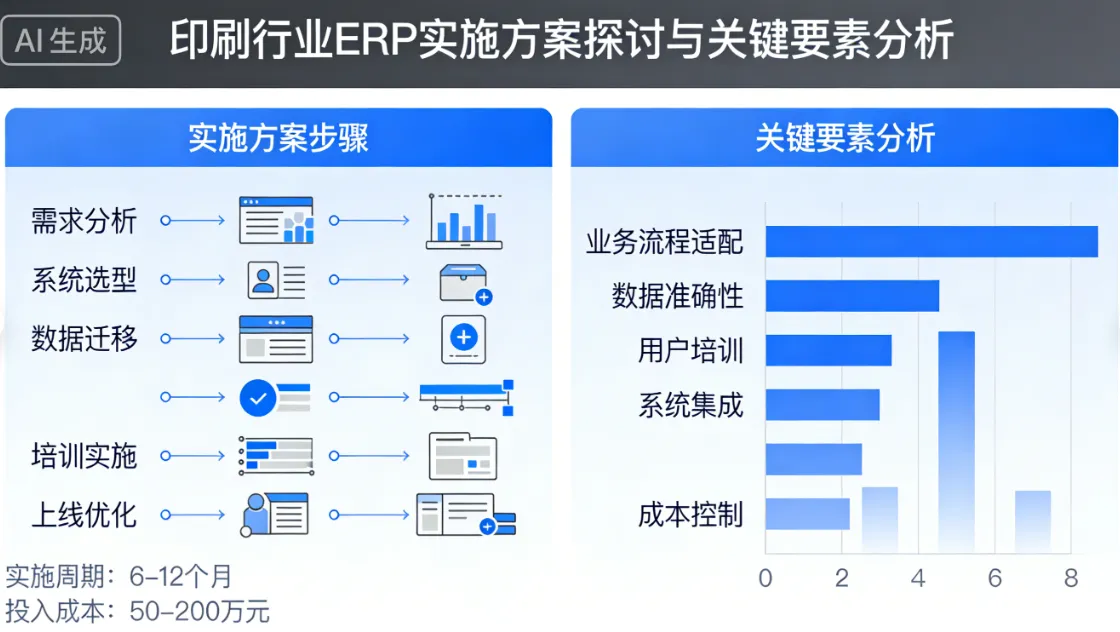
The production process of the printing industry covers four major links: pre press preparation, printing execution, post press processing, and finished product delivery, each of which includes numerous sub processes and technical parameters. The personalization level of customer orders is high, and an order may involve special paper, spot color ink, special processes, and special post-processing. This means that the ERP system of printing enterprises not only needs to manage standard production factors, but also must handle complex variant management and process parameter combinations. This complexity poses the primary challenge for ERP implementation - how to accommodate non standardized business requirements within a standard system framework.
Construction and execution of phased implementation strategy
The implementation of ERP in printing enterprises should adopt the strategic policy of "overall planning, step-by-step implementation, key breakthroughs, and gradual improvement". The core of this strategy is to identify the key business process bottlenecks of the enterprise and prioritize addressing pain points that affect operational efficiency and core competitiveness.
The first stage should focus on the core aspects of order management and production planning. The characteristic of the printing industry is order driven production, and the accuracy and completeness of order information directly affect all subsequent production processes. The implementation team needs to establish a complete information flow from customer inquiries, order confirmations, process audits to production arrangements, ensuring that the special requirements of each order can be accurately conveyed to the production workshop. At this stage, the key is to establish standardized order entry templates and review processes to avoid production errors and rework caused by missing or misunderstood information. A medium-sized packaging and printing enterprise achieved a significant improvement in order information circulation time by 50% and order processing error rate by 70% during this stage.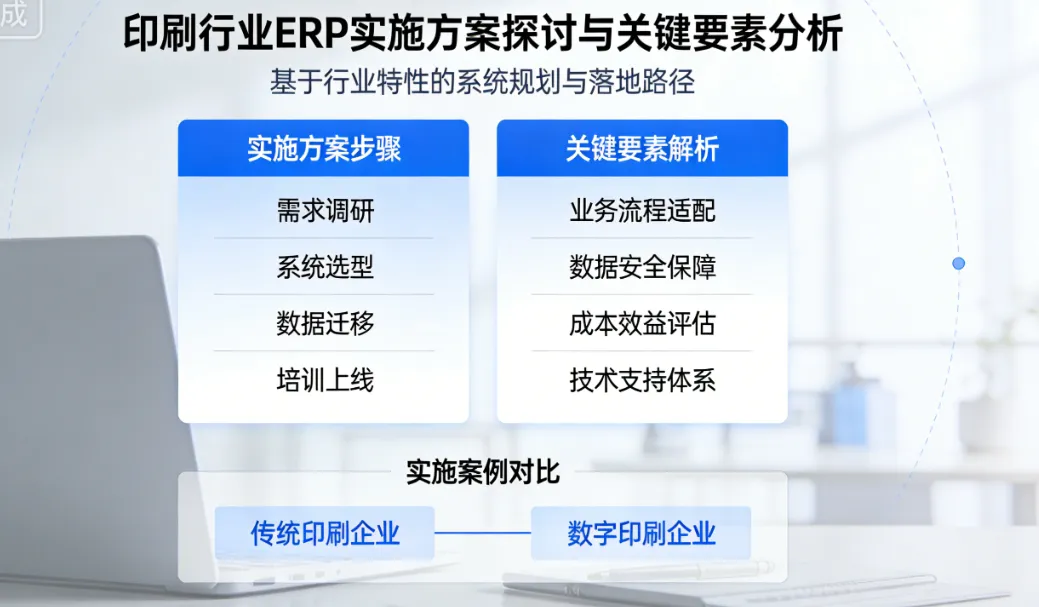
The second stage should be extended to the areas of material management and production execution. The material management in the printing industry has the characteristics of a wide variety, complex specifications, and special storage requirements. Paper, as the main raw material, not only has a variety of types, but also has strict requirements for temperature and humidity; Ink, plate materials and other auxiliary materials involve complex ratios and usage records. The ERP system needs to establish a complete material classification system to achieve full process tracking from procurement and warehousing, workshop requisition to surplus material return. The production execution module needs to interface with production equipment, collect real-time production data, monitor equipment status, and record process parameters. The difficulty in this stage lies in the integration of the system and production equipment, as well as accurate statistics of material consumption.
The third stage extends to financial accounting and cost control, establishing seamless integration between production operations and financial data. The cost structure of printing enterprises is complex, including multiple factors such as equipment depreciation, energy consumption, labor, and indirect costs in addition to direct material costs. ERP systems need to establish a refined cost accounting model that can accurately collect costs by order, product, and customer, providing reliable data support for pricing decisions and profit analysis.
In depth analysis of key success factors
Business process reengineering is the core link of ERP implementation in the printing industry, rather than simple automated replication. The implementation team needs to work together with the business department to re-examine and design core business processes, eliminate non value added links, and optimize process connections. For example, in the pre press production process, standardized templates and automated pre inspection procedures can significantly reduce manual intervention and error rates; In the production scheduling process, optimizing machine allocation through intelligent algorithms can improve equipment utilization and on-time delivery of orders. This process requires deep involvement and leadership from the business department to ensure that the new process is both in line with system logic and adapted to business realities.
The data governance capability directly affects the operational effectiveness of ERP systems. The data in the printing industry is highly specialized and complex, requiring accurate recording and standardized management of every technical parameter, from paper weight and ink ratio to die-cutting blade lines and binding methods. The implementation team needs to establish a unified data standard and management specification to ensure the accuracy, consistency, and completeness of data within the system. Especially in the design of the material coding system, a balance needs to be found between simplicity and information richness, which is convenient for system processing and can convey sufficient professional information.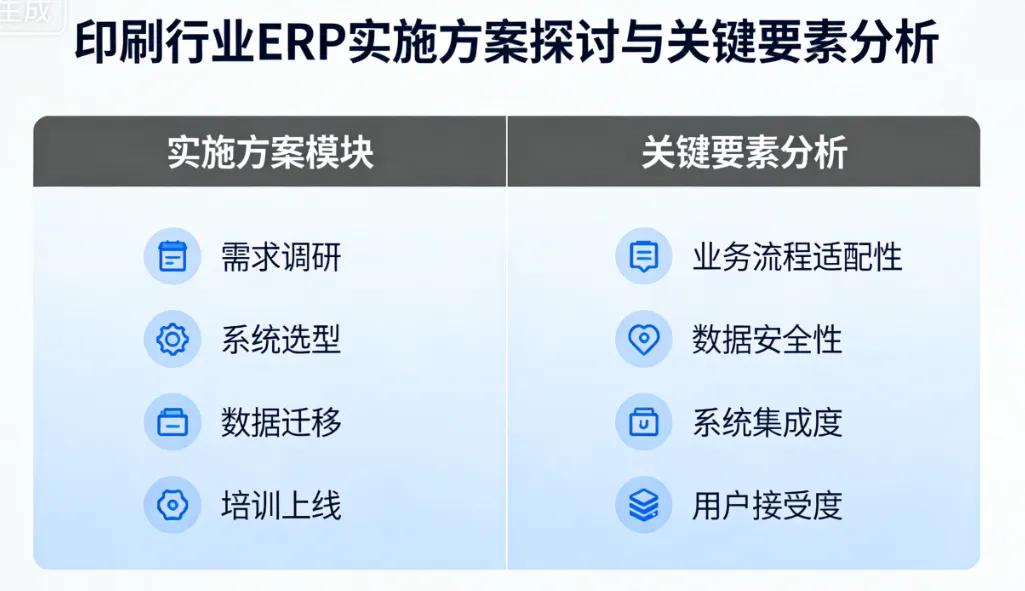
Change management and personnel training are important guarantees for ensuring the implementation of the system. Employees of printing companies may be accustomed to traditional paper work orders and experience judgments, and have a natural resistance or discomfort towards digitization. The implementation team needs to provide systematic training and communication to help employees understand the value of the new system and master necessary operational skills. More importantly, it is necessary to establish a performance evaluation mechanism that is compatible with the use of the system, encourage employees to actively use the system, provide improvement suggestions, and form a virtuous cycle of continuous optimization.
Industry specific features and system configuration considerations
The ERP system in the printing industry needs to have a series of distinctive functions to meet the unique business needs of the industry. In terms of quotation management, the system should support a fast quotation model based on material cost, process complexity, and equipment usage time, which can automatically adjust quotation parameters based on historical data, improve quotation accuracy and response speed. In terms of production tracking, the system needs to provide full process visualization from order issuance to finished product warehousing, especially for complex orders with multiple processes and long cycles, which can display the progress and quality status of each process in real time.
The material management function requires special attention to the special needs of the printing industry. The inventory management of paper needs to consider the classification and storage of different specifications, weights, and paper types, as well as the performance changes of paper caused by temperature and humidity changes. Ink management requires tracking batches, ratios, and remaining quantities, especially the mixing and usage records of spot color ink. The system should also support the management and reuse of surplus materials, reduce material waste, and lower production costs.
The quality management module needs to be aligned with professional standards in the printing industry. From the incoming inspection of raw materials, to color difference control and accuracy inspection during the production process, to the final inspection of finished products, each link requires clear quality standards and inspection records. The system should support integration with professional testing equipment, automatically collect inspection data, generate quality reports, and establish traceable quality records.
Continuous optimization and value enhancement after implementation
The launch of ERP system is not the end of the project, but the starting point for continuous optimization and value deepening. Enterprises need to establish a system operation and optimization mechanism, regularly collect user feedback, analyze system data, and identify improvement opportunities. With the development of enterprise business and changes in market environment, system functions also need to be adjusted and expanded accordingly.
The construction of data analysis capabilities is an important task in the later implementation stage. Printing companies have accumulated a large amount of business data, including order characteristics, production parameters, quality records, cost composition, etc. By establishing data analysis models, enterprises can identify production bottlenecks, identify cost drivers, predict equipment failures, optimize process parameters, and transform data into valuable business insights.
System integration and ecological expansion are important ways to enhance the value of ERP. With the development of industrial Internet and intelligent manufacturing, the ERP system of printing enterprises needs to interface with more external systems, including customer order platforms, supplier collaboration systems, production equipment monitoring platforms, etc. By building an open system architecture and standardized interface specifications, enterprises can gradually expand their digital ecosystem, improve overall operational efficiency and market responsiveness.
The implementation of ERP in the printing industry is a systematic project that requires high attention from enterprise management, deep participation from business departments, and strong support from professional technical teams. Through scientific implementation strategies, refined process management, and continuous optimization and improvement, ERP systems can become the core engine of digital transformation for printing enterprises, helping them build sustainable competitive advantages in fierce market competition and achieve a leapfrog development from traditional manufacturing to intelligent manufacturing.