
Case analysis of successful implementation of ERP system: digital transformation practices of Huawei/Haier/JD.com/Baosteel/Lenovo
In the era of digitalization sweeping global industries, the implementation of enterprise resource planning systems has evolved from a tool for improving efficiency to a core engine driving strategic transformation. Huawei, Haier, JD.com, Baosteel, and Lenovo, five benchmark enterprises from different fields, have jointly revealed how ERP has evolved from a backend to a frontend, from a management tool to a smart hub supporting business model innovation and global operations, with their unique practical paths. Their success is not accidental, but the inevitable result of the deep integration of strategic foresight, process reengineering, and technological innovation.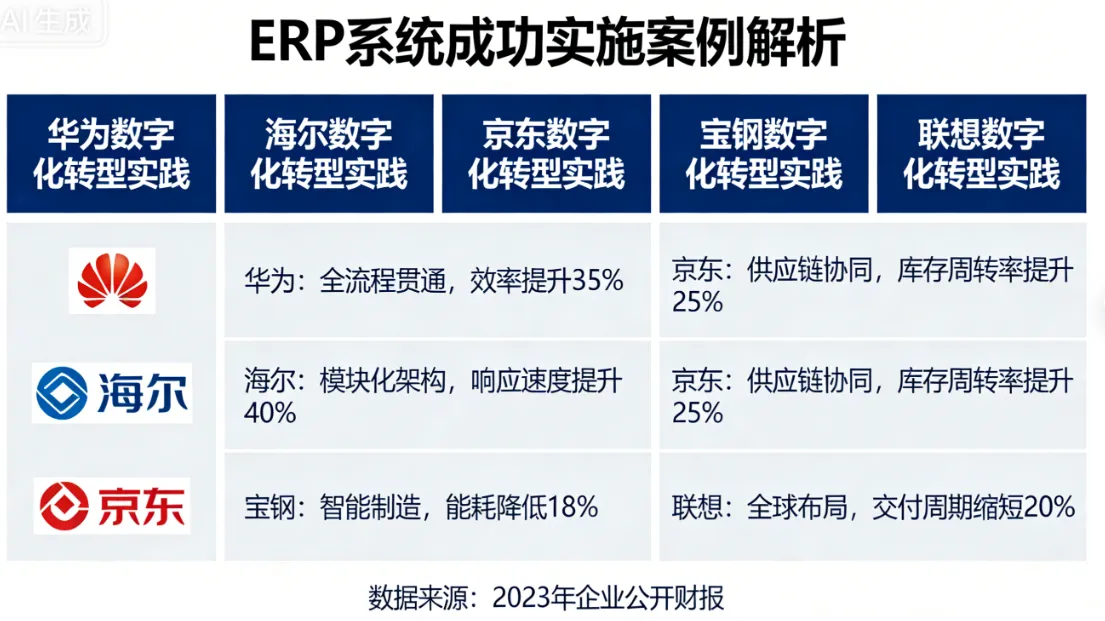
Huawei: Restructuring of the Global Financial System and Unified Language
When Huawei's business expands from China to over 170 countries and regions worldwide, the core challenge it faces is how to establish a unified control system during its rapid expansion. Huawei's ERP practice is essentially a "integrated financial services" transformation personally driven by Ren Zhengfei. This transformation positions ERP as a platform for buildingGlobal Unified Process Language and Data FoundationThe strategic platform.
By collaborating with top international consultants such as IBM, Huawei has broken through the original scattered and fragmented financial and business processes, and established the "four unifications" covering the world: unified accounting subjects, unified process architecture, unified data standards, and unified IT platform. This enables transactions from any branch worldwide to be reflected in the system in real-time and transparently, reducing the time for financial statements to be issued from days to hours. The ERP system has become the "digital nervous system" for global resource allocation, risk control, and strategic decision-making, laying a solid management foundation for its growth into a global technology giant. This practice shows that for multinational enterprises, the core value of ERP lies in building cross regional and cross-cultural capabilitiesStandardized governance capability。
Haier: the digital soil of organizational fission and "Rendanheyi" model
The digital transformation of Haier Group is accompanied by a thorough organizational revolution - splitting the huge hierarchical organization into thousands of self operated and self financing "small and micro" teams. The traditional centralized control ERP system has completely failed here, and Haier's practice is a creative subversion of the ERP concept.
Haier is not building a control system, but rather aAn ecological platform that empowers entrepreneurshipThe platform supports each small and micro team to directly face users, achieving full process online collaboration from user interaction, creative design to supply chain resource matching. For example, users' personalized needs for refrigerators can be directly accessed through the platform to research and develop small and micro enterprises and module vendors, driving customized production. The ERP backend and user interaction frontend (such as Haier Smart Home APP) data are fully integrated, transforming the system from the traditional push mode of "producing for inventory" to a pull mode of "creating for users". The case of Haier proves that when enterprises transform towards platformization and ecologicalization, ERP must evolve from a "control center" toA collaborative network that supports organizational agile innovation and value co creation。
JD: Self developed technology and fully integrated intelligent supply chain
As a retail technology company with supply chain as its core competitiveness, JD.com is facing extreme challenges that traditional ERP products cannot handle: real-time processing of daily orders of tens of millions, precise inventory management of tens of millions of SKUs, and the ultimate fulfillment commitment of "same day delivery". Therefore, JD.com has chosen toSelf research as the core, open integration as a supplementThe unique path.
JD's "ERP" is an "intelligent supply chain brain" that deeply integrates big data, artificial intelligence, and IoT technologies. It realizes the full chain automation decision-making from consumer ordering, to warehouse robot picking, and then to delivery path optimization. Its independently developed intelligent inventory system can deploy goods in advance in the warehouse closest to potential consumers based on complex prediction algorithms. This system is not only an operational tool, but also a part of its business modelCore competitiveness carrierJD's practice reveals that under the digital native and Internet ecology, the independent R&D capability of the core operating system is the key to building barriers that are difficult to replicate and deeply fit their own business models.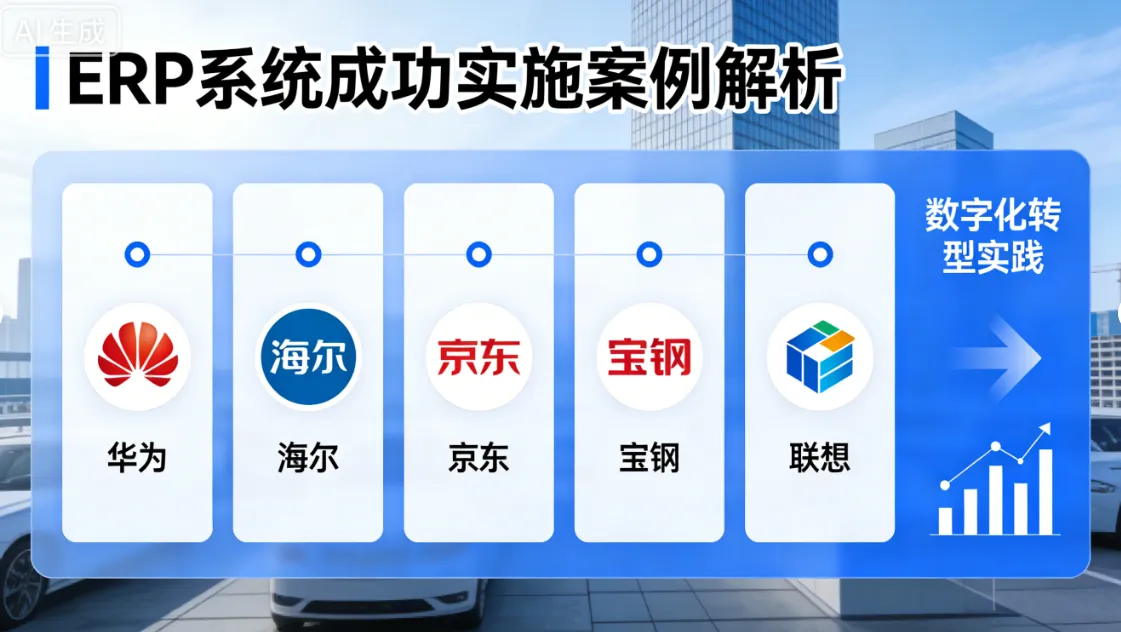
Baosteel: Integration of Production and Sales in Industrial Depth and Process Manufacturing Industry
As a typical process industry, the steel industry has strong production continuity and capital intensity, and has long faced the problem of production planning being disconnected from market demand. Baosteel (through its subsidiary Baoxin Software) represents a model of deep integration of industrial knowledge and information technology.
The essence of Baosteel ERP's success lies in its implementationThree level seamless integration of ERP+MES+PCS (Process Control System)When customer orders enter the ERP system, the system can automatically convert them into detailed production instructions and issue them to specific units through MES, even controlling the process parameters of production equipment. This deep integration enables Baosteel to strike a balance between large-scale production and personalized orders, achieving a transition from bulk orders of tens of thousands of tons to small batches of special steelFlexible productionIts system has accumulated profound knowledge in the metallurgical industry, transforming production experience into algorithm models, fully demonstrating that in the field of heavy industry, the success of ERP must be established on the basis ofDeep integration of underlying production equipment and industry process knowledgeOn the basis of.
Lenovo: Global Integration and Dynamic Supply Chain Game
Through a series of international mergers and acquisitions, Lenovo has become a technology giant with operations in 180 markets worldwide, but it has also been plagued by "system silos" and inefficient collaboration. The core strategy for implementing ERP isGlobal Template IntegrationIntended to create a unified platform that supports global business dynamics and games.
Lenovo has deployed unified business processes and ERP templates globally, covering the complete value chain from demand forecasting, global procurement, distributed manufacturing to multi country sales. This enables the management to observe the inventory, production capacity, and demand status of various regions around the world in real-time, just like observing a panoramic map, and quickly make optimization decisions. For example, when a region faces a supply shortage due to an emergency, the system can quickly simulate a plan to transfer goods from other regions and evaluate its impact on costs and delivery time. Lenovo's practice has shown that for global enterprises growing through mergers and acquisitions, the core mission of ERP is to build a system that can achieveOptimal allocation of global resources and dynamic risk hedgingAgile network.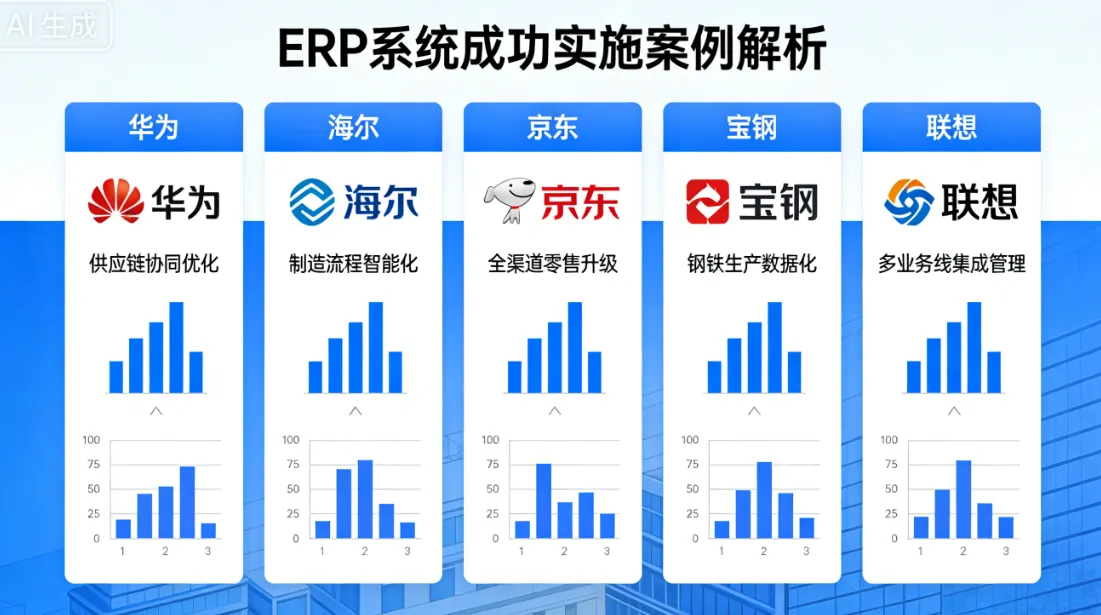
Common Inspiration: Strategic Choice Beyond Technology
Looking at the practices of the five companies, their success has a common logic that transcends industry differences:
First,The essence of ERP projects is a strategic change driven by the "top leader" engineeringIts goals must align with the highest strategic objectives of the enterprise.
Second,Process reengineering precedes technological implementationThe system is the carrier for solidifying excellent management ideas and processes.
Third,There is no 'best', only 'most suitable'Successful systems or deep self research (such as JD), deep integration of industry knowledge (such as Baosteel), or thorough restructuring of organizational logic (such as Haier) are all closely integrated with the unique genes of the enterprise.
Fourth,The system is a continuously evolving 'life form'It needs to be constantly iterated with business innovation and changes in the external environment.
These five paths ultimately converge on the same understanding: in the digital age, ERP is no longer just a simple enterprise management software, but a way for enterprises to transform their strategic vision into executable, quantifiable, and optimizable operationsCore digital infrastructureIts successful implementation marks the true transformation of enterprises from traditional organizations to a data-driven, networked collaborative, agile and intelligent modern organism.