
Analysis of the Current Status and Trends of ERP System Applications in China | Industry Cases and Digital Transformation Solutions
Driven by the global wave of digital economy and China's "integration of data and reality" strategy, ERP (Enterprise Resource Planning) systems have transformed from a luxury item for large enterprises to a core infrastructure for various organizations to achieve refined operations and digital transformation. At present, the Chinese ERP market is in a critical development period shaped by policy guidance, technology drive, and demand upgrading. Its application status presents distinct stage characteristics and is accelerating towards an intelligent and ecological future.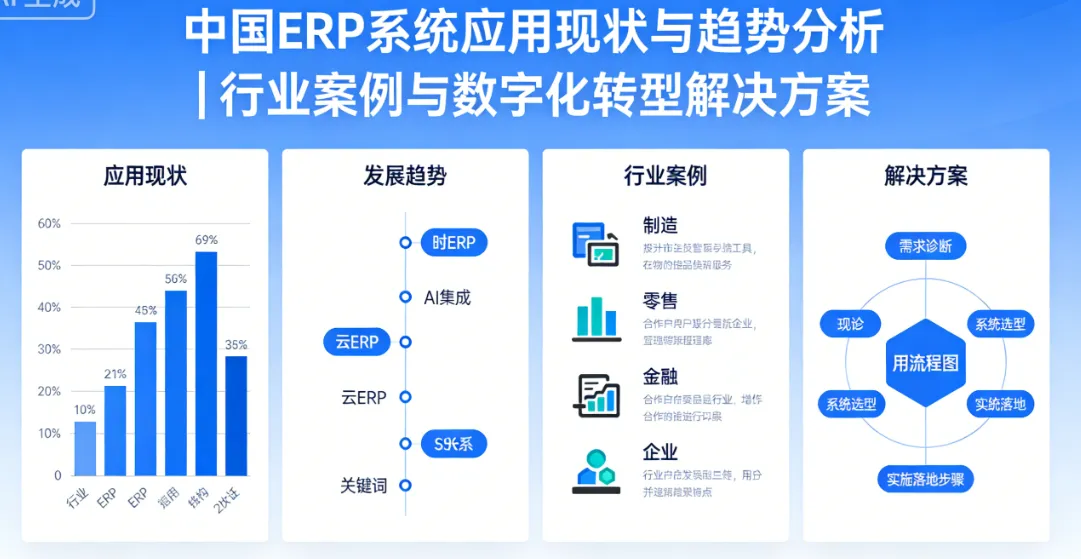
Application status: Layered popularization, domestic rise and challenges coexist
The application of ERP in China has formed a widespread but varying penetration pattern. ERP, as a core management system, has been widely adopted in large group enterprises and state-owned enterprises, and its application focus is shifting fromStandardization of processessteeringData Value Mining and Industrial Chain CollaborationDriven by the "Xinchuang" (innovation in information technology applications) policy, this market is undergoing a profound wave of localization substitution. Domestic manufacturers represented by UFIDA, Inspur, and Kingdee are gradually replacing international brands in core modules such as finance and human resources, building a secure and controllable digital foundation with a deep understanding of complex local management scenarios such as multi organizational control and state-owned asset supervision.
In the vast market of small and medium-sized enterprises, the popularity of ERP is rapidly increasing, but its application presents a different logic. Due to budget constraints and IT capabilities, small and medium-sized enterprises preferLightweight, cloud based, and industry-specific solutionsThey no longer pursue the "big and comprehensive" stacking of functions, but focus on solving the most urgent pain points, such as business and finance integration, precise inventory management, or marketing customer acquisition. This makes the public cloud based SaaS model ERP the mainstream choice, lowering the threshold for digital transformation with lower upfront costs and flexible subscription options.
However, universal challenges still exist: the phenomenon of "heavy implementation, light operation" leads to insufficient value mining after the system goes online; Poor data quality and incomplete departmental barriers have reduced the system to an advanced accounting tool rather than a decision-making hub; Meanwhile, the gap between traditional standardized products and industry specific needs still requires a significant amount of secondary development or customization to fill.
Future Trends: Cloud Native, AI Fusion, and Value Restructuring
Looking ahead to the future, the development of ERP systems in China will revolve around three core trends for deep integration and value reconstruction.
Firstly, the technological architecture is fully shifting towards cloud native and platformization.Simply deploying software on cloud servers is no longer the end point, based on microservices and containerizationCloud native ERPIt is becoming the technical standard for the new generation of systems. It endows the system with unprecedented elasticity, agility, and scalability. More importantly, ERP is evolving from a closed system to aOpen platformBy providing low code development tools and rich API interfaces, enterprise users and ecosystem partners can quickly build and iterate innovative applications that meet their own needs (such as personalized approval processes and data analysis dashboards) on a stable ERP core like building blocks, thereby supporting rapid business innovation.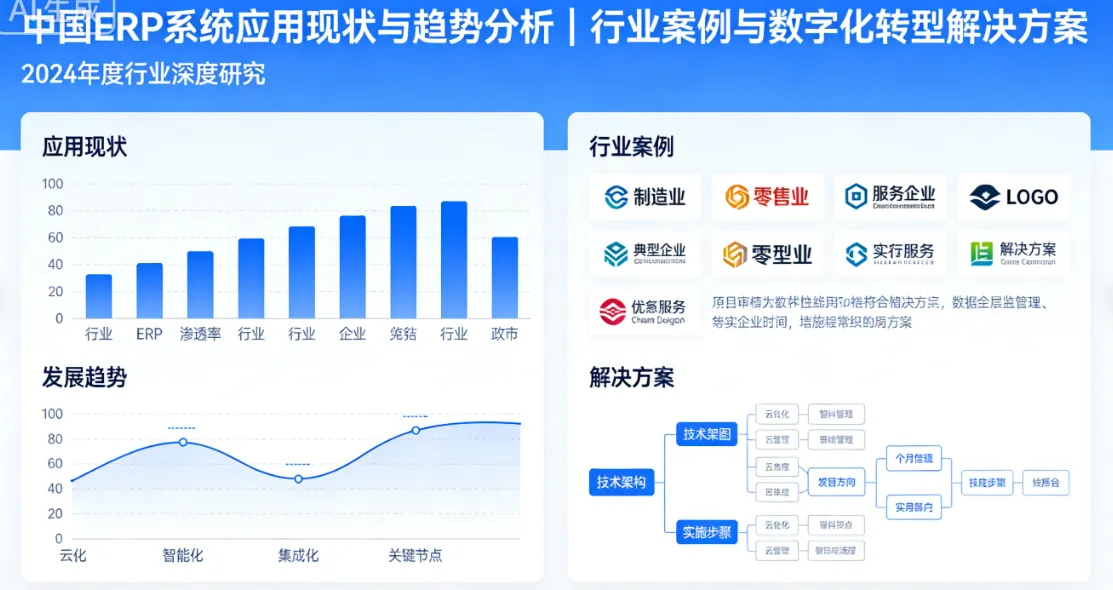
Secondly, AI deep integration drives business intelligence.Artificial intelligence technologies represented by generative AI and large models are being deeply integrated into various modules of ERP, driving the system from "process automation" to "decision intelligence". Its application is reflected in two aspects: firstlyInnovation of Interaction ModeThrough natural language dialogue, users can directly inquire about the reason for the decrease in gross profit margin in the previous quarter, and the system can automatically call data and generate analysis reports; SecondIntelligent enhancement of business processesFor example, implementing intelligent prediction and automatic replenishment in the supply chain, conducting visual recognition and root cause analysis of quality defects in production, and providing emotional analysis and verbal suggestions in customer service. AI is making ERP an intelligent business partner that can perceive, think, and act.
Finally, move from internal enterprise management to industrial ecological synergy.The ERP system boundaries of leading enterprises are expanding outward, connecting and exchanging data with upstream and downstream suppliers, distributors, and even logistics service providers' systems. This drives ERP to upgrade from "Enterprise Resource Planning" toThe core node of the "Industrial Chain Resource Collaboration Network"For example, a brand's ERP system can view dealer inventory in real-time and automatically initiate procurement appointments with suppliers based on terminal sales data, achieving precise matching of supply and demand throughout the entire value chain and optimizing global efficiency.
Industry Cases and Solutions: Empowering from General to Precise
In different industries, the application of ERP is presenting highly differentiated solutions to address specific pain points.
-
In discrete manufacturing industries such as equipment and electronicsThe core challenges are complex material management, multi-level production planning, and precise cost accounting. The solution focuses on buildingIntegrated platform of ERP and MES (Manufacturing Execution System)To achieve seamless flow and full traceability from sales orders to production work orders, and then to workshop operation instructions. For example, a certain household appliance enterprise achieved a 30% increase in production planning and scheduling efficiency and a 25% reduction in work in progress inventory by deploying an integrated ERP-MES system.
-
In the consumer goods and retail industryOmnichannel integration and consumer operation are key. The solution is centered around ERP, which centrally manages products, inventory, membership, and orders. The front-end flexibly supports various sales channels such as offline stores, e-commerce platforms, and live streaming sales. A domestic beauty brand has achieved real-time visualization and unified allocation of omnichannel inventory through cloud ERP. Online orders can be automatically shipped from the nearest store, reducing order fulfillment time by 50% and greatly improving customer experience.
-
In project-based industries such as engineering and professional servicesThe core demand is cost and schedule control for the entire project process and all elements. The solution is centered around the project management module of ERP, integrating budget, procurement, manpower, and cost modules to achieve closed-loop management of projects from bidding, project initiation, execution to payment collection, ensuring predictable and controllable project profits.
Conclusion
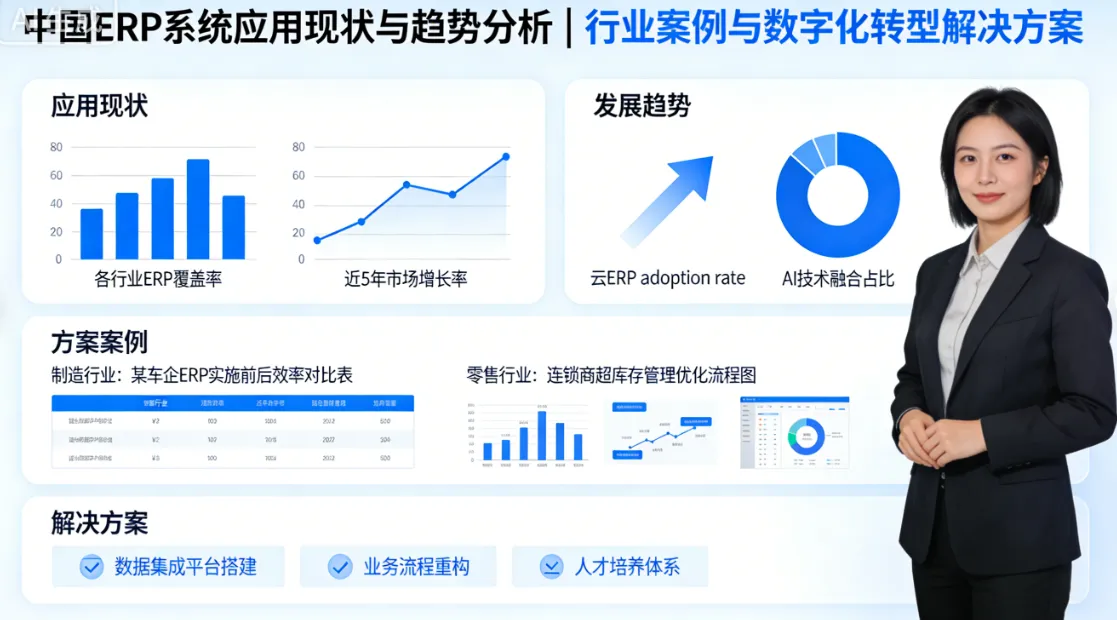
In summary, the application of ERP systems in China has entered a "deep water zone". Its current situation is a mixture of widespread popularization and deep application challenges, while its future clearly points towardsCloud native as the foundation, AI as the core, and ecological collaboration as the wingThe development direction. For enterprises, the key to success is no longer just choosing a software, but whether they can develop a digital transformation blueprint that matches their own strategy, and choose platforms and partners that can provide continuous evolution capabilities and have a deep understanding of the industry. In this process, ERP systems will surpass the scope of traditional management tools and truly become the "digital neural network" and "value creation engine" for enterprises to build core competitiveness in the digital economy era.