
DeepSeek open-source model leads AI applications in the ERP field, promoting enterprise intelligence transformation
Today, as the wave of artificial intelligence sweeps across various industries, the intelligent evolution of enterprise resource planning systems is entering a critical watershed. For a long time, the AI transformation of ERP has faced two core bottlenecks: firstly, the development cost of dedicated AI models is high and the cycle is long, which exceeds the affordability of most enterprises; Secondly, the closed source big model is like a "black box", with a gap between its data security, process interpretability, and the strict requirements of enterprise level applications. The rise of advanced open-source models such as DeepSeek is due to itsOpenness, controllability, and excellent performanceThis has opened up a new era for the AI inclusive application of ERP systems, becoming a fundamental and disruptive force driving the intelligent transformation of enterprises.
Open source breakthrough: solving the "cost" and "trust" problems of ERP intelligence
The open-source nature of the DeepSeek model fundamentally changes the way AI capabilities are supplied in the ERP field. Under the traditional path, if enterprises want to inject intelligence into ERP, they either purchase closed suites bundled with AI functions, sacrificing flexibility and autonomy; Either invest heavily in building their own team and training vertical models from scratch. The former is expensive and difficult to customize, while the latter has extremely high technical barriers and a huge risk of failure.
The open source model provides a 'third way'. It opens up the most advanced natural language processing and reasoning capabilities to the community in the form of code and parameters. For ERP software vendors and enterprise developers, this means that they can:
-
Zero cost acquisition of core AI capabilitiesWithout the need to pay expensive API call fees or authorization fees, intelligent applications can be built based on DeepSeek, significantly reducing the initial threshold for innovation.
-
Realize autonomous and controllable data and processesEnterprises can deploy and fine tune models in a privatized environment to ensure that all business data (such as financial information, customer data, production formulas) is processed within an internal closed loop, fully meeting the ultimate requirements for data security and privacy compliance in fields such as finance and manufacturing.
-
Deep customization and scene based fine-tuningBy utilizing industry-specific data such as historical work orders, customer service conversations, and device logs to supervise and fine tune the basic model or domain adaptation training, it is possible to forge "exclusive AI experts" who have a deep understanding of industry terminology, business processes, and internal knowledge of the enterprise, with much higher accuracy than general models.
Scene Refactoring: How DeepSeek Reshaps ERP Interaction and Decision Making
When powerful open-source models like DeepSeek are deeply integrated with ERP systems, it is reconstructing traditional work patterns and value creation methods from the following levels:
Firstly, it is a disruptive natural language interactive interface.The complex menu navigation and form filling of traditional ERP are being replaced by the "dialogue as operation" mode. Employees or managers only need to use natural language to make demands, such as: "Compare the gross profit of the sports shoe category in East China and South China last week, and analyze the main reasons for the differences." The DeepSeek model behind it can understand the intention, automatically call sales, cost, inventory and other module data in ERP, perform correlation queries and calculations, and generate structured analysis reports and visual charts. This greatly reduces the threshold for system usage and liberates frontline business personnel from tedious operations.
Secondly, there is intelligent process automation and exception handling.Based on the learning of process logs and rules, the model can automatically perform a large number of repetitive and rule specific business operations. For example, automatically checking purchase orders and warehouse receipts, initiating approval processes for differences; Monitor production reporting data, automatically detect abnormal working hours and trace the cause. Furthermore, it can play the role of a 'virtual process expert', automatically retrieving similar historical cases and company policies when encountering unconventional situations (such as customers requesting special payment terms), providing employees with handling suggestions, and even drafting preliminary solution drafts.
Finally, there is enhanced prediction and decision support.Although specialized time series models are still needed for deep prediction, the role of DeepSeek is indispensable. It can integrate structured and unstructured information from both inside and outside ERP, such as market reports and public opinion summaries, using the thinking mode of human experts, to provide richer feature contexts for prediction models, and generate multi-dimensional and highly readable explanatory analysis of prediction results. For example, when predicting sales for the next quarter, it can simultaneously provide trend lines based on historical data, reference recent competitor dynamics, and alert potential risks on the supply chain side, transforming predictions from cold numbers to logically supported decision storylines.
Implementation Path: Gradual Integration from "Auxiliary Insight" to "Embedded Core"
Enterprises introducing open source models to empower ERP should adopt a pragmatic and secure incremental strategy:
-
Scenario pilot, value firstStarting from low-risk and high-value scenarios, such as intelligent customer service Q&A (answering internal employees' questions about attendance and reimbursement policies), automatic generation of monthly management report drafts, etc. This can quickly verify the feasibility of the technology and build team confidence.
-
Private deployment, security basedDeploy a tailored lightweight model version in the internal IT environment of the enterprise to ensure that all data does not leave the country. Establish strict prompt word engineering and audit logs to record and review compliance for every query and output of the model.
-
Domain fine-tuning, knowledge injectionUsing the internal knowledge base, process documents, and historical data of the enterprise, fine tune the basic model instructions to master the company's unique "jargon", approval matrix, and business logic, and become a true "internal employee".
-
System integration, process reengineeringIntegrating mature AI capabilities into various core modules of ERP (such as SCM, CRM, finance) through APIs or embedded components, promoting the automation and reengineering of business processes, and ultimately achieving a new human-machine collaboration model from "human driven systems" to "AI assisted decision-making and human focused exceptions".
Future outlook: Moving towards "autonomous" intelligent enterprise operation
The continuous evolution of open-source models such as DeepSeek will drive the evolution of ERP towards more advanced forms. The future intelligent ERP may consist of multiple collaborative effortsAI agentComposition: One is responsible for interpreting market trends and adjusting sales forecasts, one optimizes the global supply chain network in real-time, and the other monitors cash flow and automatically performs risk hedging. Open source frameworks make the development and iteration of these intelligent agents democratic and efficient.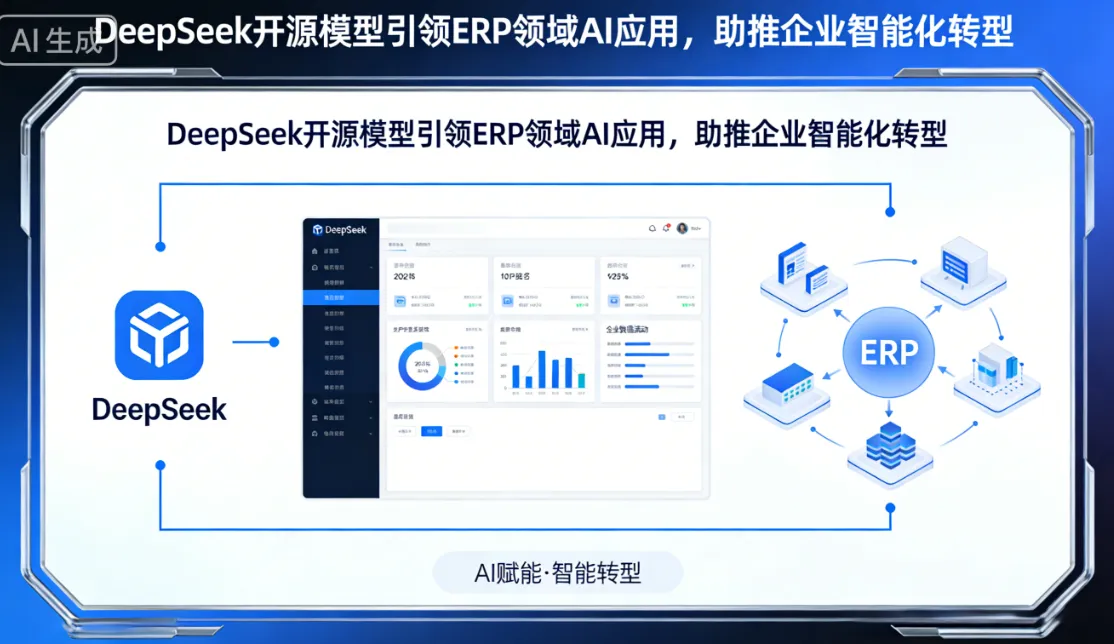
ConclusionThe rise of the DeepSeek open-source model marks the beginning of an era of ERP intelligence and popularization. It enables enterprises of all sizes to integrate cutting-edge AI capabilities into their operational core at a controllable cost by lowering technological barriers, ensuring data sovereignty, and empowering deep customization. This is not just a technological upgrade, but also a change in management philosophy - the focus of enterprise digital transformation is shifting from digitizing processes to building sustainable and endogenous decision-making advantages through open source intelligence. In this wave, enterprises that actively embrace and make good use of the power of open source AI are expected to take the lead in shaping the next generation of highly automated, adaptive, and intelligent enterprise forms.