
Technical Guide for Upgrading Shoe and Clothing ERP System | Automation Testing and Maintenance Practice | Industry's Best Operation and Maintenance Solution
In the footwear and apparel industry, seasonal changes are calculated on a weekly basis, and trends are constantly changing. Agile and precise supply chains are the foundation of survival. As the enterprise resource planning system that carries this core operation, its iteration and stability directly affect whether the enterprise can "outperform the season". A major ERP upgrade is no longer just a simple functional update, but a precise project involving business continuity, data security, and process reengineering. This article will focus on the characteristics of the footwear and apparel industry and explore how to leverage cloud native and microservice architecture trendsAutomated testing, continuous maintenance, and intelligent operation and maintenanceBuild a robust and efficient upgrade and operation system with a combination of punches.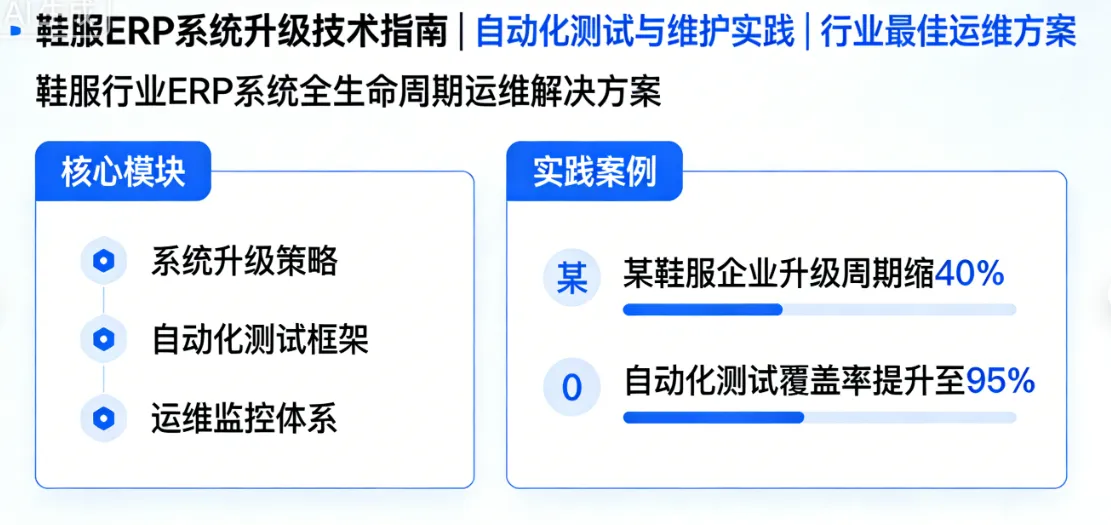
Upgrade blueprint: a technology path centered on business continuity and agility
The primary goal of upgrading the shoe and clothing ERP system is to support business innovation, rather than the technology itself. Therefore, the technological path must be closely centered around the core scenarios of the industry:Omnichannel inventory synchronization, fast response supply chain collaboration, product lifecycle management, and integrated membership operationUpgrading should not be about starting over from scratch, but rather adopting a gradual and modular strategy.
The current mainstream direction is towardsCloud native, microservice architectureEvolution. This means decoupling massive monolithic systems into independently deployed, expanded, and updated business capability units (microservices), such as independent order services, inventory services, and membership services. This enables enterprises to quickly iterate on the modules with the deepest pain points, such as prioritizing inventory and order services to cope with major promotions, without affecting the overall situation, greatly reducing upgrade risks and improving business agility. At the level of data migration, the key lies in achieving“Dual track operation and grayscale release”Let the new and old systems process a portion of the real business traffic in parallel, ensure consistency through data comparison, and then gradually switch all traffic to the new system to achieve a smooth transition.
Automated testing: a 'safety net' to ensure upgrade quality
For shoe and clothing ERP systems with complex business logic and high data correlation, traditional manual testing can no longer meet the needs of high-frequency upgrades in terms of efficiency, coverage, and reliability. Building a comprehensive automated testing system is the lifeline to ensure successful upgrades. The system should consist of three levels:
-
Automated testing of underlying interfacesThis is the cornerstone. Automated testing of application programming interfaces for all microservices to ensure that each independent service functions correctly and meets performance standards. This is particularly important in frequent interface changes and releases.
-
Business Process Automation TestingThis is the core. Simulate real shoe and clothing business scenarios and build end-to-end automated testing scripts. For example“New Product Launch Process”Testing: From creating product information, multi-channel distribution, simulating sales, triggering replenishment, to generating purchase orders, verify whether the entire chain is smooth in the new system.
-
UI interface and compatibility testingAutomated operation and compatibility verification are carried out for multi terminal interfaces such as warehouse PDA, store POS, and backend management to ensure seamless user experience on the front line.
The value of automated testing lies in its ability to be embedded into continuous integration/continuous delivery pipelines. Every time a developer submits code, the relevant test suite is automatically triggered, providing quality feedback within minutes and intercepting defects during the development phase, truly achieving "quality built-in".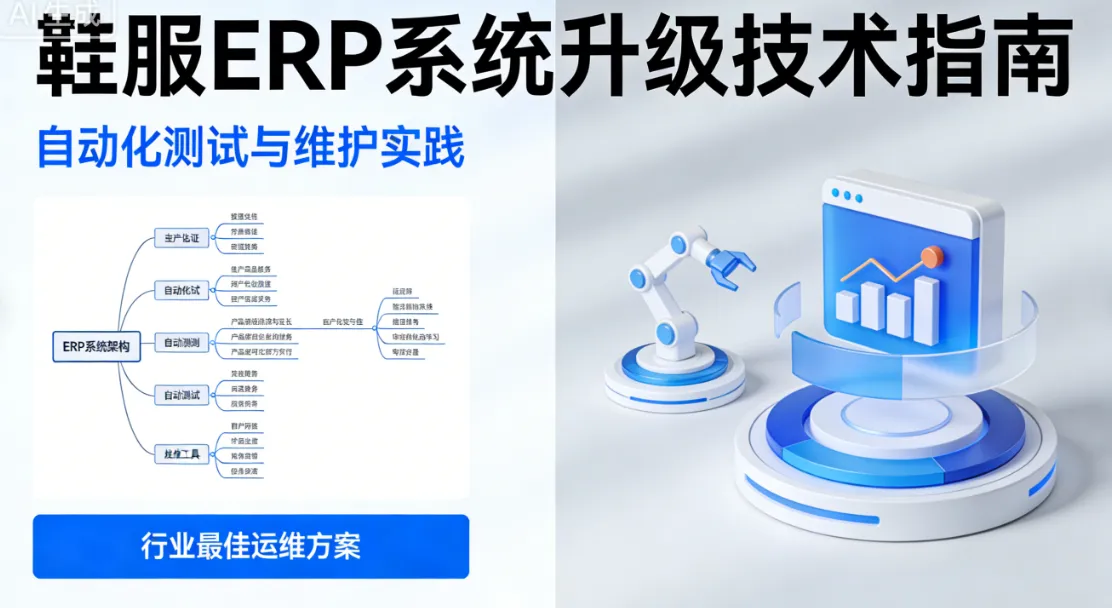
Continuous maintenance and intelligent operation: paradigm shift from "firefighting" to "foresight"
The system launch is just the beginning, continuous maintenance and high-level operation and maintenance are the long-term stable guarantees. The footwear and apparel industry has obvious peaks and valleys (such as major promotions and seasonal changes), and operations must adapt to them.
-
Observability driven intelligent monitoringBeyond simple CPU and memory monitoring, establish an observability system based on business indicators. Monitor the core transaction chain (such as "order payment inventory deduction"), track its success rate and response time in real time; Set intelligent baselines for key business indicators such as real-time inventory synchronization delay and order fulfillment rate, and automatically alert if they deviate, allowing the operations team to perceive business anomalies before user complaints.
-
Full link performance pressure testing and capacity planningBefore each major promotion, the system must undergo full chain stress testing based on real historical business scenarios. Not only do we need to test peak traffic, but we also need to simulate extreme scenarios such as "inventory flash sales" and "concentrated coupon collection", identify performance bottlenecks in advance, and based on this, make accurate elastic capacity planning to ensure that the system can handle big promotions with ease.
-
Automated operation and disaster recovery drillsAutomated daily inspections, log analysis, and execution of fault plans. More importantly, regular disaster recovery switching drills are conducted to ensure that in the event of a real data center failure, business can be restored within minutes according to the predetermined process, meeting the high requirements of the footwear and apparel industry for "zero tolerance" for business interruptions.
Industry's Best Operations Solution: Building Collaborative and Evolutionary Organizational Capability
The best technical solution needs to match the best organizational practices. Successful operations depend on a fusion ofDevelopment, Testing, Operations, and Business DepartmentsThe collaborative team. The team follows standardized operation and maintenance procedures and establishes a comprehensive knowledge base, accumulating the experience of handling each fault into collective wisdom.
The ultimate goal of this system is to promote the evolution of IT operations from a passive cost center to an active oneBusiness Value Empowerment CenterThrough a stable, efficient, and agile ERP system, the operations team directly ensures the smooth operation of peak season sales, supports rapid decision-making in the fast response supply chain, and ensures real-time accuracy of omnichannel data, thus winning the most valuable time and trust for the enterprise in fierce market competition.
ConclusionThe competition in the footwear and apparel industry is a competition of speed and data. The upgrade and operation of its ERP system must also match this rhythm. By adopting cloud native architecture to reduce upgrade complexity, ensuring the quality of each change through automated testing, and achieving continuous stability and business insights through intelligent operations and maintenance, enterprises can build a resilient and sensitive digital operation network. This is not only a set of technical solutions, but also a core organizational capability that directly transforms technical reliability into commercial competitiveness.