
Driven by policies from the Ministry of Industry and Information Technology, the localization of ERP is accelerating: new opportunities and challenges for the career development of consulting consultants
In today's era where digital economy and independent controllability have become the core strategies of the country, a profound transformation driven by policies from national ministries such as the Ministry of Industry and Information Technology is taking place in the hinterland of China's enterprise software market. With the implementation of a series of documents such as the "14th Five Year Plan for the Development of Software and Information Technology Services Industry" and the "Action Plan for Digital Transformation of Manufacturing Industry", the localization replacement process of enterprise resource planning systems has evolved from a spontaneous market behavior to a strategic task related to industrial security and development initiative. This surging wave of policies not only reshapes the competitive landscape of domestic manufacturers represented by UFIDA, Kingdee, Inspur, Huawei, etc., but also pushes the ERP implementation consulting group at the center of change to a new crossroads of career development with unprecedented opportunities and challenges.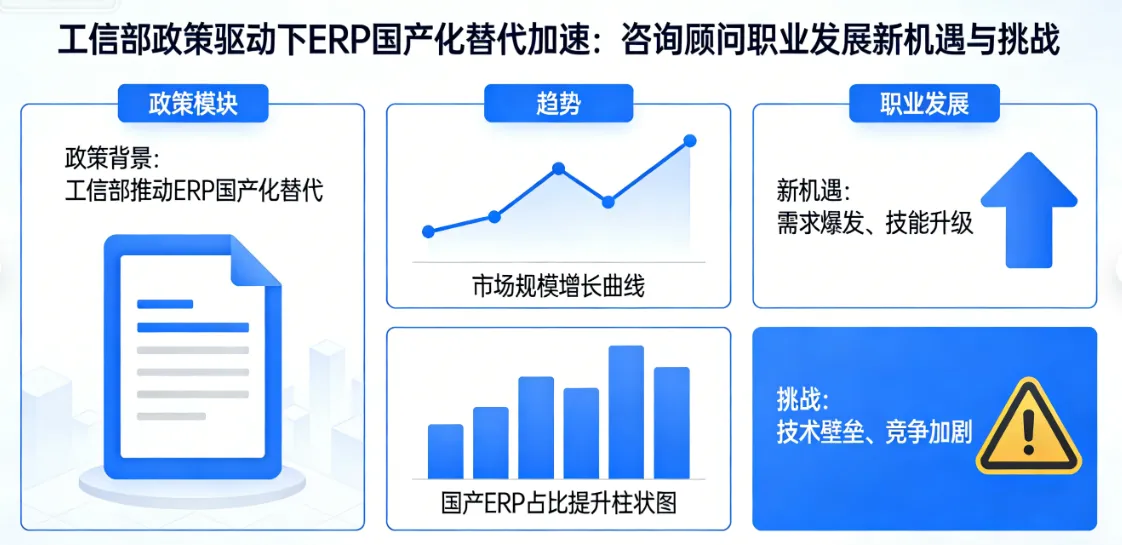
1、 Market reconstruction under the policy wind: from "substitution" to "reshaping"
Under policy driven localization substitution, its connotation goes far beyond simple software replacement. It is a systematic project with "safety and controllability" as the bottom line and "value reconstruction" as the goal. The policy has set clear timelines and roadmaps in core areas such as finance, energy, telecommunications, and key manufacturing, opening up a huge market for stock substitution and incremental innovation for domestic ERP. This directly leads to a fundamental shift in the market landscape: the high-end complex application market, which was previously dominated by international giants such as SAP and Oracle, is gradually opening up to domestic top manufacturers with deep industry accumulation and complete solution capabilities.
The essence of market demand is also upgrading synchronously. Enterprises are no longer just satisfied with achieving "benchmarking" or "replication" of foreign systems, but hope to take advantage of the opportunity of localization to complete in-depth sorting and optimization of business processes, and truly integrate ERP systems into digital systems that conform to Chinese management characteristics. This shifts the focus of the project from simply "product function implementation" to "business transformation that integrates management and technology". The changes in market demand have fundamentally redefined the value coordinates and capability requirements of consulting consultants.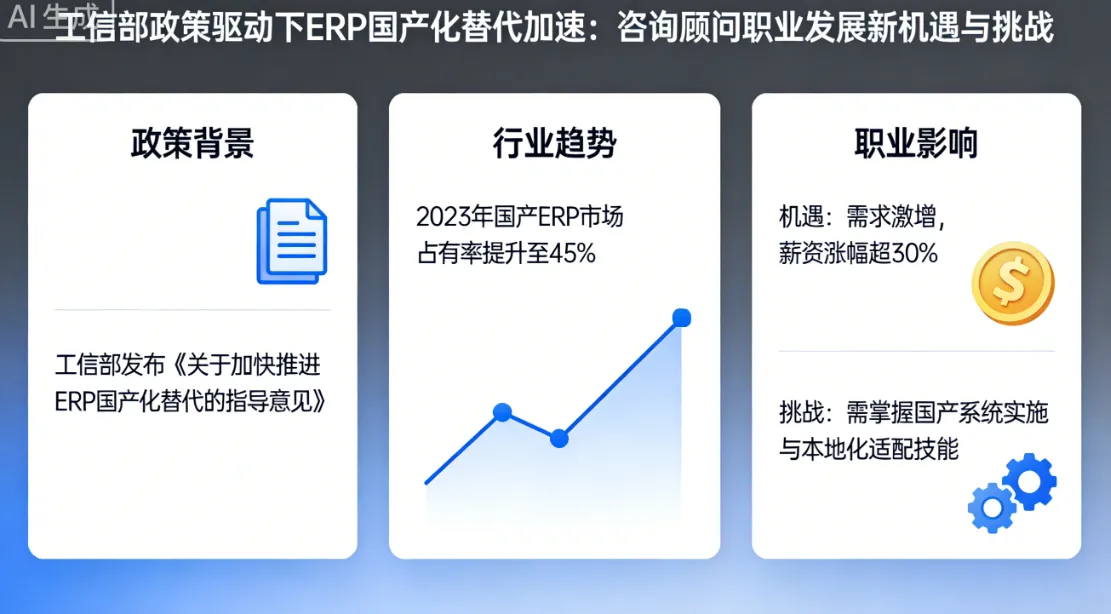
2、 Dual Variations in Career Development: Deep Interweaving of New Opportunities and Challenges
For consultants, this transformation brings not a linear dividend, but a complex and intertwined picture of opportunities and challenges.
Unprecedented new opportunities are emerging:
First,Market demand shows explosive and diversified growthFrom the comprehensive replacement of large state-owned enterprise groups to the digital enlightenment of "specialized, refined, unique and new" small and medium-sized enterprises, massive projects have released a huge demand for consultant talents. The career stage of consultants has expanded from focusing on a few large foreign enterprise projects in the past to a broader and more diverse main battlefield of the national economy.
Secondly,The professional value chain has been significantly extended and deepenedIn localization projects, the role of consultants has shifted from being "product experts" with a focus on technical configuration in the past to reshaping customer business processes, "translators" of domestic software and business scenarios, and co creators of transformation value. This requires and allows consultants to intervene earlier and deeper in the strategic and process levels of the enterprise, enhancing the strategic value and influence of their work.
Furthermore,The scarcity value of high-end composite talents is highlightedConsultants who can span multiple domestic ERP platforms, are proficient in specific industry businesses (such as discrete manufacturing and process industries), and possess excellent change management capabilities will become scarce resources in the market, and their professional premium ability will be significantly enhanced.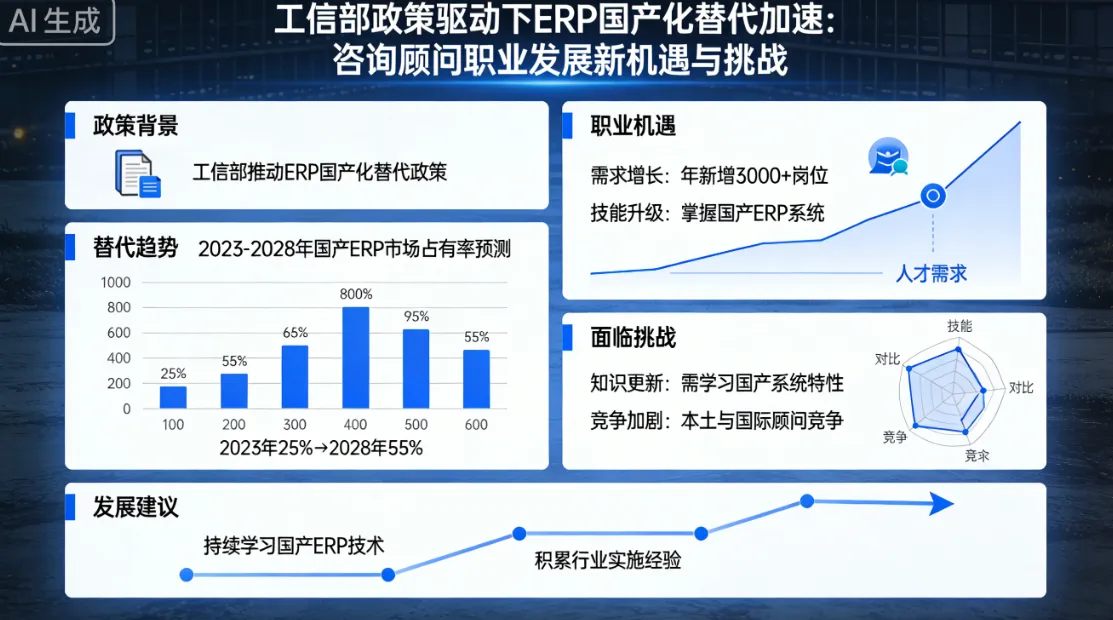
At the same time, severe new challenges cannot be ignored:
On the one hand,The knowledge system and skill structure are facing urgent reconstructionConsultants need to shift from a deep understanding of a single foreign product to a rapid learning and adaptation of the logic, technical architecture, and domestic basic software and hardware ecosystem of multiple domestic ERP products. This requires strong learning and knowledge transfer abilities.
On the other hand,The complexity of the project and the pressure of successful delivery have doubledDomestication projects are often accompanied by complex existing system migration, historical data governance, business process reengineering, and organizational change management, which are far more complex than new projects. This places extremely high demands on the consultant's abilities in project management, risk control, and comprehensive problem-solving.
In addition,Intensifying market competition and changes in value measurement standardsWith more practitioners entering the track, competition is becoming increasingly fierce. At the same time, clients are increasingly pragmatic in measuring project value, shifting their focus from "functional launch" to assessing "business effectiveness". Consultants must continue to demonstrate their actual contributions to the client's business.
3、 The Road to Breaking Through: The Evolution of Consultants' Abilities and Role Enhancement
To stand invincible in the new era, consultants must actively undergo capability evolution and role upgrading, achieving a fundamental transformation from "implementation engineers" to "digital transformation enablers".
Firstly, construct a "three-dimensional integrated" T-shaped knowledge structure.Vertically, it is necessary to have a deep understanding of the core logic and latest technological features of at least one to two mainstream domestic ERP products; Horizontally, it is necessary to have a broad understanding of how new generation information technologies such as cloud computing, big data, and artificial intelligence can be integrated and innovated with ERP; At the core, it is necessary to delve into specific vertical industries such as retail, healthcare, and equipment manufacturing, accumulate profound business knowledge, management practices, and industry insights, and form a composite competitiveness of "technology+product+industry".
Secondly, strengthen leadership in business process reengineering and change.The key to the success or failure of localization projects often lies in whether they can take advantage of system replacement to promote business process optimization and management improvement. Consultants need to master scientific process analysis methods and possess strong communication, guidance, and change driving abilities. They should be able to assist client management in building consensus, resolving resistance, and leading organizations to smoothly overcome the pain of transformation.
Thirdly, enhance the capability of value delivery oriented solutions.The top consultants of the future should be able to stand from the perspective of customer strategy and business challenges, flexibly combine, customize, and even integrate the product functions of domestic ERP with peripheral systems, package them into end-to-end solutions to solve specific business pain points (such as supply chain resilience, cost refinement control, and user lifecycle operation), and clearly define and track the value realization path.
Fourth, embrace ecology and establish a platform based collaborative mindset.Localization substitution is a massive ecological project involving basic hardware, operating systems, databases, middleware, and application software. Consultants need to understand the collaborative relationship of the entire domestic technology stack, possess the ability to collaborate with various partners within the ecosystem, and jointly deliver stable, reliable, and high-performance overall solutions to customers.
Conclusion
The wave of ERP localization substitution driven by policies from the Ministry of Industry and Information Technology is a milestone node in China's digitalization process. It brings both a magnificent stage of the times and a severe test of self-improvement to the consulting profession. Consultants who can keenly perceive trends, actively embrace changes, have the ability to iterate quickly, and always adhere to customer business value as the foundation will surely cross the cycle, anchor new career heights in the wave of localization, leap from technology implementers to leaders and enablers of value creation in the digital age. This transformation will ultimately reshape the industry, and will also reshape every person involved in it.