
Three major risks and response strategies for implementing shoe ERP: project delays, data migration, and employee resistance solutions
In the footwear industry, which combines fashion sensitivity and precision manufacturing characteristics, a successful ERP implementation is comparable to a precise multi-threaded collaborative battle. It requires precise integration of the complex chain from leather procurement, multi size production, global logistics to seasonal market launch. However, in practice, the three classic risks - project delays, data migration failures, and employee resistance - are like three mountains that constantly threaten the success of the project. They do not exist in isolation, but are interrelated and mutually reinforcing. Systematically identifying the specific manifestations of these risks in the footwear industry and adopting industry-specific response strategies is the key to project success.
Risk 1: Project Delay - From "Quarterly Project" to "Cross Year Project"
In the footwear industry, the value of time is particularly special. If the project is postponed from one quarter of the plan to the next year, it may directly miss the critical product development and launch cycle, leading to business disconnection.
Root cause analysis of risks:
-
Spread of demand and industry complexitySKU management in the footwear industry (model number x color x size) is extremely complex and involves special requirements such as environmental material certification and overseas compliance. During implementation, the business department often proposes "small but necessary" customization requirements, such as adding "last data management" for specific shoe types, which leads to a loss of scope.
-
Deep adaptation of supply chain and production modulesSimply using universal templates is difficult to cope with flexible production and outsourcing management in the footwear industry. For example, precise accounting of "cutting loss rate" and transparent tracking of "outsourced factory progress" require deep customization, which can easily become a schedule black hole.
-
Conflicts during seasonal business peaksIf the project implementation overlaps with the brand ordering meeting or peak production season, key users will not be able to invest enough time to participate, resulting in key nodes being blocked.
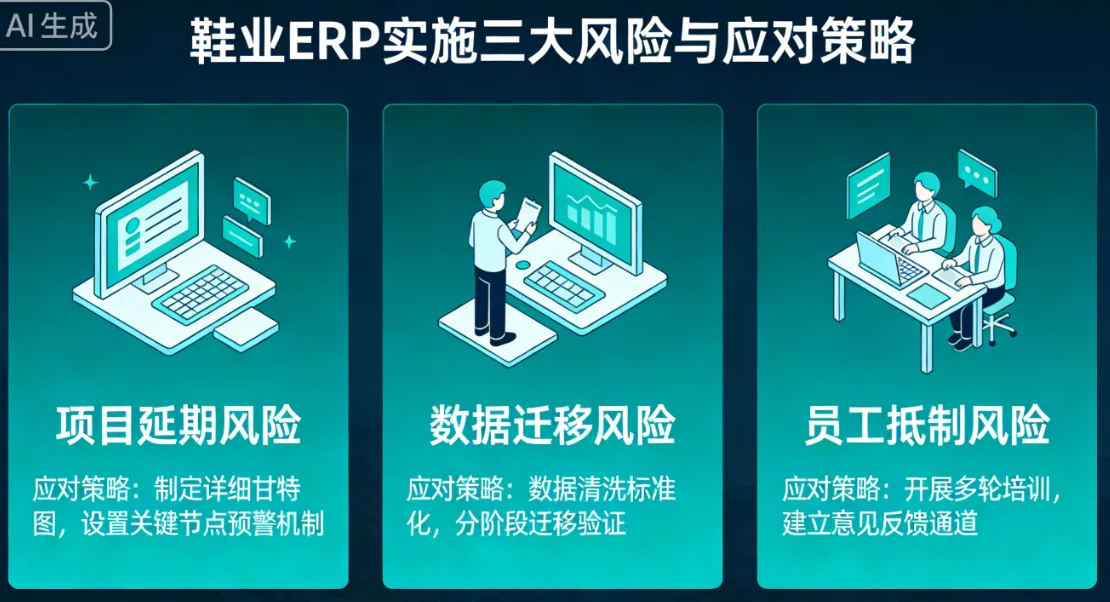
Targeted response strategies:
-
Adopting an agile hybrid model of "frozen design, segmented deployment"During the project initiation phase, clarify the scope of core requirements and 'freeze' the basic design. Priority implementationFinance+Inventory ManagementThe core module ensures that the basic business is launched and creates value within 3-4 months (such as improving inventory accuracy). Afterwards, develop and launch in an agile iterative mannerProduction management+supply chain collaborationWaiting for complex modules, every 6-8 weeks is a sprint cycle, continuously delivering visible results.
-
Establish a strict requirement change control committeeAny new requirements must undergo a CCB evaluation composed of IT, key business stakeholders, and project directors to clearly assess their impact on project duration and cost, and be linked to business priorities to avoid uncontrolled spread.
-
Develop a project plan that aligns with the business calendarProject planning must avoid the peak business periods of the enterprise itself and reserve buffer time to ensure the availability of key user resources.
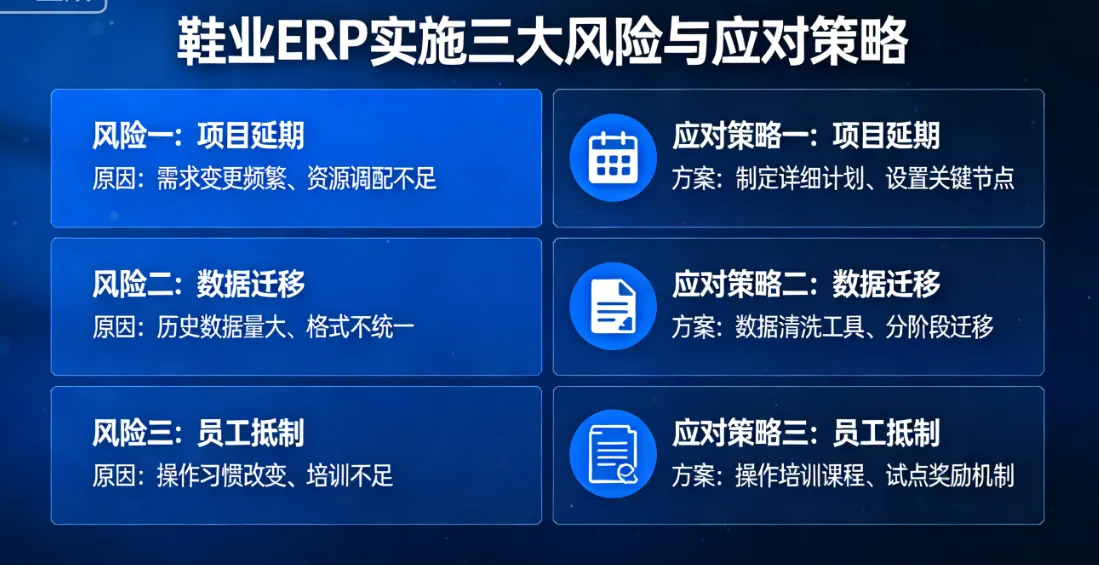
Risk 2: Data migration - "garbage in, garbage out" leading to the collapse of the system foundation
The issue of historical data in the footwear industry is particularly prominent. Years of inconsistent color codes, chaotic size systems, and coexistence of old and new material names, without thorough governance and direct migration, the new system will not be able to support accurate procurement, production, and analysis.
Root cause analysis of risks:
-
Material and BOM data are extremely complexA shoe may involve dozens of materials (leather, lining, hardware, midsole, etc.), and its BOM (Bill of Materials) and process route versions frequently change with design changes. Historical data is filled with a large number of expired, duplicated, and encoded inconsistent records.
-
Fragmentation of inventory data across multiple brands and channelsThe same material may have different codes under different brand systems; The inventory data formats and statistical standards of offline stores, e-commerce warehouses, and contract factories are different, making integration difficult.
-
Insufficient awareness of the importance of data qualityBusiness departments often underestimate the time and professionalism of data cleaning and expect a "one click import", which lays a huge hidden danger for subsequent operations.
Targeted response strategies:
-
Launch the "Data First" special project and establish a unique data standardBefore the system configuration starts, establish a cross departmental data team and spend 1-2 months to standardize the core master data (materials, suppliers, customers, item numbers). Develop and enforce enterprise level policiesRules for Material Classification and CodingTo lay the foundation for all future data.
-
Adopting a "phased and categorized" migration strategy and verification mechanism:
-
Static master dataTake the lead in cleaning and migrating (such as materials and customers).
-
Dynamic business data(such as outstanding orders and inventory balances) will be migrated last before the system switch.
-
Strict measures must be taken for each batch of migrated dataSample verification - Full comparison - Business validationThree step verification method to ensure consistency between accounts and reality before and after migration.
-
-
Establish a data responsibility system and long-term governance mechanismClarify the "owners" of various types of data (such as material data belonging to the R&D department), incorporate data quality into departmental performance evaluations, and ensure the accuracy of future data from the source.
Risk 3: Employee Resistance - "Soft" Resistance renders the system virtually non-existent
Even if the system is successfully launched, if frontline employees (such as warehouse administrators, purchasers, production planners) passively use it due to changes in habits or damage to their interests, the system will quickly fail.
Root cause analysis of risks:
-
Temporary regression in operational habits and efficiencyThe interface and process of the new system may be more complex than the original manual tables or old system, especially for workshop masters or senior warehouse managers, short-term efficiency decline can cause strong resistance.
-
Transparency triggers' implicit power 'The transparency of ERP will weaken the "influence" obtained by certain positions through information opacity (such as certain procurement positions), which may encounter hidden resistance.
-
Insufficient training and lack of supportThe superficial "big classroom" training cannot enable employees to master practical operations, and if problems are not solved in a timely manner after going online, frustration will quickly spread.
Targeted response strategies:
-
Implement the 'key user' system and create internal opinion leadersSelect influential and receptive business backbones from each core department, and deeply involve them in process design, testing, and training material development. They will become the "spokespersons" and first problem solvers of the project in the department, and their demonstration effect far exceeds that of external consultants.
-
Design a "layered empowerment" training system that fits the scene:
-
For management: The focus of training is onHow to make decisions through system data。
-
For key users: trainingSystem operation and common problem solving。
-
For frontline operators: Production'Foolish' homework guidebook and short videosConduct hands-on training exercises in real work scenarios.
-
-
Implement the transition plan of "parallel operation and positive incentives"Set a parallel period of 1-2 months, allowing both old and new methods to coexist. At the same time, special rewards will be established to provide timely material or honorary incentives to employees who actively use the new system, propose optimization suggestions, and help colleagues, turning resistance to change into driving force.
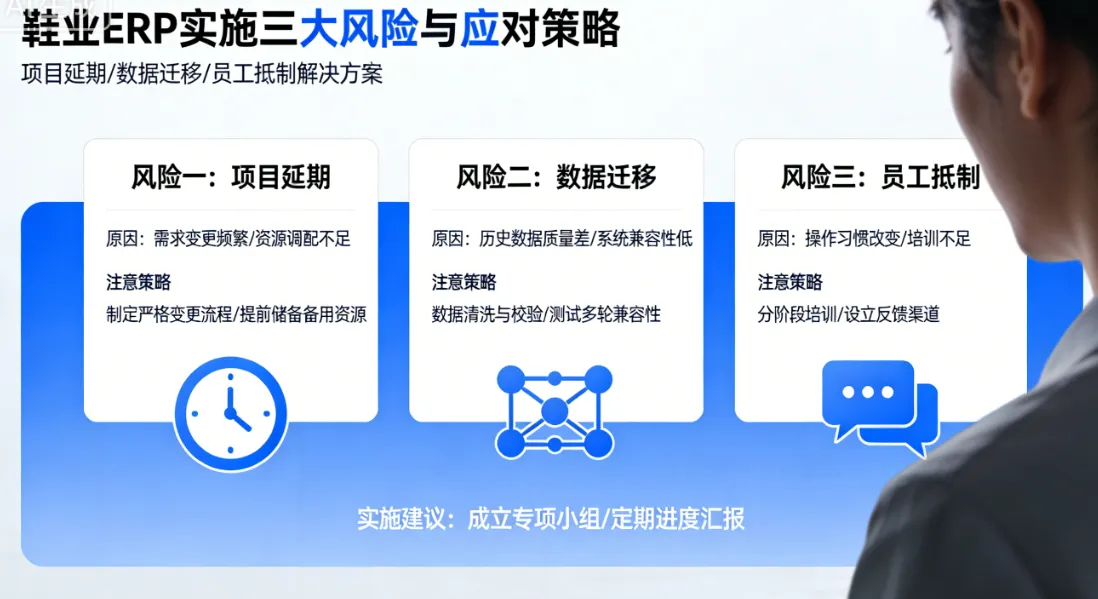
In summaryThe successful implementation of footwear ERP requires project management teams to possess profound industry insights and humanized transformation wisdom. passAdopting a hybrid mode to strictly control progress, consolidating data foundation with specialized projects, and using change management to unite people's heartsOnly by effectively managing these three major risks can enterprises ensure that ERP systems are not only successfully launched, but also truly integrated into the business bloodline, becoming the digital engine driving footwear enterprises to steadily move forward in the fast fashion competition. The ultimate test of this transformation is the organization's ability to collaborate in the face of complexity and its collective determination to embrace change.