
The Current Status of ERP Application in China: Analysis of Five Major Development Trends
Currently, the digital transformation of Chinese enterprises has entered a "deep water zone", and the ERP system, as the core pillar of this process, is undergoing a profound reconstruction of its application landscape and evolution direction. Driven by policy guidance, technological innovation, and market demand, ERP has surpassed the traditional tool scope of "enterprise resource planning" and is evolving into a tool that supports intelligent operation and industrial chain collaboration of enterprisesDigital pedestalThe current development status presents five clear and intertwined key trends, which together define a new paradigm for digital management of enterprises in the coming years.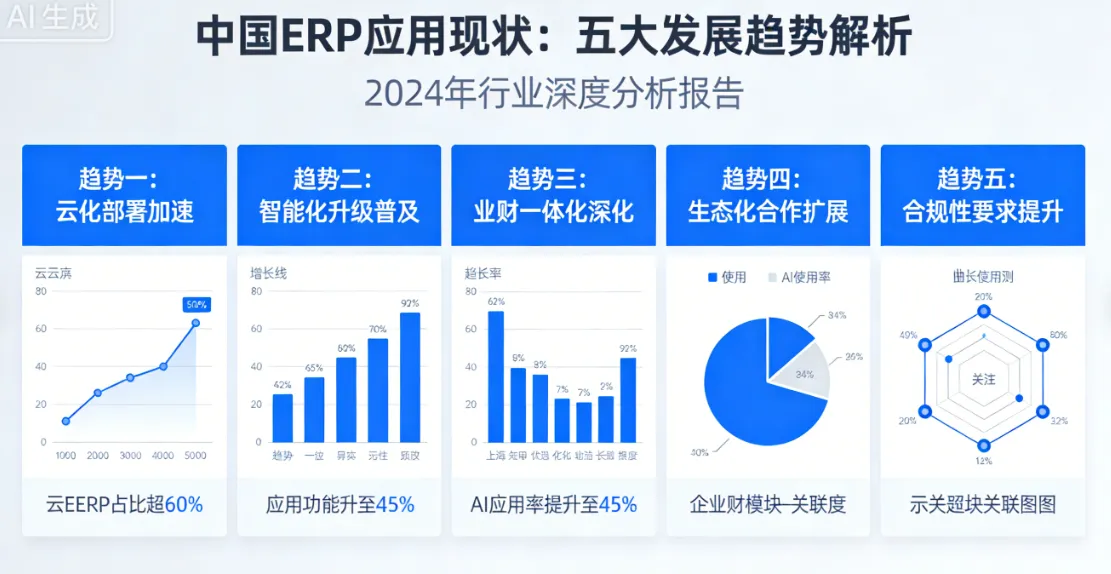
Trend 1: Cloud based and subscription based services have become mainstream, and the application threshold has significantly decreased
The previous model of on premises deployment and one-time buyout is rapidly transitioning to a subscription service model based on public or private clouds. This transformation has profoundly changed the ecology of the ERP market. For the majority of small and medium-sized enterprises, cloud ERP has its advantagesLower initial investment, faster deployment speed, and more flexible scalabilityTruly breaking the digital barrier. Enterprises no longer need to build their own data centers or establish large IT operation and maintenance teams, and can access advanced management functions that were previously only affordable to large enterprises on demand.
More importantly, cloud native architecture endows ERP systems with unprecedented agility. Service providers can continuously and seamlessly push updates, enabling enterprises to apply the latest management concepts, compliance rules (such as electronic invoice interfaces), and technical components (such as AI tools) in a timely manner. This transforms ERP from a set of expensive fixed assets that require regular "major repairs" to a readily available and continuously evolving "digital capability" service, with its value and stickiness shifting from "owning software" to "continuous operation".
Trend 2: Domestic substitution accelerates comprehensively, moving from "usable" to "easy to use"
Under the national strategic guidance of independent and controllable core technologies, the localization of ERP in key fields such as finance, energy, telecommunications, and advanced manufacturing has entered the stage of large-scale implementation. This is not just a simple software replacement, but a systematic migration involving technology stack, business ecology, and management philosophy.
Leading domestic manufacturers represented by UFIDA, Kingdee, and Inspur are transforming from pursuers to consolidators, and even becoming definers in some scenarios, thanks to their deep understanding of the complex local business environment, financial and tax systems, and state-owned asset supervision needs. The competitiveness of domestic ERP is rapidly shifting from meeting the "availability" of basic functions to adapting to industry characteristics, providing excellent user experience and deep business value through "usability". This process not only reshapes the market landscape, but also forces domestic manufacturers to strengthen core technology research and development and ecological construction, promoting the overall upgrading of China's enterprise management software industry.
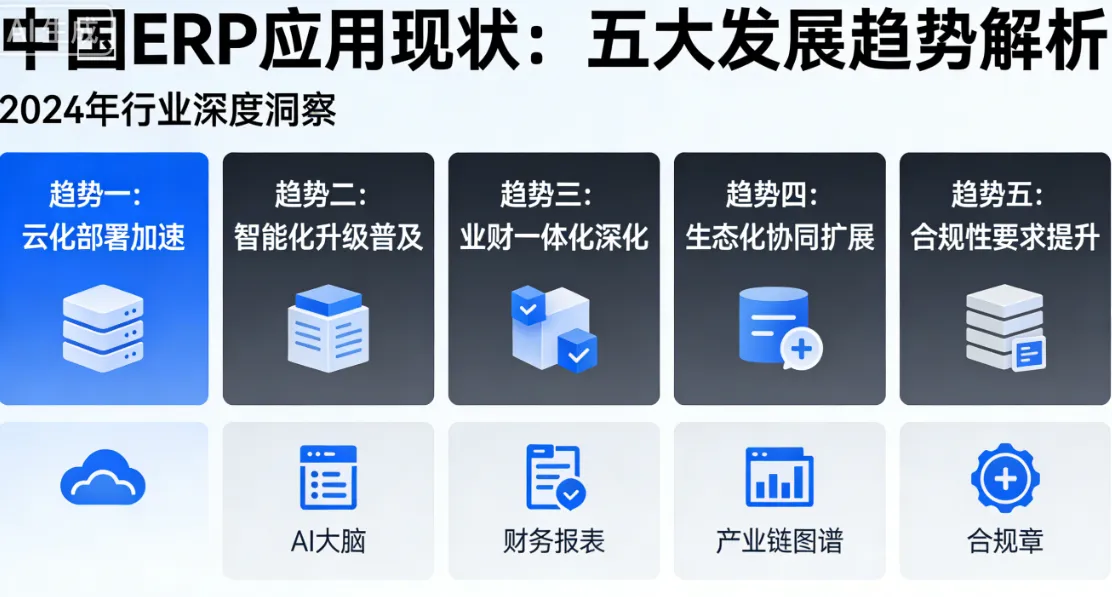
Trend 3: Deep integration of AI, driving the transition from process automation to decision intelligence
Artificial intelligence technologies represented by generative AI and big models are injecting "soul" into ERP, driving a qualitative change in its value. The fusion application of AI has penetrated into core business scenarios:
-
At the interactive levelNatural language dialogue interfaces are replacing complex menu navigation. Managers can directly inquire about business status through voice or text, and the system can automatically parse, retrieve data, and generate insight reports, achieving "dialogue is analysis".
-
At the process level, AI is moving from automating the execution of preset rules to intelligent enhancement based on situational awareness. For example, the system can automatically review abnormal terms in purchase orders, predict supply chain delay risks and recommend response plans, or intelligently recommend credit terms based on customer historical behavior.
-
At the decision-making level, AI has become a powerful analytical engine. It can integrate internal and external data for sales forecasting, dynamic pricing, intelligent production scheduling, and risk simulation, upgrading managers' decision-making from "experience driven" to "data and model assisted intelligent driven".
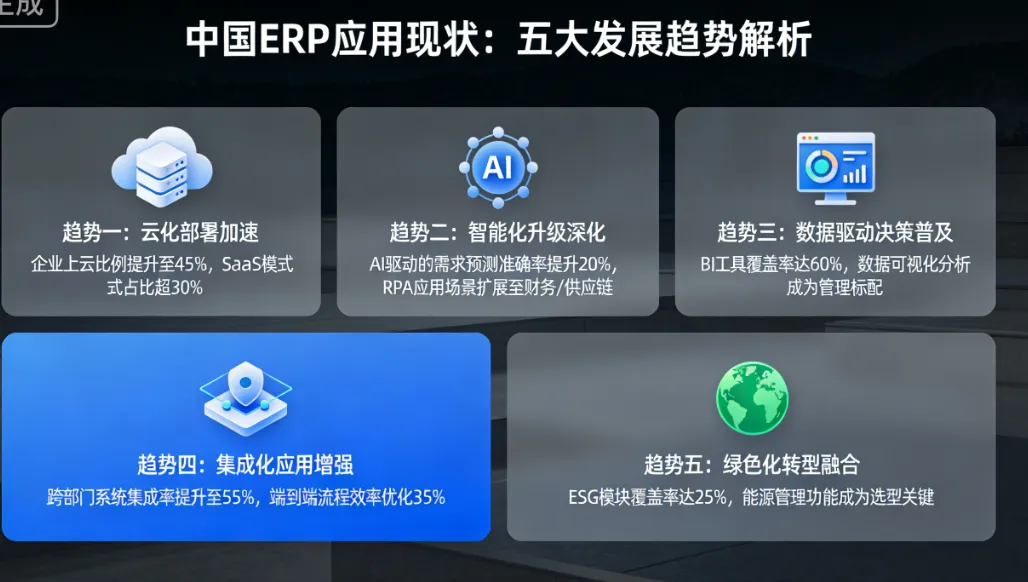
Trend 4: Deep cultivation in vertical industries, solutions move from "universal" to "precise"
With the popularization of applications, enterprises' expectations for the value of ERP are no longer satisfied with the online process, but require it to directly solve the core pain points unique to the industry. Therefore,Industrialization and scenarizationBecoming a critical path for deepening the application of ERP.
General purpose products are being replaced by solutions with deep industry attributes. For example, inDiscrete Manufacturing, ERP is deeply integrated with manufacturing execution systems and the Internet of Things, focusing on solving complex material integration, advanced planning and scheduling, and refined cost accounting problems; inretail industryFocus on the integration of omnichannel inventory, precise member marketing, and fast response supply chain. Service providers must encapsulate industry-specific knowledge, processes, and compliance requirements into their products, providing best practices for 'out of the box' use. This deep empowerment has transformed ERP from a management software to a "professional weapon" that enhances the core competitiveness of the industry.
Trend 5: Ecological and platformization, from internal systems to industrial collaborative hubs
The leading ERP system is actively breaking through the boundaries of enterprises, evolving from an internal management "walled garden" to connecting upstream and downstream partnersIndustrial Collaboration PlatformThe ERP system has built a scalable digital business platform through open APIs, low code development tools, and a cloud marketplace ecosystem.
Enterprises can quickly integrate or develop applications for specific scenarios (such as supplier collaboration portals, dealer self-service, logistics tracking dashboards) based on a stable ERP core, like building blocks. More importantly, the ERP of core enterprises can securely and controllably connect and exchange data (such as inventory levels, forecast plans, production schedules) with the systems of key suppliers and distributors, thereby achieving visible and dynamic collaboration of supply and demand throughout the entire value chain. This means that the competition mode is shifting from efficiency competition among a single enterprise to one dominated by itThe overall agility and resilience of the supply chain or ecological networkThe competition.
Conclusion
In summary, the current application status of ERP in China is at a turning point from "tool popularization" to "value reshaping". Cloudization has lowered the threshold for popularization, domestication has solidified the security foundation, AI has injected intelligent cores, industrialization has deepened application value, and platformization has expanded the ecological extension. These five trends are not evolving in isolation, but rather promoting and integrating with each other, jointly driving the evolution of ERP systems towards a more agile, intelligent, open, and integrated "enterprise digital core".
For enterprises, choosing and deploying ERP is no longer just an IT procurement, but a strategic decision related to future digital competitiveness. The key to success lies in choosing a platform and partner that can provide stable and reliable core capabilities, open integration, continuous evolution, and deeply understand the pain points of the industry guided by a clear digital strategy. In this data-driven new business era, ERP, as a key digital foundation, its depth and breadth will directly determine the level of intelligence and collaboration that enterprises can reach.