
Case Analysis of Successful Implementation of ERP System: Experience Summary and Key Factors of 7 Major Enterprises
In today's era where digital transformation has become a core strategy, the successful implementation of ERP systems has become the cornerstone for enterprises to build modern operational management systems. However, the road to success is not smooth, it is a profound transformation involving strategy, technology, processes, and organization. By analyzing the practices of seven industry leaders, namely Huawei, Haier, JD.com, Baosteel, Lenovo, Midea Group, and Sany Heavy Industry, we can go beyond specific technical details and extract successful experiences and key driving factors with universal guiding significance. They represent excellent practices in different industries (manufacturing, retail, technology), starting points (independent development, global mergers and acquisitions, domestic substitution), and modes (group control, ecological platform, global collaboration), jointly outlining a strategic map to success.
Seven paths, one goal: panoramic scanning of core experience
| enterprise | Industry and Core Challenges | ERP Implementation Strategy Focus | Iconic achievements and essence of experience |
|---|---|---|---|
| Huawei | Global ICT giants face control failures amidst rapid expansion | Integrated Financial Services TransformationUnified global financial language and processes, building a 'digital neural network'. | Global report time ranges from day to hour.Experience:Using ERP as a strategic infrastructure to solidify global best practices and support refined management at a scale of billions, rather than an IT project. |
| Haier | Consumer goods manufacturing, bureaucratic barriers to innovation | RenDanHeYi "Empowerment PlatformRefactoring ERP from a control tool to an ecological soil that supports thousands of small and micro enterprises to start their own businesses. | Realize the transformation from "producing for inventory" to "creating for users".Experience:When an organization splits into a network, ERP must evolve from a "control center" to an "empowerment platform", and its logic needs to be isomorphic to the philosophy of organizational change. |
| JD.com | Retail and Logistics, Ultimate Supply Chain Challenge | Self developed intelligent supply chain hubDeep customization, building a native system with technology as the core competitiveness. | Support millions of SKU management and "same day delivery" fulfillment.Experience:When the business model is driven by technology, the deep self-developed and independently controllable core operating system is the construction of an irreplaceable moat. |
| Baosteel | Steel process manufacturing leads to a disconnect between production, supply, and sales | Deep integration of production and sales integrationRealize the three-level integration of ERP/MES/PCS, allowing orders to be directly delivered to the unit. | Realize flexible manufacturing from large-scale production to personalized orders.Experience:In the process industry, the success of ERP depends on its ability to deeply integrate with production equipment and process knowledge, and is a model of the integration of industrialization and informatization. |
| Lenovo | Global technology manufacturing, system silos after mergers and acquisitions | Global template integrationEstablish a unified platform to achieve dynamic global resource scheduling and risk hedging. | Establish a globally unified business process and decision-making view.Experience:For global corporations, the core value of ERP lies in establishing a standardized 'operational syntax' to support optimal resource allocation and agile collaboration across regions and cultures. |
| Midea Group | Diversified manufacturing, collaborative dilemma under the business unit system | 632 Strategy and Unified Platform for the Entire GroupVigorously promote the standardization of processes, data, and systems, and break down internal barriers. | Achieving a qualitative leap in operational efficiency, data transparency, and group control.Experience:In diversified enterprises, successful ERP implementation requires strong top-level will to promote process standardization with the determination of "scraping bones to heal wounds", laying the foundation for subsequent digital transformation. |
| Sany Heavy Industry | Equipment manufacturing, complex services, and mass customization | End to end full process connectivityFrom intelligent research and development, flexible manufacturing to intelligent services, achieve full value chain digitization. | Significantly improve equipment utilization and customer service response efficiency.Experience:For the complex equipment industry, ERP needs to extend to both ends, deeply integrate PLM and CRM, and become the core backbone connecting product lifecycle data. |
Key factors for success: five commonalities beyond technology
Analyzing these seven cases, although the paths are different, the underlying logic of their success is highly consistent and can be summarized as five key factors that go beyond the technology itself.
Firstly, the absolute dominance of strategic foresight and leading projects.In all successful cases, ERP projects are strategic projects personally led and deeply involved by the "first person". Huawei's transformation was personally driven by Ren Zhengfei, while Midea's "632" was strongly promoted by the top management of the group. This ensures that the project has the authority to cross departmental barriers, continuous resource investment, and the ability to translate business strategies into system design. The success of ERP is first and foremost the strategic determination and transformational leadership of the top management of the enterprise.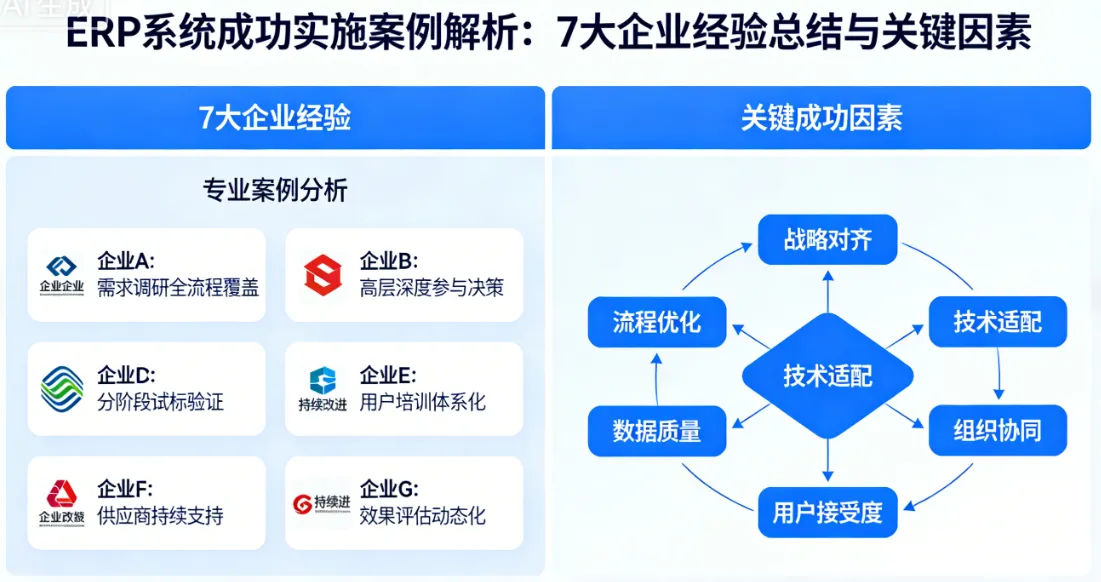
Secondly, process reengineering precedes technological implementation and deeply adapts to the essence of the business.No enterprise simply digitizes old processes. They all took advantage of the implementation of ERP to fundamentally reflect on and redesign their core business processes (BPR). Whether it is Huawei's global financial process, Haier's decentralized process, or Baosteel's integrated production and sales process, their system design is deeply rooted in and strengthens the unique business model and core competitiveness of the enterprise. The system is the carrier of excellent processes, not the other way around.
Thirdly, the synchronous evolution of organizational change and talent culture.ERP changes people's work methods, power structures, and information acquisition capabilities. Successful implementation is accompanied by profound organizational change management. This includes: establishing a strong dedicated project team (integrating business and IT); Deeply empower key users to become drivers of change; Design a thorough training and communication plan to resolve resistance. Haier's organizational miniaturization and Lenovo's cultural integration are both organizational reshapes that are synchronized with system implementation.
Fourthly, the prudent selection and sustained investment of technological routes.Enterprises have made different technological choices based on their own genes: JD.com has taken the path of deep self research, Huawei and Lenovo have introduced international top products and highly customized them, and Midea and Sany have promoted a unified platform for the entire group. Regardless of the route, the commonality is that technical decisions closely serve business strategy and establish strong internal teams or partnerships to ensure the long-term evolution, integration, and operation of the system. Effective management of technical debt.
Fifth, a long-term mechanism for data governance and continuous optimization.Successful companies consider data as their core asset. They attach great importance to the unity and standardization of master data (materials, customers, suppliers) in the early stages of the project, and establish a continuous data governance system. The launch of the system is seen as the starting point, not the end point. They are based on the data generated by the system, continuously optimizing business processes, analyzing performance, and innovating management, making ERP a "living system" that can continuously learn and evolve, and continuously releasing value.
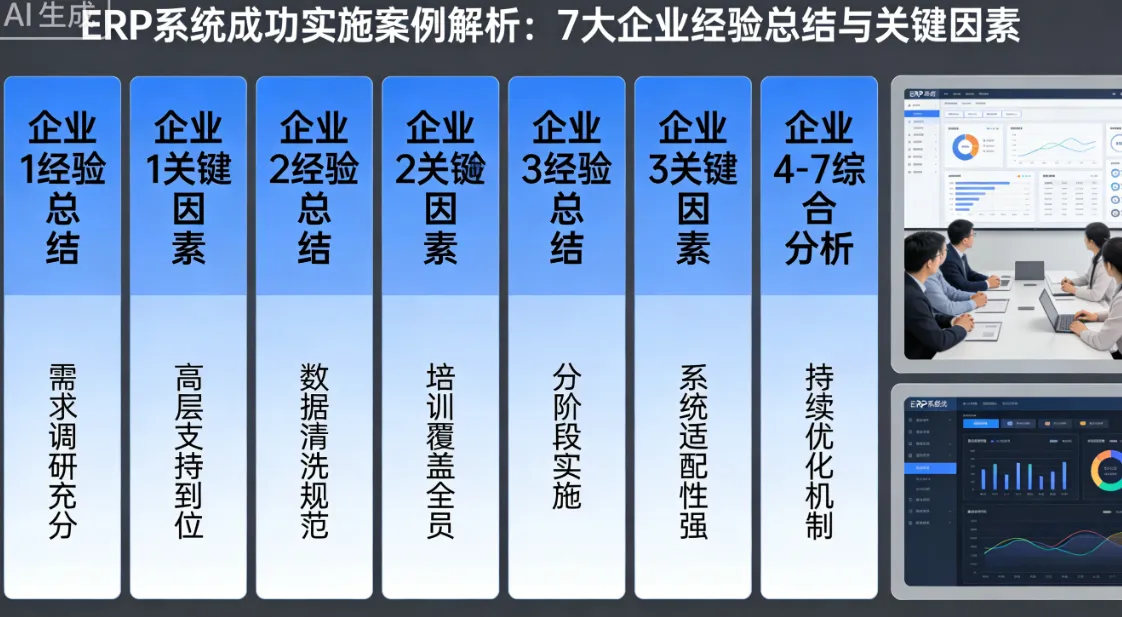
Inspiration: From 'Successful Implementation' to 'Sustainable Value'
The practices of these seven major enterprises collectively reveal that the success of ERP systems is essentially a process ofStrategic leadership, core processes, technological empowerment, organizational adaptationA systematic victory. It does not have a universal template, but the core logic of its success is interconnected. For newcomers, the biggest lesson is that we should not only focus on software functionality and supplier selection, but also return to the enterprise itself. First, we should think clearly: What is our strategic goal? What core processes do we need to reshape? Is our organization ready to embrace this change? Only by placing ERP implementation within the grand narrative of the overall transformation of the enterprise, with business value as the sole criterion, can we navigate this complex transformation and transform ERP from an expensive IT investment into a core digital engine driving sustained growth and innovation for the enterprise in the future.