
Shoe and Clothing ERP Mobile Development: Framework Selection, Technical Solution, and Interface Design Analysis
In the footwear and apparel industry, the speed of decision-making and the accessibility of information are directly related to inventory turnover and market response. Traditional PC ERP, as a stable backend brain, is breaking its capability boundaries, and mobile development has become an inevitable choice to extend core business capabilities to stores, warehouses, and decision-makers' fingertips. This process is not just a simple interface migration, but a deep reconstruction that requires precise matching of industry-specific business scenarios, strict performance requirements, and complex operating environments. It is a deep integration of technical rationality and business intuition.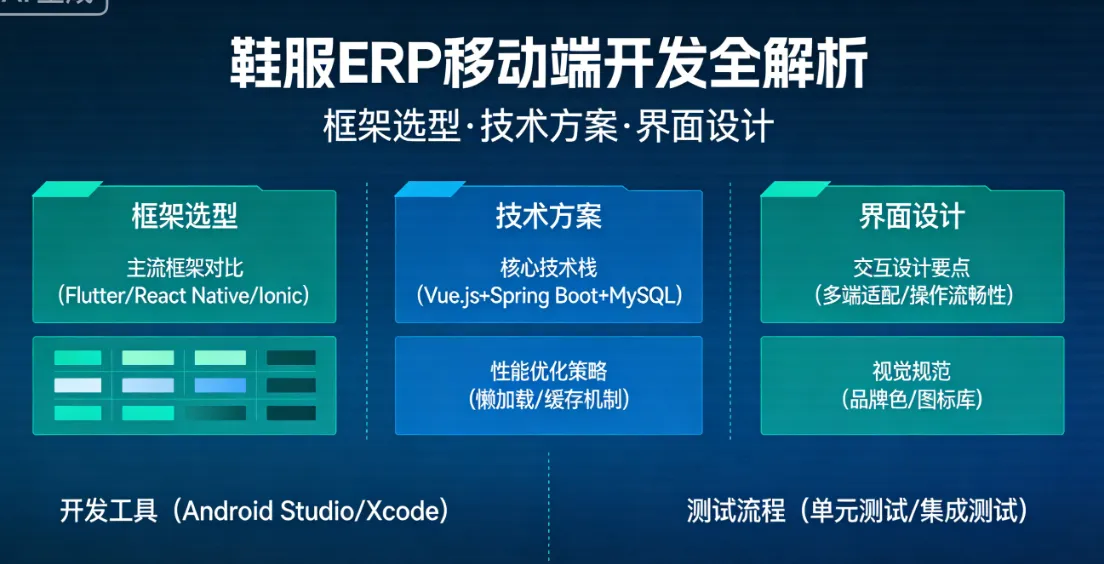
Scenario definition: Understanding the essence of mobile first business
The mobile demand of the footwear and apparel industry is rooted in its dynamic business environment. Store guides need to face customers to instantly query omnichannel inventory and membership information; Warehouse administrators rely on handheld terminals to complete high-speed and accurate scanning, receiving, and picking of goods in noisy environments; When the regional manager inspects the store, they need to upload display photos synchronously and issue rectification instructions; The management expects to control global performance and risk warnings through clear data dashboards during the fragmented time of the journey. These scenarios collectively outline the rigid requirements for mobile development: strong dependence on offline operations, deep invocation of hardware capabilities (such as high-precision scanning and image capture), stringent requirements for real-time data synchronization, and ultimate pursuit of interface interaction efficiency. Any technical decision must first respond to these business voices.
Framework selection: Finding a balance between efficiency, ecology, and cost
Faced with numerous technological paths, the selection decision is actually a technical projection of business strategy. The native development path can provide unparalleled performance and hardware access depth, especially suitable for building high-strength, high complexity core production tools, such as deep customization applications for large-scale warehouse management and integrated with professional Bluetooth scanning engines. However, its high development and maintenance costs, as well as long iteration cycles, are also realities that must be balanced.
Cross platform frameworks such as React Native or Flutter achieve a significant balance between development efficiency, performance experience, and future maintenance costs by covering both the iOS and Android ecosystems with a single set of code. They can provide a nearly native smooth experience while significantly accelerating feature iteration, making them particularly suitable for building comprehensive mobile workbenches that meet the complex needs of multi role users from store managers to buyers. For footwear and apparel companies, this is often a rational choice that balances quality and efficiency.
Mini programs or lightweight applications, with their ready to use and portable features within super applications, have become powerful tools for connecting ecosystem partners with lightweight users. The ideal application scenarios for it are an ordering tool for dealers, a membership service for consumers, or a quick inventory tool for guides. It extends the capability boundaries of ERP in a low-cost and high reach manner.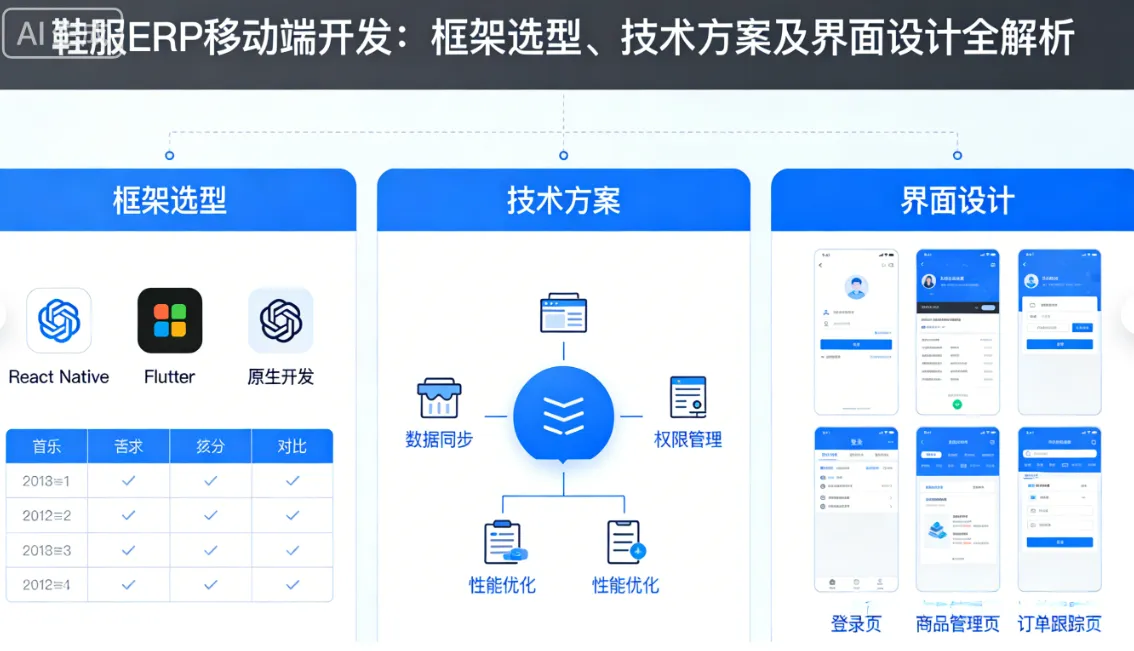
Technical architecture: Building a solid, agile, and secure digital foundation
Once the development framework is established, it is even more necessary to build a technical foundation that can support complex businesses, cope with network fluctuations, and ensure data security. The core of architecture lies in clear separation and efficient dialogue between the front-end and back-end. The backend needs to provide a set of elegantly designed and stable API interfaces that comply with RESTful and other standards, and are optimized specifically for the characteristics of mobile networks, such as using data differential updates, request merging, and other technologies to minimize traffic consumption and waiting delays.
The construction of offline capabilities is the lifeline of mobile availability. A robust mechanism for local queue and incremental synchronization is crucial. The operations of users in blind spots or areas with poor signal in the warehouse network should be securely and reliably stored locally, and automatically and orderly synchronized to the cloud server after the network is restored. At the same time, based on the user's role and permissions, intelligent preloading of key master data and business benchmark information ensures that core business can continue to operate in any environment.
In terms of performance and security, a multi pronged approach is needed. In terms of performance, attention should be paid to lazy loading and adaptive compression of images, virtual scrolling technology for long lists, and the use of native modules to accelerate core operations such as scanning. In terms of security, it is necessary to implement transmission encryption, local sensitive data encryption, token based authentication and dynamic refresh mechanism, as well as strict device and access permission binding, to build an end-to-end security defense line.
Interface and Experience: A Design Philosophy Born for Efficiency
The interface design of the shoe and clothing mobile ERP should adhere to the highest principle of improving the operational efficiency and decision-making speed of frontline personnel, and aesthetics should serve clear business purposes. The information architecture must be extremely flat and direct, placing the high-frequency core modules such as "goods", "inventory", "tasks", and "my workbench" in the most prominent positions to ensure that core operations can be completed with the least number of steps.
Visual presentation requires a high degree of dataization and contextualization. The interface should extensively use cards and charts to visually display key information, such as product cards that need to present inventory status, size distribution, main visual images, and core attributes. More importantly, the homepage and core interface should be dynamically intelligent, customizing information flow according to different roles - store managers see real-time sales dashboards and pending tasks, while warehouse managers face today's picking lists and inventory plans.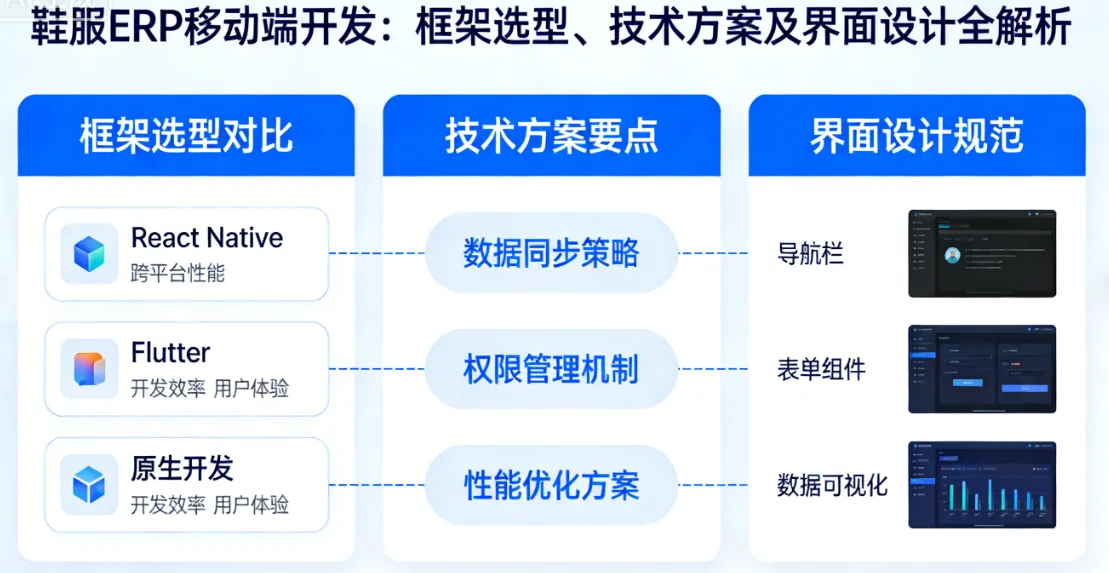
Interactive logic should fully utilize the characteristics of mobile devices, advocating gesture operations and batch processing. Support left scrolling on the product list for quick inventory or transfer, and enable one click completion of batch inbound and outbound operations after selecting multiple products. In the scanning scene, the application should automatically focus and recognize after starting the camera, simplifying the operation to "align and complete". The search function needs to be powerful enough to support multi-dimensional filtering, voice input, QR code search, and intelligent error correction, becoming a powerful tool for instantly locating targets in thousands of SKUs.
In summary, the success of the shoe and clothing ERP mobile end stems from a profound insight into the "mobile first" business scenario, a careful balance in the technical path and a solid construction in the architecture, ultimately condensed into every interaction detail polished to improve efficiency. It should not be a shrunken version or accessory of the backend system, but a new digital organ born in mobile, specialized in business, and truly empowering the front line. It is a key bridge to transform the core digital capabilities of enterprises into terminal competitive advantages.