
Analysis of Successful ERP Implementation Cases: Huawei/Haier/JD Digital Transformation Experience Sharing
When exploring the grand narrative of enterprise digital transformation, the practices of Huawei, Haier, and JD.com, the three leading Chinese companies, provide three distinct yet equally profound examples. They go beyond the conventional understanding of enterprise resource planning systems as "management software" and reshape them as the core engine driving strategic change. Its successful experience reveals a core law: the value of ERP does not depend on the advancement of the technology itself, but on its ability to deeply engage and shape the unique business model, organizational genes, and strategic ambitions of the enterprise.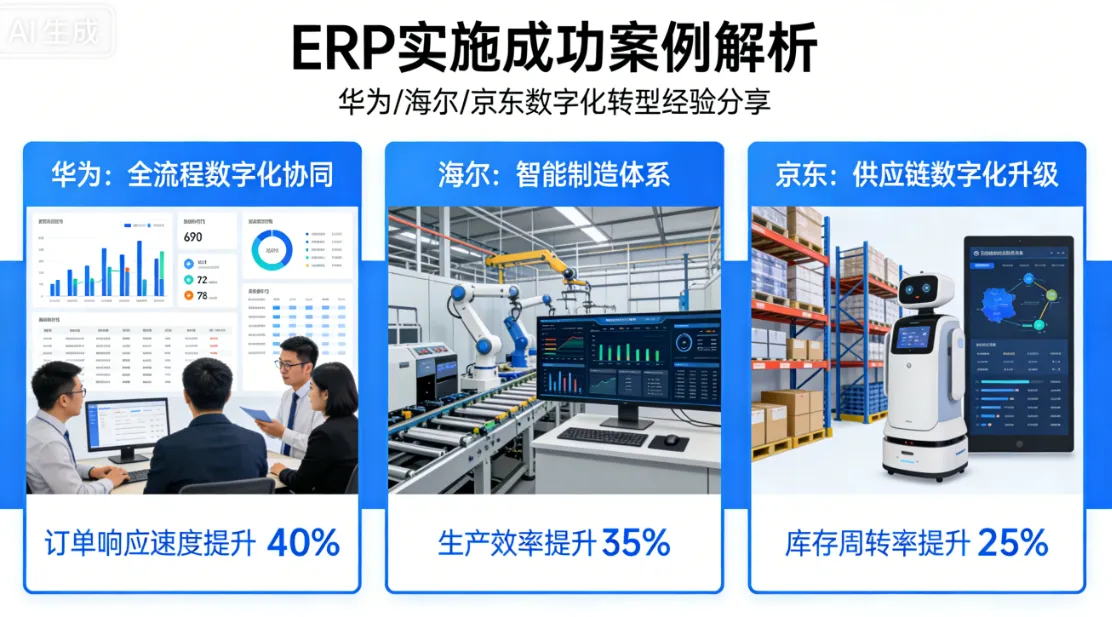
Huawei: Building a globally unified control 'digital nervous system'
Huawei's ERP implementation (with its core being integrated financial services projects) is a classic case of building a precise "digital nervous system" for a behemoth in the midst of globalization. The core challenge is not technology, but how to ensure the unity of global financial language, transparency and controllability of operations, and effective allocation of resources in the context of rapid business expansion and complex organizational structure.
Huawei's path isThorough process reengineering and global standardizationBy collaborating with IBM, Huawei sees ERP as a vehicle for solidifying global best management practices, rather than simply a technical tool. The project has restructured core business processes such as "opportunity point to contract" and "procurement to payment", achieving a globally unified accounting subject, process, and IT platform. The fundamental transformation brought about by this is the integration of previously scattered and fragmented financial data into a real-time and transparent global management view. The financial statement release time has been shortened from days to hours, enabling this global giant to conduct refined management, risk prevention, and strategic decision-making like commanding a whole. The core of its experience is that when enterprises move towards globalization, the primary mission of ERP is to build a set ofA 'universal language' and control foundation that transcends cultural differences and supports efficient collaboration。
Haier: Providing an Empowering Platform for the Ecological Strategy of "RenDanHeYi"
The practice of Haier Group is a disruptive deconstruction of traditional ERP management philosophy. Faced with the management challenges of the Internet era, Haier has dismantled the traditional bureaucratic organization and transformed into a networked ecosystem composed of thousands of self operating, self financing "microenterprises". At this point, the traditional ERP system aimed at centralized control is completely malfunctioning.
Haier's innovation lies in transforming ERP fromRedefine centralized control tools as distributed empowerment platformsThis platform no longer pursues a uniform process, but is committed to providing support for every entrepreneurial small and micro enterprise. The system provides a digital "soil" and "water, electricity, and coal" for small and micro teams to connect with user needs, calculate operating profits and losses, and allocate global R&D and manufacturing resources. For example, a product idea driven by user needs can quickly find design resources, module suppliers, and production lines through the platform, achieving rapid conversion from idea to product. Haier's ERP has therefore become the digital twin of its "RenDanHeYi" model, and its success has proved that when an enterprise undergoes profound organizational fission and ecological transformation, ERP must evolve from "control center" toA collaborative network that supports self-organization, self driven innovation, and value co creation 。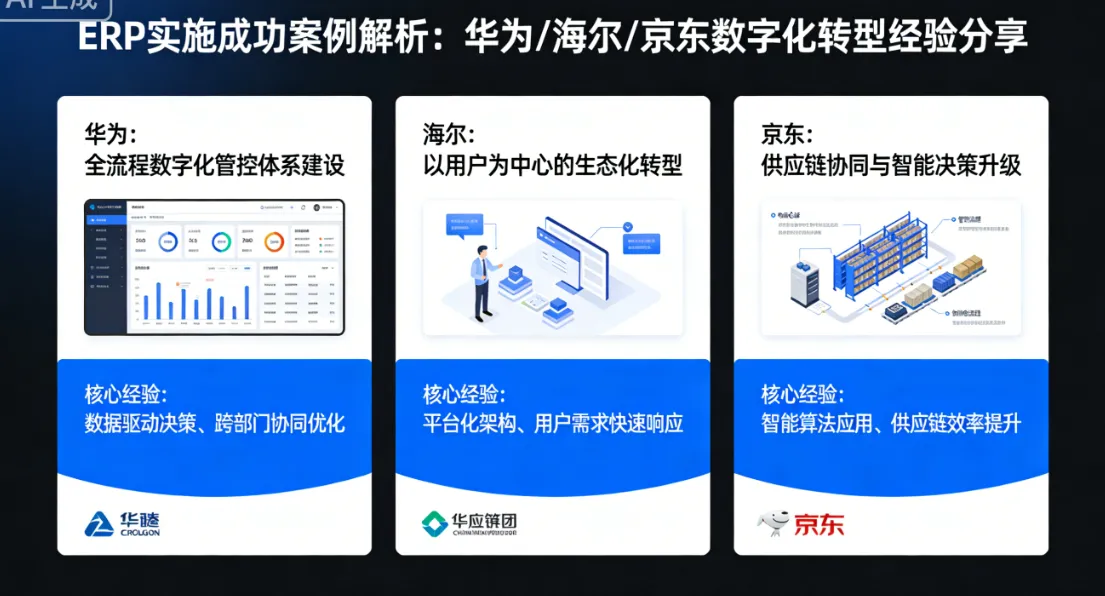
JD: Integration of self-developed technology system and business model
Unlike Huawei and Haier, JD.com, as a technology driven retail infrastructure service provider, faces extreme scenarios that traditional commercial ERP software cannot handle: real-time processing of tens of millions of orders per day, precise management of tens of millions of SKUs, and the ultimate fulfillment experience of "same day delivery". Therefore, JD.com has embarked on a unique path:Build a technology system that is seamlessly integrated with the business model, with deep self-developed as the core。
JD's "ERP" is essentially an "intelligent supply chain super brain" that deeply integrates big data, artificial intelligence, and the Internet of Things. This system is tailor-made for JD's business model from the bottom, achieving full chain automation decision-making from consumer ordering, warehouse robot picking, delivery path optimization to intelligent demand prediction. For example, its intelligent inventory system can deploy goods in advance in the warehouse closest to potential consumers based on complex algorithms. Here, the system is the business, and the business is the system. The case of JD profoundly reveals that in the field of Internet and digital economy,The independent controllability and deep customization of the core operating system are the key to building a business model moat and achieving maintenance reduction strikesIt cannot be achieved through the procurement of standardized products and must rely on endogenous technical capabilities and continuous closed-loop iteration of business scenarios.
Common Inspiration: Strategic and Organizational Wisdom Beyond Technology
Despite the different paths, the success of the three major cases contains a common underlying logic:
-
Top level strategic driveAll projects are top-level projects that serve the profound transformation of the company's highest strategy, rather than isolated tasks of the technical department.
-
Process change takes the leadThe prerequisite for success is to use the opportunity of ERP to fundamentally reflect on and reshape unreasonable business processes. The system is just a tool to solidify and enable excellent processes.
-
Organizational Adaptation and Cultural TransformationWhether it is Huawei's standardization, Haier's platformization, or JD's self-developed, they are all accompanied by corresponding organizational structure adjustments and cultural changes. Without organized synchronous evolution, technology is difficult to realize its value.
-
Continuous iterative evolutionERP is not a one-time project, but a living organism that needs to evolve and expand along with enterprise strategy and business models.
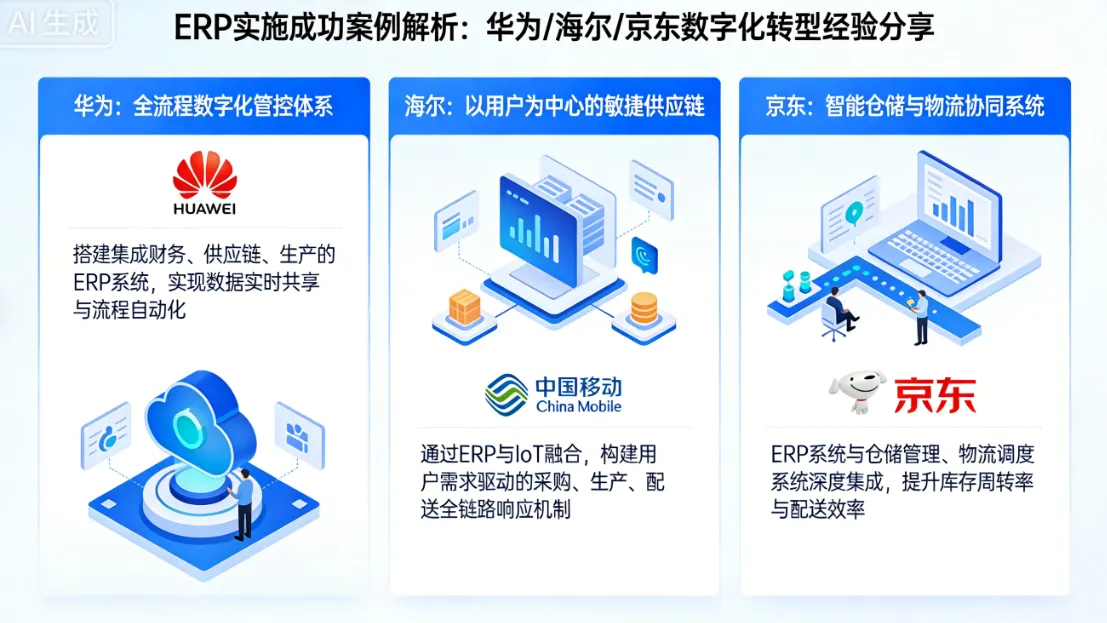
ConclusionThe practices of Huawei, Haier, and JD.com have jointly drawn a panoramic picture of the transformation from "business digitization" to "digital business". They represent three typical paradigms: global operation, ecological reconstruction, and technology native. Their experience shows that in the deep waters of digital transformation, there is no standard answer to successful ERP implementation. Enterprises must return to their own business essence and conduct a profound self-examination: like Huawei, using ERP to create a globally unified "digital main road"; Like Haier, turn it into an "ecological rainforest" that nourishes internal entrepreneurship; Or is it like JD, forging it into a "technological heavyweight" with core competitiveness? Only by elevating the deployment of ERP to a systematic revolution that matches its unique strategy, runs through technology, processes, and organization, can it truly become the intelligent engine driving enterprises towards the future.