
Footwear ERP Data Governance and Privacy Protection Strategy | Compliance and Security Practices in Digital Transformation
In the process of digital transformation in the footwear industry, ERP systems converge panoramic data assets from consumer preferences, design drawings, supply chain graphs to financial records. These data not only drive intelligent decision-making and enable precise operations, but also constitute unprecedented risk exposure for enterprises - poor data quality can lead to decision-making failure, while privacy breaches or compliance violations may trigger huge fines, reputation collapse, and customer loss. Therefore, building a data governance and privacy protection system that is deeply integrated with the business, with compliance as the bottom line and security as the barrier is no longer an IT auxiliary function, but a strategic cornerstone to ensure the sustainability and trustworthiness of digital transformation results.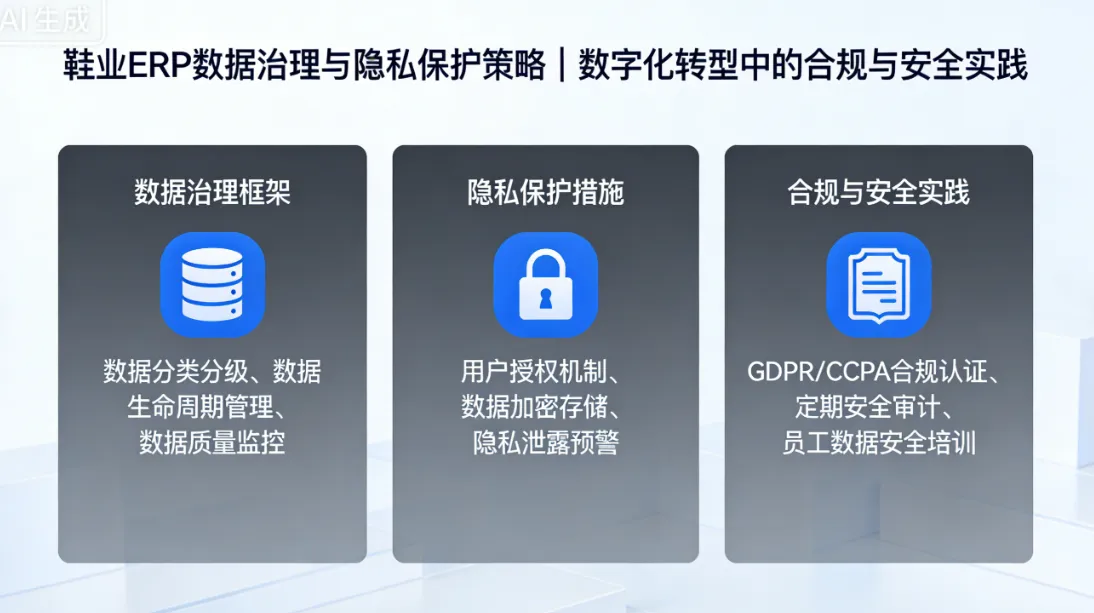
Core Challenge: The Unique Value and Governance Dilemma of Footwear Data
The complexity of data governance in the footwear industry is rooted in its business nature. First,The data dimensions are extremely complex and closely relatedBehind a shoe, there are hundreds of material attributes, global multi-level supplier information, cross channel sales records, and a massive amount of personal information such as consumer foot shapes and preferences. These data are scattered across multiple isolated systems such as design, procurement, production, logistics, and marketing, with varying standards, making it difficult to form a unified 'digital twin of goods'. Secondly,Data flow crosses regulatory boundariesShoe companies often layout their global markets, with designs possibly in Italy, production in Vietnam, and sales spread all over the world. This makes cross-border transmission of data, especially consumer personal information, subject to strict regulations from multiple jurisdictions such as the EU's General Data Protection Regulation and China's Personal Information Protection Law. Finally,The value and risk of data coexistThe purchasing history and body shape data of members are treasures of precision marketing and product innovation, but once leaked or abused, they directly violate the legal red line. The traditional, passive, and IT centric local governance model is no longer able to address these systemic challenges.
Governance framework: Building a value oriented collaborative defense system
An effective strategy must establish a comprehensive framework from organization, system to technical tools, the core of which isGovernance drives protection, compliance empowers business。
Firstly, establish top-level governance organization and data rights and responsibilitiesIt is necessary to establish a leadership team led by senior management (such as the Chief Data Officer or Chief Risk Officer), covering legal, compliance IT、 The core business departments (such as e-commerce, membership center, supply chain)Data Governance CommitteeIts core responsibility is to develop enterprise level data strategies, clarify the "owners" of various types of data (such as product data belonging to the design/product department, consumer data belonging to the member center), and give them the authority to define data standards, quality rules, and access permissions. This is a crucial step in pushing data management from the technical backend to the business frontend.
Secondly, implement precise governance throughout the entire lifecycle of dataThis requires embedding control rules for every step of data creation, storage, usage, sharing, archiving, and destruction.
-
On the creation and collection endPromoteMetadata driven master data managementDefine unique and authoritative business attributes and coding standards for all core entities (such as materials, suppliers, customers), and ensure mandatory implementation at the ERP source. The collection of consumer personal information must comply withThe principle of "minimum necessity" and "informed consent"Clearly inform the collection purpose and obtain separate authorization in the front-end of ERP integration (such as store POS, mini program).
-
At the end of use and processingEstablishClassification and Dynamic Desensitization MechanismClassify and label based on data sensitivity (such as general business information, core process formulas, personal biometric information). When different roles access, the system automatically implements a strategy: R&D personnel can view complete process parameters, while outsourced factory personnel can only view partial process requirements related to their production; When data analysts conduct market research, they see anonymized consumption records that have been desensitized.
-
On the sharing and transmission endEspecially in cross-border scenarios, deployment is requiredCompliance Channel and Security AuditFor the transmission of data containing personal information to overseas parent companies or cloud service providers, security assessments must be completed or standard contract terms must be signed in accordance with the law. All data exports and API calls must have detailed log records that can be traced back to specific personnel and purposes, ensuring that 'data is safe and accountable'.

Privacy Protection Practice: Embedding Compliance Requirements into Business Processes
Privacy protection cannot be a post remedy for the legal department, but must be deeply embedded as a prerequisite in the design of core business processes based on ERP.
-
Membership and Marketing Management ProcessERP and associated CRM systems should be implementedFull view management of personal informationThe system should be able to clearly record the source of each consumer information (when, where, and how they agreed to collect it) and support their lawful exerciseConsultation, correction, deletion, and withdrawal of consentWaiting for rights. When consumers request to delete their accounts, the system should be able to automatically trigger cleaning tasks in multiple associated databases such as orders, customer service, and marketing to ensure complete deletion.
-
Supply chain collaboration processWhen sharing data with suppliers and logistics providers through the ERP portal, it is necessary to executeMinimize permissionsprinciple. By binding electronic contracts with system permissions, suppliers can only access data directly related to their fulfillment of orders (such as specifications, quantities, and delivery dates of required materials), and cannot see information about other suppliers, the overall cost structure of the enterprise, or unpublished product designs.
-
Data Analysis and Innovation ProcessPrioritize using ERP data to train AI models or conduct big data analysisPrivacy Enhancement TechnologyFor example, using federated learning techniques to analyze sales trends across regions without centralizing raw data; Using differential privacy technology to ensure that no individual consumer information can be inferred when publishing macro statistical reports.
Technology Empowerment and Continuous Evolution
The implementation of the above strategies requires strong technical platform support. Modern cloud ERP should provide fine-grainedIdentity recognition and access managementUnified data encryption services (including static encryption and transmission encryption), as well as completeUser behavior audit logAt the same time, a dedicated data security governance platform can be introduced to automatically scan and discover sensitive data, continuously monitor abnormal data flow, and automate the execution of some compliance policies.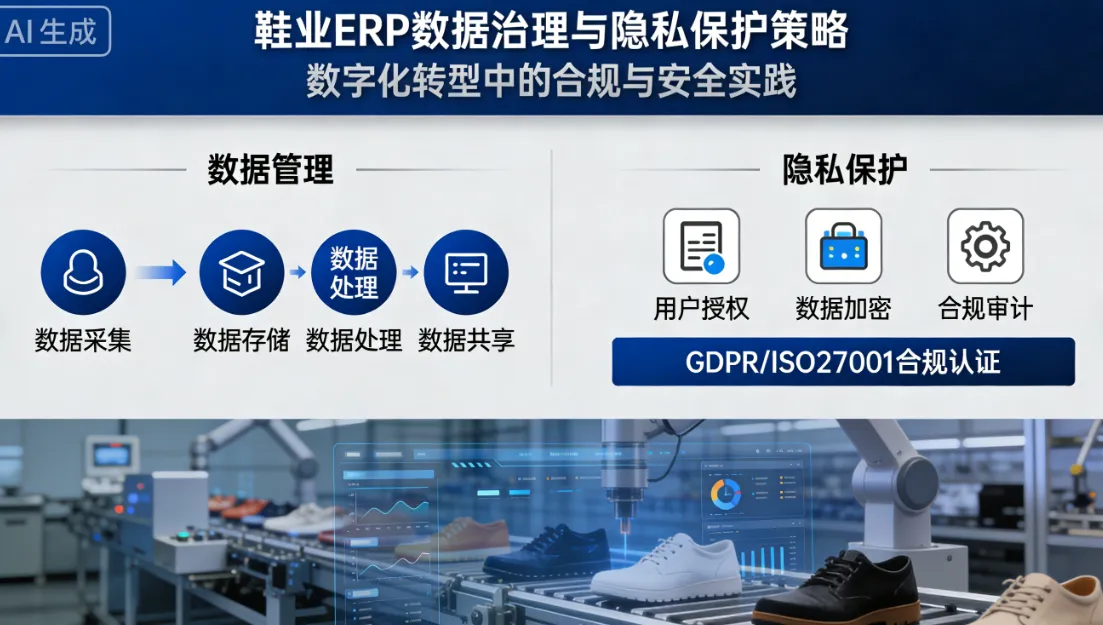
Ultimately, successful governance and protection are a continuous art of balancing safety and agilityIt establishes clear data rules and secure barriers precisely to enable data to flow more freely and efficiently in a controlled and trustworthy environment, thereby unleashing its maximum commercial value. For shoe companies aspiring for the future, elevating data governance and privacy protection to a strategic level is not only to avoid risks, but also to build the most precious asset of the digital age——customer trust, as well as sustainable intelligent operation capabilities based on high-quality data-driven approaches. This marks the digital maturity of the enterprise, officially entering a new stage of responsible and trustworthy digital civilization from the technology application stage.