
DeepSeek Reshaps New Landscape of ERP Market: Technological Innovation and Industrial Integration Accelerate
In the wave of digital transformation, the enterprise resource planning market is undergoing a structural change driven by underlying artificial intelligence technology. The new generation of big model technology represented by DeepSeek is penetrating the functional boundaries of traditional ERP systems with its excellent code generation, natural language understanding, and complex reasoning capabilities, fundamentally changing the way products are built, delivered, and value logic. This transformation is not only about technological upgrading, but also a profound oneIndustrial order restructuring and ecological integrationThis indicates that the ERP market will move from "software tool competition" to a new era of "intelligent capability competition".
Technological Innovation: Refactoring the Value Core of ERP System
The core breakthrough of DeepSeek technology lies in transforming the business logic and process knowledge that was originally highly dependent on professional development and solidified in code into "intelligent services" that can be interacted with, dynamically generated, and continuously optimized by natural language. This has brought about fundamental reshaping on three levels:
First,Revolutionary shift in development paradigmThe high cost and long cycle of customized development of traditional ERP have become the main obstacles to the deep digitization of small and medium-sized enterprises. And intelligent development assistants based on large models can understand business requirement descriptions, automatically generate high-quality business logic code, database query statements, and even interface components. For example, when a company needs to customize a module for a unique material approval process, the system can understand the rules through dialogue and quickly generate a functional prototype that can run. This greatly reduces the threshold for customization, making "personalization" no longer exclusive to large enterprises, and promoting the evolution of ERP applications from "standardized products" to "modular solutions". Fangtian Software, based on DeepSeek's "Hui'er" AI product, can quickly generate accurate process card standard working hours, which is the specific practice of this paradigm in the production and manufacturing process.
Secondly,Product interaction and user experience are redefinedThe complex and rigid menu and form interfaces of traditional ERP are being replaced by natural language conversational "business assistants". Users can complete complex operations such as data queries, report generation, and process initiation through questioning and dialogue. For example, the CFO only needs to ask: 'Compare the input-output ratio of marketing expenses in each region for this quarter', and the system can automatically associate relevant data to generate multidimensional analysis charts and insight summaries. This transformation has transformed ERP from a specialized tool that requires specialized training to a decision-making partner within reach of ordinary business personnel, significantly increasing the system's penetration rate and data utilization.
Finally,The core of the system shifts from "process recording" to "decision optimization"Traditional ERP is good at recording 'what happened', while intelligent empowered ERP can answer 'why it happened' and 'how to act'. By deeply analyzing internal and external data, the system can predict supply chain risks, intelligently schedule production resources, dynamically optimize inventory levels, and even automatically execute some routine operational decisions. This marks the upgrade of the value focus of ERP from "improving process efficiency" to "enhancing business insights and decision-making agility", becoming the true "digital brain" of enterprises.
Industrial Integration: Creating a New Competitive Ecology and Collaborative Network
Technological innovation will inevitably lead to the reshaping of the industrial landscape. The popularization of technologies such as DeepSeek is breaking the relatively rigid boundaries of the traditional ERP market and accelerating the formation of a new, more dynamic, and integrated industrial ecosystem.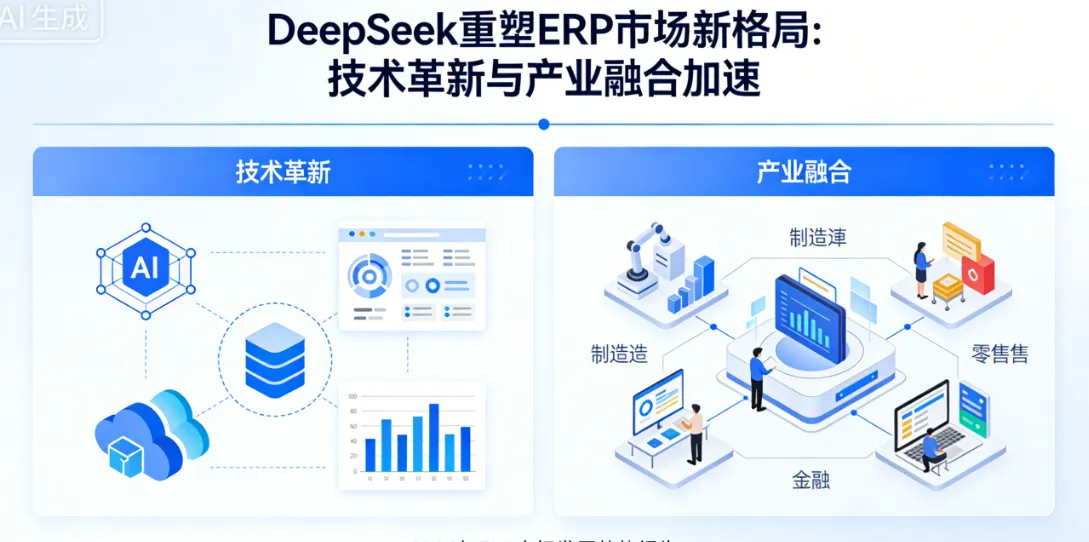
On the one hand, the roles and relationships of market participants are being restructured.
-
Traditional ERP giantsFaced with the pressure of transformation, they must quickly integrate AI capabilities deeply into their existing product lines, otherwise their complex functions and customer base accumulated over the years may be impacted by the generation gap in user experience and intelligence level. Their advantage lies in their profound industry knowledge accumulation and extensive customer implementation experience. How to combine these "tacit knowledge" with new AI technologies is the key to competition.
-
Emerging AI native companies and platformsDeepSeek's ecosystem partners, with their technological agility and deep understanding of next-generation interactions, are entering the market from the flank. They may not provide a complete ERP suite, but instead offer key AI capability components such as intelligent process generation engines and data analysis assistants, empowering traditional vendors or directly serving enterprise customers through APIs, becoming "capability providers" in the new ecosystem.
-
Industry vertical solution providerThe value is amplified. On top of general AI capabilities, the encapsulation of process, workflow, and compliance knowledge for specific industries such as footwear, machinery, and chemicals has become increasingly scarce. Manufacturers who can utilize AI technology to quickly create deep solutions for specific industries will establish strong barriers in segmented markets. Industrial integration presentsGeneral AI Capability Platform+Industry Knowledge Experts+Localized Service PartnersA new mode of collaboration.
On the other hand, the evolution path of business models has become diverse.
In addition to traditional software licenses and SaaS subscription fees,AI Capability Service Fee 、 Value sharing chargingNew business models such as dividing costs saved through intelligent optimization may emerge. The focus of services has also shifted from "system implementation and operation" toData governance, model optimization, and continuous operation of business valueExtend. What enterprises purchase is no longer just a set of software, but an "intelligent partnership" that requires continuous feeding of data, mutual growth, and iteration.
Future vision: from enterprise tools to industrial intelligent infrastructure
Looking ahead, the ultimate impact of technology driven changes such as DeepSeek may extend beyond the management scope of individual enterprises.
The ERP system that deeply integrates AI will be easier to understand and collaborate semantically with partner systems upstream and downstream of the enterprise, thus becomingKey hub of industrial InternetFor example, a brand's intelligent ERP can send structured production requests directly to the supplier's production capacity system based on market forecasts; Abnormal production scheduling from suppliers can also provide real-time feedback and trigger alternative solutions for the brand. Competition will increasingly manifest as a core enterprise intelligent ERP systemThe overall efficiency and resilience competition of "supply chain or ecological network"。
Meanwhile, open-source and open AI models are lowering the barriers to accessing advanced technologies. This may give rise to a group of highly optimized technologies based on a common technological foundation (such as DeepSeek) for different industries and scenariosOpen source ERP intelligent ecosystemFurther changing the supply structure and game rules of the market.
Conclusion:
The technological wave represented by DeepSeek is pushing the ERP market from a relatively mature "red ocean" to a "new blue ocean" full of changes and opportunities. The essence of this reshaping isDemocratization of knowledge expression and application, inclusiveness of intelligent construction and deliveryIt requires all market participants - whether traditional manufacturers, emerging forces, or businesses as users - to rethink their positioning and value creation methods with a more open attitude. For enterprises, the criteria for selecting partners will no longer only focus on the completeness of their feature list, but also on the forward-looking technology architecture, open ecology, and ability to jointly carry out intelligent innovation. A new pattern of ERP market with intelligence as the core, more dynamic integration, and more focused on continuous co creation of business value has accelerated.