
How to Implement ERP in Enterprises
The starting point of any ERP project must be a clear strategic consensus and top-level design. Enterprises must first answer the fundamental question of 'why do we need to implement ERP'. The goal should be specific business value, such as "achieving integrated financial control of the group", "shortening order delivery cycles by 30%", or "achieving real-time visibility of omnichannel inventory", rather than vague "improving management level". At this stage, the deep participation and absolute support of the top management are the "number one" guarantee for the success of the project. Their role is to break down departmental barriers, allocate key resources, and drive change.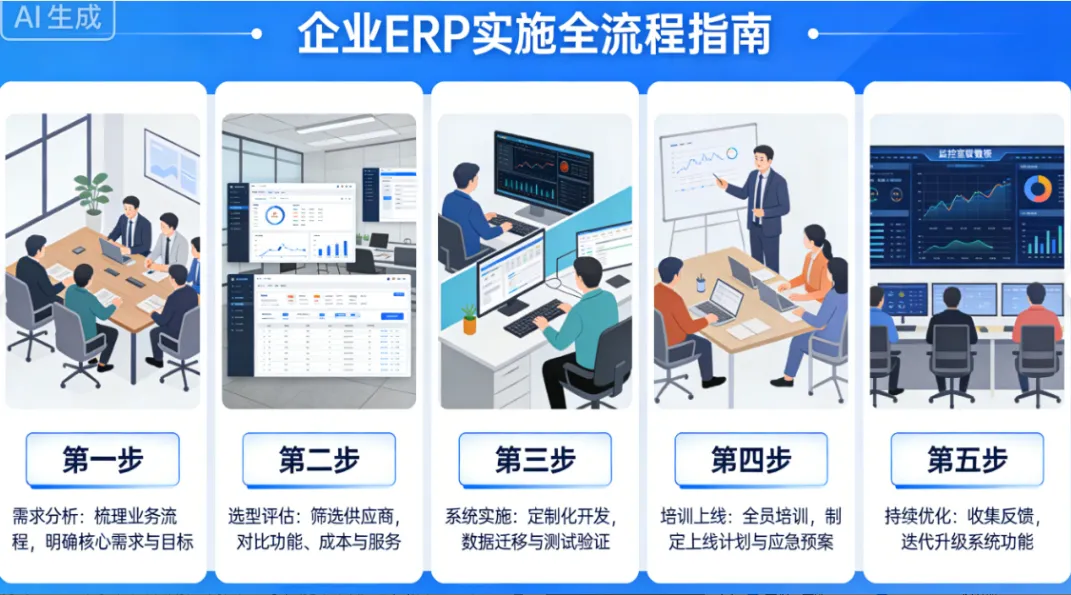
Under strategic consensus, it is crucial to establish a cross functional project core team consisting of business backbone, IT experts, and key users. Subsequently, the enterprise and implementation partners need to jointly carry out detailed current situation diagnosis and future blueprint design. This is not simply recording existing processes, but based on the best practices embedded in ERP, it applies to core business processes such as sales to collection, procurement to paymentRe examine, simplify, and optimizeThat is, business process reengineering. At the same time, standardized planning must be carried out for master data (such as materials, customers, suppliers), which is the cornerstone of future system data quality. The final implementation plan and roadmap are the guiding principles that run through the entire project, clarifying the project scope, stage goals, resource investment, and risk response strategies.
System Configuration and Data Migration: Building a Digital Foundation
Entering the construction phase, the focus is on transforming the business blueprint into a reality within the system. The implementation team will perform detailed configuration in the system to match the unique organizational structure, accounting rules, and business process parameters of the enterprise. For reasonable needs that cannot be met by standard functions, appropriate platform based customized development will be carried out, but the core principle isPrioritize adapting to the best practices of the system and cautiously conduct secondary developmentTo control long-term technological debt and upgrade costs.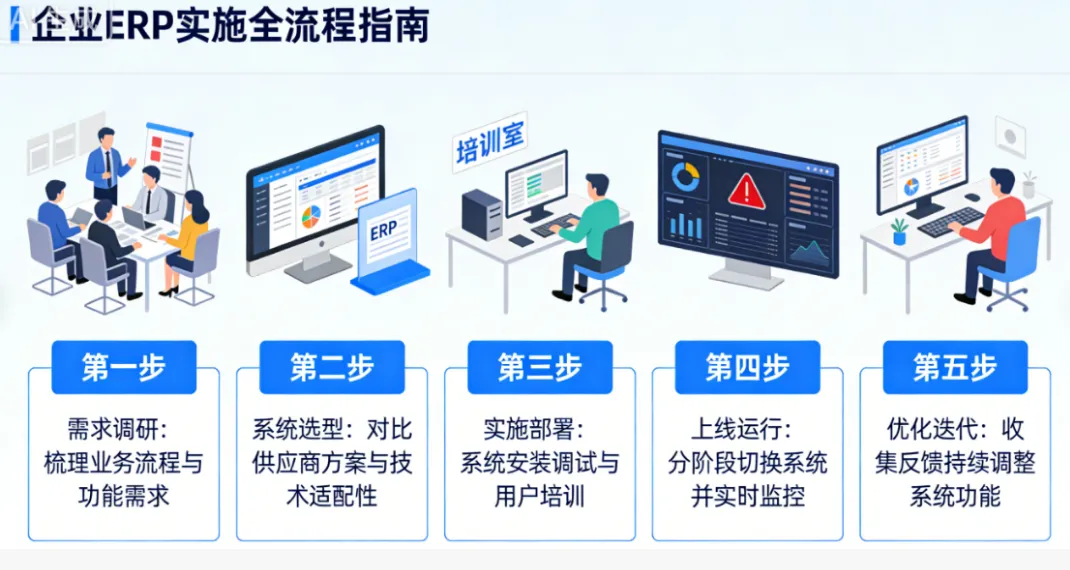
Parallel to this is a fundamental engineering that is often underestimated but determines the success or failure of the system:Data Governance and MigrationThe historical data must be thoroughly cleaned, converted, and validated to ensure its accuracy, completeness, and consistency before it can be imported into the new system. Low quality data input will directly lead to ineffective or even harmful decision information output by the system. At this stage, representative business units or product lines should be selected for pilot verification, testing processes, data, and system performance within a controllable range, adjusting plans in a timely manner, and clearing obstacles for comprehensive promotion.
Change driven and fully launched: from project to operation
The completion of technical deployment only means that the system is ready, and true success depends on human acceptance and use. Therefore, strong change management must be implemented throughout. This includes developing a thorough communication plan to clarify the necessity and personal value of change to all employees; Design a hierarchical and role based training system to ensure that everyone from management to frontline operators can master the required skills; More importantly, guiding behavior change through incentive measures and moderately linking the execution of new processes with performance evaluation.
After sufficient training and data preparation, the project will enter the final stage of switching online. The strategy of launching in modules and batches is usually adopted to control risks. The initial stage of the launch is the most stressful period, requiring the implementation team and internal support personnel to provide high-intensity and rapid on-site support, timely solve operational problems, and calm user emotions. After the system has been running smoothly for a period of time, the project can be officially handed over, shifting from a "project-based" to a regular state of "continuous operation and optimization".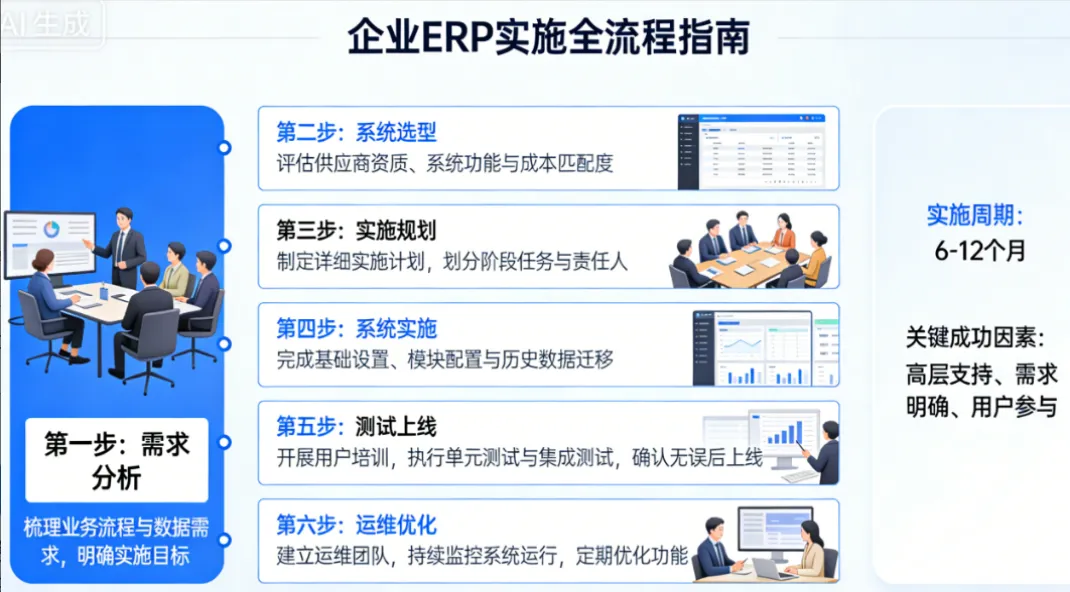
Continuous optimization and value deepening: an endless journey
The launch of the system is not the end, but a new starting point for value mining. Enterprises should establish a continuous optimization mechanism, regularly collect user feedback, monitor key performance indicators, use new data generated by the system to identify business bottlenecks, and carry out a new round of process improvement. Modern ERP systems, especially cloud architecture, provide convenience for this continuous iteration.
In the long run, a successfully implemented ERP system will evolve into an enterprise'sDigital Core PlatformIt not only integrates internal resources, but also lays a solid foundation for integrating more advanced business intelligence analysis, artificial intelligence applications, or expanding industrial chain collaboration in the future. It will gradually transform from a backend system that supports business operations to a core competitiveness that empowers business innovation and drives strategic decision-making.
Therefore, implementing ERP in enterprises is essentially aboutReshaping its own operational DNAIt tests not only the technological capabilities of the enterprise, but also its strategic determination, process intelligence, courage to change, and learning ability. Following a scientific path and adhering to business value as the foundation, we can transform challenges into sustainable competitive advantages in this complex journey, truly ushering in a new era of data-driven intelligent management.