
Different types of ERP in the market
After decades of evolution, enterprise resource planning systems have evolved from a relatively unified management software concept to a complex product lineage that is multi-level, multi-dimensional, and meets different needs. This differentiation is not accidental, but the common result of technological iteration, market stratification, differences in management philosophy, and deep penetration of industry characteristics. Understanding the essence and boundaries of these different types is crucial for companies to make strategic choices that fit their own genes. From deployment patterns to design concepts, from technical architecture to industry attributes, the modern ERP market presents a "harmonious yet diverse" ecological panorama.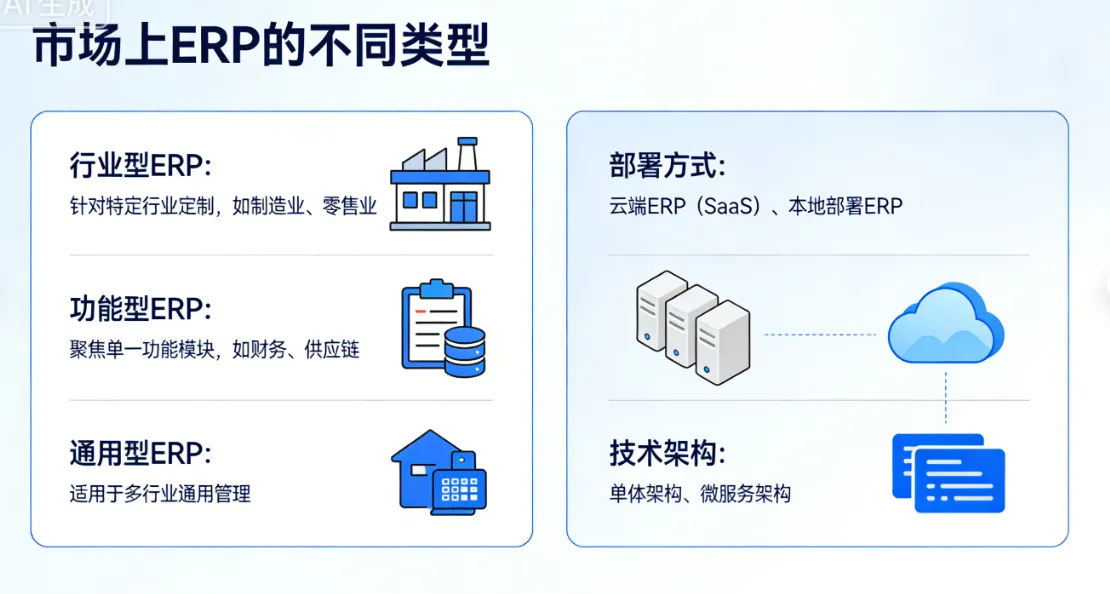
From the perspective of deployment mode and architecture evolution, the competition between cloud and on premises has shifted from choice to trend differentiation.traditionLocal deployment type ERPLike a self built data center, all software, hardware, and data are located within the enterprise. Its core value lies in absolute control over data, depth of customized development, and meeting extremely strict compliance requirements, but at the cost of high initial investment, complex operational upgrades, and limited flexibility. In contrast,Cloud based ERPEspecially the SaaS model based on cloud native architecture has become the mainstream and innovation focus in the market. It transforms software into a subscription service that enterprises can use on demand and access through the Internet. Its revolution lies in its extremely low entry cost, built-in continuous updates, almost unlimited elastic scalability, and professional level security and operations guaranteed by service providers. This model not only changes the cost structure, but also reshapes the delivery and evolution rhythm of ERP, transforming it from a fixed asset that requires periodic "big surgery" upgrades to a continuous iterative and agile "living system".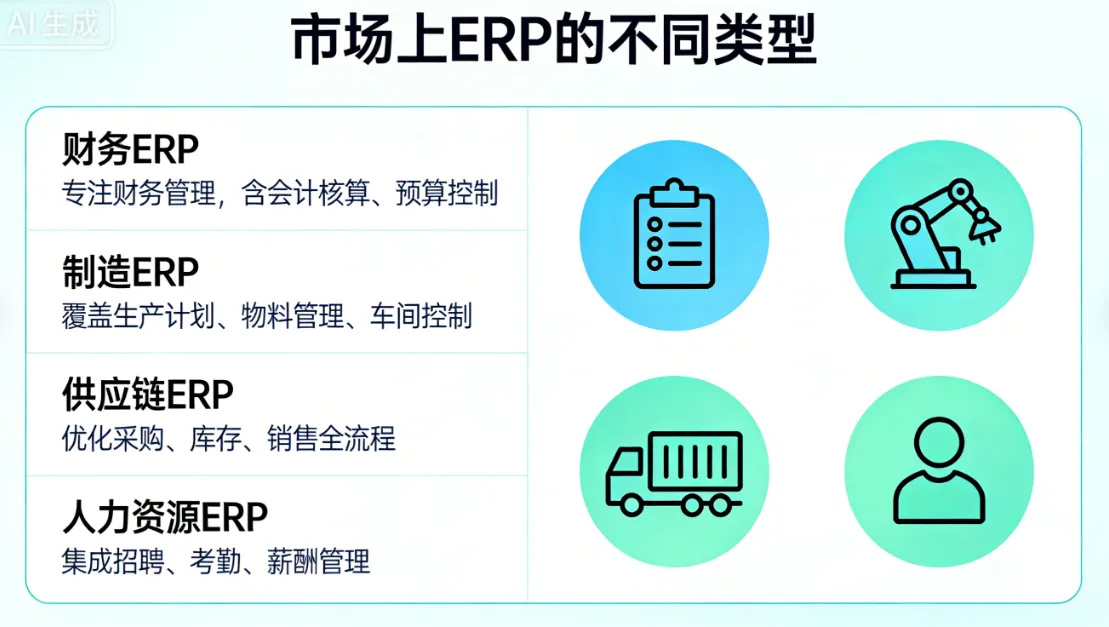
From the perspective of target customers and enterprise scale, the market presents a distinct pattern of "giant ships" and "fast boats".oriented towardsLarge corporations and complex organizationsERP can be referred to as a 'heavy platform'. Their design philosophy is control, integration, and globalization, such as SAP S/4HANA, Oracle Fusion, etc. This type of system has vast functions, covering all aspects from group financial consolidation, cross-border supply chain to precision manufacturing, and has strong capabilities in complex business modeling and strict process control. Its implementation is like a massive management project, pursuing the establishment of a unified, stable, and auditable 'digital constitution' across the entire group. And towardsSmall and medium-sized enterprises and growth organizationsERP, on the other hand, is a representative of the "Agile Suite", such as domestic UFIDA U8 Cloud, Kingdee Cloud · Starry Sky, and numerous international SaaS products. They emphasize more on out of the box, rapid deployment, cost control, and ease of operation, usually focusing on core financial, supply chain, and production management processes, based on standardized best practices, and meeting needs through configuration rather than deep development, aiming to support business growth and standardization of enterprises with the highest cost-effectiveness.
The deep penetration of industry characteristics has given rise to the distinction between general and vertical ERP systems. Universal ERPIt provides a widely applicable management framework, with the advantages of standardized processes and cross industry replicability, suitable for industries such as commerce and services where management models are relatively universal. However, for industries with unique processes and intensive professional knowledge, a universal framework often seems inadequate. Therefore,Vertical (or industry-specific) ERPAs a result, it is essentially a software encapsulation of industry know-how. For example, ERP deep integration engineering management, advanced scheduling, and workshop control for discrete manufacturing industries; For process industries, strengthen batch tracking, formula management, and compliance; The solution for the retail industry will inevitably incorporate omnichannel inventory and membership management core. The competitiveness of such systems lies not in their comprehensive functionality, but in their deep understanding of the core pain points in the industry and the accuracy of their solutions.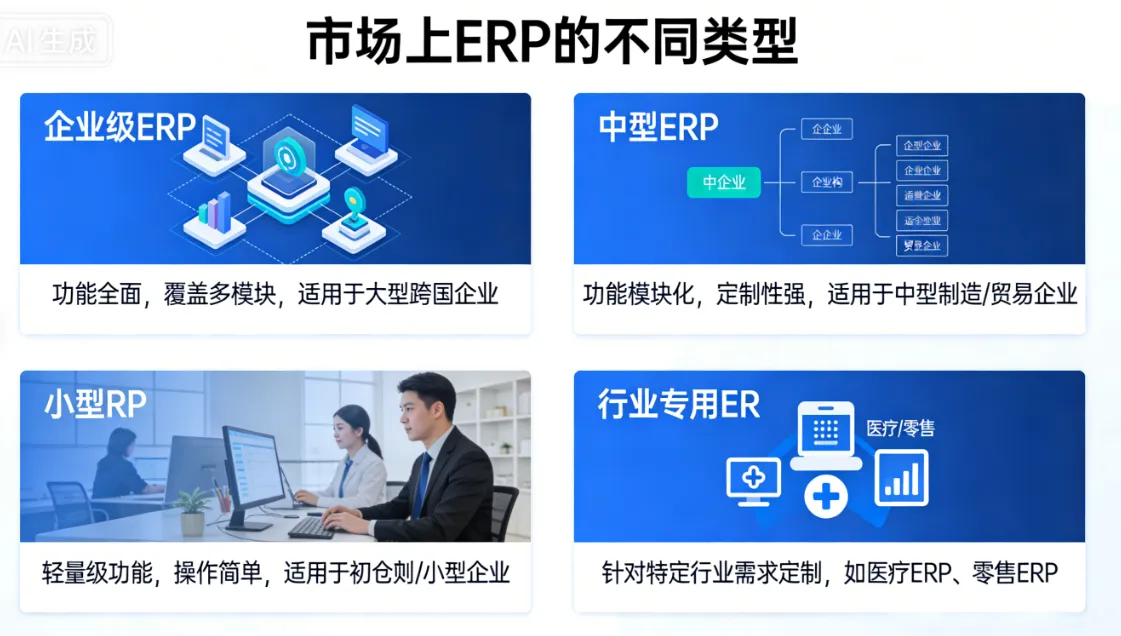
From the perspective of technical architecture and extension paradigms, new and old concepts are being replaced.traditionalSingle unit architecture ERPTightly coupling all functional modules, making customization difficult and risky. And modernPlatformization and microservice architecture ERPIt is becoming mainstream. It breaks down core business capabilities into independent, reusable service units (microservices) that are loosely coupled and connected through APIs. On this basis,The combination of low code/no code platform and ERPIt has also pioneered a new paradigm. It allows enterprises to quickly build and modify process applications, reports, or lightweight features through visual drag and drop by business personnel on a stable core periphery, thereby responding to personalized needs at extremely low cost and high speed, achieving an agile balance of "core standardization, edge personalization".
A more cutting-edge perspective is the germ of an emerging paradigm.With the breakthrough of artificial intelligence technology,AI native ERPMoving from concept to reality. This type of system is not simply embedded with AI functions, but uses AI capabilities such as large language models as the core interaction and decision engine from the bottom, achieving natural language driven business, intelligent prediction, and automated execution. In addition, in specific fields such as project-based organizationsProject ERPThe core of it is to manage the entire lifecycle of cost, resources, schedule, and procurement based on the project dimension.
It can be seen that the diversity of the ERP market is a two-way mapping of enterprise needs and technological possibilities. The key to choosing lies in a profound understanding of the scale stage, industry essence, management maturity, and innovation demands of one's own organization. There is no 'best' ERP, only the 'most compatible' ERP. This choice itself is an important test of the clarity of the enterprise's digital transformation strategy. In the future, with the continuous integration of technology and business, the types of ERP may be further subdivided and evolved, but its core mission remains the same: to become the most solid and intelligent digital cornerstone supporting the unique value creation process of enterprises.