
Analysis of Four Major Methods for ERP Management System to Significantly Improve Enterprise Efficiency
Systematic path for improving enterprise efficiency in the digital age
In an increasingly competitive market environment, operational efficiency has become a key factor determining survival and development for enterprises. The traditional management model that relies on manual coordination, paper-based processes, and decentralized systems is facing many efficiency bottlenecks such as slow response, frequent errors, and resource waste. The enterprise resource planning management system, as an integrated digital solution, is fundamentally reshaping the operational model of enterprises through its systematic approach, providing a quantifiable and sustainable implementation path for efficiency improvement. Through the four core methods of process automation, data integration, resource optimization, and decision intelligence, ERP systems are driving an efficiency revolution for enterprises from local improvement to overall optimization.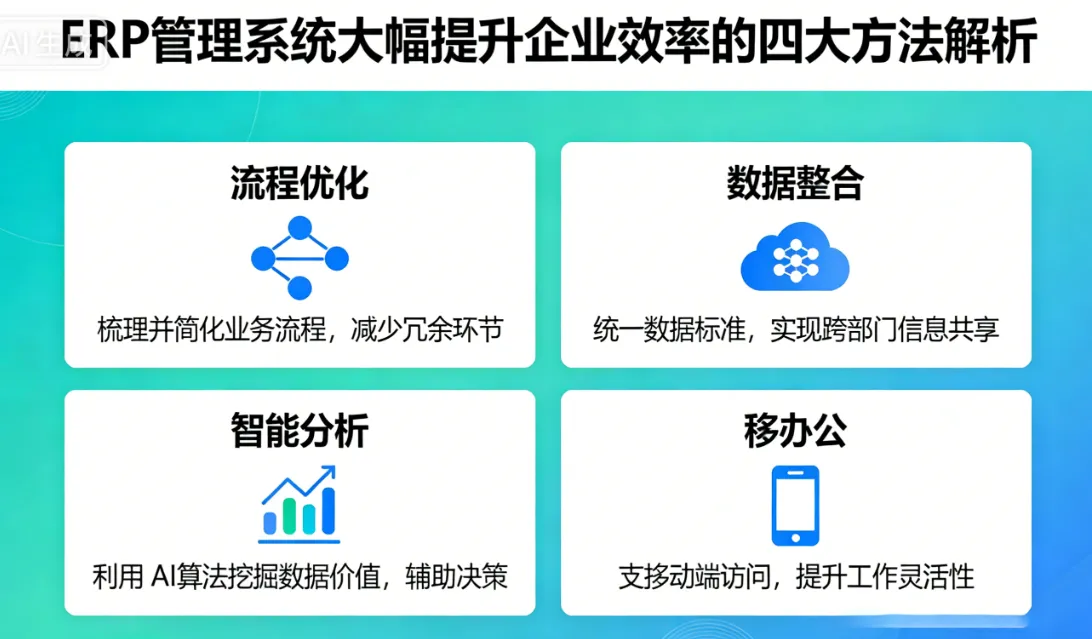
Process automation: eliminating bottlenecks in manual operations
A large amount of repetitive and routine work in enterprise operation consumes valuable time and energy of employees, and human operation inevitably brings errors and delays. The ERP system achieves end-to-end automation of key business processes through workflow engines and business rule engines, which is the primary method for improving efficiency.
In the procurement to payment process, the traditional model involves multiple stages such as demand application, multi-party approval, supplier selection, order issuance, goods acceptance, invoice verification, and payment processing, involving multiple departments and a large number of paper document circulation. The entire process usually takes several weeks. The ERP system fully automates this process: after employees submit procurement requests online, the system automatically performs budget checks and triggers approval processes based on preset rules; After approval, the system automatically generates purchase orders based on supplier performance data; After the goods are delivered, scanning and acceptance can trigger the accounts payable process; Finally, the system automatically matches the order, receipt, and invoice to complete the payment operation. After implementing an ERP system in a manufacturing enterprise, the procurement to payment cycle was shortened from an average of 21 days to 7 days, and the per capita order processing volume of the procurement department increased by three times. At the same time, the invoice matching error rate was reduced by 85%.
The automation in the field of production and manufacturing is also significant. The ERP system automatically generates production plans based on sales orders and inventory status, and directly issues production instructions to the workshop. The material requisition, work hour reporting, quality inspection and other links in the production process can be completed through mobile terminals, and data is synchronized in real time. This automation not only reduces the coordination work of production scheduling personnel by more than 60%, but also improves the timeliness and accuracy of production data collection to a new level, providing a reliable data foundation for subsequent efficiency improvement.
Data integration: breaking down information silos
The information barriers and inconsistent data between departments are the underlying reasons for inefficient business operations. The sales department is not aware of the production progress, the production department is not clear about the inventory status, the procurement department is not aware of the actual demand, and the finance department finds it difficult to obtain business data in a timely manner - this information fragmentation leads to a lot of time being wasted on data verification, communication and coordination, and waiting for decisions. The ERP system achieves real-time integration and sharing of critical business data by building an enterprise level unified data platform, which is the second core method for improving efficiency.
When salespeople enter orders into the system, the production department can immediately see the new requirements and adjust the production plan. The procurement department synchronously obtains material demand information, the warehousing department prepares shipping resources, and the finance department updates revenue forecasts. All relevant departments work based on the same data source, without the need for repeated communication and confirmation. After integrating sales, production, and supply chain data through an ERP system, a consumer goods enterprise improved sales forecasting accuracy by 35%, inventory turnover by 40%, and reduced cross departmental meeting time by 50%. The team was able to devote more energy to high-value activities such as market analysis and customer service.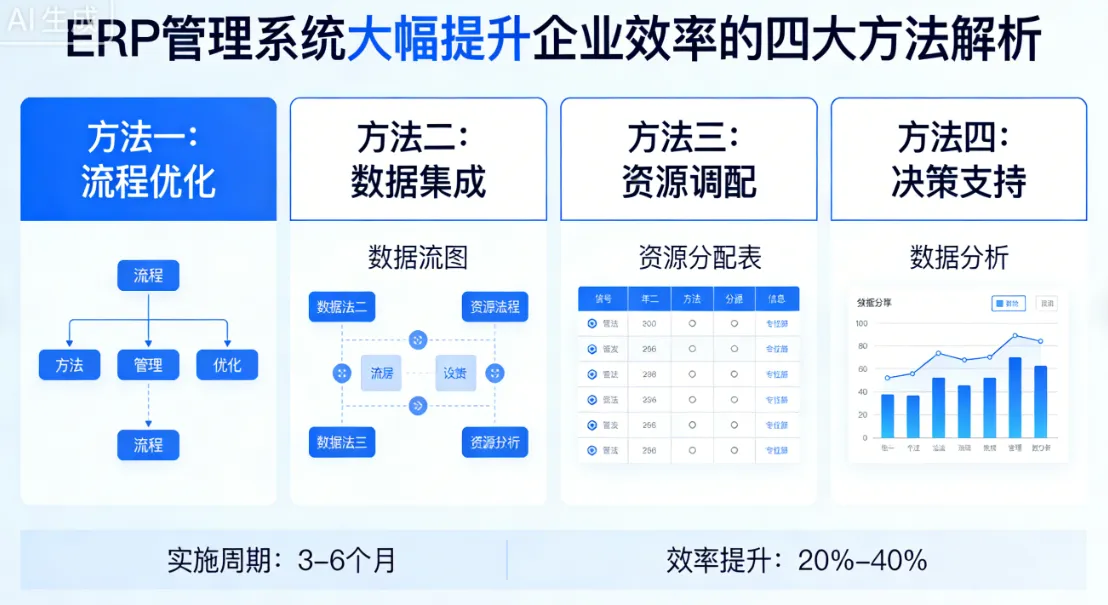
The deeper efficiency improvement comes from the analytical ability after data integration. The business intelligence tools built into ERP systems can perform multidimensional analysis on integrated data, revealing efficiency bottlenecks that are difficult to detect under traditional models. For example, by analyzing the time distribution of each link in order processing, companies can find that 80% of delays occur during the credit review stage; By analyzing equipment operation data and maintenance records, maintenance plans can be optimized to reduce unplanned downtime. This insight based on complete data shifts efficiency improvement from experience driven to precise optimization.
Resource Optimization: Maximizing Efficiency from a Global Perspective
The resources of a company, including materials, equipment, manpower, and funds, are always limited, and local optima often lead to overall efficiency losses. The ERP system optimizes resource allocation from a global perspective through integrated planning and scheduling functions, which is the third key method to improve efficiency.
In terms of production scheduling, traditional methods often optimize based on individual orders or devices, which can easily lead to resource conflicts and overall low efficiency. The advanced planning and scheduling module of the ERP system comprehensively considers the priority, delivery deadline, material supply, equipment capability, and personnel skills of all orders to generate the overall optimal production plan. After applying APS modules in an electronic manufacturing enterprise, despite a 30% increase in order volume, the comprehensive utilization rate of equipment increased by 15%, the average delivery cycle of orders was shortened by 20%, and the number of emergency line changes was reduced by 35%.
Inventory optimization is another important area of resource optimization. The ERP system achieves a balanced optimization of inventory and service levels through precise demand forecasting and inventory strategies. The system dynamically calculates the safety stock and reorder point for each material based on sales history, demand patterns, and supply chain reliability, avoiding stockout losses and reducing capital occupation. A retail enterprise reduced its overall inventory level by 25% while maintaining a 98% spot rate through inventory optimization using an ERP system, which is equivalent to releasing tens of millions of yuan in working capital.
The optimal allocation of human resources is equally important. The human resources module of ERP system is integrated with project management, production scheduling and other functions, which can allocate suitable personnel to appropriate tasks based on skills, experience and availability. A consulting company optimized resource allocation through an ERP system, increasing the utilization rate of project personnel from 68% to 82%, while reducing project overspending rates by 40%.
Decision Intelligence: From Empirical Judgment to Data Driven
The inefficient decision-making process and high cost of decision-making errors are important reasons for the efficiency loss of enterprises. Traditional decision-making often relies on the personal experience and scattered information of managers, which has shortcomings such as strong subjectivity, incomplete information, and slow response. The ERP system achieves intelligence in the decision-making process by providing real-time, accurate, and comprehensive business data and analysis tools, which is the fourth core method for improving efficiency.
At the level of daily operational decision-making, the real-time dashboard and warning mechanism provided by the ERP system enable managers to quickly identify anomalies and take action. When the system detects inventory below safe levels, abnormal equipment efficiency decline, or order delivery risks, it will automatically issue alerts to relevant personnel to shorten problem discovery and response time. A certain logistics enterprise has shortened the average time for detecting transportation anomalies from 4 hours to 30 minutes through real-time monitoring and early warning of the ERP system, and improved the efficiency of anomaly handling by 70%.
At the strategic decision-making level, the historical data and predictive models accumulated by ERP systems provide scientific basis for long-term planning. The system can simulate resource demands in different market scenarios, evaluate the feasibility of capacity expansion plans, and analyze the profit potential of new product lines. A manufacturing enterprise used the data model of an ERP system to evaluate the long-term costs and risks of three different construction plans, and ultimately chose the optimal plan, which is expected to save 15% of initial investment and reduce operating costs by 20%.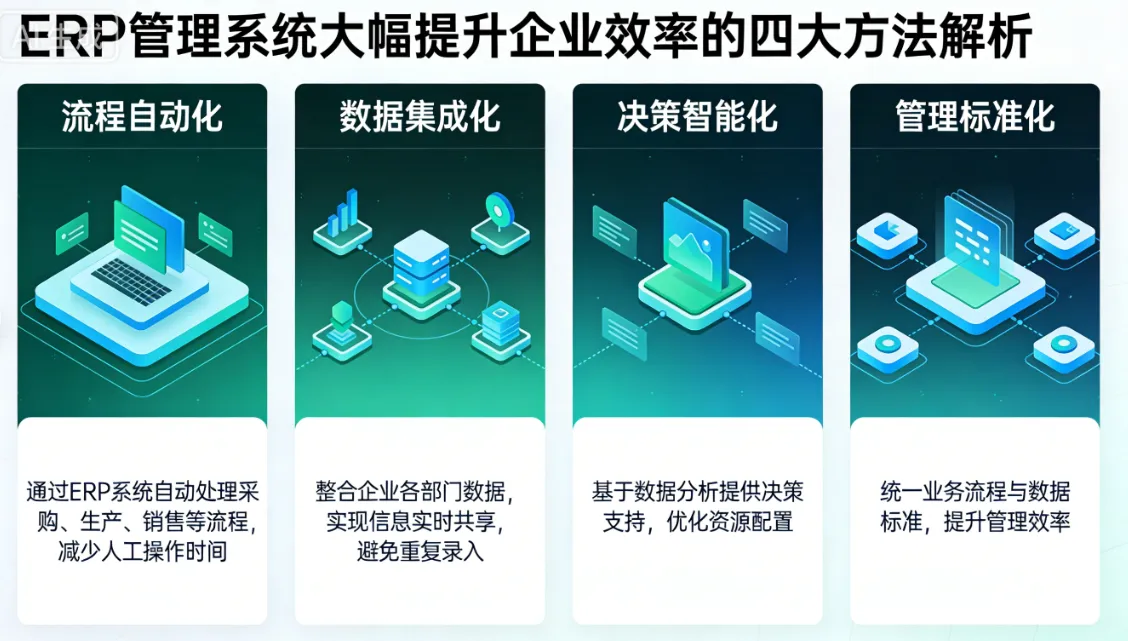
More noteworthy is that modern ERP systems are beginning to integrate artificial intelligence and machine learning technologies to achieve more advanced decision automation. Algorithms trained on historical data can automatically adjust inventory parameters, optimize production schedules, and even predict equipment failures. This intelligent decision-making not only improves the quality of decision-making, but also liberates managers from a large number of routine decisions to focus on more complex strategic issues.
The Implementation Path of Systematic Efficiency Revolution
The ERP management system provides a systematic solution for improving enterprise efficiency through four methods: process automation, data integration, resource optimization, and intelligent decision-making. These four methods are interrelated and mutually reinforcing: automated processes generate accurate data, integrated data supports resource optimization, optimized resources lay the foundation for intelligent decision-making, and intelligent decision-making further guides process automation improvement, forming a virtuous cycle of continuous efficiency improvement.
However, the implementation of these efficiency improvement methods depends not only on the technical capabilities of the ERP system, but also on the enterprise's perception of it as a management change rather than a purely technical project. Successful efficiency improvement requires enterprises to redesign business processes to adapt to automation needs, establish a data-driven culture to fully utilize integrated information, cultivate system thinking to achieve global optimization, and embrace new technologies to unleash the potential of intelligent decision-making. Only when the changes in technology and management are synchronized can ERP systems truly become catalysts for the efficiency revolution of enterprises, helping them build sustainable competitive advantages in the digital age and achieve high-quality development.