
What are the implementation stages of an ERP project?
The Systematic Path of ERP Projects in Digital Transformation
The implementation of enterprise resource planning system is one of the most complex and critical system engineering in the process of digital transformation of enterprises. It is far more than just software installation, it is a profound transformation involving strategic planning, business process reengineering, organizational change, and technology integration. Successful ERP projects follow a structured and interconnected phased path, with clear goals, core tasks, and deliverables for each stage, collectively forming a complete lifecycle from vision to value realization. Understanding and rigorously executing these stages is the foundation for ensuring that the project goes live on time within budget and achieves expected business goals.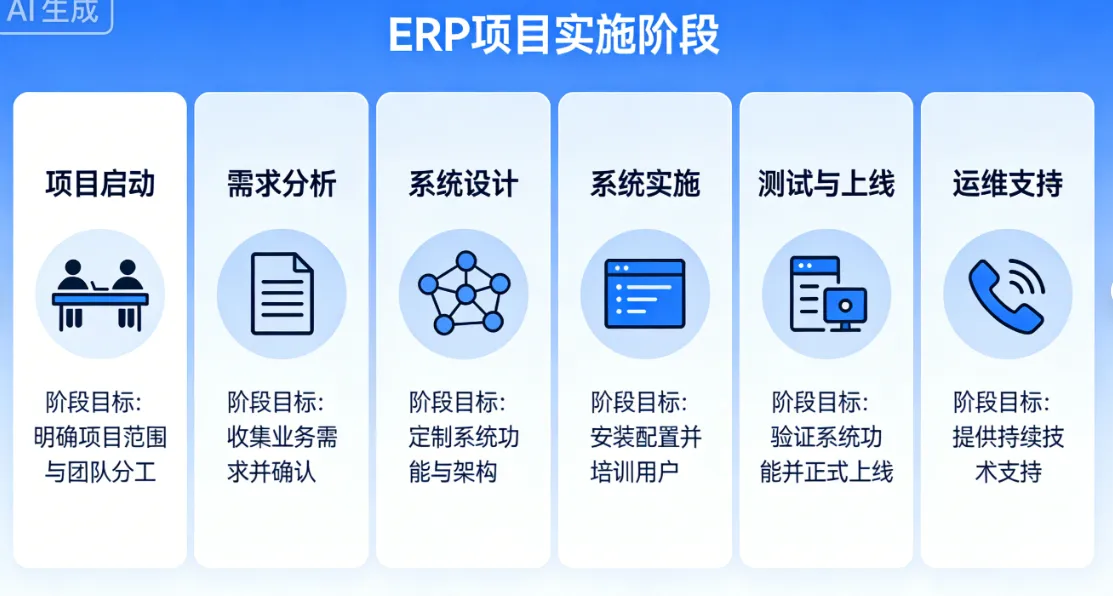
Phase 1: Strategic Planning and Project Launch
Any successful ERP project begins with clear and consensus strategic planning. The core goal of this stage isDefine 'why' and 'what to achieve'Ensure that the project is closely aligned with the overall strategy of the enterprise and establish a solid organizational and resource foundation. The primary task is to establish a project governance structure, which typically includes a project steering committee composed of senior management, a core project team composed of business backbones and IT experts, and clear roles and responsibilities for all parties involved. Subsequently, the project team needs to have in-depth communication with various business departments of the enterprise, conduct detailed requirement research and analysis, identify core business process pain points and optimization opportunities.
Based on this, the team will develop a project charter that outlines the scope, objectives, key success indicators, preliminary budget, and high-level timeline of the project. For example, the goal may be to "shorten the financial closing time from 10 days to 3 days" or "increase inventory turnover by 25%", and these goals must be specific, measurable, and directly linked to business value. At the same time, conducting preliminary risk assessments and stakeholder analysis is also crucial. This stage will ultimately be marked by a formal project kickoff meeting, announcing the start of the project to the entire organization and obtaining public commitment and support from the top management. The quality of work in this stage directly determines the direction and success or failure of the project's follow-up.
Phase 2: Business Process Analysis and Solution Design
After clarifying the goals, the project enters the stage of thoroughly reviewing the current situation and designing a blueprint for the future. The focus of this stage isAnswer 'How will it change'The project team needs to work with key users to carefully review and diagnose the current status of all business processes included in the project scope, draw a detailed "current status process" diagram, and identify inefficient, risky, or strategic areas.
Subsequently, based on the standard functions of the ERP system and industry best practices, combined with the strategic needs of the enterprise, design the "future business processes". This is not simply automating existing processes, but an opportunity to rethink and optimize business operations. The future process of design should be more efficient, transparent, and controllable. For example, the original serial approval may be changed to parallel approval, or automated matching may be introduced to replace manual verification. This' future blueprint 'will become the absolute basis for system configuration. At the same time, the detailed design of the technical architecture is also completed in this stage, including system deployment mode (cloud/local), hardware and network planning, integration interface design, and data migration strategy. The output of this stage is a clear, detailed, and confirmed business process design plan and system architecture specification by the business department.
Phase Three: System Configuration, Development, and Testing
This stage is the "construction" process of transforming the design blueprint into a runnable system. The implementation team will configure the ERP system in detail based on the confirmed future business process plan, setting up organizational structure, master data (such as materials, customers, suppliers) structure, chart of accounts, business process parameters, and approval workflow. For unique requirements that cannot be met by standard functions and are truly core competencies, limited customized development will be carried out.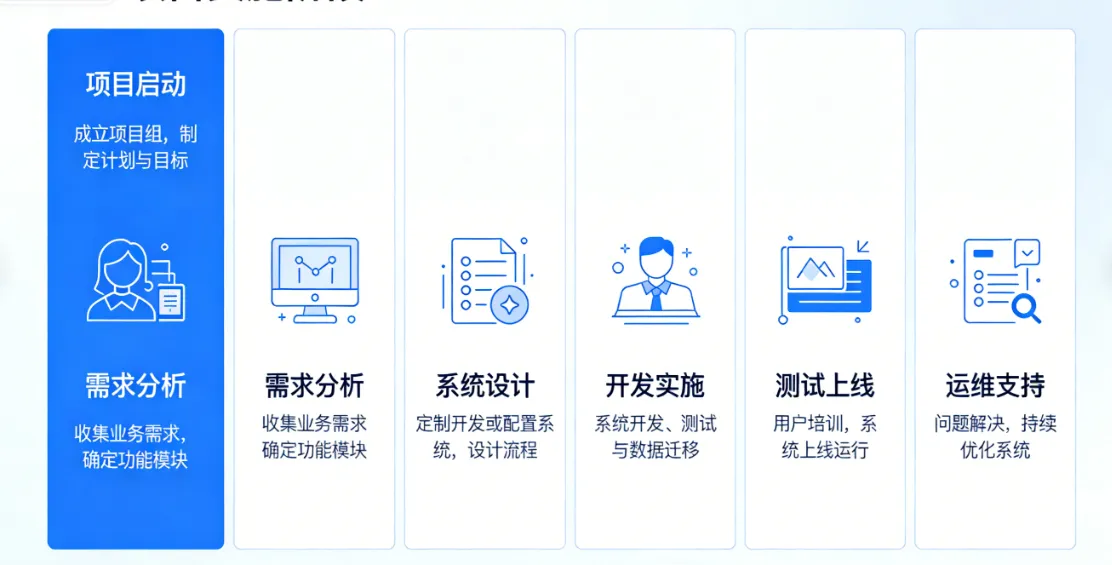
data migrationThis is an extremely critical and arduous task at this stage. A thorough migration plan needs to be developed to clean, transform, and validate historical data, ensuring its accuracy, completeness, and consistency in the new system. Usually, relatively static master data is migrated first, followed by dynamic transaction data.
Comprehensive testingIt is the lifeline of ensuring system quality and must be strictly implemented. This includes: unit testing (verifying individual functional points), integration testing (verifying the coherence of cross module business processes), and user acceptance testing. UAT is a simulation environment where the end user representative verifies the system based on real business scenarios to ensure that it meets business requirements and is easy to use. All issues discovered during testing must be recorded, tracked, and fixed until they meet the online standards.
Phase Four: System Deployment and Launch
This is an exciting and challenging moment for the project to transition from preparation to formal operation. The core of this stage isSmoothly and orderly push the new system into the production environmentAnd ensure the continuity of business operations. Firstly, it is necessary to develop a detailed online plan and emergency response plan, clarifying the switching timing, steps, personnel responsibilities, and rollback plan. There are multiple options for online strategies, such as one-time switching (aggressive), parallel operation of new and old systems (robust), or gradual deployment of modules and business units (incremental). Enterprises need to make choices based on their own risk tolerance.
Before going online, comprehensive training for end-users must be completed to ensure that they not only know how to operate the system, but also understand the management logic behind the new process. At the same time, complete the final data migration and system environment deployment. During the transition to online, it is necessary to establish a "combat command room", where the project team and key users provide high-intensity support to quickly respond to and solve various problems encountered by users. The first few weeks after going live are a stable period, requiring close monitoring of system performance and business process operation.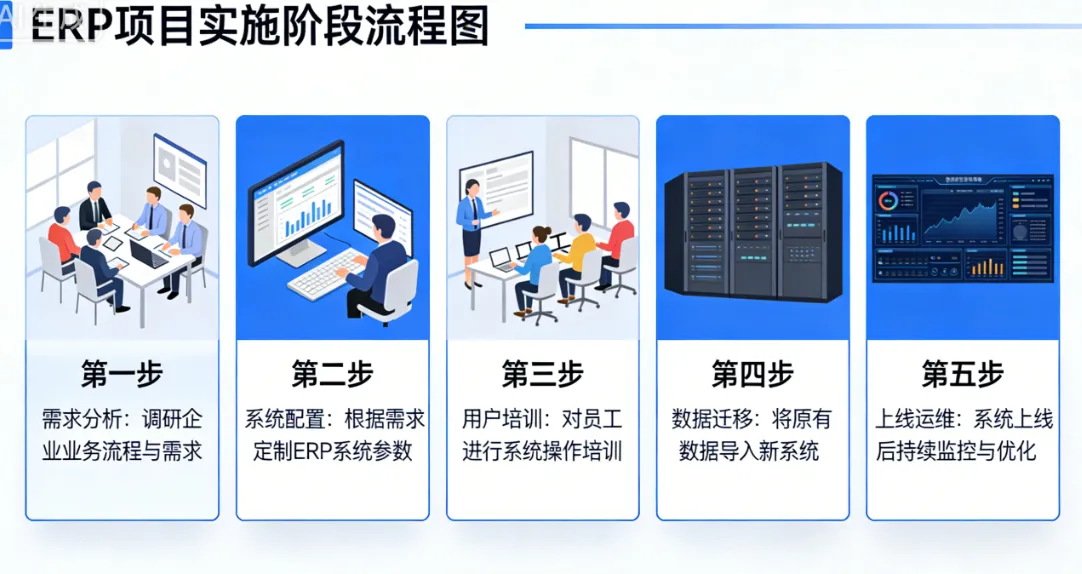
Phase 5: Continuous Support and Optimization Enhancement
The successful launch of the system is not the end of the project, but ratherA new starting point for the continuous deepening and release of valueThe role of the project team needs to shift from 'implementer' to 'supporter and optimizer'. Firstly, it is necessary to establish a formal system operation and maintenance support system to handle daily user operation issues, system failures, and routine maintenance.
More importantly, establishContinuous optimization and value evaluation mechanismEnterprises should regularly (such as quarterly) review the system usage, collect user feedback, analyze whether the business goals set at the beginning of the project have been achieved based on the real operational data generated by the system, and identify new improvement opportunities. ERP system should be regarded as a "living system" that can continuously evolve and expand with the growth of enterprises. Subsequent optimizations may include enabling new functional modules, deepening existing functional applications, optimizing business processes, or integrating new technologies such as business intelligence and mobile applications.
In summary, the implementation of an ERP project is a rigorous and interconnected journey from strategy to operation, from design to optimization. These five stages - planning and initiation, analysis and design, configuration testing, deployment and deployment, and support optimization - constitute a complete lifecycle. Only by respecting this objective law, investing sufficient resources and delivering high-quality results at each stage, can enterprises minimize risks and ensure that ERP projects transform from a major investment to a powerful engine driving the enhancement of core competitiveness and successful digital transformation.