
ERP system implementation failure? Key factor analysis: not just software issues
In the wave of digital transformation in enterprises, enterprise resource planning systems are highly anticipated and regarded as the core tool for improving operational efficiency and achieving data-driven solutions. However, in reality, a considerable proportion of projects fail to meet expectations or even end in failure. Through in-depth analysis of these cases, it can be found that the reasons for failure often go far beyond the technical defects of the software itself, but are a concentrated manifestation of a series of management, organizational, and cultural issues. Understanding these non-technical factors is crucial for enterprises to avoid risks and improve the success rate of ERP projects.
Strategic deficiency and vague goals: navigation without direction
The failure of many ERP projects has already laid hidden dangers at the beginning of their establishment.Ambiguity or misalignment of strategic objectivesIt is one of the most common and deadly root causes. Enterprises often view ERP implementation as a simple IT task and lack awareness of deeply linking it to the overall business strategy. The project goal setting is too vague, such as "improving management level" or "achieving informatization", but lacks specific, measurable indicators directly related to business value. Even worse, some companies expect to solve all management problems in one go through a single system, leading to an unlimited expansion of project scope and ultimately falling into an uncontrollable quagmire. This strategic deficiency results in a lack of clear navigation for the project team, with different departments having varying definitions of 'success', which can easily lead to disagreements and internal conflicts during the execution process.
Accompanying strategic ambiguity isSubstantial absence of senior managersAlthough most projects can receive verbal support from senior management at the beginning, decision-makers often fail to invest the necessary time and authority during the implementation process. They completely entrust the project to the IT department or external consultants, becoming the 'hands off managers' themselves. However, ERP is essentially a profound processManagement changeIt involves process restructuring, redistribution of rights and responsibilities, and adjustment of interest patterns. When a project touches on the existing power or habits of core departments, without decisive decision-making and strong promotion from senior management, reform is often difficult to move forward. The project stalled at critical nodes due to a lack of decision-making, ultimately missing the best opportunity and leading to failure.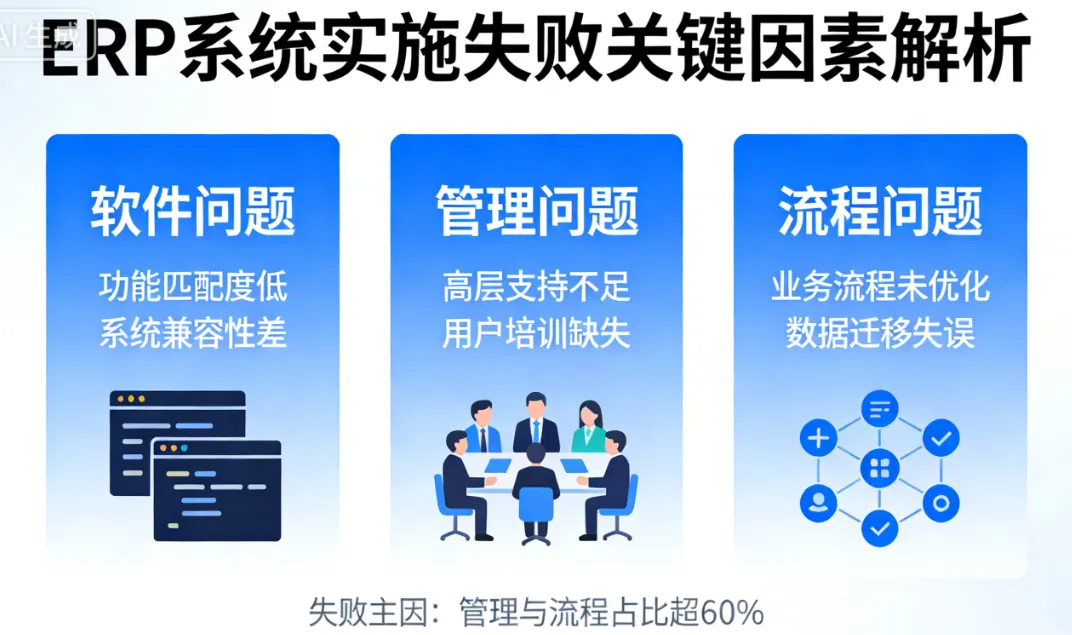
Resistance between organization and culture: an insurmountable invisible barrier
People are the most complex variable in any change. The introduction of ERP systems means changes in work methods, process standards, and even power structures, which inevitably encounter resistance from organizational inertia.Systematic deficiencies in change managementThe key reason for this resistance escalating into project failure. Many companies mistakenly believe that once technology deployment and operational training are completed, change will naturally occur. In fact, employees may experience anxiety, confusion, and even resistance due to the uncertainty, learning pressure, or weakened power brought about by the new system.
Successful change management requires starting from the early stages of a project, clarifying the necessity and vision of change through continuous communication, and enabling employees to understand 'why change is necessary' and 'what it will become'. The deep participation of key users, comprehensive training in stages, and supporting incentive mechanisms and performance adjustments are all indispensable. However, failed projects often only focus on the technical aspect and overlook the transformation of people's hearts and cultures. When employees lack a sense of identification with the new system, they may passively cope and even privately use old processes, resulting in the system being "virtually non-existent" after going online, with low data quality and unable to realize its full value.
The dilemma of process and data: old wine in new bottles
Another common failure trap is the failure to take advantage of ERP implementation to fundamentally optimize business processes. Many companies have chosenAutomated Inefficient ProcessesThe path requires the new system to completely replicate the existing offline operation mode that may have defects. This leads to ERP becoming merely an expensive electronic tool that solidifies old drawbacks, not only failing to bring about efficiency gains, but may also exacerbate or even magnify problems due to system rigidity.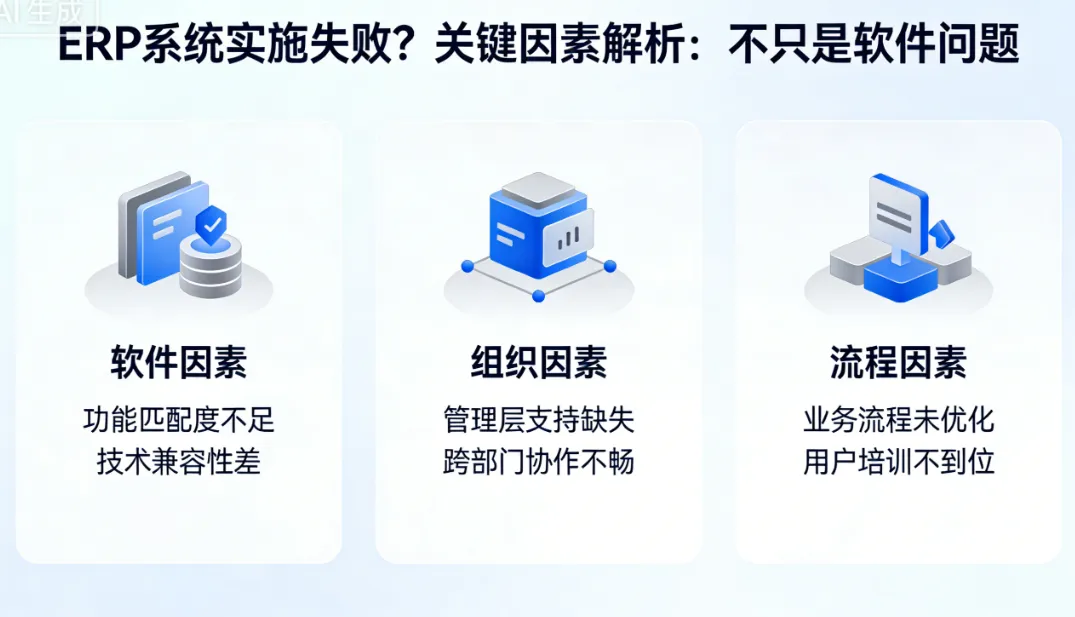
Meanwhile,Data quality crisisIt is the direct technical reason that causes the system to fail to operate effectively after going online. Many companies only realize at the start of a project that their master data is chaotic and their historical data is incomplete. The material code contains "one item multiple codes" or "one code multiple items", the material list is inaccurate, and supplier information is missing. Under the pressure of a tight schedule, only rough data migration can be carried out, planting a 'data landmine' for the system. After going online, an incorrect material price or inaccurate formula may cause the entire cost accounting or production planning system to malfunction. Lack of sustainedData governance mechanismThe data quality will rapidly deteriorate, ultimately causing the system to lose credibility and be abandoned by users.
Partners and Project Management: Dual Test of External Factors and Internal Control
Misjudgment and excessive dependence on implementing partnersIt is an important external risk. Enterprises sometimes focus too much on software prices and underestimate the importance of implementation teams' industry experience, methodological maturity, and long-term service capabilities. A consulting team lacking a deep understanding of the industry may provide solutions that are significantly disconnected from actual business scenarios. In addition, if a company holds a "turnkey project" mentality and outsources the entire project, and the internal team lacks deep participation and learning, it will lead to knowledge transfer failure. Once external consultants leave, the system becomes unable to be maintained and optimized, gradually becoming rigid.
At the project management level,Unrealistic time pressure and uncontrolled spreadThey are two major killers. In order to meet the aggressive launch date set by the management, the project team was forced to compress key processes such as process testing, user training, and data validation, resulting in the system being launched with problems and a constant stream of issues. On the other hand, the business department constantly proposes new customized requirements that have not undergone strict review during the implementation process. If the project team lacks a strict change control process, it will lead to unlimited expansion of the project scope, budget overruns, and dilution and delay of the core objectives.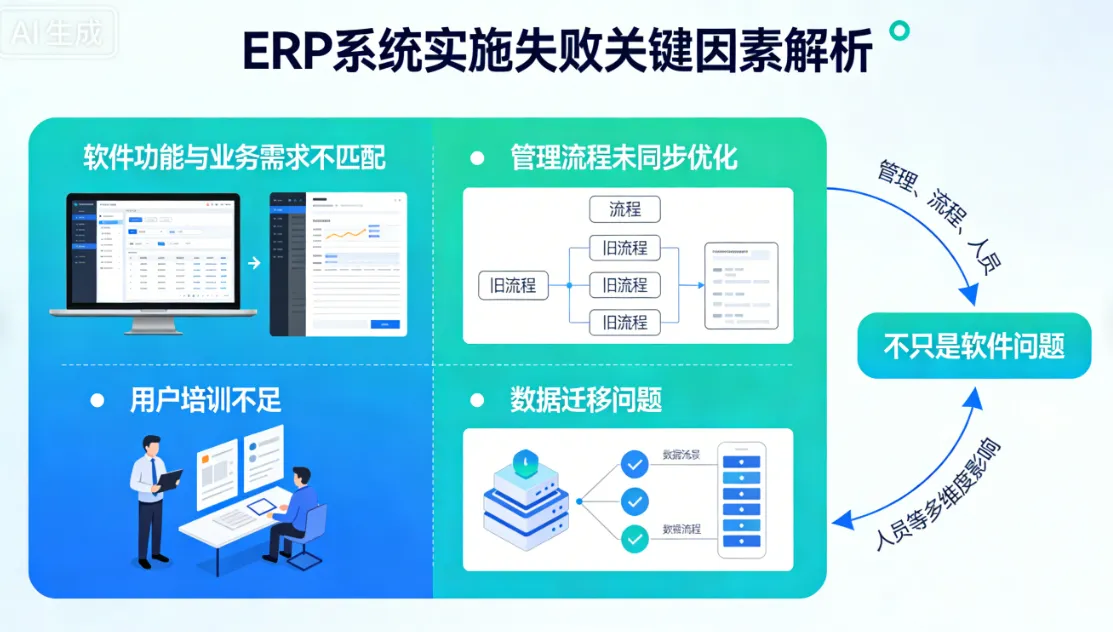
Conclusion: Systematic Engineering Beyond Technology
In summary, the success or failure of ERP implementation goes far beyond the scope of software functionality and technical architecture. It is a systematic project that integrates strategy, organization, processes, data, and project management. Failure is often not caused by a single factor, but by the interplay of multiple factors. If a company wants to succeed, it must position itself as a project from the beginningStrategic driven management changeRather than isolated IT projects.
This means that companies require sustained and substantial leadership and support from top management; Resources need to be invested in optimizing business processes, not just automation; Need to establish a strict change management and data governance system; We need to carefully select and collaborate with partners in combat; More scientific project management is needed to balance scope, time, and cost. Only when enterprises treat these "non software" factors with the same rigor can ERP systems truly transform from an expensive set of software to a powerful engine for enterprises to create sustained value and drive digital transformation.