
Double digit growth in revenue of China's software industry in the first three quarters of 2023, accelerated promotion of domestic substitution
Strong growth engine under the wave of digital economy
Against the backdrop of slowing global economic growth and complex external environment, China's software and information technology services industry has delivered an exciting performance. The latest data released by the Ministry of Industry and Information Technology shows that in the first three quarters of 2023, China's software business revenue exceeded 8.7 trillion yuan, a year-on-year increase of 13.5%, maintaining a double-digit high-speed growth for consecutive years. This growth rate is not only significantly higher than the GDP growth rate of the same period, but also ranks among the top in all industrial industries, fully demonstrating the strong resilience and vigorous vitality of the software industry as the core engine of the digital economy. More noteworthy is that while the overall scale continues to expand, the industrial structure is undergoing profound changes - key areas such as basic software and industrial software are growing faster than the market, the process of domestic substitution is significantly accelerating, and China's software industry is moving from "scale expansion" to a new stage of "value leap".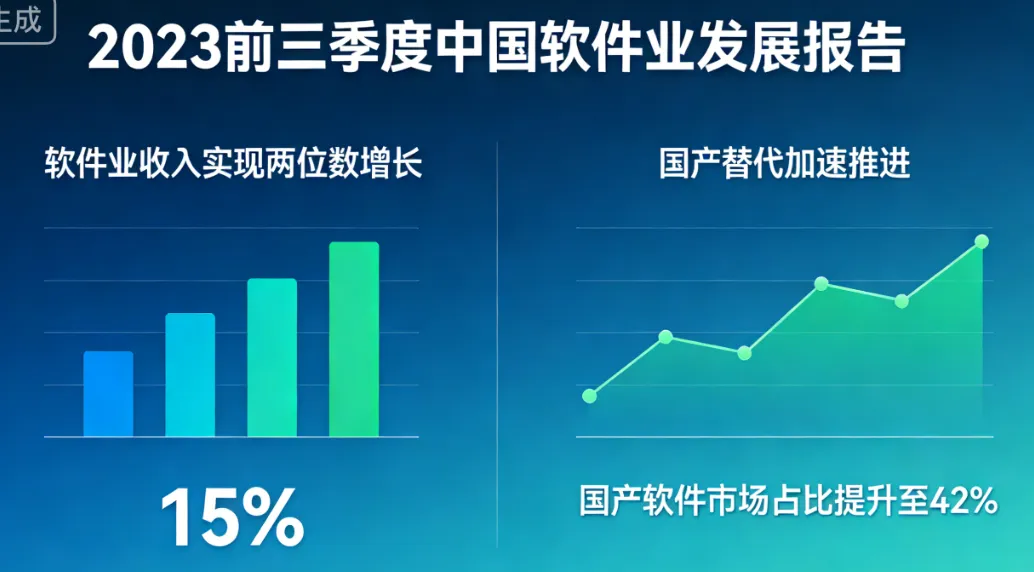
Change of industrial structure: from consumer Internet to industrial Internet
Through in-depth analysis of the operational data for the first three quarters, a clear trend is evident: the growth momentum of the software industry is shifting from the consumer side to the industry side, and penetrating from the application layer to the infrastructure layer. The revenue from information technology services still accounts for half of the country, reaching 5.8 trillion yuan, a year-on-year increase of 14.5%. Among them, cloud computing and big data services have achieved nearly trillion yuan in revenue, a year-on-year increase of 15.8%. Behind this is the rigid demand for enterprise digital transformation to shift from "optional" to "mandatory". More and more traditional enterprises are no longer satisfied with purchasing a single application software, but are turning to a complete set of digital solutions, from resource cloud, data governance to business intelligence, which puts higher demands on the depth and breadth of software services.
What is even more striking is the structural change in software product revenue. In the first three quarters, software product revenue was nearly 2 trillion yuan, a year-on-year increase of 12.2%. Among them, the revenue of industrial software products exceeded 200 billion yuan, a year-on-year increase of 13.2%, higher than the industry average level. The significance of this data goes far beyond the numbers themselves. Industrial software is the "brain" and "nerve" of the manufacturing industry, which has long been monopolized by foreign giants and is one of the most prominent shortcomings of China's software industry. Nowadays, driven by the strong demand for upgrading intelligent manufacturing and the strong guidance of domestic substitution policies, domestic industrial software is moving from "usable" to "user-friendly". A domestic CAD software manufacturer saw a year-on-year revenue growth of over 40% in the first three quarters, with the addition of large equipment manufacturing enterprises among its new customers. This is an important turning point signal.
Regional pattern change: from unipolar drive to multipole resonance
The geographical distribution of the software industry is also undergoing subtle and profound changes. Traditionally, the software industry has been highly concentrated in a few provinces and cities such as Beijing, Guangdong, and Jiangsu. In the first three quarters of this year, although the top regions still maintained steady growth, the performance of the central and western regions and the northeast region was more impressive. Data shows that the software business revenue in the western region increased by 16.8% year-on-year, which is 3.3 percentage points higher than the national average level; The Northeast region saw a year-on-year growth of 14.9%, also outperforming the market. The software business revenue growth rates in provinces such as Hubei, Sichuan, Shaanxi, and Anhui have all exceeded 15%.
This trend towards regional balance is not accidental. On the one hand, with the popularization of digital infrastructure and the maturity of cloud computing, the dependence of software development and delivery on geographical location has significantly decreased; On the other hand, various regions have taken the software industry as the core driver of the digital economy, introduced special policies, built industrial parks, and attracted talent to return. Chengdu's Tianfu Software Park, Wuhan's Optics Valley Software Park, and Xi'an's Software New City have become important sources of software innovation in the central and western regions. The diffusion of industrial agglomeration effects not only alleviates the talent competition pressure in top cities, but also expands broader space for the long-term development of China's software industry.
The Change of Competitive Logic: From Pattern Innovation to Technological Breakthrough
Looking back at the development of China's software industry in the past decade, the dividends of the mobile Internet era were mainly captured by application layer innovation. Domestic software in e-commerce, social networking, payment, travel and other fields not only dominated, but also exported to the global market. However, at the same time, there have been long-term shortcomings in the underlying core technology fields such as basic software, industrial software, and R&D design software, forming an unbalanced pattern of "strong trunk and fragile core brain".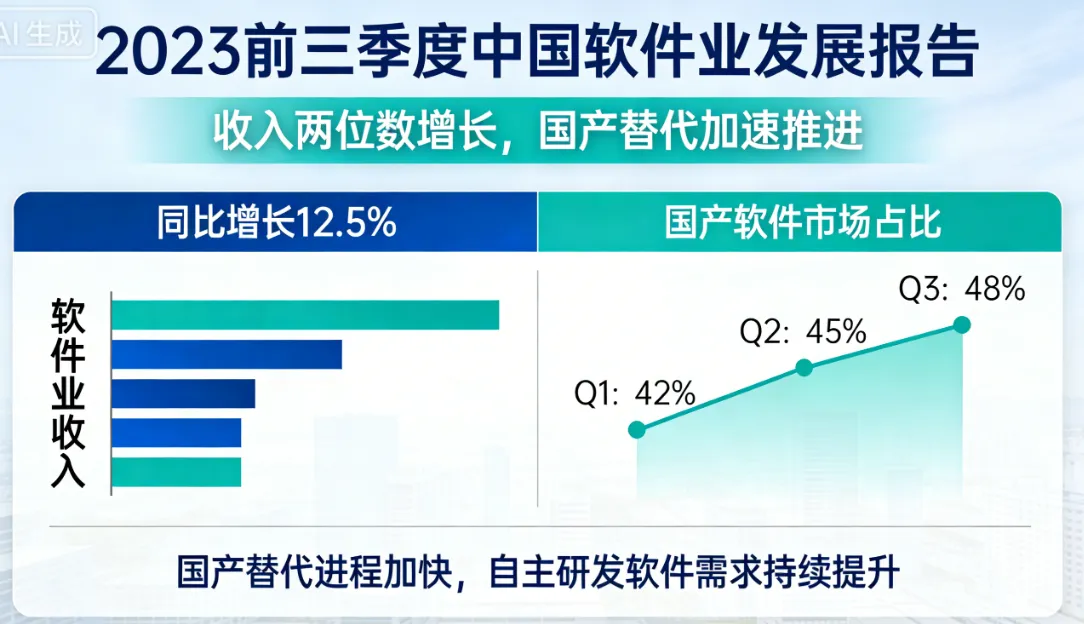
The data for the first three quarters of 2023 sends a positive signal: this imbalance is being broken. In the field of operating systems, the domestic desktop operating system ecosystem continues to improve, with installed capacity exceeding one million, and has formed large-scale applications in key industries such as government, finance, and education; In the field of databases, domestic distributed databases have achieved breakthroughs in high demand scenarios such as financial core trading systems and telecommunications billing systems; In the field of industrial software, research and development design software has made progress in high-end areas such as 3D CAD and CAE, and the localization rate of production control software has significantly increased.
The core driving force behind this transformation is the fundamental adjustment of the competitive logic of software enterprises. In the past, many companies were accustomed to innovating applications on mature technological frameworks, pursuing rapid iteration and scale expansion; Today, more and more software companies are advancing into the deep waters of technology, continuously investing in underlying capabilities such as algorithms, architecture, and engines. In the first three quarters, the R&D intensity of the software industry continued to remain above 10%, higher than the national average level of R&D investment. An industrial software company listed on the Science and Technology Innovation Board has invested over 20% of its revenue in research and development for five consecutive years. The new generation geometric modeling engine launched in the first three quarters of this year has reached the international advanced level in multiple key indicators. This kind of determination to sit on the bench for ten years is being transformed into tangible competitiveness.
The Change of Ecosystem: From Single Point Breakthrough to Collaborative Evolution
Behind the accelerated promotion of domestic substitution is not the simple replacement of a single product for a single product, but the collaborative evolution of the entire ecosystem. In the past, the biggest challenge faced by domestic software was not whether it could be made, but whether it could be used by people. Users are concerned about compatibility, stability, and future services, and would rather pay high costs to use mature foreign products. The solution to this dilemma requires a two-way coordination between the supply and demand sides.
On the supply side, domestic software companies are shifting from "selling products" to "selling services", and from "fighting alone" to "working together". Basic software and application software vendors strengthen adaptation certification and form joint solutions; Deep cooperation between industrial software and equipment manufacturers to polish products in real-life scenarios; The open source ecosystem is becoming increasingly active, and more and more companies are opening up their core code to attract developers to work together to improve it. On the demand side, there has been a fundamental shift in the attitudes of key industry users. In the past, it used to be 'imported instead of domestically produced', but now it is' equally prioritized and moderately advanced '. A large state-owned enterprise has launched a software localization replacement project covering the entire group this year. Not only has it formulated a detailed timetable and roadmap, but it has also mobilized technical backbone to deeply participate in the requirement definition and testing verification of domestic software.
This ecological synergy is forming a positive cycle: users are willing and willing to use it, forcing products to iterate quickly; Improve product maturity and attract more users to join; Expand user base and attract more developers to join the ecosystem. In the first three quarters of 2023, the number of domestic operating system ecosystem partners will increase by over 30%, and the number of contributors to the domestic database community will double. This is an indicator that better reflects the health of the industry than revenue and profit.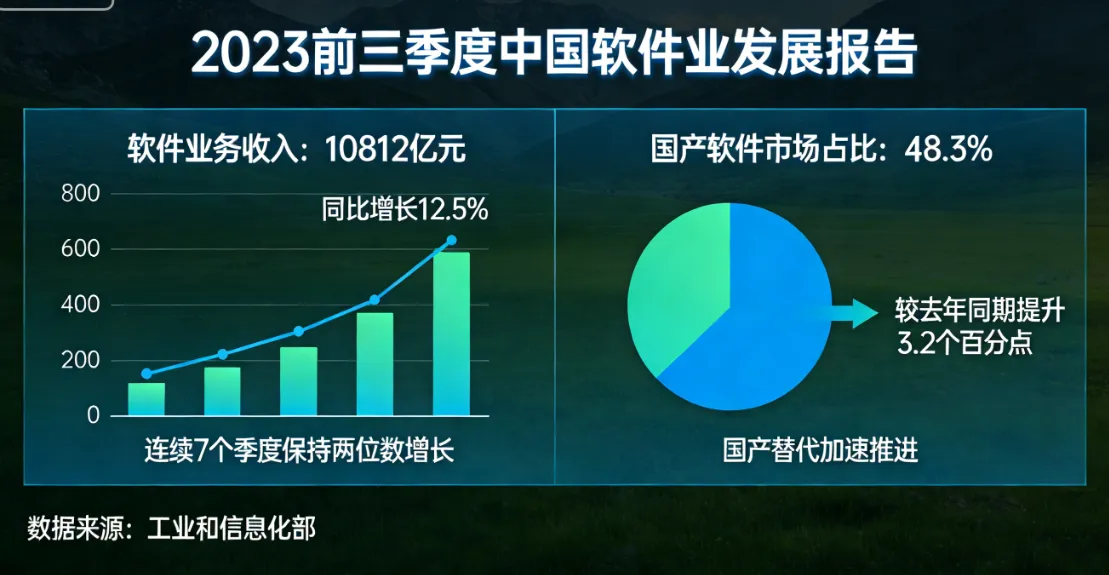
Opportunities and Challenges: The Final Sprint from Big to Strong
Under the backdrop of double-digit growth, the challenges remain severe. From a global coordinate system perspective, China's software industry has ranked among the top in the world in terms of scale, but the problem of being large but not strong has not been fundamentally solved. Among the top 100 global software companies, Chinese companies are few and far between; In core areas such as basic software and high-end industrial software, market share remains highly concentrated; The growth rate of software exports has slowed down, and globalization capabilities need to be improved. The high-quality development of the software industry is a final sprint from big to strong, competing not only in speed and scale, but also in endurance, determination, and innovation.
The performance report of the first three quarters gives us reason to maintain confidence in the future of China's software industry. This confidence not only comes from impressive double-digit growth figures, but also from deep optimization of industrial structure, fundamental transformation of competitive logic, and collaborative evolution of the ecosystem. When more and more software companies are willing to do the "difficult but right things", when more and more users are willing to give domestic software the "opportunity to be chosen", and when policies, capital, and talent form a joint force to gather in core technology fields, the leap of China's software industry from a follower to a leader is no longer an unattainable vision, but a reality that is happening.