
Analysis of 40 Core Advantages of ERP Systems for Small and Medium sized Enterprises | Resource Integration and Management Upgrade
The way for small and medium-sized enterprises to break through in the digital age
In the economic landscape of over 40 million small and medium-sized enterprises in China, digital transformation has shifted from a "multiple-choice question" to a "survival question". Unlike large enterprises with sufficient IT budgets and professional teams, small and medium-sized enterprises have relatively weak foundations in terms of funding, talent, and management, but also face multiple challenges such as intensified market competition, changing customer demands, and rising cost pressures. A set of ERP systems adapted to the characteristics of small and medium-sized enterprises is no longer an exclusive tool for large enterprises, but a strategic lever to help small and medium-sized enterprises achieve resource integration and management upgrading. Based on the practical experience of serving thousands of small and medium-sized enterprises, Shuntong Network has systematically sorted out the 40 core advantages that ERP systems bring to small and medium-sized enterprises. These advantages cover various dimensions such as finance, supply chain, production, sales, human resources, and decision-making, collectively forming a complete capability map for building core competitiveness for small and medium-sized enterprises.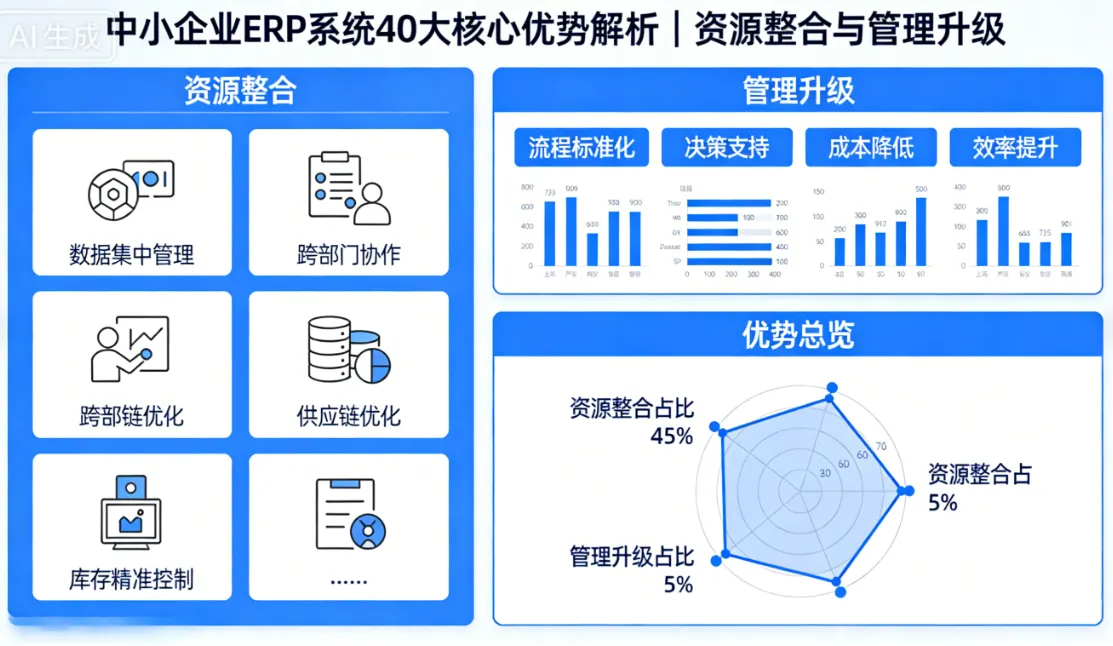
Financial Control: From Confused Accounts to Clear Accounts
Financial chaos is the most common growth bottleneck for small and medium-sized enterprises. The primary value that ERP systems bring to small and medium-sized enterprises is to build a standardized and transparent financial management system.Real time cost accountingEnable enterprises to grasp the true profit of each order and product at any time, bidding farewell to brainstorming at the end of the month;Automatic voucher generationAutomatically convert business documents such as procurement, sales, and inventory into accounting vouchers, freeing financial personnel from duplicate entries;Automatic matching of fund flowEnable intelligent verification of bank statements and accounts receivable and payable, with clear discrepancies between accounts and actual transactions;Multidimensional profit analysisSupport different perspectives on profitability, such as customer, project, department, and salesperson;Budget execution monitoringTransforming post accountability for cost control into in-process warning;Automatic verification of tax risksReduce tax compliance risks through built-in tax differential inspection rules;Mobile ApprovalEnable the boss to complete critical payment approvals no matter where they are;cash flow forecastBased on accounts receivable, accounts payable, and business plans, provide early warning of funding gaps. These eight major financial advantages enable small and medium-sized enterprises to bid farewell to the era of "confused accounts" and truly achieve "clear calculation, manageable, and far sighted".
Supply Chain Collaboration: From Broken Chain to Strong Chain
Supply chain capability is the lifeline for the survival of small and medium-sized enterprises. The ERP system reshapes the supply chain collaboration capability of enterprises by connecting the entire chain of procurement, inventory, and sales.Intelligent procurement suggestionsAutomatically calculate material demand timing and quantity based on production planning, sales forecasting, and inventory upper and lower limits;Supplier Performance EvaluationThe system records on-time delivery rate, quality qualification rate, and price stability, providing quantitative basis for procurement decisions;Inventory turnover warningAutomatically identify stagnant materials and overstocked inventory, and release occupied working capital;Batch and expiration date managementEnable food, chemical, and pharmaceutical enterprises to achieve precise first in, first out and reduce expiration losses;Automatic conversion of multiple units of measurementResolve the conversion difficulties between different purchasing units, production units, and sales units;Intelligent allocation of multiple suppliers for one productAutomatically split orders based on procurement strategies to diversify supply risks;Visible inventory in transitEnable procurement personnel to keep track of the status of orders placed but not yet delivered, in order to avoid duplicate purchases;Barcode scanning for inbound and outbound storageImprove warehouse operation efficiency by more than three times, while reducing error rates to below one thousandth. These eight supply chain advantages help small and medium-sized enterprises transform fragile single chains into robust supply networks, finding the best balance between stockouts and backlogs.
Manufacturing: From Black Box to Transparency
For production-oriented small and medium-sized enterprises, the workshop is often a management "black box". The ERP system makes the production execution process transparent and refined.Schedule production according to ordersAutomatically convert customer orders into production work orders to ensure production is based on sales;Accurate calculation of material requirementsAutomatically expand according to BOM to avoid over procurement and under procurement;Process level progress trackingReal time feedback on which process each work order is currently in, who is operating it, and the completed quantity;Automatic calculation of piece rate wagesLinking with production reporting data, real-time conversion of worker output into salary, and stimulating motivation;Visible inventory of work in progressLet managers have a clear understanding of how many assets are "sleeping" on the production line;Collaborative outsourcing processingInclude outsourced vendors in unified management, with full control over the entire process of material issuance, receipt, and reconciliation;Equipment efficiency monitoringBy collecting equipment operating status, calculating OEE comprehensive efficiency, and identifying production capacity bottlenecks;One click quality traceability queryBy tracing the raw material batch, production team, and inspection records from the finished product, we have a clear understanding when dealing with customer complaints. These eight production advantages have enabled small and medium-sized enterprise workshops to upgrade from "experience based management" to "relying on data to speak", improving their comprehensive output capacity by more than 20% without increasing hardware investment.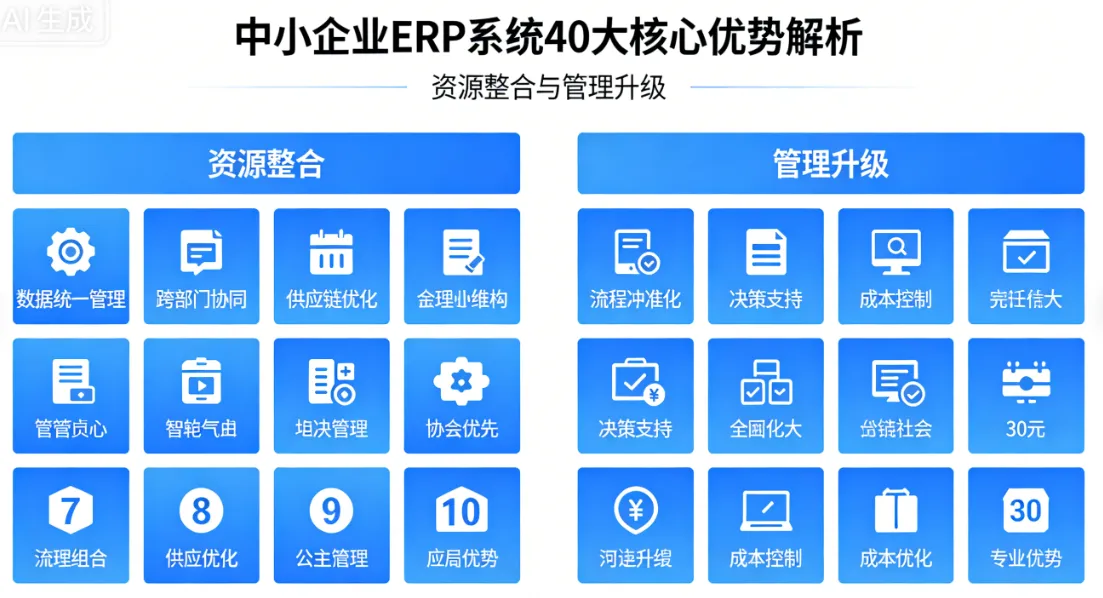
Sales and Customers: From Transactions to Relationships
Against the backdrop of continuously rising customer acquisition costs, deep management of customer relationships has become the key to reducing costs and increasing efficiency for small and medium-sized enterprises. ERP system empowers enterprises to build a customer-centric value management system.Customer lifecycle managementComplete recording of every interaction from clues, business opportunities, quotations, orders to after-sales service;Automatic control of credit limitReal time interception of over credit shipments based on customer payment history and credit policies;Flexible configuration of price systemSupport various strategies such as customer level pricing, batch tiered pricing, promotional pricing, and expiration date pricing;Closed loop return and after-sales processTransforming customer complaints into inputs for quality improvement;Sales targets and performance benchmarkingEnable salespeople to keep track of task completion progress at all times;Analysis of Product Profit ContributionIdentify which products are profit pillars and which products are profit traps;Customer churn warningIdentify high churn risk customers in advance based on order frequency and changes in order amount;Mobile orderingEnable sales representatives to complete order entry at the customer site and seize immediate business opportunities. These eight sales advantages help small and medium-sized enterprises shift from "one-time transactions" to "sustainable relationships", significantly enhancing customer lifecycle value.
Human Resources: From Statistics to Development
People are the most important asset for small and medium-sized enterprises, but traditional personnel management often stays at the level of attendance and salary calculation. ERP system promotes the upgrade of human resource management from transaction processing to talent development.Organizational structure and job systemClearly define reporting relationships and responsibility boundaries;Employee full career cycle fileComplete records of the entire process of onboarding, training, job transfer, promotion, and resignation;Intelligent association between attendance and schedulingAutomatically calculate working hours and overtime;Performance evaluation and salary linkageReal time conversion of assessment results into performance bonuses;Training plan and execution loopSupport tracking of employee skill improvement;Labor costs are allocated by projectAccurately collect personnel expenses into cost objects;Labor contract and license expiration warningAvoiding employment compliance risks;Employee self-service platformAllow employees to independently check their salaries, apply for leave, submit reimbursements, and release HR transactional work. These eight human resource advantages have upgraded small and medium-sized enterprises from "employing people" to "nurturing people", transforming human resources from a cost center to a value creation center.
Decision Support: From Intuition to Data
Small and medium-sized enterprise owners are often the strongest business experts in the enterprise, but as the scale expands, personal experience is difficult to cover all business dimensions. ERP systems equip enterprises with a 'data cockpit'.Manage panoramic signageReal time presentation of core indicators such as sales revenue, receipts, gross profit, inventory, and expenses;Abnormal Warning CenterAutomatic alerts for abnormal situations such as negative gross profit orders, overdue accounts receivable, and below safety stock;Trend analysis chartDisplay trend information such as three-year comparison, month on month growth rate, and target achievement rate;Structural Analysis PerspectiveUnderstand the detailed distribution of income composition, cost composition, expense composition, and profit composition;DuPont analysis modelDecompose the return on equity layer by layer and identify the key factors that affect profitability;cash flow forecastBased on the order funnel and accounts receivable and payable, predict the future financial situation;Mobile reportEnable managers to grasp business dynamics in fragmented time;Custom cockpitConfigure exclusive dashboards according to role requirements, with the sales director looking at pipelines, the production manager looking at output, and the finance director looking at funds. These eight decision-making advantages help small and medium-sized enterprise managers upgrade from "making decisions based on intuition" to "making decisions based on data", capturing opportunities for certainty in uncertainty.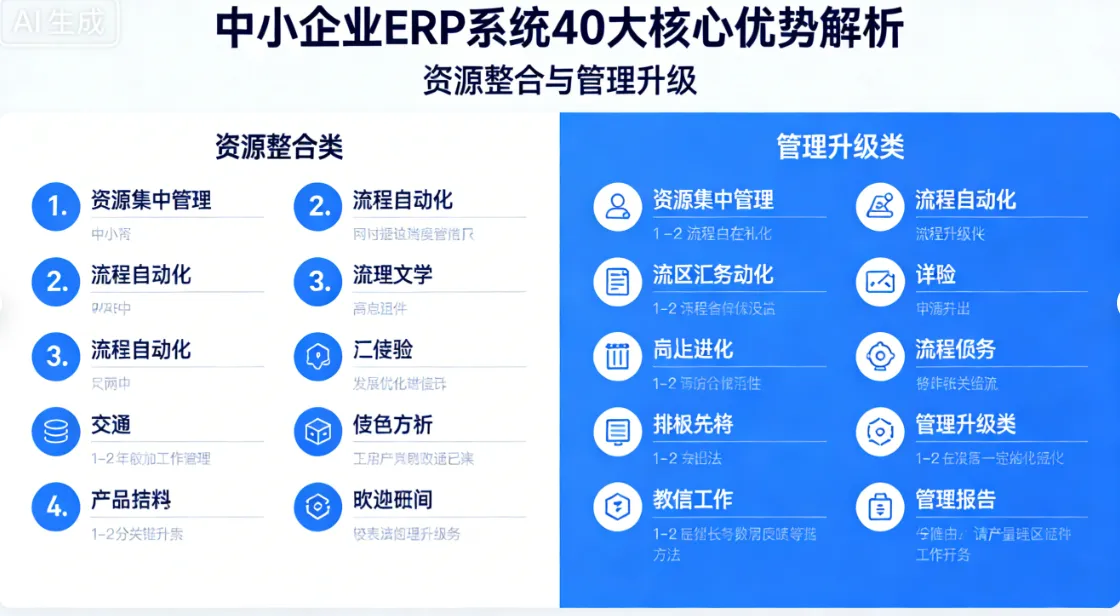
The transition from tools to abilities
The above 40 core advantages are not isolated functional stacks, but an organic whole that is interrelated and mutually reinforcing. The homogeneity of financial and business data ensures consistency between business and finance, the integration of production and supply chain ensures production and sales coordination, the accumulation of sales and customer data supports precision marketing, and the refinement of human resources provides organizational support for business expansion. When these capabilities operate systematically on the same platform, small and medium-sized enterprises not only receive a set of software tools, but also a set of replicable, evolving, and sustainable digital management systems.
Through serving thousands of small and medium-sized enterprises, Shuntong Network has deeply realized that the value of ERP systems lies not in the number of functions, but in their deep adaptation and continuous application to enterprise business scenarios. For small and medium-sized enterprises, the 40 core advantages are not the endpoint, but the starting point. When enterprises establish a standardized, transparent, and efficient operational foundation through ERP systems, they have the core ability to transform and upgrade towards intelligence, service, and platformization. This is precisely the key password for small and medium-sized enterprises to break through growth bottlenecks and achieve long-term success.