
Software Development Preparation Steps: Detailed Explanation of 10 Key Contents
The success of software development begins with meticulous preparation
In today's era of digital transformation sweeping across various industries, software development has become a key means for enterprises to build their core competitiveness. However, a large number of software development projects end in failure, often due not to coding issues, but to a lack of solid preparation before starting to write the first line of code. The so-called 'sharpening the knife does not hinder the chopping of wood' requires sufficient, systematic, and rigorous software development preparation, which is a prerequisite for ensuring the smooth progress of projects, controlling risks, and achieving expected goals. Based on over ten years of project experience serving thousands of clients, Shuntong Software has systematically identified ten key steps in the software development preparation phase, providing actionable methodological guidance for enterprises that are about to launch software projects.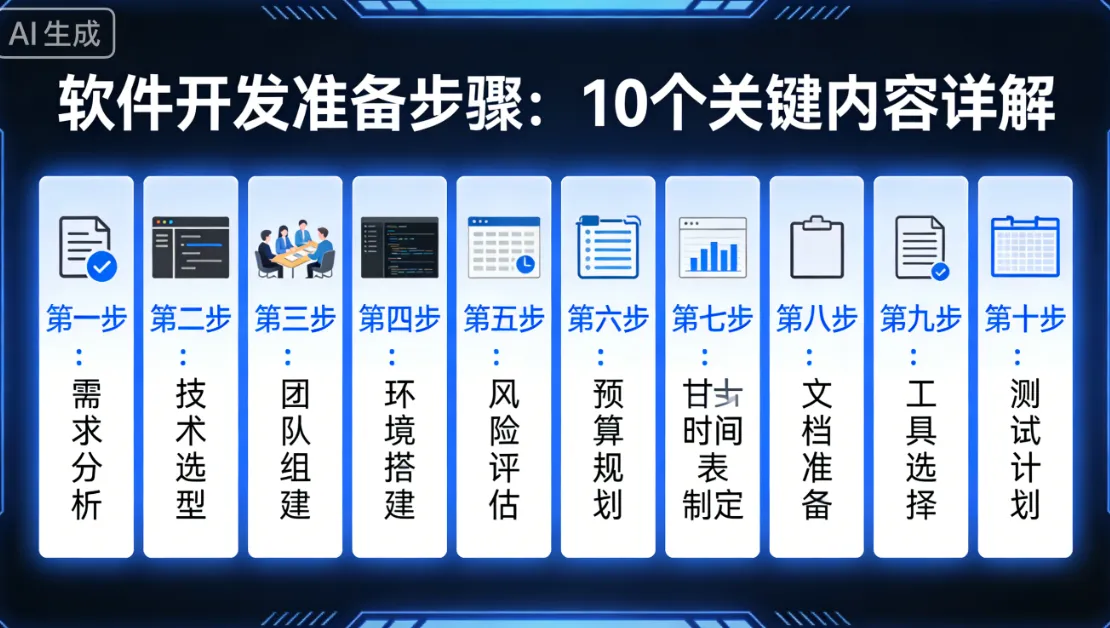
Requirement research: From vague ideas to clear portraits
The first and most crucial step in software development is to conduct systematic and structured research and organization of requirements. The mission of this stage is to answer a fundamental question: what problem do we really need to solve? Requirement research is not simply asking users what features they want. An excellent approach is to delve into real business scenarios, observe the complete workflow of users, understand the pain points and bottlenecks of existing models, and gain insight into potential needs that have not been explicitly stated. The research subjects should cover stakeholders of different levels and roles, including senior managers who focus on strategic value, middle-level managers who focus on control efficiency, and frontline executors who focus on operational convenience.
The output of requirement research is a complete requirement research report, which includes a description of the current business situation, summary of core pain points, definition of user roles, and restoration of key scenarios. This report serves as the input point for all subsequent work, and its quality directly determines whether the project direction is correct. Before starting the development of the production execution system, a manufacturing enterprise's project team stayed in the workshop for two weeks, fully tracking the 37 links from order issuance to finished product warehousing, and discovering seven efficiency black holes that the management was completely unaware of before. These insights become the core value points for subsequent system design.
Requirement analysis: from business language to product logic
After collecting the original requirements, the next key step is to systematically analyze, filter, classify, and transform them. The core task of requirement analysis is to transform the "what I want" described by business personnel into "what the system should do" understood by product personnel, and further into "how to implement the code" that technical personnel can execute. This is a progressive and constantly concrete process.
Requirement analysis first requires prioritization. The resources and time of any project are limited, and it is necessary to distinguish which are the core requirements of "not doing it will not survive", which are the enhancement requirements of "doing it will be better", and which are the extension requirements of "considering it in the future". The classic MoScoW method - must have, should have, can have, and will not have - is an effective tool for this stage. Next is the identification and coordination of demand conflicts. There may be inherent contradictions in the needs of different departments and roles. The sales department hopes that orders can be changed freely, while the production department hopes that plans will be frozen and no longer adjusted. This requires the product manager to mediate and find the optimal balance point. The final delivery is the requirement specification document, which translates business requirements into a clear list of functions, business rules, data requirements, and performance indicators. This is the core work basis for the development and testing teams.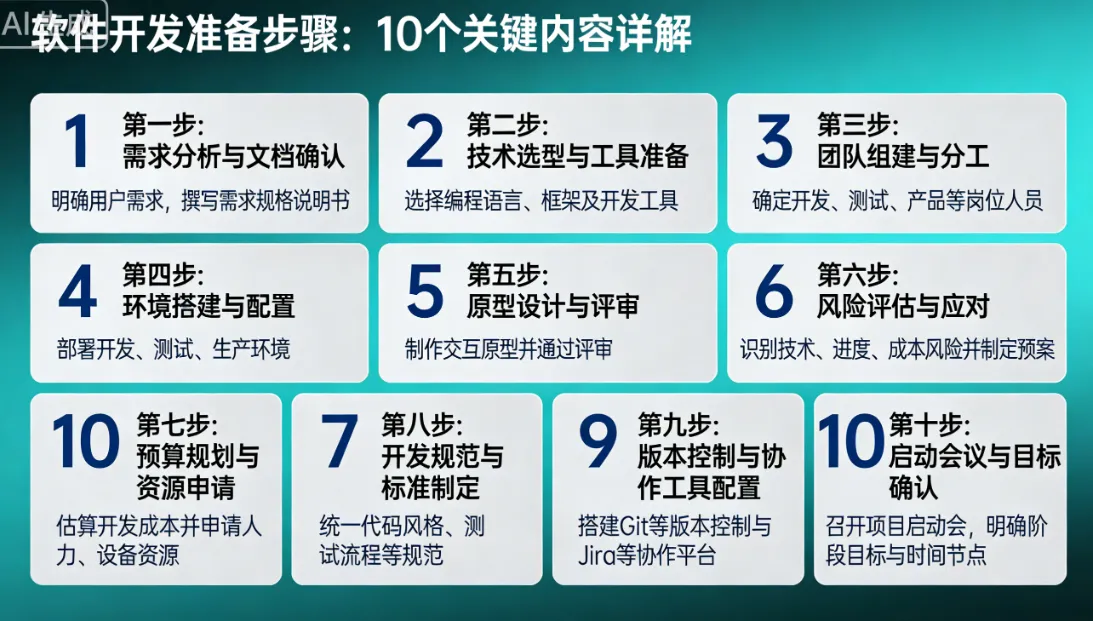
Feasibility Study: Predicting Risks Before Investment
Before formal project approval, a comprehensive and careful evaluation of the feasibility of the project must be conducted. The purpose of this step is to avoid investing resources into projects that do not meet the conditions for success from the beginning. Feasibility studies typically cover four dimensions: technical feasibility, economic feasibility, operational feasibility, and legal compliance.
Technical feasibility assessment: Whether the existing technical architecture and development team capabilities are sufficient to meet the technical challenges of the project, and whether there are any technical difficulties that need to be overcome in advance; Calculate the total investment and expected returns of the economic feasibility project, conduct investment return analysis, and provide quantitative basis for business decision-making; Whether the operational feasibility assessment system has the corresponding organizational capabilities, personnel skills, and operational support after its launch; Legal compliance focuses on specific industries or functions, examining whether there are legal risks related to data security, intellectual property, industry access, and other aspects. Before investing heavily in the development of a new system, an Internet finance start-up company discovered the risk of patent infringement of core algorithms in advance through feasibility study, adjusted the technical route in time, and avoided tens of millions of potential losses.
Prototype design: visualizing abstract requirements
The requirement specification document described in text has a natural limitation - there are a thousand Hamlets in the eyes of a thousand readers. To ensure a highly consistent understanding of the requirements among all parties involved in the project, prototype design is an essential and critical step. Prototype is the process of transforming abstract requirements into visual interfaces, allowing users to perceive the form, process, and interaction of the product in advance before actually seeing the runnable software.
Prototype design is usually divided into two stages: low fidelity prototype and high fidelity prototype. The low fidelity prototype is presented in the form of a wireframe, focusing on page layout, information architecture, and operational processes, without caring about visual details, making it easy to quickly adjust and iterate; High fidelity prototypes are produced after low fidelity confirmation, approaching the visual effects and interactive feedback of the final product, for final confirmation and user testing. Prototype is not only a communication tool, but also a requirement verification tool. When users simulate operations on the prototype, they often discover many unexpected scene omissions and logical flaws. During the prototype demonstration phase of a certain e-commerce platform, the operators suddenly realized that there was a logical loophole in the stacking rule of member points and coupons. If this problem is discovered only after the development is completed, the repair cost will be tens of times higher than it is now.
Technical selection: Choose appropriate tools for the project
Technology selection is a key decision that determines the technical direction of a project, and its impact runs through the entire project and even the entire lifecycle of the system. Selection is not simply about choosing between several popular frameworks or databases, but requires comprehensive consideration of project characteristics, team capabilities, ecological maturity, community activity, long-term maintenance costs, and other multidimensional factors.
Technology selection usually covers multiple levels such as development language, front-end framework, back-end architecture, database, server, third-party services, etc. For the development of management software for small and medium-sized enterprises, stability, reliability, complete ecology, and easy access to talent are the top priorities; For Internet high concurrency scenarios, high performance and high scalability become core indicators; For sensitive industries such as finance and healthcare, safety and compliance are the bottom line that cannot be compromised. The technology selection meeting should invite technical leaders, architects, and core developers to participate together, and form a decision memorandum based on sufficient argumentation, clarifying the reasons for selection, applicable scenarios, and alternative solutions. There is no absolute right or wrong selection, the key is whether it matches. Forcefully applying a technology stack suitable for short video live streaming platforms to manufacturing ERP systems could be a catastrophic mismatch.
Architecture design: Building the skeleton of the system
If requirements are the soul of software, architecture is the skeleton of software. The task of the architecture design phase is to integrate dispersed functional requirements into an organic whole, define macro level design decisions such as module division, hierarchical structure, interaction interfaces, and data flow of the system. Excellent architecture design can balance current business needs with future expansion possibilities, finding the right balance between flexibility and stability.
Architecture design typically includes four levels: business architecture, application architecture, data architecture, and technical architecture. Business architecture describes how a system supports an organization's business processes from a business perspective; Define the module division and inter module relationships of the application architecture system; Design core data entities and data storage solutions for data architecture; The technical architecture will implement the first three architectures into specific technical solutions. The output of architecture design is the system architecture design document, which is the technical constitution of the development team. All subsequent development work should be carried out within the architecture framework. Architecture review should invite technical experts and business representatives to participate together, and conduct rigorous questioning from multiple dimensions such as scalability, maintainability, performance, and security. A good architecture can handle changes in requirements with ease, while a poor architecture can make every requirement adjustment difficult.
Task decomposition and time estimation: Transforming blueprints into executable plans
After the requirements are clear and the technical solution is determined, the system development work needs to be decomposed into specific, executable, and measurable development tasks, and the workload of each task needs to be scientifically estimated. This step is a key milestone in advancing the project from 'what to do' to 'who will do it and when to complete it'.
Task decomposition follows the principle of top-down and gradual refinement, breaking down the entire system into subsystems, modules, and functional points until the atomic tasks cannot be further divided. Each atomic task should have clear definitions, clear acceptance criteria, reasonable work hour estimates, and responsible personnel. The estimation of working hours is the most challenging aspect of this stage. Developers naturally tend to be optimistic and tend to overlook implicit costs such as debugging, testing, documentation, communication, and collaboration. Scientific estimation methods include analogy estimation based on historical project experience, parameter estimation based on code lines or functional points, and three-point estimation that comprehensively considers optimistic, pessimistic, and most likely scenarios. Task breakdown structure and work breakdown structure are the foundation of project management, as well as the basis for subsequent progress tracking, resource allocation, and performance evaluation.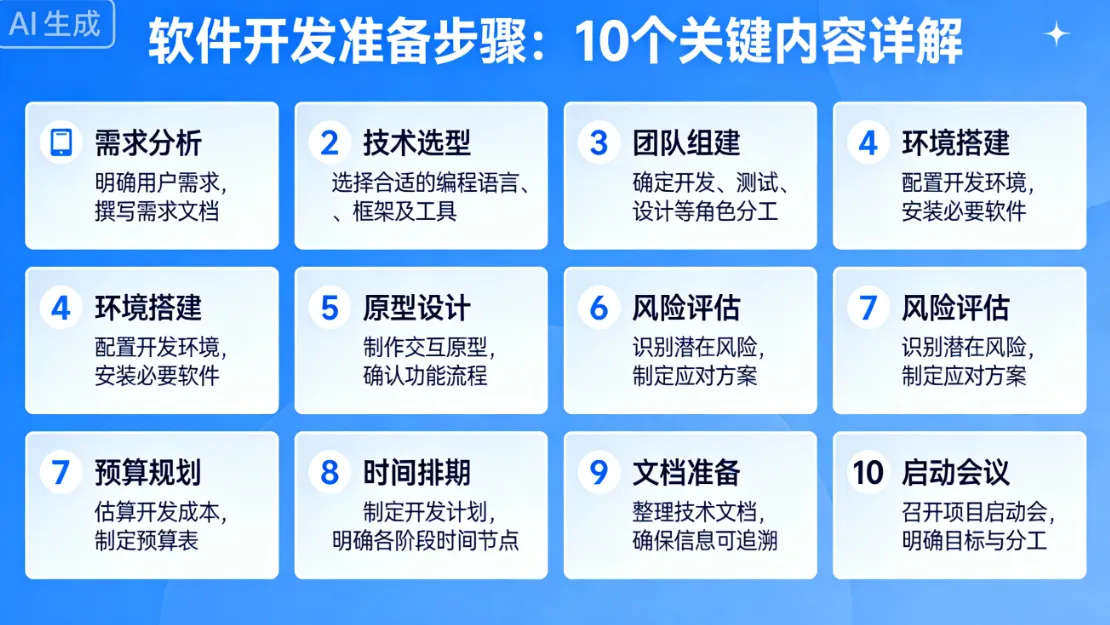
Development environment preparation: paving the way for efficient coding
Building a stable, consistent, and efficient development environment before formal coding begins is an underestimated but crucial step. The development environment includes infrastructure such as code version control system, project dependency management, local development environment configuration, database environment, interface simulation service, and continuous integration pipeline.
Code version control is the cornerstone of the development environment, and Git has become a de facto standard. Clear branch management strategies such as Git Flow or Trunk Based Development need to be developed, with clear collaboration specifications for feature development, defect fixing, and version release. Dependency management ensures that all developers use the same version of third-party libraries, avoiding the awkward situation of 'running on my computer'. Continuous integration pipeline enables automatic building, testing, and deployment of code after submission, delegating repetitive labor to machines and allowing developers to focus on creative work. The quality of development environment preparation directly affects development efficiency and code quality. A certain entrepreneurial team did not pay attention to environmental consistency in the early stages of project initiation. Six developers used six different versions of databases and middleware, and during the joint debugging phase, a large number of compatibility issues were discovered, forcing them to shut down for two weeks to unify the environment.
Team building and role division: the right people do the right things
Software development is a product of team collaboration, and human factors are often the biggest variable in the success or failure of a project. Before the official start of development work, it is necessary to complete the formation of the project team and clarify the role positioning and responsibility boundaries of each member. A typical software development team includes roles such as product manager, project manager, architect, front-end developer, back-end developer, testing engineer, UI designer, and operations engineer.
For small and medium-sized projects, one person may have multiple responsibilities, but the duties must be clear. The product manager is responsible for ensuring the correctness of requirements and ensuring that the team is doing the right thing; The project manager is responsible for the controllability of the progress and ensuring that the team is doing things correctly; Architects are responsible for the rationality of technical solutions; Development engineers are responsible for the quality of code implementation; The testing engineer is responsible for ensuring the reliability of the deliverables. Team building is not only about staffing, but also about shaping culture. The self-organization, continuous improvement, and user collaboration advocated by agile development should become a team consensus. The first project kickoff meeting is not only a deployment of work tasks, but also an opportunity to establish a common vision and unite team morale. Research has shown that project success rates in teams with clear role cognition and high cohesion are 2.3 times higher than those in loose teams.
Project charter release: officially kicking off the development process
The final step in preparing for software development is to formally release the project charter, announcing the project's official approval and the start of the development phase. The project charter is an authoritative guiding document, usually issued by the project initiator or senior management, which clarifies the business objectives, core scope, key milestones, budget constraints, major risks and response strategies, project team authorization, and other core elements of the project.
The value of a project charter lies in giving legitimacy to the project and declaring to all members of the organization that it is an important project that has gained recognition and support from senior management; Granting authority to project managers to coordinate resources and make decisions; Establish a common sense of purpose and urgency for all participants, and stimulate their willingness to invest. After the release of the project charter, organize a formal kickoff meeting and invite senior leaders to attend the platform to convey the significance and expectations of the project to all project members. This is not formalism, but a crucial ceremony for establishing project status, building team consensus, and gaining organizational support. At this point, all ten key steps in the software development preparation phase have been completed, and the project has officially met all the conditions to enter the coding implementation phase. The foundation has been solidified, the blueprint has been drawn, and the team has gathered. The next step is to gradually transform the concept into a real, usable, and valuable software product.