
Intellectual Property Work Management System - Detailed Explanation of Functions and Features
The Challenges of Core Asset Management in the Knowledge Economy Era
In today's era where innovation driven development strategies are deeply implemented and the knowledge economy is thriving, intellectual property has become the most essential intangible asset and competitive weapon for enterprises. Patents, trademarks, copyrights, trade secrets - these intellectual achievements not only carry the innovation value of enterprises, but also directly relate to market exclusivity, brand premium power, and capital valuation level. However, compared to tangible assets, the management complexity of intellectual property rights increases exponentially: application cycles can last for several years, legal status dynamically changes, annual fees need to be accurately calculated, evidence of rights protection needs to be fully preserved, and reward rewards need to be fulfilled in compliance. The traditional management method that relies on spreadsheets and paper archives is completely inadequate when facing hundreds or thousands of intellectual property assets. The Shuntong Intellectual Property Work Management System is designed to solve this management dilemma. It focuses on the full lifecycle management of intellectual property and integrates functions such as process automation, intelligent deadline warning, multi-dimensional asset analysis, and collaborative office support. It provides a one-stop and refined digital management platform for innovative enterprises, research institutes, and intellectual property service institutions.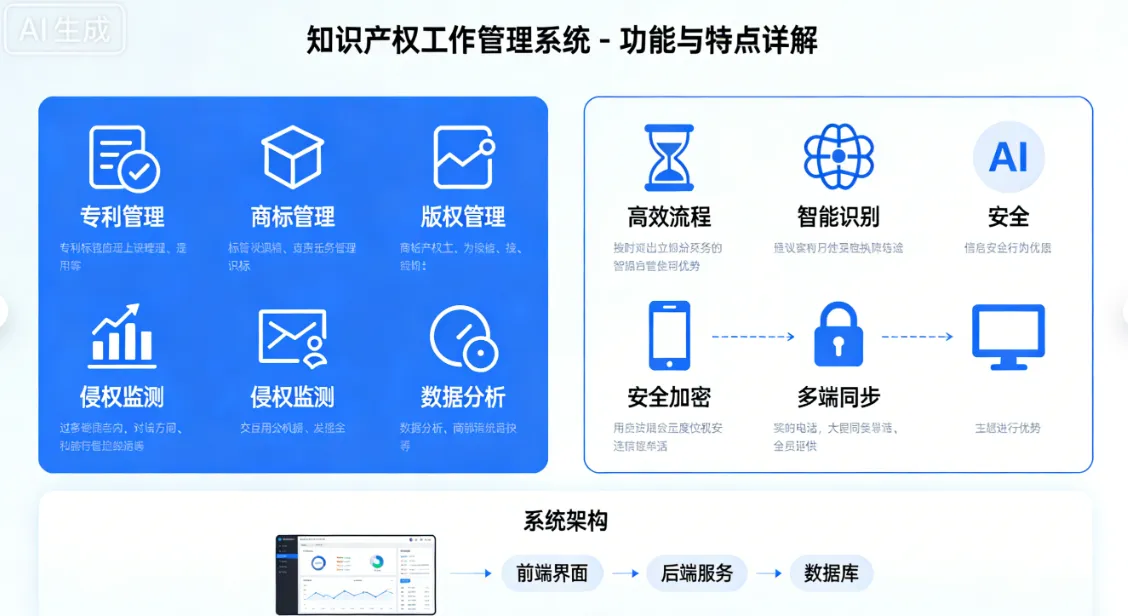
Patent lifecycle management: from creativity to rights and then to assetization
Patent management is the most complex and core module of the intellectual property system, covering the entire process from invention and creative disclosure, disclosure writing, application document preparation, examination opinion response, authorization registration, annual fee maintenance to patent operation. The Shuntong system breaks the limitations of traditional segmented management and integrates patent processes scattered among different personnel and stages into a continuous and visible lifecycle management mainline.
Inventors can submit transaction cases online through the system, fill in information such as technical fields, innovation points, commercial value, and upload attachments such as technical disclosure documents and experimental data. After online acceptance, the patent engineer conducts preliminary duplication check and patentability evaluation. The system supports the interface docking with the public database of the China National Intellectual Property Administration, and automatically retrieves the comparison documents. After entering the application process, the system automatically generates standardized documents such as fee reduction certificates, agency authorization letters, and application requests based on preset templates, greatly reducing the workload of copywriting. After the application is submitted, the system enters a dynamic process monitoring state: whether the acceptance notice is returned, whether the public date is approaching, whether the deadline for the actual review request is sufficient, and whether the review opinion notice is processed - each node is included in the system tracking scope. Of particular note is the intelligent deadline warning function, which incorporates nearly a hundred statutory deadline calculation rules based on the Patent Law and its implementation regulations. From the priority period, actual examination request period, authorization registration period, and annual fee payment period, the system automatically calculates the deadline and provides hierarchical warnings. After a certain technology enterprise applied the system, the rate of patent annual fee underpayment decreased from 7.2% to zero, resulting in an annual savings of over 500000 yuan in late fees and restoration fees.
Standardized management of trademarks and copyrights: guardians of brand assets and original achievements
The trademark management module focuses on the institutionalized maintenance of brand assets. The system supports the full process management of trademark selection, distinctiveness evaluation, category selection, application for registration, and renewal and change. In response to the complex scenario of multinational corporations registering in multiple countries and categories, the system has constructed a data model centered on the "trademark family". The extension registration, defense registration, and international registration of a basic trademark can all be presented in association, clearly demonstrating the overall global brand layout. Evidence management is the fundamental support for trademark rights protection. The system supports the regular collection, classification, and storage of usage evidence such as product packaging, promotional materials, sales receipts, exhibition photos, etc. with trademark logos, and associates them with corresponding trademark registration numbers. When facing a withdrawal application or infringement lawsuit, evidence can be packaged and presented within minutes, whereas in traditional models, this process often takes several weeks.
The copyright management module is applicable to the registration and certification of various works such as software copyright, written works, art works, audio-visual products, etc. The system provides standard upload formats and naming conventions for source programs, manuals, design drafts, and creative drafts, and automatically generates file packages that meet the requirements of the copyright registration center. For high-frequency and fragmented creative content in the Internet environment, the system integrates trusted timestamp and blockchain certificate storage technology to generate tamper proof evidence for the originator immediately after the creation of the work, significantly reducing the difficulty of providing evidence afterwards. A design company successfully responded to three third-party infringement complaints after applying the evidence storage function, all of which were quickly processed due to the completeness and effectiveness of the evidence stored.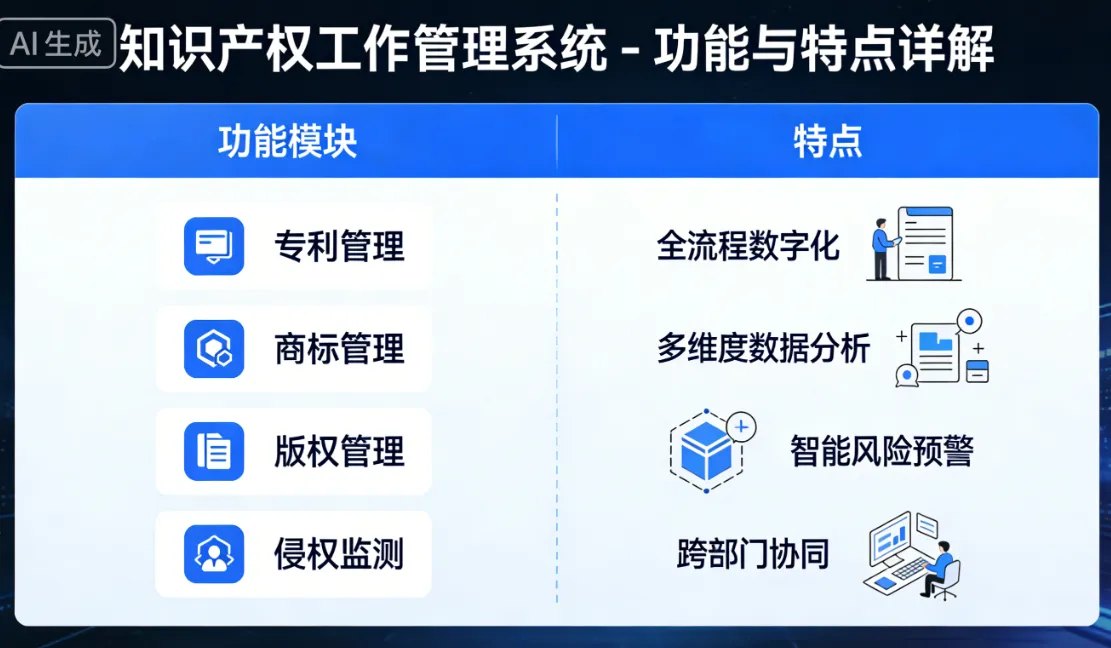
Dynamic inventory of intangible assets: from static ledger to operational dashboard
Many companies spend a lot of costs every year to maintain the validity of patents and trademarks, but it is unclear how much value these assets actually create. The asset management module of Shuntong system elevates intellectual property from "legal affairs archives" to "business decision data". The system constructs a multidimensional asset value evaluation model, integrating more than 20 evaluation indicators from three major categories: technical dimension, legal dimension, and market dimension. The technical dimension considers the number of patent citations, the size of patents in the same family, and the technology lifecycle; Consider the remaining protection period, invalid review history, and stability of rights from a legal perspective; Market dimension considers license transfer records, product correlation, and industry standard correlation. The system regularly updates various indicators and generates asset health scores and value stratification reports.
Based on the value assessment results, the system supports asset classification and management strategies. Core assets adopt the highest level of maintenance standards, with dedicated personnel monitoring, priority renewal, and key operations; Maintain reserve assets in the lowest cost-effective state and regularly evaluate the timing of disposal or abandonment; Automatic push disposal suggestions for idle assets, realizing value realization through open licensing, technology transfer, or valuation investment. After applying the asset analysis function of the system in a certain research institute, 76 "dormant patents" that have been maintained for a long time but have no conversion value were identified. They were decisively abandoned and saved more than 300000 yuan in maintenance costs every year. At the same time, the released budget was reinvested into the cultivation of high-value patents.
Process collaboration and role portal: professional collaboration that breaks down departmental barriers
Intellectual property management involves the collaboration of multiple roles such as inventors, IP specialists, legal, financial, and external agencies. Cross departmental communication costs often account for a significant proportion of the total management cost. The Shuntong system reconstructs the linearly connected workflow into a parallel collaborative value network through process engine and role portal design.
The inventor portal focuses on proposal and status tracking, with a clear display of the current progress, official status, and pending tasks of each individual invention proposal list. The IP specialist portal is the command center for daily work, where proposals awaiting review, notifications awaiting transmission, annual fees pending payment, and trademarks awaiting renewal are presented in a centralized and graded manner, requiring manual intervention. The management portal provides a decision-making dashboard that displays real-time application trend charts, authorization rate analysis tables, expense structures, and geographical layout heat maps. External agencies can log in to the system through a dedicated channel, receive commissioned tasks online, upload official documents, and declare agency fee bills. All interactive data is automatically associated with the corresponding case file, forming a complete record of agency services. After the application system of a certain group type enterprise, cross departmental communication emails for intellectual property decreased by 70%, and the average case circulation cycle was shortened by 23 days.
Fine tuned control of expense budget: from passive payment to proactive planning
Intellectual property fees have the characteristics of multiple types, long cycles, and dispersed amounts, making them a difficult area in financial management. The Shuntong system has moved expense control from "post reimbursement" to "pre budgeting". The system has a built-in official fee standard library, covering various official fee items and amounts such as patents, trademarks, integrated circuit layout designs in China and major countries and regions, and updated in real-time with policy adjustments. The agency service fee supports custom configuration based on case type, agency, and service content.
When preparing the annual budget, the system automatically calculates the next year's expenditure requirements based on the existing asset portfolio and expected new application volume, including application fees, review fees, authorization fees, annual fees, renewal fees, agency fees, and other comprehensive cost components. During the budget execution process, each expense is associated with the budget item, and the system automatically monitors the execution progress. If the budget threshold is exceeded, it will automatically alert and freeze the approval of new expenses. The cost sharing function supports automatic splitting of jointly applied patent fees to each applicant according to the agreed ratio, and generates internal settlement documents. After the application of the system cost module in a multinational company's China R&D center, the accuracy of the annual intellectual property budget increased from 67% to 92%, and the number of additional applications outside the budget decreased by 80%.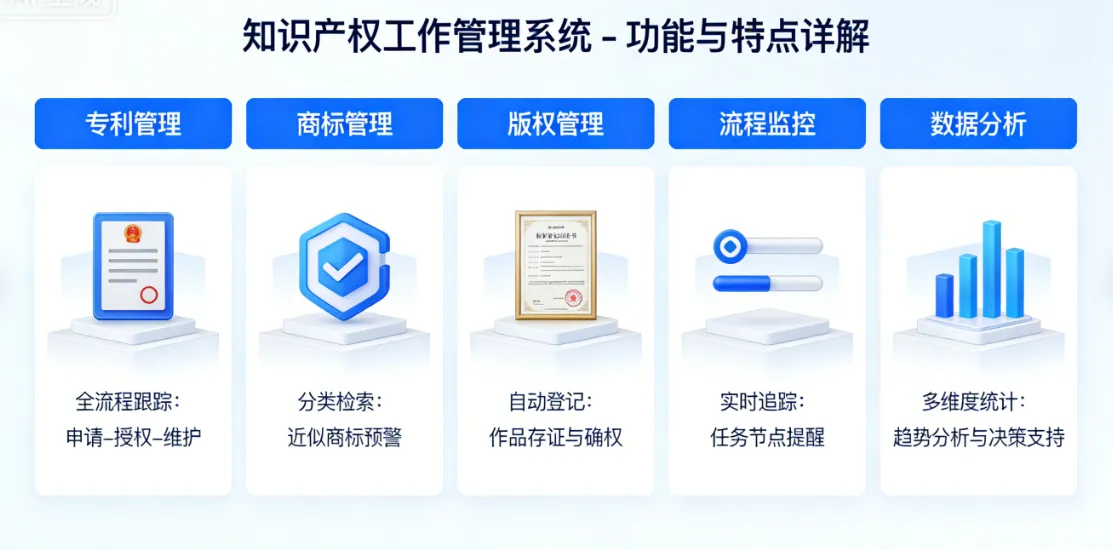
Digitalization empowers the creation of intellectual property value
The Shuntong Intellectual Property Work Management System not only serves as a tool for improving process efficiency, but also as an empowering platform for releasing the value of enterprise innovation achievements. It transforms intellectual property from professional documents in the legal department to visible, perceptible, and collaborative business resources for all employees; Integrate information fragments scattered across different systems, carriers, and personnel into complete, dynamic, and analyzable intellectual property big data. When the birth process of each patent is fully recorded, the evidence of the use of each trademark is systematically retained, and the origins of each expense are clear and traceable, intellectual property management completes the essential transition from "passive response" to "active operation", from "cost consumption" to "value creation". In today's era where innovation driven development has become a national strategy and intellectual property is increasingly becoming a core competitiveness, such digital infrastructure is rapidly evolving from an "optional" option for innovative organizations to a "mandatory" one.