
Piece rate traceability: a solution to reduce the five major costs of enterprises
The Management Revolution from Fuzzy Allocation to Precise Accounting
In labor-intensive manufacturing, piece rate wages are the most common and direct way of salary distribution. It closely links workers' income with output quantity, appearing fair and reasonable, with clear incentives. However, the traditional piece rate management model hides profound systemic flaws: production statistics rely on manual filling, data lag and are prone to distortion; Quality responsibility is difficult to trace, and defective products and rework cannot be accurately attributed; Unclear circulation of work in progress and inflated inventory of semi-finished products; Lack of data support for labor price determination and frequent labor disputes. The essence of these problems is the same - the lack of precise correlation records between the "human, machine, material, and method" elements in the production process and the final output, forming a "black box" of management. Piece rate traceability is a systematic solution that combines industrial engineering concepts with digital technology to make this black box transparent. It establishes a complete identity file for each product and process, accurately linking workers' labor results, quality performance, material consumption, and final output, thereby releasing considerable cost reduction space in the five core cost areas.
Labor cost: from timing inertia to piece rate efficiency
Labor costs are the most direct and sensitive expenditure item for enterprises. Under the traditional piece rate model, the quantity of products completed by workers is usually estimated visually by team leaders or declared by workers themselves, and managers cannot verify the authenticity of the data and can only passively accept it. This information asymmetry leads to two common problems: firstly, the phenomenon of "grinding workers" is difficult to cure, as workers consume a large amount of effective working hours in waiting, preparation, and non value added activities, resulting in actual output far below theoretical production capacity; The second issue is the repeated occurrence of the labor price game, where the management lacks objective data support and can only rely on experience to set prices, falling into a cycle of "reducing prices leads to work delays, and increasing prices leads to overproduction".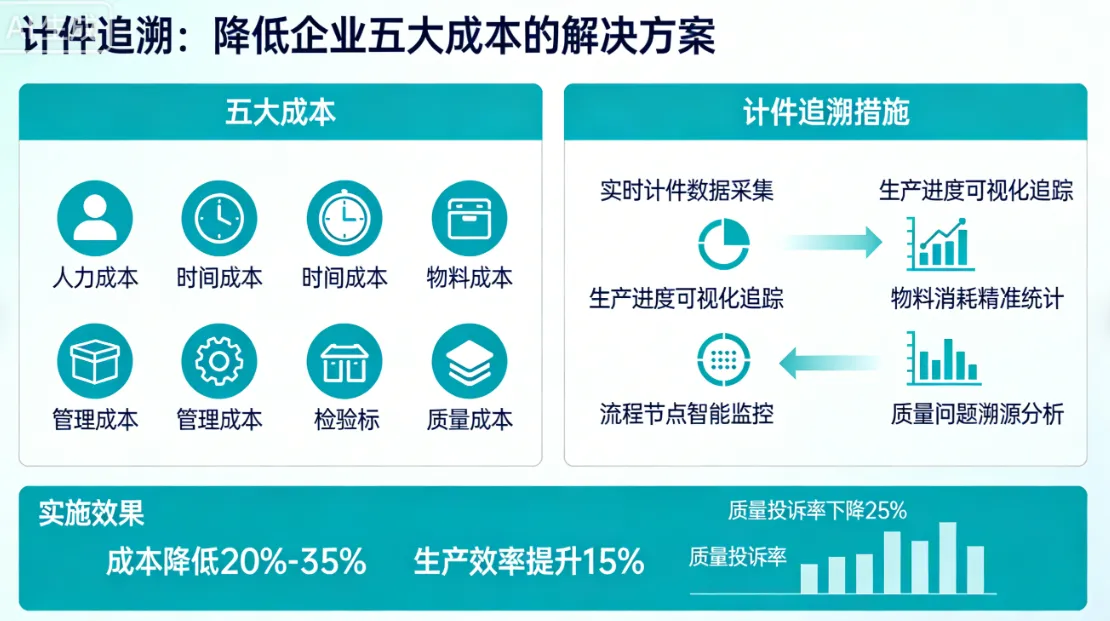
The piece rate traceability system has completely changed this situation through process level data collection. Every time a worker completes a process, they need to scan the work order QR code or personal ID card, and the system automatically records the start time, end time, completion quantity, and processing equipment. All data is uploaded in real-time and cannot be tampered with. Managers can view the real-time output efficiency of each production line and workstation through the backend. After a hardware manufacturing enterprise introduced a piece rate traceability system, the actual working time of workers increased from 62% to 84%, and the daily output increased by 35% under the same personnel configuration. More importantly, the system has accumulated a massive amount of standard working hours data for each process, transforming the determination of labor prices from empirical games to data calculations - the socially necessary labor time for each process is clearly visible, and labor and management engage in dialogue based on the same set of facts, reducing the dispute rate by 90%.
Quality Cost: From Batch Rework to Precise Accountability
Quality cost is one of the most hidden and heavy hidden costs in the manufacturing industry. In the traditional mode, when batch quality problems are found during finished product inspection, managers often have to rework or scrap the entire batch of products, and cannot accurately locate the responsible process, responsible person, and responsible period. This "cascading" approach not only causes huge waste, but also makes it difficult to start quality improvement - problems are hidden in vague responsibility boundaries.
The piece rate traceability system establishes a complete 'production history' for each product. From raw material input, various process processing, quality inspection to finished product warehousing, the operators, equipment parameters, and inspection data of each link are recorded in real time and bound with the unique product code. When there are quality complaints or defective products found on the sales backend or production line, simply scan the product code, and the system can fully trace its birth process within seconds: which supplier's raw materials, which production line, which equipment, which operator, and which quality inspection record. After applying this feature, a certain automotive parts company has reduced the precise positioning time for quality issues from an average of three days to three minutes. The deeper value lies in the system's ability to automatically calculate the pass rate of each operator, the failure rate of each equipment, and the incoming material yield rate of each supplier, transforming quality improvement from a "full staff review meeting" to "data targeted governance". The company continuously tracked the first month quality data of a new employee and found that their defect rate in a specific process was significantly higher than the average level. After targeted training, the defect rate in that process decreased by 67%.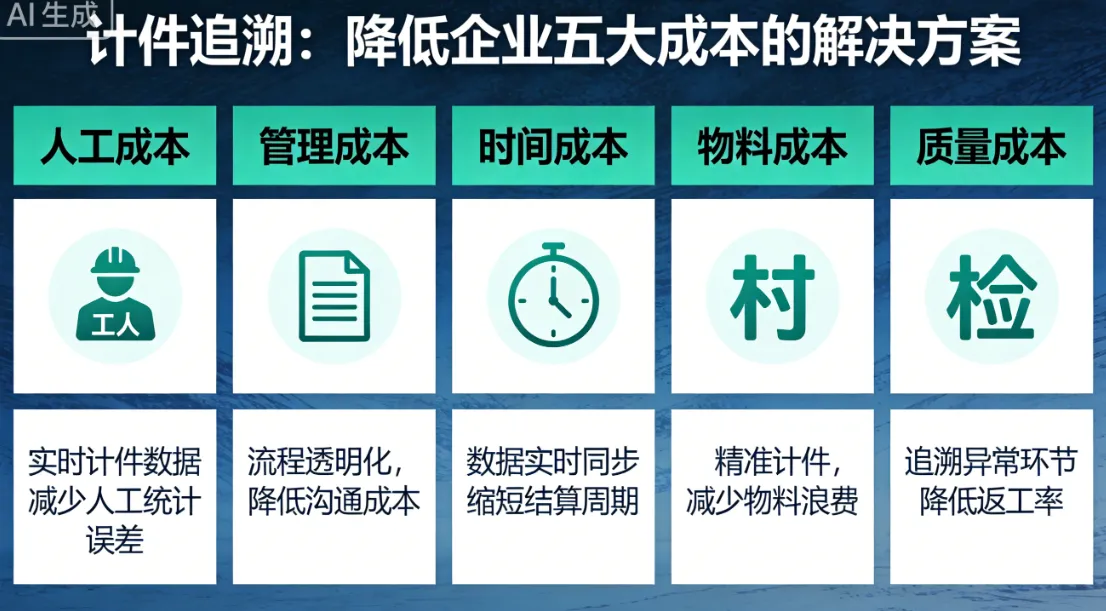
Material cost: from extensive requisition to precise verification
Material costs typically account for over 60% of the total manufacturing costs and are the main battlefield for cost reduction and efficiency improvement. In traditional workshop management, material requisition adopts the "big in, big out" mode - the warehouse issues materials in batches according to the production plan, and returns the remaining materials after the workshop is completed. This extensive management has led to three major problems: firstly, there is a serious backlog of materials on site, and a large amount of funds are deposited as work in progress inventory; The second issue is the oversight of material loss, where the actual consumption differs significantly from the theoretical consumption but the cause cannot be identified; Thirdly, the management of surplus materials is out of control, and the returned scraps are difficult to reuse due to missing information.
The piece rate traceability system refines the granularity of material management from "batch" to "work order" and even "process". When a production work order is generated, the system automatically calculates the standard consumption based on the bill of materials and implements limited material issuance through linkage with the warehouse system. After each worker completes a process, the system automatically deducts the corresponding material based on the actual output and compares it with the standard usage in real time. Once a workstation continuously experiences over consumption, the system immediately alerts and managers can accurately intervene to verify whether there are equipment parameter deviations or non-standard operations. After a certain electronic assembly enterprise applied this model, the inventory of work in progress in the workshop decreased by 42%, and the material loss rate decreased from 3.8% to 1.2%. More noteworthy is the management of surplus materials: when a certain process generates reusable scraps, the system automatically generates surplus material labels, recording their material, specifications, quantity, and original work order information. When they are collected again, they are prioritized for matching with applicable orders. With this alone, the company has saved over 2 million yuan in annual raw material procurement costs.
Equipment cost: from fault repair to predictive maintenance
The comprehensive efficiency of equipment is a direct reflection of the core competitiveness of manufacturing enterprises, while traditional equipment management is generally in a passive state of "not repairing when it is not broken, and only repairing when it is broken". The piece rate traceability system upgrades device management from passive response to active prediction through device interconnection and data collection. The system real-time collects the operating status, processing parameters, and alarm records of each device, and associates them with production work orders and product batches. When a certain device frequently experiences efficiency decline or quality fluctuations in a specific process, the system automatically alerts and prompts the manager to check tool wear, transmission accuracy, or lubrication status.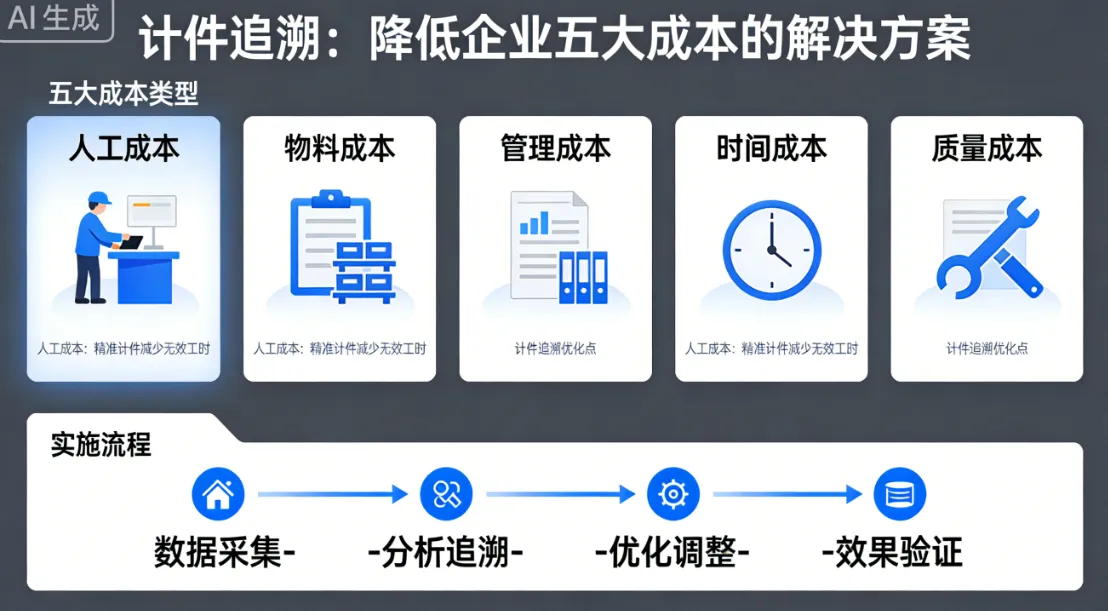
More importantly, the accumulated equipment operation data of the system provides a scientific basis for preventive maintenance. A certain mechanical processing enterprise found through analyzing the equipment shutdown records over the past six months that the spindle vibration value of a certain model of machining center significantly increases every 800 hours of operation, and is highly correlated with subsequent failures. Based on this, adjust the maintenance strategy and change the maintenance cycle of the equipment from a fixed calendar cycle to a dynamic cycle based on actual operating hours, reducing unplanned downtime by 55% and saving annual maintenance costs by 30%.
Management costs: from crowd tactics to system collaboration
Management costs are the most difficult to quantify but also the most significant cost item for enterprises. Under the traditional piece rate model, a large workshop management team consists of production statisticians, quality inspectors, warehouse managers, and payroll accountants, who spend a lot of time daily engaged in low value-added work such as document entry, data verification, and report production. The piece rate traceability system systematically releases this part of labor costs through full process automation. Workers scan the code to report work, and the system automatically generates output statistics; Real time upload of quality inspection data, and automatic calculation of quality deduction by the system; Scan the material code for verification, and the system will automatically update the inventory account set; After all data is aggregated, the system automatically calculates the daily salary of each employee. After a certain enterprise imported the system, the workshop management personnel were reduced from 28 to 12, and the monthly average management cost decreased by 80000 yuan.
The deeper value lies in the system transforming managers from "counting beans" to "planting beans". When data collection, statistics, and accounting are all automatically completed by the system, workshop directors no longer need to chase production every day, but can focus on improving activities that truly create value, such as production line balance, process optimization, and personnel training. This shift in management focus is an essential sign of enterprises shifting from extensive growth to lean operation.
From tools to systems: the management philosophy of piece rate traceability
Piece rate traceability is not a simple software tool, but a complete manufacturing site management philosophy. It establishes a refined control system covering the entire process by transforming every product, every process, and every operation into traceable and analyzable data nodes. In this system, every income earned by workers has a clear output basis, every decision made by managers is supported by solid data, and every cost incurred by the enterprise has a clear flow record. When these capabilities are accumulated into the normalized operational capabilities of the organization, cost reduction and efficiency improvement are no longer just a slogan, but a deterministic result that occurs every day on the production line. Under the long-term trend of declining demographic dividend and rising factor costs, this set of capabilities is evolving from a "bonus point" for excellent manufacturing enterprises to a "passing line" for survival and development.