
SaaS software core advantages analysis: six major values including cost reduction, flexible expansion, and rapid deployment
The fundamental transformation of enterprise software consumption patterns
In the past two decades, the delivery of enterprise software has undergone a profound transition from physical media to the cloud. Once upon a time, deploying an enterprise resource planning system or customer relationship management system meant purchasing expensive servers, building dedicated data centers, hiring professional operations teams, and going through implementation cycles that lasted for months or even years. This heavy asset, long-term, and high threshold model has blocked a large number of small and medium-sized enterprises from digitalization, and has also put many large enterprises that have already invested in a dilemma in the face of technological iteration. The rise of the software as a service model has completely rewritten this rule. It redefines software from "product" to "service", reconstructs from "capital expenditure" to "operational expenditure", and transforms from "technological barriers" to "universal tools". Understanding the six core advantages of SaaS essentially involves understanding the fundamental shift in the paradigm of enterprise digital construction.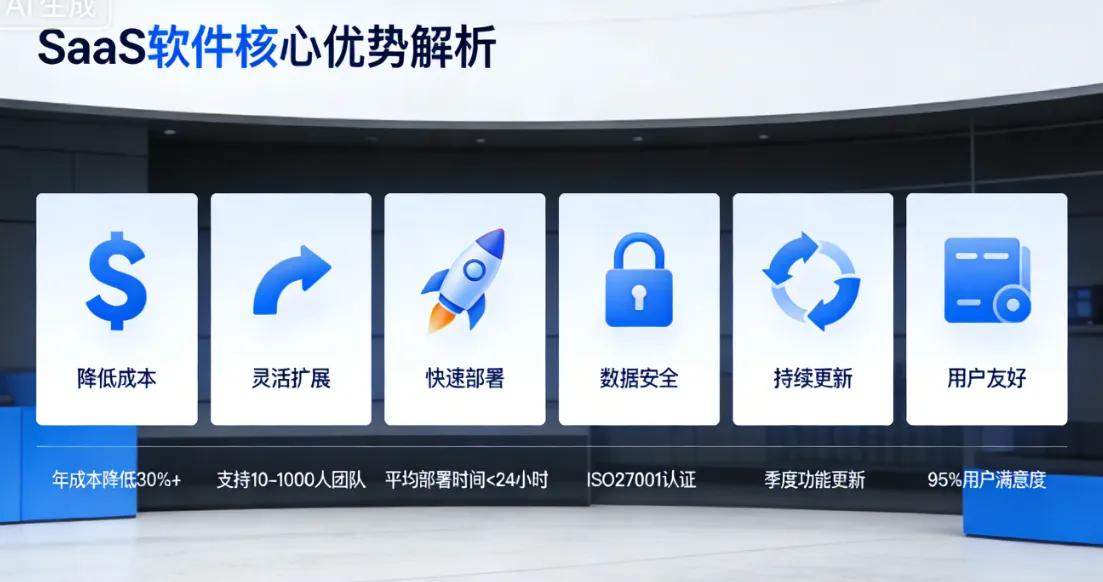
Cost restructuring: shifting from heavy asset investment to lightweight subscriptions
The most intuitive and impactful value of the SaaS model lies in the systematic optimization of cost structure. Under the traditional software model, enterprises need to pay a high software license fee at once, while also bearing the hardware procurement costs such as servers, storage devices, and computer room facilities, as well as the labor costs of the IT operation and maintenance team that support them. This massive upfront investment not only occupies a large amount of working capital, but also carries a high risk of sinking for the project itself - once the implementation effect falls short of expectations, millions of investments are almost impossible to recover.
The SaaS model completely deconstructs this cost structure. Enterprises pay subscription fees based on the number of users, functional modules, and usage cycles, without the need for any hardware investment or the establishment of dedicated operation and maintenance teams. The shift from capital expenditure to operating expenditure has reduced the dimension of digital construction from "major investment decisions" to "daily expense management". More importantly, predictable subscription fees enable enterprises to accurately plan their IT budgets and avoid unplanned expenses caused by sudden hardware failures or version upgrades. A medium-sized trading enterprise once calculated that the total ownership cost of a customer relationship management system using the SaaS model over five years is only 42% of the traditional deployment model, and there is no need to bear any debt pressure in the early stages of the project. This cost restructuring is transforming enterprise software from a privilege for a few large enterprises to a standard for all sizes of enterprises.
Deployment efficiency: time compression from monthly to daily
Time is a more scarce resource than money. The implementation cycle of traditional enterprise software often takes six months, twelve months, or even longer. Requirements research, system configuration, data migration, user training, and parallel testing can all become risk points for project delays. During the lengthy implementation process, business requirements may have undergone several changes, and the initially envisioned solution may have partially lost its timeliness by the time it was launched.
The deployment efficiency of SaaS model shows an exponential improvement. As the software itself is pre deployed on the infrastructure of cloud providers, enterprises do not need to go through any hardware procurement or environment setup process. Registering and opening an account, completing basic configuration, importing core master data, and organizing key user training, a standardized SaaS system can be put into actual business operation within weeks or even days. A certain chain retail enterprise is facing explosive growth in online orders during the epidemic and urgently needs an order management system. From decision-making and selection to the formal processing of the first order by the system, the entire process only took nine days. This response speed is unimaginable in the traditional software era. More importantly, rapid deployment brings not only time savings, but also the release of business trial and error capabilities - enterprises can quickly verify whether a certain software is truly suitable for their own needs at a very low cost, and the risk of decision-making errors is compressed to an extremely low level.
Scalable elasticity: resource supply that dynamically beats with the pulse of business
A fundamental paradox faced by traditional software models is that when purchasing hardware, forward-looking investments must be made for business peaks in the next three to five years, and these redundant resources are mostly idle for most of the time. When business growth exceeds expectations, hardware expansion requires a long cycle of procurement, deployment, and debugging, often missing the market window.
The SaaS model achieves resource supply capability that resonates with the pulse of enterprise business through multi tenant architecture and elastic computing resource pool. When a company adds new branches, opens new business lines, or experiences seasonal order peaks, it only needs to adjust user permissions or pay corresponding subscription fees in the management backend, and system resources are automatically dynamically allocated in the cloud. When business contracts or off-season approaches, resource utilization decreases accordingly, and costs decrease accordingly. This almost perfect elastic matching enables enterprises to completely bid farewell to the efficiency paradox of "paying 100% hardware costs to cope with 10% peak periods". During the Black Friday promotion period, a cross-border e-commerce enterprise experienced an eight fold increase in concurrent system users. The SaaS platform automatically called on cloud redundant resources to smoothly pass the peak. After the promotion ended, the resources were automatically released, and the enterprise did not need to pay any additional hardware costs for this brief peak.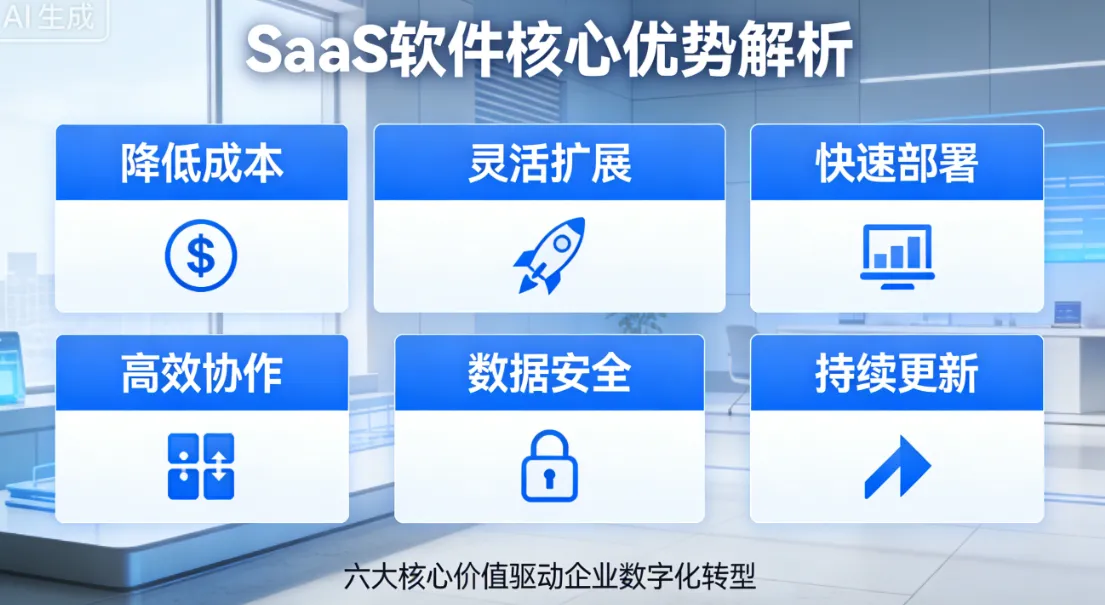
Continuous Evolution: Say Goodbye to the Technological Shelf Life of Version Stagnation
Under the traditional software model, version upgrade is one of the most headache inducing tasks for enterprise IT departments. The upgrade cycle is long, the cost is high, and the risk is high. Many companies choose to stay on the old version for several years or even more than ten years. The direct consequence of this is that system functionality gradually lags behind business requirements, security vulnerabilities cannot be patched in a timely manner, and technical debt is increasing day by day. When enterprises are finally forced to upgrade, data migration and process adaptation across multiple versions have become almost impossible tasks.
The SaaS model embeds' continuous delivery 'as a native capability within the service itself. Suppliers maintain a single version in the cloud, and all feature optimizations, performance improvements, and security patches are automatically deployed in the background. Users can enjoy all the capabilities of the latest version without any operation. This technology preservation mechanism keeps enterprises at the forefront of digital capabilities. When new technologies such as artificial intelligence, big data analysis, and Internet of Things integration are mature, SaaS users are often able to invoke these capabilities in familiar operating interfaces at the first time, without having to go through the long process of model selection, procurement, and integration again. During the five years of using a SaaS enterprise resource planning system, a manufacturing enterprise has inadvertently completed three capability transitions from basic inventory management to intelligent production scheduling, from manual reconciliation to automatic verification, and from empirical decision-making to data insight, all of which have never triggered a system shutdown upgrade.
Mobile Collaboration: Office Freedom Breaking through Time and Space Boundaries
Traditional enterprise software was mostly born in the era of fixed office, and its interaction logic, data access permissions, and business process design are all based on office wired networks and fixed terminals. When mobile office, remote collaboration, and cross regional collaboration become the new normal, the limitations of these systems are exposed.
SaaS mode is born with Internet gene, and all core functions are provided through browser or mobile application. As long as there is network connection, users can obtain consistent access experience at any time, anywhere and on any device. Managers can complete expense approvals during business trips, salespeople can enter orders in real-time at customer sites, and warehouse administrators can use handheld terminals to scan and receive goods. The melting of these temporal and spatial boundaries is not only an improvement in efficiency, but also a redefinition of business models. A certain engineering service enterprise has achieved real-time cost collection for more than 20 project sites nationwide through SaaS systems. Project managers can complete project accounting and personnel scheduling without returning to headquarters every week, reducing travel costs by 40% and increasing decision response speed by three times.
Ecological integration: from information silos to value networks
Under the traditional software model, system integration from different vendors requires a large amount of customized development and interface debugging, which is costly, time-consuming, and unstable. Many enterprises have been trapped in information silos for a long time, unable to connect the entire value chain from customer acquisition, order processing, production execution to financial accounting.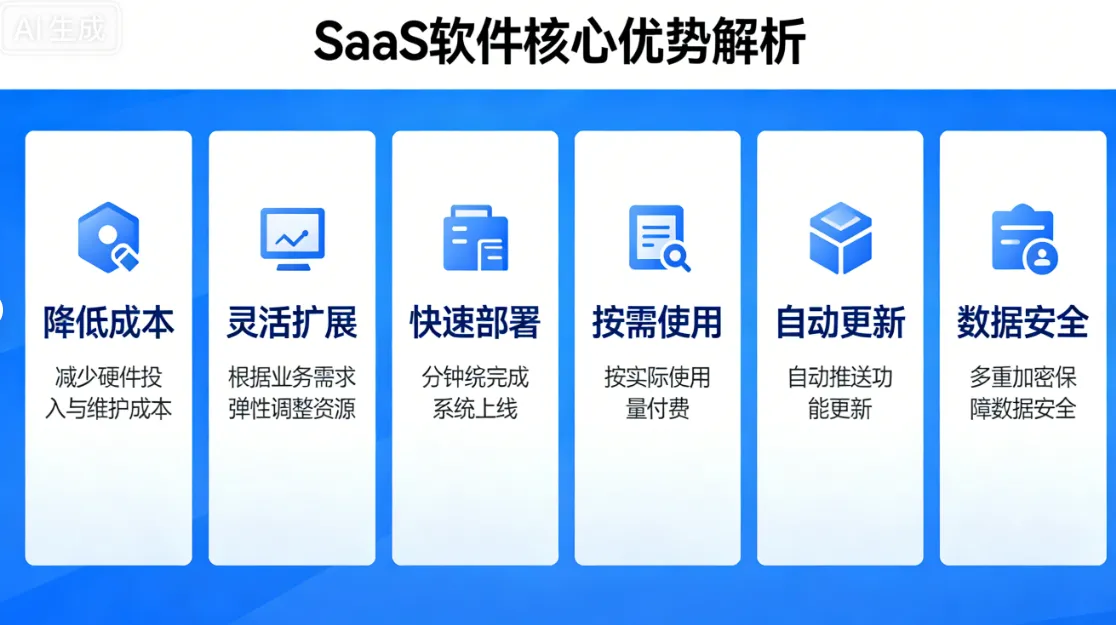
The open architecture centered around application programming interfaces in the SaaS era is connecting enterprise software from isolated islands to interconnected value networks. Mainstream SaaS products all provide standardized API interfaces, supporting seamless integration with third-party services such as e-commerce platforms, payment gateways, logistics systems, electronic invoice platforms, and enterprise WeChat. Enterprises can combine professional SaaS services from different fields based on their own business characteristics, like building blocks, to construct a highly customized and flexible digital ecosystem. A consumer goods company has directly connected its order management system with seven mainstream e-commerce platforms, three warehousing service providers, and five express delivery companies through APIs. The entire process from order generation to shipment does not require any manual intervention, resulting in a 90% reduction in error rates and a five fold increase in operational efficiency.
From Tools to Capability: The Intrinsic Logic of SaaS Value
The six core advantages of SaaS software - cost restructuring, rapid deployment, elastic scaling, continuous evolution, mobile collaboration, and ecological integration - are not isolated technical features, but interrelated and mutually reinforcing value systems. Low entry barriers provide more enterprises with the opportunity to embrace digitization, rapid deployment reduces trial and error costs to extremely low levels, flexible expansion provides ample growth space for businesses, continuous evolution ensures investment does not depreciate over time, mobile collaboration breaks organizational boundaries, and ecological integration amplifies overall efficiency. The underlying logic of this value system is that enterprise software is transforming from heavy assets that need to be "managed" to lightweight services that can be called at any time. Under this paradigm, digital capability is no longer a competitive advantage for a few large enterprises, but a survival baseline for organizations of all sizes. When software is used on demand, billed on demand, and automatically maintained like water and electricity, enterprises are able to shift scarce attention and resources from dealing with technology itself to creating business value - perhaps the most fundamental and far-reaching change brought about by SaaS.