
Shuntong Online Education Resource Management System - A one-stop platform for sharing and managing educational resources
The core dilemma of resource management in the digital education era
The explosive growth of online education has created, disseminated, and consumed educational resources at an unprecedented speed and scale. However, accompanied by a surge in the number of resources, there is an increasingly severe management crisis. High quality teaching resources are scattered across teachers' personal computers, training institution servers, and various cloud accounts, forming insurmountable data islands; The lack of unified standards for various formats of resources such as course videos, teaching courseware, exercise papers, and virtual simulation experiments results in low retrieval efficiency; The ownership of copyright is ambiguous, and resources are copied and disseminated arbitrarily without being traceable; Serious duplication of construction, with the same course being repeatedly developed in different institutions, resulting in significant waste. These issues are intertwined, leading educational institutions into the paradox of 'the more resources, the more chaotic management'. The Shuntong Online Education Resource Management System is designed to solve this dilemma. It focuses on the full lifecycle management of resources and integrates five functional modules: resource aggregation, intelligent retrieval, copyright protection, shared transactions, and teaching applications. It builds a standardized, efficient, and open digital resource governance system for educational institutions, training institutions, and educational administrative departments.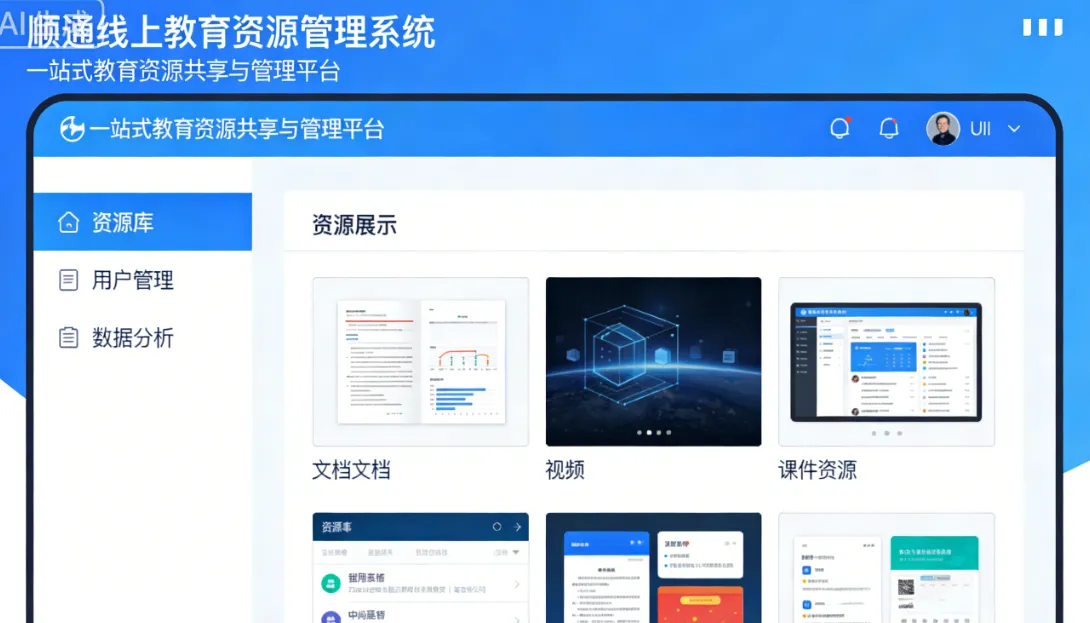
Resource aggregation and standardization: from dispersed sedimentation to unified governance
The primary challenge in educational resource management is the extreme fragmentation of resource forms. Shuntong system breaks down data barriers between different sources, formats, and standards by building a unified digital resource access gateway. The system supports online uploading and cloud transcoding of dozens of resource formats such as videos, audios, documents, images, animations, courseware packages, virtual simulation experiments, VR/AR courses, etc. It automatically converts non-standard format files into a universal format suitable for multi terminal playback. When resources are stored, the system requires complete metadata information to be filled in, including title, author, keywords, applicable academic stages, subject areas, knowledge point tags, copyright statements, etc., forming a structured resource file.
For the historical resources of institutional inventory, the system provides a batch import tool that supports automatic recognition of folder structures and batch linking of metadata. When a provincial-level education resource library was connected to the Shuntong system, a total of over 200000 teaching resources scattered in more than ten districts and stored on different media were standardized and stored in the database at once. The resource retrieval efficiency was improved fourfold, and duplicate resources were automatically checked and filtered to reduce by 18%. The built-in classification system of the system supports multidimensional mapping of national standards, industry standards, and institutional custom standards, enabling the same resource to be accurately located from different classification perspectives, laying the foundation for subsequent precise push and intelligent recommendation.
Intelligent retrieval and precise recommendation: enabling suitable resources to find the people they need
Resources can only generate value when they are effectively utilized, and traditional folder based browsing or simple keyword searches are completely ineffective when facing massive resources. Shuntong system upgrades the discovery mode of resources from passive query to active service by constructing an educational resource knowledge graph. The system performs in-depth content analysis on the stored resources, automatically extracts keyframes and generates subtitle indexes for video resources, supports full-text retrieval for document resources, and analyzes the internal structure and associated materials for courseware resources. Based on the disciplinary knowledge system and textbook catalog, the system establishes semantic associations between resources, knowledge points, and ability points, enabling retrieval to evolve from string matching to concept matching.
In the scenario of teacher lesson preparation, by inputting "trigonometric function image transformation", the system not only returns courseware with keywords in the title, but also intelligently recommends related animation demonstrations, history high school entrance exam questions, student common error analysis reports, teacher micro lesson clips and other extended resources. In the scenario of student self-learning, the system dynamically pushes differentiated learning resource packages based on their historical learning behavior, homework completion status, and weak points in the test, achieving personalized resource services for thousands of people. After a certain online education institution applied an intelligent recommendation engine, the click through rate of platform resources increased by 167%, the average time for students to retrieve resources decreased by 73%, and the dropout rate of courses due to inconvenient resource access decreased by 31 percentage points. The built-in heatmap analysis module of the system can intuitively display the resource abundance and access popularity of various disciplines, stages, and knowledge points, providing accurate data guidance for resource construction planning.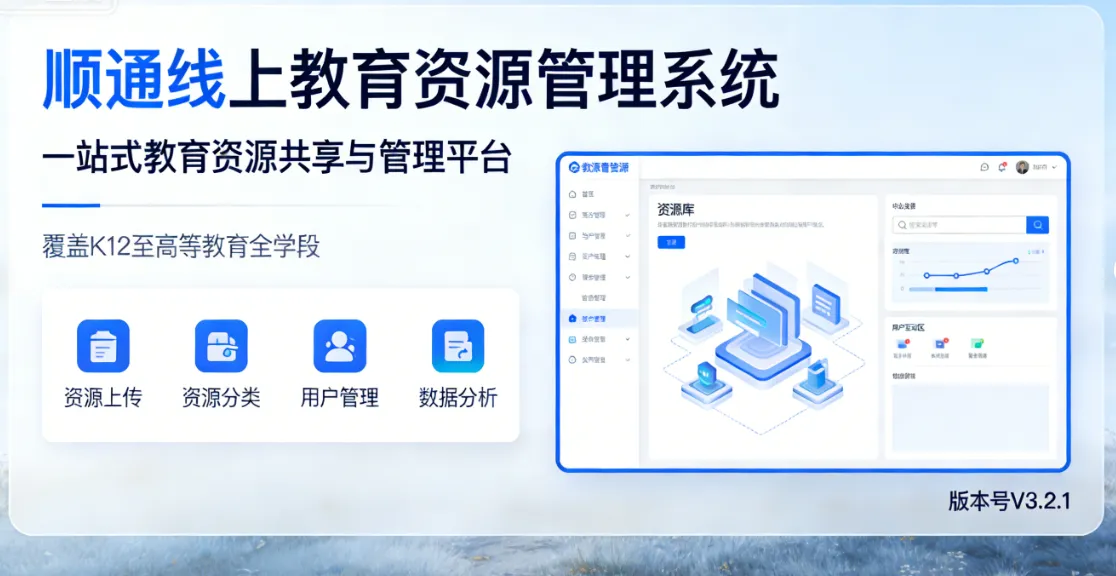
Copyright Protection and Authorization Management: Empowering Creators to Achieve Adequate Returns
The high-quality development of educational resources cannot be achieved without effective protection of the intellectual property rights of creators. For a long time, digital educational resources have been arbitrarily copied, tampered with, and disseminated, and the labor achievements of original creators cannot receive reasonable returns, seriously suppressing the continuous supply of high-quality resources. Shuntong System constructs a copyright protection mechanism covering the entire lifecycle of resources through a triple technical system of digital watermarking, blockchain authentication, and authorization control.
When uploading resources, the system automatically embeds invisible digital watermarks, permanently binding author information, institution identification, and timestamps to the resource file. Any screenshots, recordings, or format conversions cannot be completely removed. The creative process and initial upload time of key resources are synchronously recorded to the blockchain node, forming a legally recognized proof of originality and providing solid evidence for subsequent rights protection. In the resource utilization process, the system supports refined authorization policy configuration, including different levels of viewing permissions, downloading permissions, adapting permissions, transferring permissions, commercial usage permissions, etc. The authorization scope can be limited to specific users, specific classes, specific time periods, and specific regions. After a certain educational publishing house integrated core copyrighted textbooks into its system, unauthorized illegal dissemination incidents decreased by 92%. The sales revenue of individual content through micro fee models has covered the operating costs of the system, forming a virtuous cycle of high-quality resource creation, protection, and monetization.
Resource circulation and transaction settlement: building an open education resource market
The traditional model of educational resource construction is a closed planning model - institutions invest funds for commissioned development, and the resources are only for internal use after completion, and cannot be circulated or monetized. Shuntong System transforms a closed resource warehouse into an open education resource market by building a resource trading sub platform. Institutions can list their own copyrighted resources on the system mall, set their own pricing and authorization models. The purchaser can browse resource details online, preview sample seal fragments, view user reviews, confirm the purchase, and complete electronic signing and online payment through the system. The resources will be automatically synchronized to the purchaser's resource library.
The system supports various business models such as single article sales, bundled sales, subscription services, and billing based on usage. Transaction data is fully recorded, and profits are automatically distributed to resource providers, platform operators, and channel promoters according to preset rules. A certain vocational college has integrated more than ten high-quality online courses into its trading system, providing cross campus credit course services to sister colleges. The annual transaction volume has exceeded three million yuan, not only recovering the cost of course construction, but also forming sustainable course iteration funds. The cross institutional resource exchange function supports the non monetary transaction mode of barter. Two institutions can complete resource exchange evaluation and equivalent exchange through the system, greatly reducing the funding threshold for small and medium-sized institutions to obtain high-quality resources.
Teaching Application Integration: From Resource Management to Classroom Implementation
The ultimate goal of resource management is to serve teaching. Shuntong system deeply integrates mainstream teaching platforms to transform static resource libraries into dynamic teaching support capabilities. The system seamlessly integrates with teaching environments such as learning management platforms, online classrooms, and smart classroom terminals. Teachers can directly access the system resource library on the teaching interface during lesson preparation, searching, previewing, and inserting seamlessly without the need to switch login between multiple systems. Students can access teacher recommended extended learning resources through the course portal without the need for a separate account or secondary authentication.
In classroom teaching scenarios, the system supports embedded applications of interactive teaching modules. Teachers can access virtual simulation experiments, 3D models, and historical image materials from the resource library at any time during classroom teaching, and initiate real-time quizzes and topic discussions. Students can participate in real-time through mobile devices, and interactive data is automatically transmitted back to the teaching analysis system. After applying the integrated teaching module in a certain middle school, the average number of resource calls per lesson for teachers has increased from 3.2 to 7.8, and the actual utilization rate of digital resources in classroom teaching has tripled. The resource library has shifted from "stored for storage" to "built for use".
Data Insight and Governance Optimization: Driving the Sustainable Evolution of Resource Ecology
The deep value of the Shuntong system lies in transforming the massive behavioral data generated during resource management into governance wisdom. The system has a built-in education resource big data analysis engine that monitors the entire process of resource creation, storage, access, evaluation, and circulation in real-time. Managers can intuitively grasp core indicators such as the total amount of institutional resources, structural distribution, quality rating, usage popularity, and user satisfaction through a visual cockpit. The resource utilization efficiency analysis module can accurately identify scarce resource types with "high heat, low stock" and redundant resources with "low heat, high stock", providing quantitative decision-making basis for annual resource procurement budget. The user behavior analysis module can reveal resource usage preferences in different disciplines, stages, and teaching scenarios, and provide reverse guidance for resource design and development direction. After applying the data analysis module, the education management department of a certain city accurately invested 60% of the annual resource construction funds into the urgently needed areas of frontline teaching. The input-output ratio of resource construction increased by 2.3 times, and teachers' satisfaction with resource services jumped from 56% to 89%.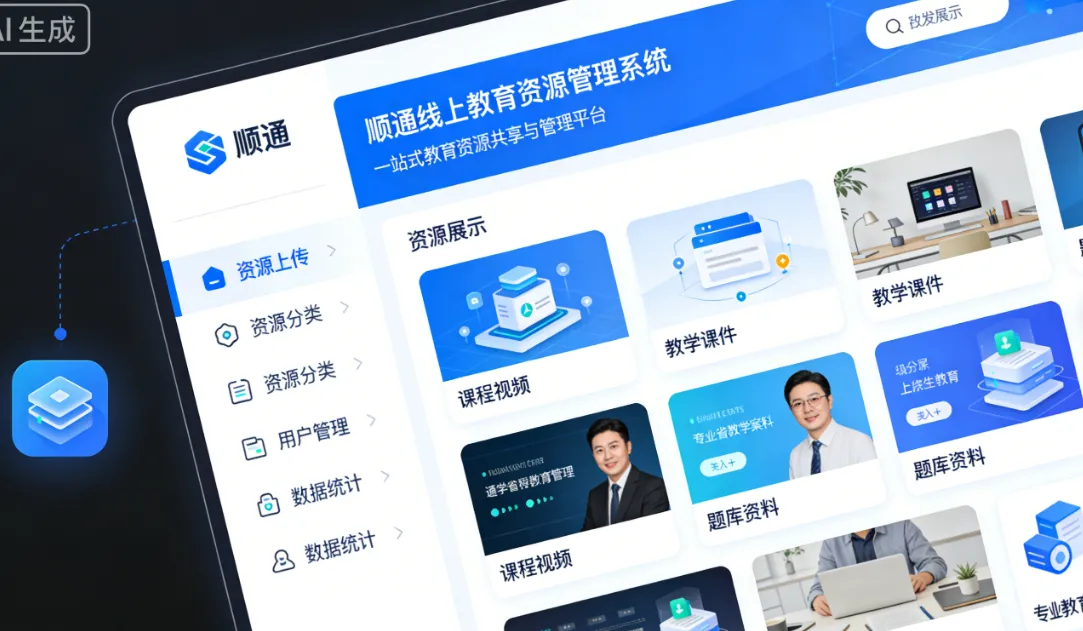
Towards an open, intelligent, and sustainable new ecosystem of educational resources
The Shuntong Online Education Resource Management System not only serves as a tool for improving resource management efficiency, but also represents a systematic reconstruction of the production, circulation, and consumption patterns of educational resources. It enables high-quality resources to no longer be dormant on personal hard drives or institutional servers, but to be seen, used, evaluated, and optimized on a broader scale; Enable resource creators to no longer contribute for free or passively infringe, but instead obtain the expected value return and motivation for continuous creation; Enable resource managers to no longer rely on empirical judgment, but to have real-time, accurate, and predictable data governance capabilities. When these transformations truly occur, educational resource management completes the essential transition from "warehouse storage" to "ecological operation". In the era of deep integration of information technology and education, such digital infrastructure is evolving from "innovative practices" of excellent educational institutions to "standard configurations" for the future.