
Shuntong Laboratory Open Appointment System - Query, Appointment, and Data Management Functions
Efficiency misconceptions and management pain points in the express logistics industry
China's express delivery business has consistently ranked first in the world for many years, handling over 100 billion packages annually. Behind this huge number are countless express delivery vehicles traveling day and night in the urban network, distribution centers working on assembly lines all night long, and end outlets struggling to cope with massive data. However, scale does not equal efficiency. Many regional express delivery companies, specialized logistics companies, and urban distribution fleets are still stuck in the quagmire of traditional management models: handwritten entry of waybills leads to frequent errors and omissions; Vehicle scheduling relies on calling people over the phone, resulting in a high rate of empty driving; The freight settlement cycle is long, and accounts receivable are piled up like mountains; Customer inquiries can only be answered manually, and customer service phone numbers have been flooded. These issues are intertwined, forming a black hole that erodes profits. The Shuntong Express Transportation Management System was born to solve this dilemma. It focuses on the full lifecycle management of waybills and integrates five functional modules: intelligent scheduling, in transit monitoring, automatic settlement, end delivery, and customer service. It helps logistics enterprises build a transparent, efficient, and efficient digital operation system.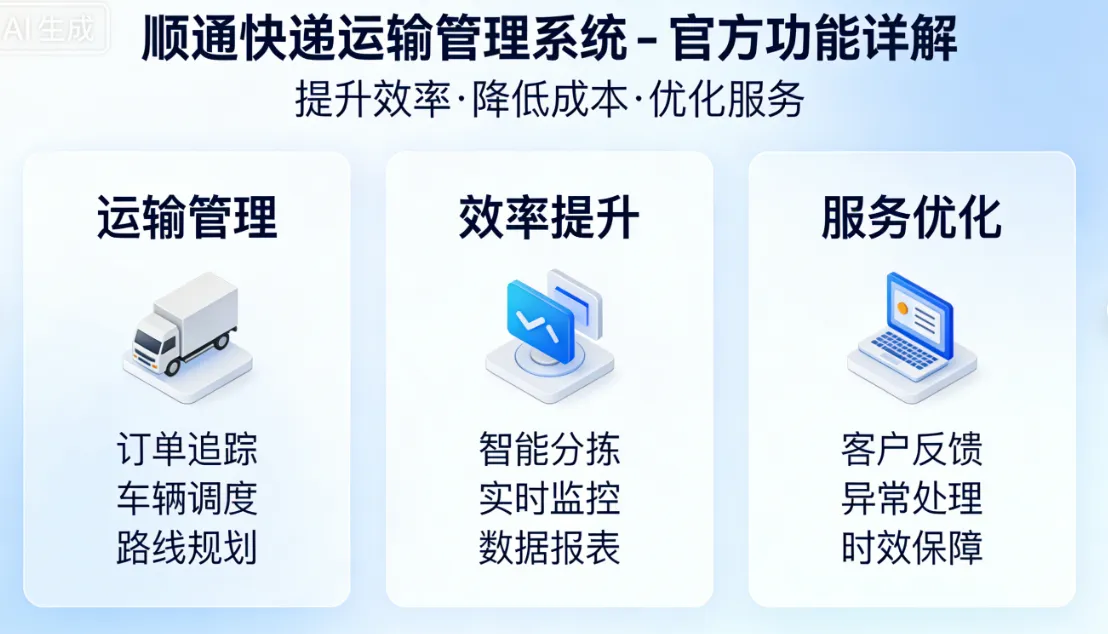
Full lifecycle management of waybill: a complete closed loop from shipment to receipt
Waybill is the smallest unit of express transportation management and the logical starting point for system empowerment. The Shuntong system assigns a unique waybill identification code to each package, which will accompany the entire process of receiving and signing for the goods, recording every operational node it goes through. When customers place orders, the system supports multi-channel waybill entry: e-commerce platform orders are automatically synchronized through API interfaces, protocol customers are imported in batches through Excel, and scattered customers are manually recorded by branch personnel. The system automatically checks the completeness and logic of sender information, identifies abnormal addresses and prompts for correction, and eliminates invalid waybills from the source.
In the pick-up process, the courier uses a handheld terminal to scan the waybill barcode, and the system automatically records the pick-up time, pick-up personnel, estimated weight, and prints the electronic waybill in real time. After the waybill enters the sorting center, the system completes the step-by-step sorting operation record through the automated sorting line interface or manual PDA scanning. In the trunk transportation process, the waybill is bound to the vehicle task list to form a batch loading list. When delivering at the end of the day, the delivery personnel receive the daily delivery task through the mobile terminal, execute it according to the system's planned route sequence, and scan and confirm the signing status for each completed ticket. Abnormal waybills are marked separately and enter the processing flow. At this point, the entire trajectory of a waybill from generation to completion is fully recorded and permanently retained. Managers can access the full timeline of any waybill at any time and accurately locate the time consumption distribution of each node. After the application of the system by a regional express delivery enterprise, the completeness rate of waybill information increased from 83% to 99.7%, and the number of wrong or missed shipments caused by incorrect waybill information decreased by 76%.
Intelligent scheduling and path planning: making every kilometer more valuable
Transportation costs are the biggest variable costs for express delivery companies, with empty vehicles and circuitous routes being the two major efficiency killers. Under the traditional scheduling mode, fleet leaders allocate tasks based on experience, which makes it difficult to coordinate the overall situation; Drivers choose their driving routes based on personal habits, often resulting in delays or detours due to congestion. The intelligent scheduling engine of Shuntong system upgrades this decision-making process from empirical to algorithm driven.
The system provides real-time access to all available vehicle information, including model, load capacity, volume, current location, and maintenance status. Before daily dispatching, the dispatching module automatically generates the optimal train number task scheme according to multi-dimensional constraints such as the volume of goods to be transported, destination distribution, customer timeliness requirements, vehicle loading restrictions, etc. The system not only plans which goods to load onto which vehicles, but also further outputs the loading sequence and driving path of each vehicle. In the scenario of mainline transportation, the system comprehensively considers mileage, fuel consumption, road and bridge tolls, and driver hour limitations to output the most cost-effective route plan; In urban delivery scenarios, the system predicts the shortest delivery sequence based on order density, time window, and traffic congestion. Dispatch instructions are directly pushed to the driver's mobile device, including task lists, navigation links, and customer contact information. After applying the intelligent scheduling module to a local delivery fleet, the daily average number of delivery tickets per vehicle increased by 34%, fuel consumption per 100 kilometers decreased by 11%, overtime hours for drivers decreased by 28%, and the number of dispatch positions was reduced from three to one.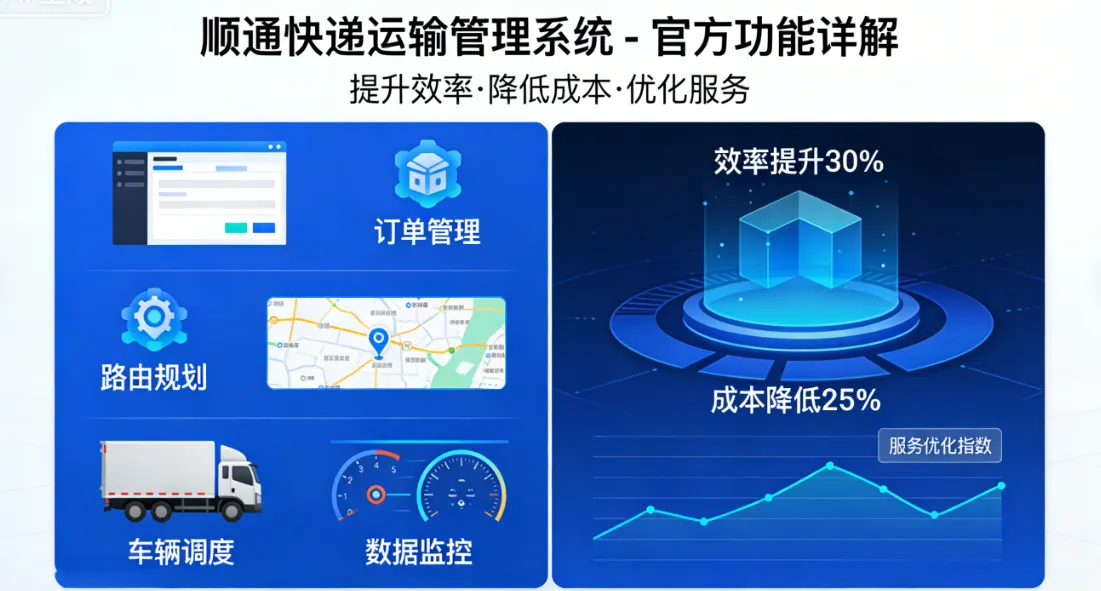
In transit monitoring and abnormal warning: visible transportation process
After the package leaves the distribution center, it enters the most opaque "black box period" under the traditional management mode. The customer doesn't know where the goods have arrived, the customer service doesn't know how to respond, and the manager doesn't know if the driver is driving according to regulations. Shuntong System makes the transportation process fully transparent through the integration of mobile Internet and Internet of Things technology.
After the vehicle departs, the driver's app automatically starts the travel mode, and the system continuously sends back the vehicle's position trajectory through the mobile GPS, synchronously recording the driving speed and continuous driving duration. Managers can view in real-time the distribution location, current task progress, and estimated arrival time of all vehicles in transit at the dispatch center. The electronic fence function sets up geographical fences for key nodes. When vehicles enter and exit the fenced area, the system automatically triggers event records and pushes notifications - the vehicle leaves the warehouse, enters the highway service area, and arrives at the destination park, and each node automatically leaves a trace without the need for manual reporting by the driver. When the vehicle deviates from the planned route, stops continuously for too long, approaches prohibited areas, or exceeds the driver's fatigue time limit, the system automatically issues graded warnings to both the dispatcher and the driver. Temperature sensitive goods such as fresh produce and medicine are supported by the system to be connected to on-board temperature control sensors, which can transmit real-time temperature curves back to the cabin. If the threshold is exceeded, an alarm will be triggered immediately. After a certain cold chain logistics enterprise connected to the in transit monitoring module, the satisfaction rate of cargo owners increased from 71% to 95%, and claims for cargo damage caused by abnormal temperature decreased by 82%.
Automatic settlement and cost accounting: enabling clear calculation and management of freight costs
Freight settlement is the core link of the capital chain of express logistics enterprises and also a high-risk area for financial disputes. In manual mode, the freight cost for cross provincial transportation may involve multiple complex fees such as trunk line fees, delivery fees, upstairs fees, waiting fees, and collection fees for goods. The calculation rules vary, and reconciliation is time-consuming and labor-intensive. The Shuntong system deeply binds freight settlement with waybill execution data, achieving billing automation, online reconciliation, and cost refinement.
The system has a built-in customizable billing engine that supports multiple billing dimensions such as weight, volume, quantity, distance, region, and vehicle model. It also supports complex strategies such as tiered pricing, time-based pricing, and differentiated pricing based on flow direction. After the waybill is signed for, the system automatically calculates the receivable freight and payable cost according to preset rules, and pushes them to the customer's bill and the carrier's statement respectively. Financial personnel do not need to manually enter, generate reconciliation details with one click, and initiate collaborative processing of differences online. Accounts receivable aging report is automatically generated, and overdue accounts are automatically collected by the system. The cost accounting dimension can penetrate to single tickets, single lines, and individual vehicles, and managers can clearly grasp the true profitability of each route. After a certain specialized logistics enterprise applied the settlement module, the monthly customer reconciliation time was reduced from 7 days to 2 hours, the accounts receivable turnover days were shortened by 28 days, and the annual bad debt provision decreased by 65%.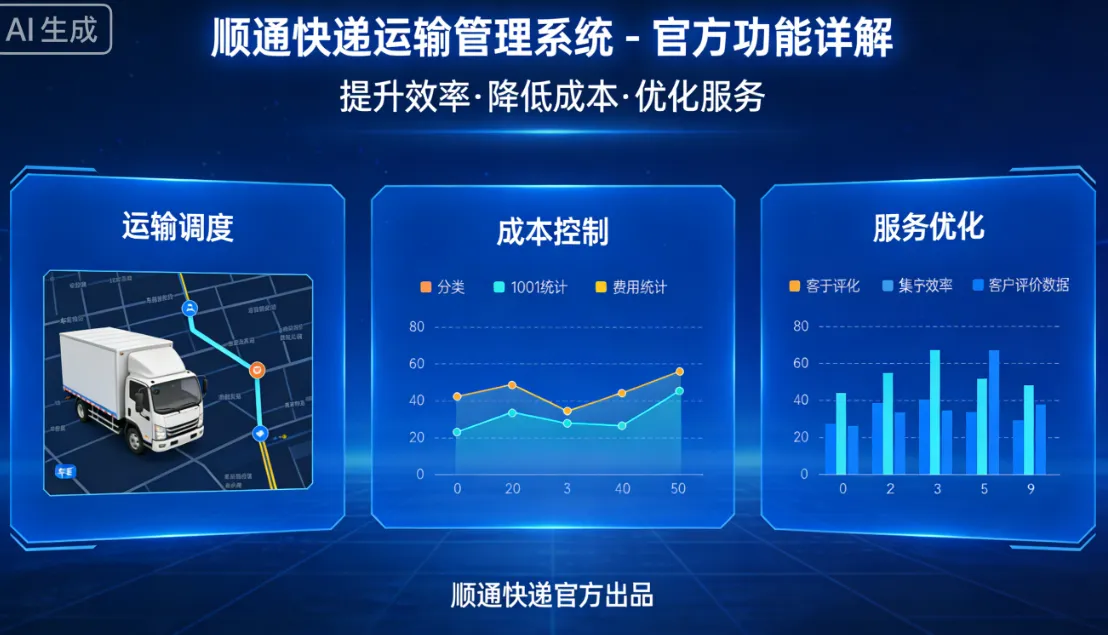
End of Line Delivery and Customer Service: The Last Mile of Delivery Experience
Terminal delivery is the only interface between express delivery services and customers, and the quality of service directly affects brand reputation. However, there are common management challenges in the end network, such as uneven quality of delivery personnel, arbitrary signing processes, and delayed handling of exceptions. The Shuntong system incorporates the delivery process into unified control through mobile and standardized end of pipe operation tools.
The delivery personnel receive the daily delivery task list through a dedicated APP, and the system intelligently sorts it by geographical location, supporting batch phone calls and bulk sending of appointment messages. The signing process supports multiple verification methods such as electronic signature, photo retention, and ID verification. All signing vouchers are digitally archived and can be accessed at any time. Standardization of problem handling process - for various abnormalities such as customer rejection, unknown address, and inability to contact, the dispatcher selects the corresponding reason on the APP and uploads supporting evidence, and the system automatically triggers the return or retention process to avoid long-term unresolved problem items. At the customer service level, the system provides an omni channel document checking interface. Customers can query the real-time status of the waybill through WeChat official account, applet, customer service agent, official website and other multiple portals without manual intervention. After a certain express delivery company applied the terminal module, the delivery and signing rate increased from 88% to 97%, the customer complaint rate decreased by 63%, and the number of customer service personnel answering inquiry calls sharply decreased by 71%.
Data driven continuous evolution
The ultimate value of Shuntong Express Transportation Management System lies in its ability to transform the massive amount of waybill data, vehicle trajectories, cost records, and customer feedback generated day after day into analyzable, insightful, and optimizable digital assets. Managers no longer rely on experience judgment and scattered feedback, but instead use the built-in BI cockpit of the system to real-time grasp the overall operation of the enterprise: collection trends of various branches, loading rates of various routes, gross profit margins of various customers, and efficiency ratings of various drivers. These data insights provide precise targeting for management improvement - which routes should be adjusted for continuous losses, which customers should focus on maintaining stable cargo volume, and which periods of warehouse explosions should increase allocation capacity. When the flow of each express delivery resonates with the flow of funds and information, and when the mileage of each vehicle is converted into measurable efficiency indicators, express transportation management has completed the essential leap from extensive expansion to lean operation. In today's express delivery industry where competition is increasingly focused on cost and experience, such digital capabilities are evolving from a "bonus point" for excellent enterprises to a "passing line" for survival and development.