
How to choose a shoe manufacturing ERP system for enterprises
The industry characteristics of footwear manufacturing and the special logic of ERP selection
Shoe manufacturing is a highly underestimated area of management complexity. A seemingly simple pair of sports shoes may involve over forty types of fabrics, more than twenty processes, more than ten suppliers, and multi-dimensional combinations such as color, size, width, left and right feet. What's even more tricky is that the rapid iteration of fashion trends compresses the product lifecycle to months or even weeks, making multi variety and small batch orders the norm. Meanwhile, labor-intensive production models demand extremely high requirements for piece rate wages and personnel scheduling. Universal ERP systems often struggle to adapt in such scenarios - they excel at handling standardized finance and inventory management, but struggle to understand the specialized logic of shoe last management, grading, cutting layout, needle and cart balancing, and more. Therefore, the ERP selection of shoe companies is essentially not a comparison among numerous generic products, but a search for industry experts who truly understand the language of shoe manufacturing.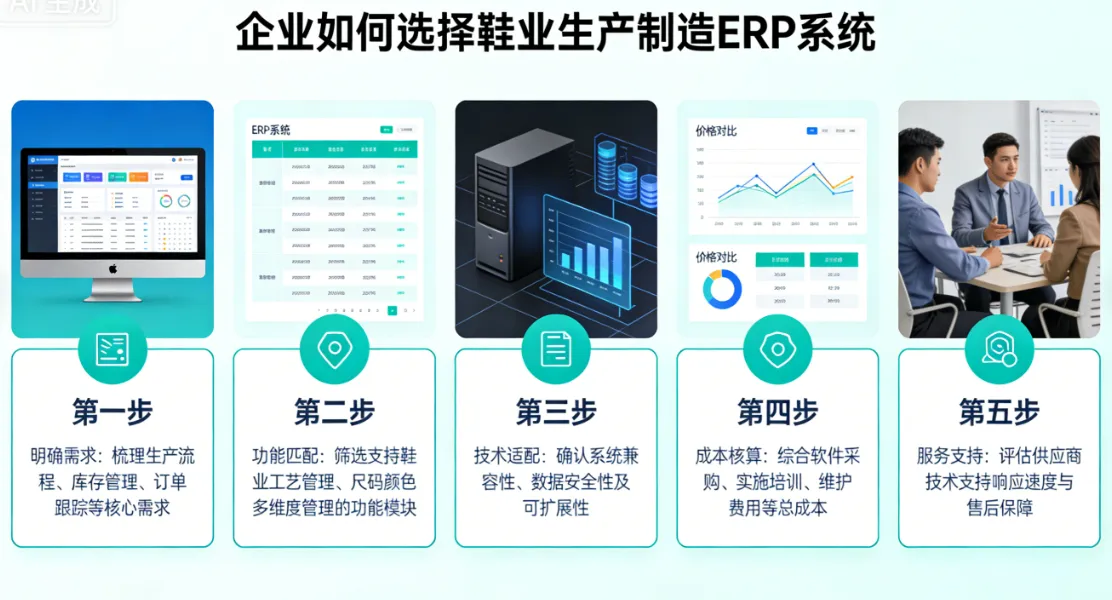
Industry genetic testing: whether the system grows in the soil of the footwear industry
The primary criterion for determining whether an ERP system is suitable for the footwear industry is not the length of the functional list, but whether its core architecture is designed with the footwear manufacturing logic as the starting point. A true footwear ERP must have a material coding system that naturally supports a three-dimensional matrix of styles, colors, and sizes. When the salesperson enters an order, the system should be able to quickly retrieve the corresponding shoe type's material list and automatically calculate the material usage based on the customer's selected color scheme, rather than allowing users to manually maintain it line by line in the general BOM interface. The cutting workshop is a unique management challenge for shoe companies. A qualified footwear ERP system needs to have a built-in layout utilization management module, which can record the number of layout pieces per blade and the actual utilization rate of each batch of leather materials, and include the utilization rate differences in cost accounting. The process balance of the needle car assembly line is an efficiency bottleneck, and the system should support process splitting and restructuring simulation to assist production managers in quickly responding to personnel changes and order structure changes. A certain sports brand once inspected seven suppliers during the selection process, and the final selected supplier may not be the largest in scale, but it is the only manufacturer who can demonstrate the complete loop of "order entry automatic material calculation cutting plan needle car dispatch" on the spot and can clearly explain the logic of shoe specific terminology. This round of screening filtered out more than half of the generic competitors.
Flexible planning capability: intelligent scheduling for multiple varieties and small batches
The scheduling difficulty of shoe manufacturing is much higher than that of standardized industries such as automobiles and electronics. The same production line may produce 5000 pairs of vulcanized shoes for foreign trade orders in the morning and 300 pairs of cold bonded shoes for e-commerce bestsellers in the afternoon; The same order may be delivered in batches, with the first batch being rushed and the second batch being delayed for months. The material requirement planning logic of traditional ERP is based on the assumption of relatively stable demand, which often falls short in the face of high-frequency changes in the order rhythm of the footwear industry. When selecting, it is necessary to focus on whether the system has advanced planning and scheduling capabilities, whether it supports a visual scheduling interface, whether it can clearly display the real-time load of each production line, team, and machine in the form of a Gantt chart, and whether it supports drag and drop adjustment. More importantly, when an emergency insertion occurs, the system can quickly simulate its chain effect on raw material supply, existing order delivery time, equipment and personnel allocation, and provide multiple feasible solutions for managers to make decisions. A certain shoe company once shared its selection lesson: a set of universal ERP systems with extremely attractive prices was abandoned after six months of implementation due to the inability to handle frequent order changes and material substitutions, resulting in a complete decline in initial investment.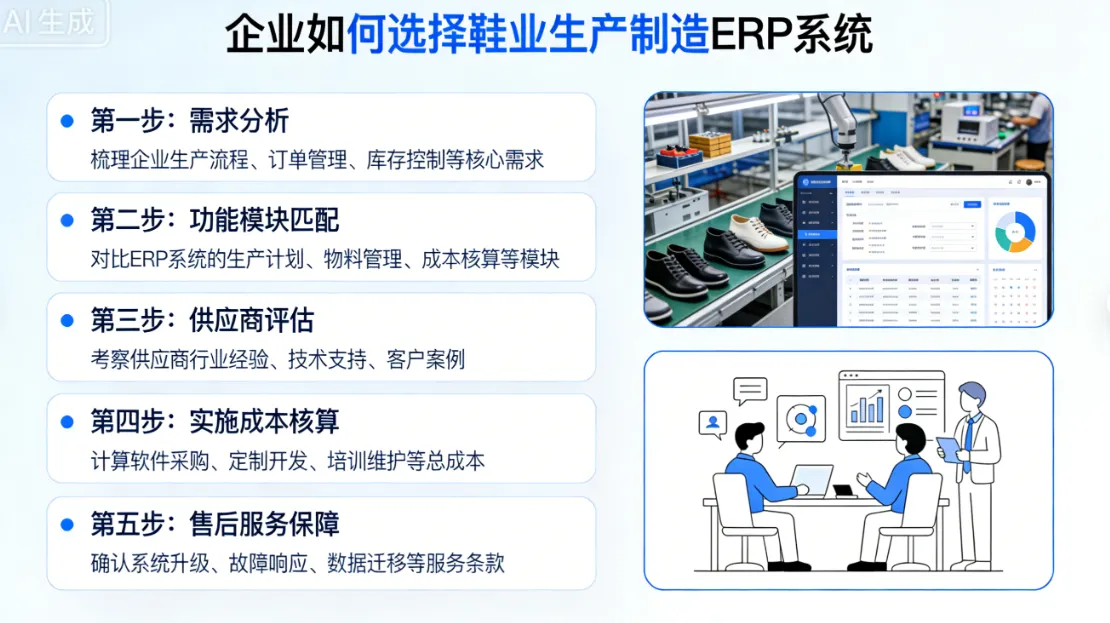
Real time cost accounting: from fuzzy estimation to precise perspective
The cost composition of footwear products is complex and dynamic. The price difference between different batches of the same fabric is significant; The utilization rate of the same leather material varies greatly in different parts; The labor cost of the same style produced on different production lines may differ by more than 20%. The traditional financial software that calculates comprehensive costs on a monthly basis is almost ineffective in the footwear manufacturing scenario - when managers receive cost reports, orders have already been delivered for several weeks, and the problem has already settled into losses. The selection of footwear ERP must take real-time cost as a hard indicator. The system should support multi-dimensional cost collection by order, batch, and style. Material costs should be accurate to the actual consumption of each pair of shoes and each process. Labor costs should be linked in real-time with the piece rate wage system, and manufacturing expenses should be dynamically allocated based on reasonable drivers. When a certain product experiences cost anomalies in a certain order, the system should be able to penetrate to the specific abnormal link: is the utilization rate of a certain batch of fabric low? Is the labor price for a certain process too high? Is the efficiency of a certain production line not meeting the standard? After importing the real-time cost module, a certain export shoe company found that its best-selling products were repeatedly developed due to frequent color changes by customers, resulting in hidden costs that consumed 80% of its book profits. This is a management blind spot that has never been quantified before.
Precision and transparency of piece rate wages: the cornerstone of trust between labor and management
The footwear industry is a typical labor-intensive industry, and piece rate wages are the core link between workers' income and enterprise output, as well as a high-risk area for labor disputes. A set of ERP systems that are not suitable for the footwear industry often becomes a tool for post accounting, with the piece counting module becoming a tool for post accounting. Team leaders manually count production on a daily basis and input it into the system at the end of the month, making it impossible for workers to know their daily income in real time and for accounting discrepancies to be traced. To truly adapt to the footwear industry, ERP must move piece rate wage management from month end accounting to daily operations. The system should be deeply integrated with process level production reporting. For each completed process, workers can report their work in real-time through their work ID or QR code. The system will immediately calculate the wages due for that process based on the preset work price and accumulate them in their personal income account for the day. Workers can check their production and income details for the day, week, and month at any time through their mobile phones, with each penny linked to specific processes and work orders. When adjusting the labor price, the system fully records the change history, and any disputes can be traced back to the adjustment date, adjustment basis, and approver. After a listed shoe company implemented the precise piece rate module, employee complaints caused by salary calculation decreased by 97%, recruitment difficulty significantly reduced, and skilled worker turnover rate decreased by 15 percentage points.
Supply chain collaboration: from going it alone to ecological linkage
The supply chain of the footwear industry is complex, involving numerous specialized suppliers from leather, fabric, substrate to accessories. Traditional ERP considers suppliers as external entities, and information exchange remains at the level of purchase orders, resulting in serious information lag between brand owners and suppliers - brand owners do not know whether raw material inventory is sufficient, and suppliers do not know why orders are delayed. ERP adapted to the footwear industry should have the capability of a supply chain collaboration portal, integrating core suppliers into a unified digital network. After the production plan and material requirements of the brand are desensitized by the system, they can be directed and pushed to the supplier end; Suppliers can log in to the dedicated portal to view demand forecasts for the next three to six weeks, prepare materials in advance, and reserve production capacity. After the purchase order is issued, the supplier confirms the delivery date online and generates an electronic shipping notification synchronously when shipping. The brand's warehouse can arrange for receipt preparation in advance. A certain sports brand has compressed the procurement cycle of materials by an average of 7 days through a supply chain collaboration module, resulting in a 64% decrease in production downtime caused by material delays.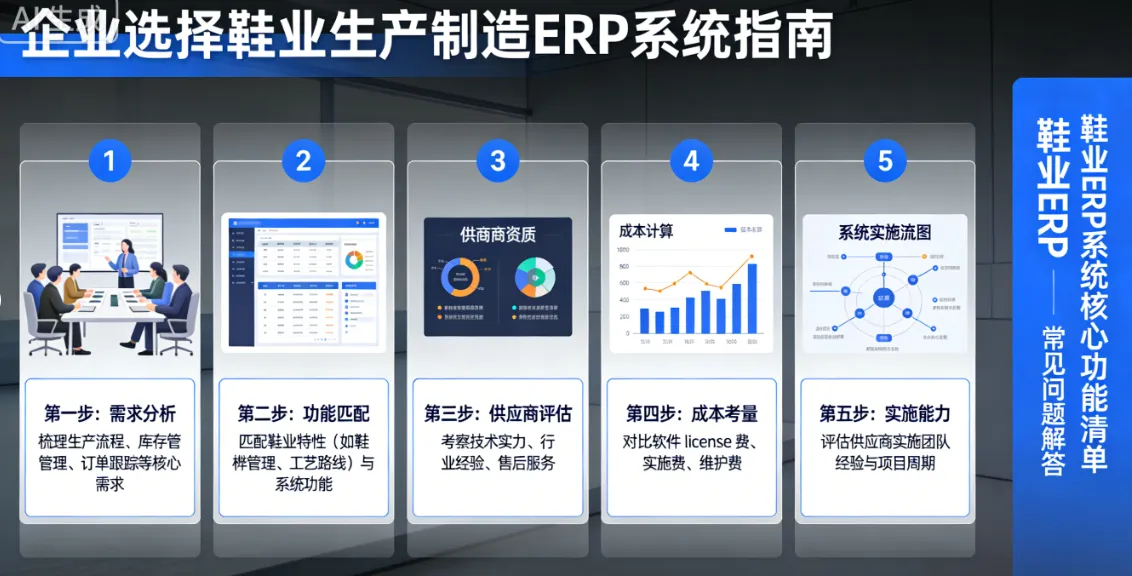
Success factors beyond selection
The final choice for shoe ERP is not a set of software, but a long-term partner. In addition to a rigorous assessment of product functionality, it is also necessary to carefully evaluate the supplier's industry focus - how many years of experience does the company have in the footwear industry? Does the R&D team have professionals who understand shoe-making techniques? Has the implementation consultant ever worked in a shoe factory? How many successful cases among existing customers are similar in scale and category to our own? How stable is the service team? The customer renewal rate is the ultimate measure of value. In addition, companies themselves also need to be prepared for change. Shoe ERP is not a project of the procurement department or the IT department, but a project of the chairman. Without the continuous push of the top decision maker, any excellent system will fail in the face of departmental conflicts of interest and habitual inertia. When enterprises examine their own determination to change and external solutions with the same rigorous attitude, selection is no longer an uncertain adventure, but a deterministic investment towards a refined operational future.