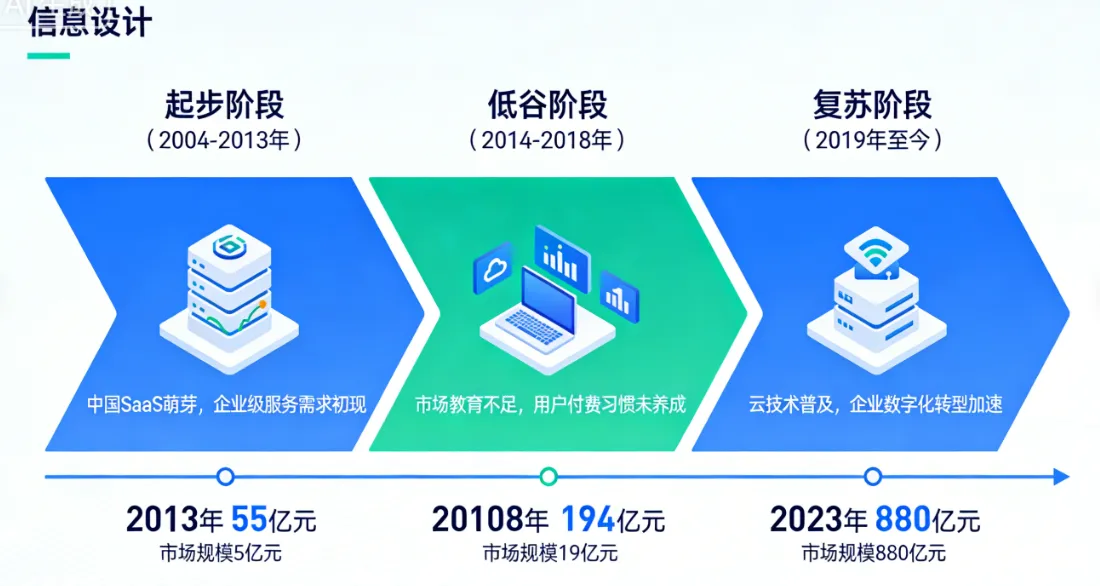
The Development History of China's SaaS Market: From Start, Low Point to Recovery
Sprout stage: localization attempts of imported concepts
The story of China's SaaS market began at the beginning of this century. Around 2004, Salesforce successfully went public on the US capital market, demonstrating the business potential of its software subscription model to the world. At that time in China, the enterprise software market was still dominated by traditional suite software, and financial software from UFIDA and Kingdee were delivered through CDs, with one-time payment, permanent use, and local deployment. A few entrepreneurs with keen sense of smell began to try to introduce the concept of "software as a service" into China, and early players such as Baipake and XTools successively appeared. However, the reality is far more than the ideal bone feeling - at that time, China's Internet infrastructure was still in the era of ADSL dialing, and the network speed was slow and the prices were expensive; Business owners are wary of 'putting data on someone else's server'; Even more deadly is that customers who are accustomed to paying for physical goods find it difficult to understand why software that cannot be seen or touched needs to be paid annually. During this period, most SaaS companies were struggling to explore, with rudimentary product forms, high market education costs, and capital not yet paying attention to this barren land. But they sowed the seeds, validated the technical feasibility of the subscription model in China, and cultivated the first batch of SaaS users in China.
Golden Age: Dual Catalysis of Capital and Demand
The period from 2012 to 2015 was the first explosive period of China's SaaS market, often referred to as the "golden age" by eyewitnesses. This is no accident: the popularity of mobile Internet enables employees to access the Internet anytime and anywhere for the first time; The rise of domestic cloud service providers such as Alibaba Cloud and Tencent Cloud has significantly reduced the development and operation costs of SaaS products; The enterprise level service track has received intensive attention in the spillover effect of the consumer Internet capital feast. More importantly, the decline of the demographic dividend has led business owners to face the proposition of "reducing costs and increasing efficiency" - since hiring has become more expensive, can software replace people?
So, capital poured in like a tide. Top investment institutions such as Jingwei China, Sequoia Capital, and IDG have set up enterprise service special funds. From 2014 to 2015, there were over 500 financing events in the SaaS field in China, with a total amount exceeding 30 billion yuan. Fenxiang Salesman and SalesEasy are in close competition on the mobile CRM track, with Beisen and Kenaikesa leading HR SaaS, Youzan and Weimeng rapidly increasing their volume through the WeChat ecosystem, and Mingyuan Cloud deeply cultivating the real estate vertical field. The characteristic of this period is to rise high and conquer territories, with companies generally prioritizing "revenue growth rate" and "burning money for growth" as the mainstream narrative. Industry conferences are bustling with people, startup valuations have doubled in months, and traditional software vendors are anxiously turning around, creating a prosperous scene.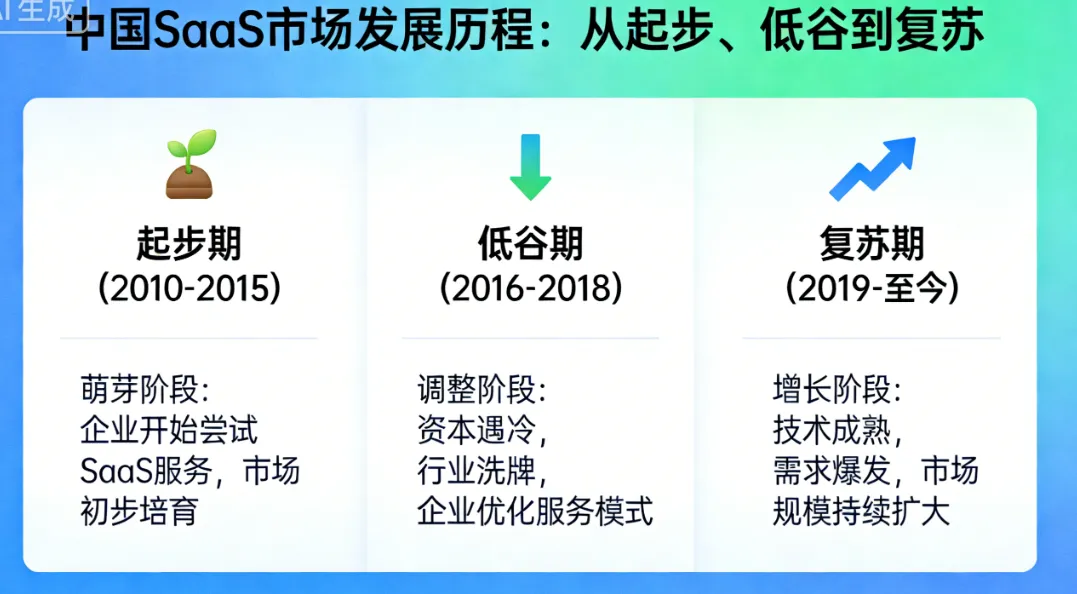
The first shuffle: the bursting of the prosperity foam
The carnival came to a sudden end in the second half of 2016. The capital winter has unexpectedly arrived, and the difficulty of financing in the primary market has sharply increased. Even more deadly, investors and entrepreneurs almost simultaneously discovered a cruel fact: the SaaS products sold in the past two years generally had poor customer renewal rates. Many companies, in order to meet their financing targets, sign a large number of small and medium-sized customers regardless of cost, with extremely low unit prices but providing high cost customized services, resulting in losses on the first order and no hope of renewal. A well-known CRM manufacturer once publicly disclosed data that its customer base with an annual income of less than 50000 yuan had a renewal rate of less than 30% in the second year. This model is jokingly referred to as "pseudo SaaS" by the industry - customized projects disguised as subscriptions.
The pain of the foam burst lasted for nearly three years. A large number of start-up companies have broken their funding chains, gone bankrupt, or been acquired at low prices. Surviving enterprises are forced to undergo painful transformations: shrinking their customer base from a massive number of small and micro customers to medium to large customers, shifting from pursuing customer quantity to managing customer quality, and shifting from functional stacking to deep value mining. Shrinking the front line, refining operations, and prioritizing cash flow have become the new creed. Although this stage is full of frustration, it is the true coming of age ceremony for China's SaaS industry. Survivors have come to a clear realization in their labor pains: the essence of SaaS is not to "change software from selling to renting," but to continuously create measurable value for customers in exchange for long-term repeat purchases. This simple yet forgotten truth became the spiritual core of the industry's recovery in the future.
Hibernation period: technical reserves and value accumulation
The period from 2019 to 2021 was a relatively quiet but turbulent period for the Chinese SaaS market. Although the primary market financing is not as prosperous as before, top enterprises have generally received large pre IPO rounds of capital injection, and the trend of capital concentration towards a few leading companies is obvious. At this stage, there was no exciting business model innovation, but a qualitative change occurred at a deeper level.
Firstly, there is a systematic improvement in product strength. Top SaaS companies have significantly reduced their marketing budgets and instead invested over 20% of their revenue in research and development. The extensive model of relying on dozens of sales to bombard the market and two or three product managers to draw prototypes in the past has been abandoned, replaced by a deep understanding and knowledge encapsulation of vertical industry business processes. Next is the accumulation of organizational skills. The core backbone turnover rate has significantly decreased, and a group of middle-level forces who understand the industry, products, and customers have grown. The third is a fundamental shift in customer perception. After experiencing the cycle of "free trial - low-priced import - abandonment and loss", enterprise users are no longer simply based on price as the primary criterion for selection, but are more concerned about the product's business adaptability, implementation service capabilities, and long-term evolution roadmap. The Chinese SaaS market has completed a cognitive leap from "whether there is" to "whether it is good or not" in silence.
Recovery and Differentiation: A New Cycle of Rational Prosperity
Since 2023, the Chinese SaaS market has shown a completely different recovery feature from the golden age. This is no longer a universal feast of picking up money everywhere and everyone getting a share, but a highly differentiated and value returning structural market. In the secondary market, the stock prices of listed SaaS companies have gradually stabilized after experiencing a deep correction, and investors have shifted their focus from valuation models based on market to sales ratios to cash flow and profitability. The number of financing transactions in the primary market is much lower than the peak period, but the single amount has significantly increased, and funds are concentrated in scarce tracks such as PaaS platforms, industry vertical solutions, and overseas services.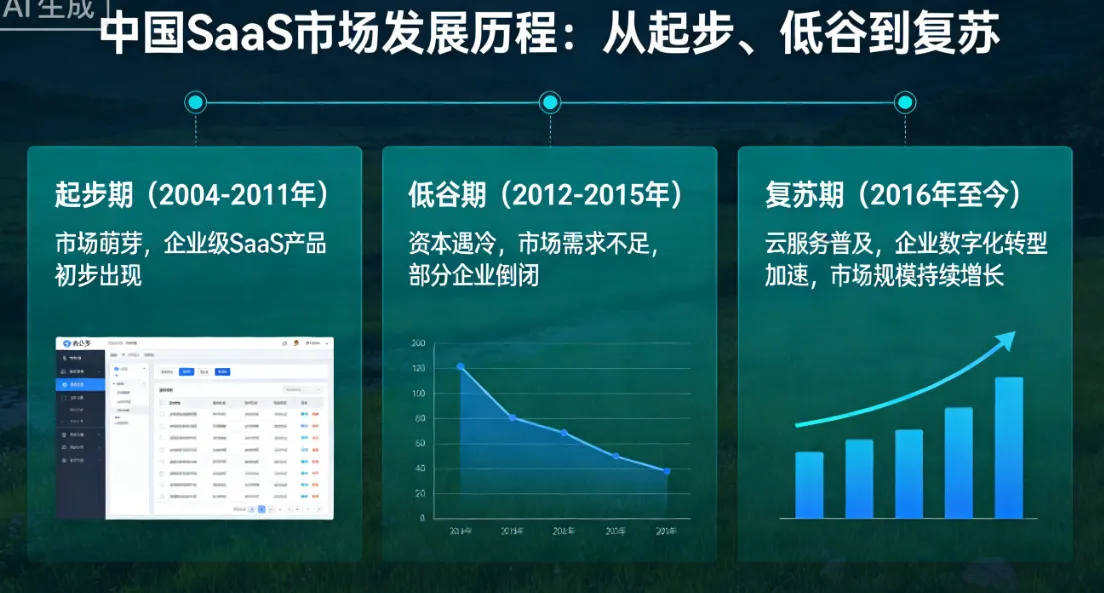
The customer group structure has undergone fundamental restructuring. The halo of the small and micro enterprise market, which was once excessively pursued, has faded, and large and medium-sized enterprises have become the core battlefield for SaaS vendors. This type of customer has a high unit price, stable contract renewal, and complex requirements, forcing SaaS vendors to upgrade from "selling tools" to "selling services" - products need to be deeply integrated with customers' existing IT systems, adapted to personalized business processes, and provide full stack capabilities from consulting, implementation to secondary development. Leading companies such as SalesEasy and Beisen have launched PaaS platforms, allowing customers and partners to customize low code products based on standardized standards; Youzan and Weimeng are exploring integrated services for private domain operations and digital systems within the Tencent ecosystem.
At the same time, going global has become a common choice for incremental markets. Against the backdrop of a saturated domestic market, Chinese SaaS companies with product capabilities have begun to systematically expand into emerging markets such as Southeast Asia, the Middle East, and Latin America, exporting their software capabilities in mature e-commerce, social networking, and payment scenarios overseas. In 2023, SaaS overseas financing cases will increase by over 150% year-on-year, becoming the vanguard of China's software industry globalization.
Redefine the Value Base of SaaS in China
Looking back at the development track of China's SaaS in the past two decades, from the restlessness of concept introduction, to the expansion of capital ripening, to the disillusionment of foam bursting, and finally to the rational recovery today, this is not a straight upward line, but a cognitive curve of spiral evolution. The core takeaway of this curve is a fundamental return to the industry's understanding of the essence of SaaS - SaaS is neither a variant of a "product" nor an innovation of a "channel", but a new, long-term, value sharing contractual relationship between software companies and customers. Under this contract, customers pay as needed to obtain continuously optimized service capabilities, and software companies obtain compound interest on stable cash flow by continuously creating value. The once wildly sought after "growth hackers" and "exponential explosions" have ultimately given way to simple yet enduring business principles such as "customer success," "long-term repurchase," and "positive cash flow.
Today's Chinese SaaS market no longer has crowded conferences or dizzying valuation myths, but it has also completely bid farewell to the confusion of unclear themes. Survivors and the new generation have a clear understanding of why they exist, who they create value for, and what they rely on to sustain themselves. This may be the beginning of the true maturity of China's SaaS industry - shedding its superficiality, returning to its essence, and cultivating this fertile land of enterprise services that requires long-term watering with enough patience and determination.