
Detailed Explanation of OA System: Definition, Core Functions, and Development Stages
In today's enterprises, almost no one has not been exposed to OA. From leave and reimbursement to document sending and receiving, from meeting scheduling to knowledge sharing, this system known as "office automation" has already penetrated every capillary of organizational operation. But strangely, the more everyday tools they are, the easier it is for people to turn a blind eye to them. Many managers equate OA with "approval software", and many employees feel that it is just a "leave only entrance". This cognitive narrowness precisely obscures the management thinking changes carried by the more than 30 years of evolution of OA systems. Today's OA is no longer the OA of the past, and enterprises' understanding of it often remains stuck in the previous era.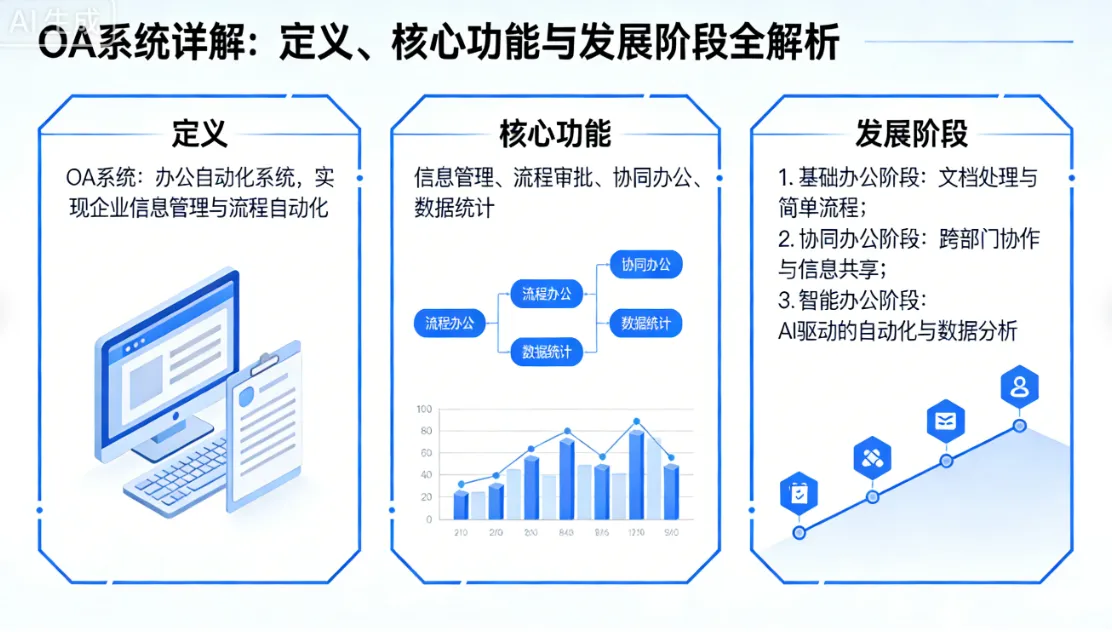
The concept of office automation was born in the late 1970s, when the United States was the first to introduce computer technology into the field of transaction processing. At that time, OA was truly a "secretary level" tool, with a single device, an electronic document, and a data table enough to make traditional paper office appear clumsy and cumbersome. The popularization of LAN technology in the 1980s made file sharing and data transmission possible, and OA rose from a personal tool to a departmental system. But no matter how technology evolves, this stage of OA is essentially doing the same thing: moving things from paper to the screen. It is efficient, standardized, and traceable, but lacks thinking about management itself.
The real qualitative change occurred after China's accession to the World Trade Organization. With the expansion of enterprise scale, the spread of branch offices, and cross departmental collaboration becoming the norm, traditional document based OA is beginning to expose fatal limitations. It can still handle leave requests and reimbursement forms, but cannot understand the relationships between projects; It can still archive contracts and official documents, but cannot allow the sales department and production department to share the same set of customer information. Enterprises have discovered that the automation systems they have built at their own expense are nothing more than parallel digital assembly lines, with walls still towering between them. So, the word 'collaboration' entered the genetic sequence of OA.
To understand modern OA systems, it is first necessary to dismantle that deeply ingrained cognitive barrier: OA is not "office automation", but "the digital mirror of the organization". Its essence is not to make existing processes run faster, but to project all the people, finances, materials, information, and processes of the enterprise into the same digital space, allowing previously fragmented departments, positions, and business nodes to communicate within the same semantic framework. In this sense, OA system is no longer an exclusive tool for administrative departments, but a digital hub that runs through the entire operation scenario of enterprises. From senior decision-makers to frontline executors, everyone in this system sees the same set of facts, follows the same set of rules, and is oriented towards the same set of goals.
The development process of OA system is a microcosm of the refinement of management in Chinese enterprises. The late 1980s to the late 1990s were the embryonic period of the first generation of OA, and also the popularization period of the concept of "paperless office". Lotus Notes, WPS, MS Office and other standalone office software have enabled enterprises to experience the convenience of electronic documents for the first time. The efficiency of file retrieval has been improved by dozens of times, and the scene of paper archives piling up like mountains is beginning to disappear from the office. But at this stage, OA has no processes or collaboration. It is more like a digital filing cabinet, solving the problems of storage and retrieval, but not touching the core of management.
Entering the 21st century, the second generation of OA, with workflow engines at its core, ushered in the golden decade of process automation. Leave approval no longer requires signatures from all over the building, and procurement requests no longer need to ask 'where has the order gone?' The system automatically processes, urges, and archives according to preset nodes. This is the first time that OA has truly intervened in enterprise management, and it is also the first time that management terms such as "standardization" and "normalization" have been implemented as carriers. But problems also arise: the process is solidified in the code, and once the enterprise business is adjusted, the cost of modifying the process is extremely high; Each department operates independently, and the approval process for finance and the attendance process for personnel are not interconnected. The information silos have only been replaced from paper partitions to electronic partitions.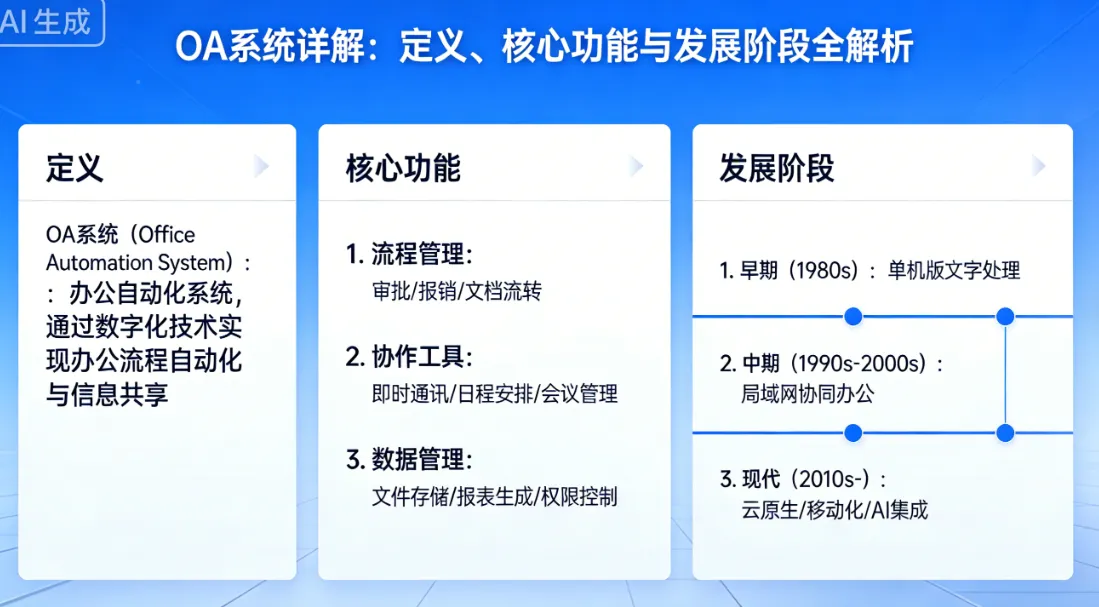
Around 2010, the wave of mobile Internet swept in, and the third-generation OA ushered in explosive growth. Smartphones have liberated the office from the confines of cubicles, and approvals no longer have to be completed by sitting in front of a computer. Field personnel can initiate applications at the customer's site, and management can complete remote approvals at the airport. More importantly, during this period, OA began to break down system barriers and deeply integrate with business systems such as CRM, ERP, HRM, etc. Sales orders can trigger financial reimbursement and inventory scheduling, and project progress can be linked to personnel performance and resource allocation. Integration is no longer a concept, but a tangible reality. At the same time, the maturity of cloud computing enables small and medium-sized enterprises to acquire digital capabilities that were previously only affordable to large corporations at extremely low costs, and the popularity of OA is exponentially increasing.
And today, we are in the midst of the fourth generation OA transformation. The injection of artificial intelligence and big data is evolving OA from a "passive response" tool to an "active service" intelligent agent. The intelligent process engine can automatically identify duplicate approvals and batch process routine applications; Semantic analysis technology enables file retrieval to no longer rely on keyword matching, but to understand users' true intentions; The data visualization dashboard pushes process efficiency, collaboration frequency, and resource utilization to managers in the form of real-time charts. The organizational temperature that was once perceived intuitively now has precise numerical scales. This is no longer an evolution of tools, but a leap in abilities: OA has for the first time taken on the role of a "staff officer".
In terms of functionality, modern OA systems have long surpassed the original combination of "approval process+bulletin board" and grown into a functional network covering the entire operation scenario of enterprises. The collaborative office module is the backbone of enterprise communication and collaboration, with built-in capabilities such as instant messaging, schedule sharing, meeting management, and task allocation. It enables cross departmental collaboration to no longer rely on fragmented information from WeChat groups. Every communication, resolution, and to-do list is structured and sedimented, becoming a part of organizational memory. The process approval module is the backbone of standardized management, but it is no longer a passive tool for accepting processes. Enterprises can drag and drop nodes and adjust paths at any time according to business changes, and the process itself becomes an iterative management asset. The information management module is a container for enterprise knowledge and experience, from rules and regulations to training materials, from project reviews to technical documents. All implicit knowledge is made explicit, structured, and retrievable here. New employees no longer need to rely on "asking seniors" to get started, and the experience of old masters will not be lost with resignation.
The resource management module integrates the assets, attendance, and logistics affairs of the enterprise into a unified scheduling system. The entire process of equipment storage, requisition, depreciation, and scrapping can be traced, and the reservation, use, return, and maintenance of a bus are recorded. The data center module is the value export of the OA system, which aggregates the scattered operation trajectories, process data, and collaborative records of various modules into a multidimensional analysis model. Managers can intuitively see which nodes often lag, which departments have the most intensive collaboration, and which types of processes take the longest time, and make optimization decisions based on data rather than experience.
The enterprise value of OA systems is often simplified as "reducing costs and increasing efficiency", but if we only focus on this layer, we miss its deeper meaning. Cost reduction and efficiency improvement are real: process automation has reduced the average approval time by more than 30%, electronic documents replacing paper files have significantly reduced office consumables costs, and mobile office has nearly doubled the response speed of cross departmental collaboration. But more fundamental than efficiency is the risk control ability brought by standardized management. The hierarchical control of permissions allows data to only be accessed by authorized individuals, the retention of approval traces makes every decision traceable and auditable, and the institutionalization of processes transforms "doing things according to regulations" from a slogan to a default path in the system. When the scale of the enterprise expands and personnel flood in, it is impossible for managers to keep an eye on people alone. Only the system can become a rigid constraint for the implementation of the system.
Looking deeper, the true strategic value of OA systems lies in laying the foundational infrastructure for enterprise digital transformation. It does not solve specialized problems in a particular vertical field - which can be accomplished by ERP, CRM, SCM - but it connects all specialized systems together, allowing data to flow freely within the enterprise without being stuck at the boundaries. It is the starting point of data governance, a testing ground for process standardization, and a training camp for employees' digital literacy. Without this foundation, any grand digital transformation blueprint would be a castle in the air.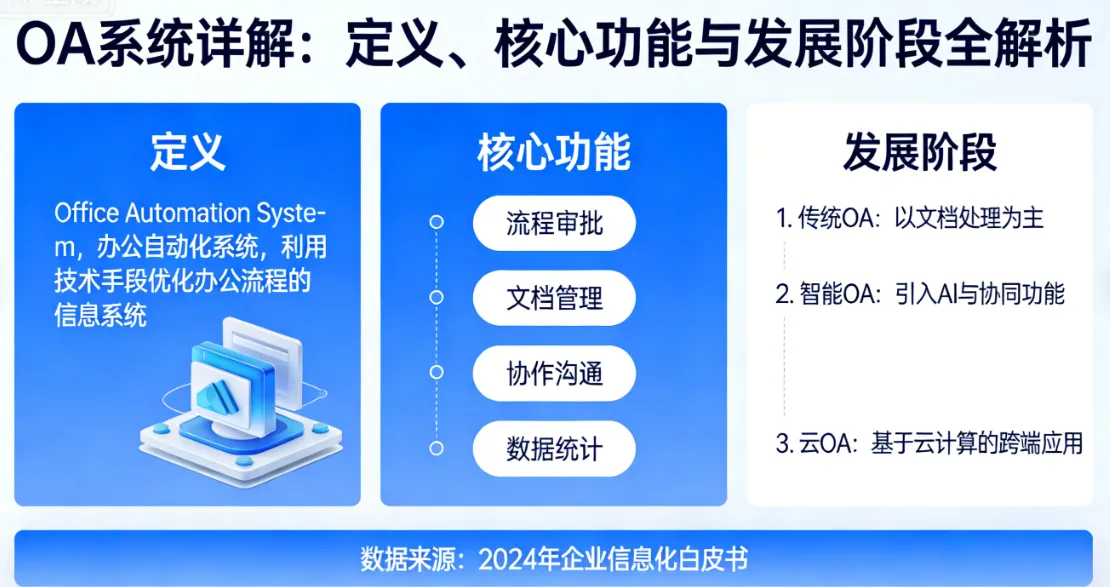
Looking back at the evolution trajectory of OA systems over the past thirty years, a clear thread runs through it: from tools to platforms, from solidification to flexibility, from recording to insight, from assistance to driving. It is no longer the edge system that hides in the corner of the administrative department and only exists for processing incoming and outgoing documents, but is becoming the central nervous system of the enterprise's digital ecosystem. In the future, OA will be more deeply integrated into artificial intelligence, moving from "assisted decision-making" to "proactive prediction"; We will more thoroughly break down organizational boundaries and weave customers, suppliers, and partners into the same collaborative network; We will take on the mission of knowledge management more consciously, making organizational wisdom sedimentable, inheritable, and reusable.
Those companies that still see OA as a 'leave application' are missing an era. And those enterprises that regard OA as a core component of digital strategy have already taken the lead in this long and profound organizational evolution.