
OA System Guide: Definition, Selection Recommendation, and Core Function Analysis
In the landscape of enterprise digital transformation, OA systems often play the most familiar yet unfamiliar role. Almost all companies use it and almost all employees have access to it, but when asked what OA is, the answer often stops at "a tool for leave reimbursement" or "a channel for sending and receiving documents". This cognitive narrowing has kept the OA system locked on the edge of administrative affairs for a long time, and its true value has been severely underestimated. In fact, today's OA is no longer an abbreviation for office automation, but the nerve center of organizational digitization. It is the strategic infrastructure for enterprises to move from experience driven to process driven, and from rule of man to rule of law.
What is an OA system?To understand it, we must start with conceptual demystification. The term office automation was coined in the late 1970s, initially only to digitize paper documents and automate manual processes. But more than forty years have passed, and the connotation of OA system has already undergone a complete transformation. Modern OA system is a digital carrier platform for all information processing and management activities of enterprises, except for production control. It is not an assistant to the secretary, but a staff member to the decision maker; It is not an exclusive territory of administration, but a collaborative operating system that runs through the three levels of strategy, management, and execution. Senior managers use it to perceive organizational temperature, middle-level managers rely on it to grasp business rhythm, and grassroots employees use it to complete business collaboration. An excellent OA system must simultaneously accommodate these three perspectives and achieve a delicate balance among them.
The analysis of core functions should start from the real pain points of the enterprise, rather than the supplier's list of functions.Process approval is the most mature and essential module in OA systems, but it is no longer a simple linear chain of "initiation approval archiving". Modern process engines must support multi node branching, conditional jumps, co signing or signing, proxy authorization, and time limited reminders, so that approval processes such as leave, reimbursement, procurement, contracts, etc. no longer rely on the chaos of paper documents and WeChat notifications. More importantly, the process itself should be a dynamic asset management, and enterprises can drag and drop nodes and adjust paths at any time according to business changes, rather than rigidly solidifying them in the code. The endpoint of the process is not archiving, but the precipitation and reuse of data.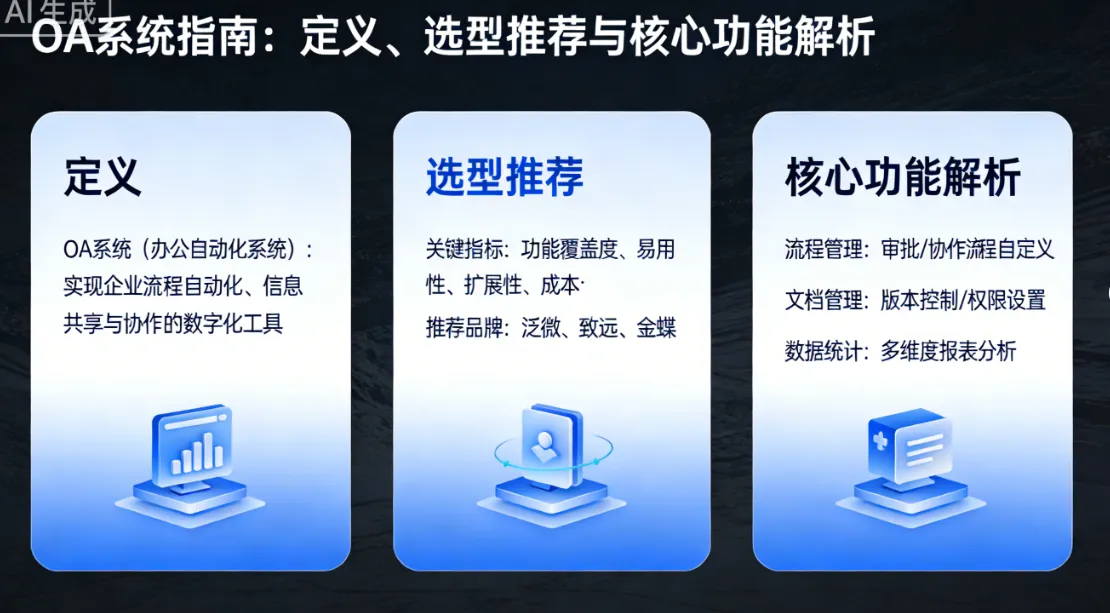
Document management and knowledge accumulation are another highly undervalued area of value in OA systems. In the traditional office model, experience is stored in the minds of old employees, and resignation is a discontinuity; The files are scattered in personal computers and WeChat groups, and searching is like finding a needle in a haystack. Modern OA systems achieve version traceability, full-text search, permission grading, and online collaborative editing through enterprise level document libraries and knowledge communities. When institutional documents, project reviews, and training materials are systematically deposited, new employees no longer rely on word of mouth to get started, organizational wisdom changes from implicit to explicit, and from personal assets to public wealth. This is the true contribution of OA system to organizational capability.
Collaborative communication and schedule management constitute the flesh and blood of daily office work. Modules such as instant messaging, meeting scheduling, task allocation, and work logs structure fragmented collaborative behavior, ensuring that every communication is traceable and every decision is supported by evidence. The maturity of mobile office capabilities has completely dissolved the physical boundaries of the office, and approvals no longer have to be completed by sitting in front of a computer. Field personnel can initiate applications at the customer's site, and management can complete approvals during travel. When the friction cost of collaboration is minimized, the response speed of the organization can approach its limit.
The administrative logistics modules such as asset management, vehicle management, item requisition, and attendance statistics may seem trivial, but they are actually the touchstone of standardized management. The entire process of storing, receiving, depreciating, and scrapping a device can be traced, and the reservation, use, return, and maintenance of a bus are recorded. The digitization of these edge scenes often better tests the granularity of an organization's management than the core processes. The overlooked leaks and leaks are precisely the most concealed channels for profit loss.
Integration capability is becoming a watershed indicator for OA systems. Information silos are a stubborn problem in enterprise digitization, with financial systems managing accounts, human resources systems managing personnel, and sales systems managing customers, all of which have language barriers and data fragmentation. An excellent OA system should have open API interfaces that can seamlessly integrate with business systems such as ERP, CRM, HRM, etc. When OA becomes the hub connecting various professional systems, organizations truly have a complete set of data views, and decision-makers do not have to switch and compare between multiple systems, making decisions based on experience.
The starting point for selection recommendation is not to compare the length of the menu, but to honestly diagnose the needs of the enterprise itself.There is no OA on the market that can adapt to all enterprises, only the most suitable solution for the current stage and the most in line with business logic. Enterprises should first examine internally: what are the most urgent office pain points? What are the extension requirements for the system in the next one to three years of business development? What are the operating habits and acceptance levels of the core user group?
From a budget perspective, the market presents a clear three-tier structure. Start up or small and micro enterprises have core requirements focused on basic collaborative functions such as process approval, document sharing, and attendance statistics. At this stage, priority should be given to choosing the basic version of the SaaS model, with annual subscription payments and no need to bear hardware procurement and operation team costs. DingTalk OA and Enterprise WeChat are practical choices in this range. The former covers the basic needs of small and micro enterprises with a free version, while advanced process functions require subscribing to the professional version; The latter is deeply integrated with Tencent's ecosystem, providing a smooth experience for document collaboration and schedule management. The light flow basic version is known for its low code capability and is suitable for small teams with certain personalized process requirements but unable to customize development.
Growth oriented enterprises and medium-sized teams have extended their demands from basic office to multi departmental collaboration, light business integration, and mobile office. At this stage, SaaS advanced version or hybrid deployment solution can be chosen to obtain personalized process configuration and API docking capabilities under the premise of controllable costs. The A6 series of Zhiyuan Internet has a deep foundation in the government and small and medium-sized enterprise markets, while the pan micro eteams are known for modular subscriptions and flexible expansion. Lanling KK has differentiated advantages in mobile experience and knowledge management. Enterprises should choose functional combinations based on their own industry attributes. Manufacturing enterprises can focus on asset management integration, while commercial circulation enterprises can strengthen the association between mobile approval and customer information.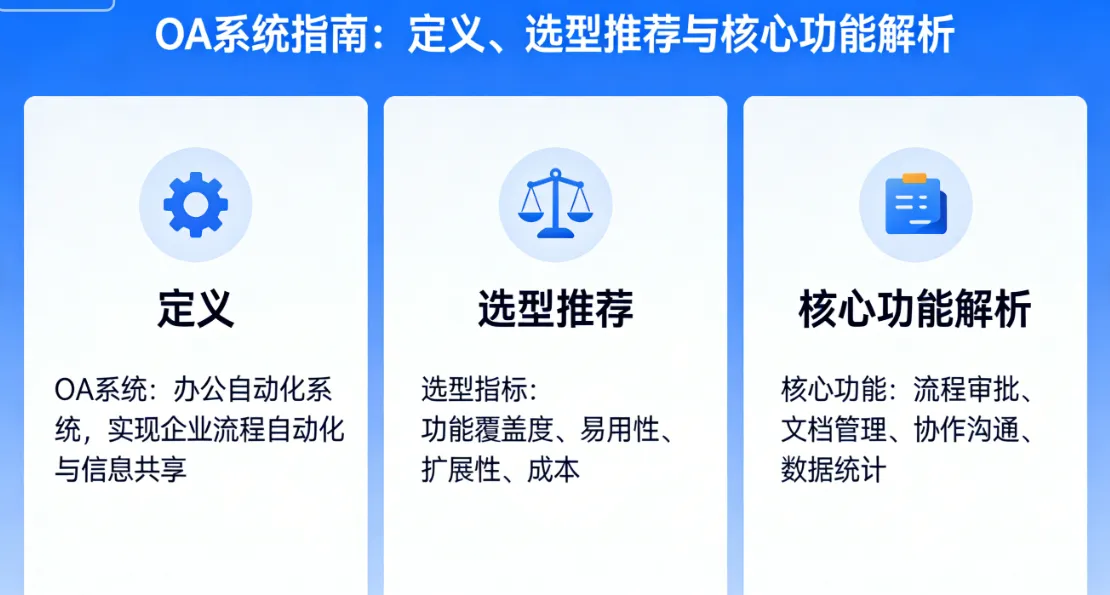
Large corporations and large-scale enterprises require complex business process customization, deep integration of multiple systems, strict data security compliance, and cross organizational collaboration. Local deployment or private cloud solutions are the absolute mainstream in this range, and enterprises need to bear the full cycle costs such as hardware procurement, software licensing, and professional IT team operation and maintenance. LanLing Software's full stack innovation adaptation and AI intelligent agent capabilities have taken a leading position in the market of central state-owned enterprises and large manufacturing enterprises. Benchmark customers such as China Merchants Group and OPPO have verified the implementation effect. Government agencies can choose between Huidian Technology or Zhiyuan Internet. The former is backed by China Electronics Group and has a background in the national team of information and innovation, while the latter dominates the "AI+Information and Innovation" ecological alliance. For organizations that have extreme requirements for deep customization of processes, Pan Micro Networks still have competitiveness with their digital brain centered on process management, but they need to accept the reality of longer customization cycles and uneven service quality in EBU mode. Urban investment companies and grassroots government units can pay attention to Huatian Power, which has solid adaptability, fast implementation speed, and obvious advantages in service cost-effectiveness.
The core principle of selection must penetrate the fog of sales rhetoric and return to the track of rational decision-making.The first principle is to reject functional stuffing and focus on the essence of requirements. Many companies fall into the misconception of 'more functions are better', paying a premium for advanced modules that they won't need for five years, resulting in budget overruns and bloated systems. Before selecting, the boundaries between essential and redundant functions should be sorted out department by department. Non essential modules can be reserved with expansion interfaces, and additional purchases can be made when needed by the business.
The second principle is to calculate the full cycle cost and be wary of implicit expenditures. The real cost of an OA system goes far beyond software licensing fees. Hidden expenses such as hardware procurement, implementation training, data migration, secondary development, annual operation and maintenance, and security protection often surface only after signing the contract. Enterprises should require suppliers to provide itemized quotation details, clarify the unit price per person day and the upper limit of subsequent operation and maintenance cost increases, and reserve an emergency budget of 10% to 20%.
The third principle is to conduct pilot verification first and make rational decisions to conclude. Through preliminary evaluation, select two to three alternative systems for small-scale pilot testing, covering core user departments such as administration and personnel. Test the functional adaptability, operational fluency, mobile stability, and smooth data migration in practical scenarios, collect real user feedback, and then promote it throughout the enterprise. No promotional language can replace the physical sensation after personal use.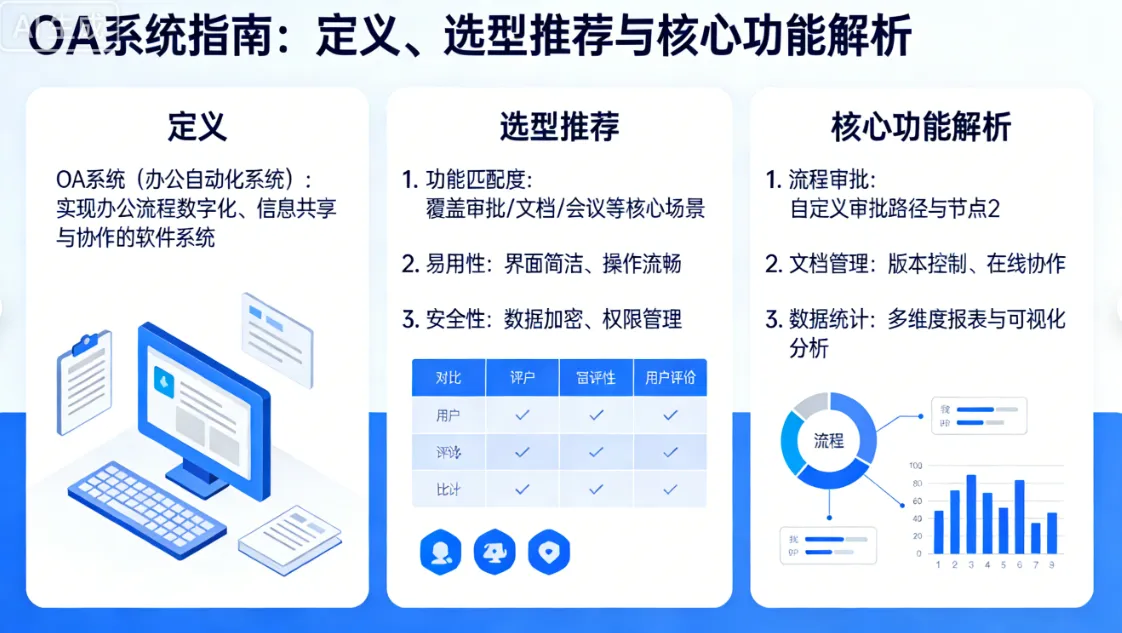
The selection of OA system is not a one-time procurement decision, but a strategic layout for enterprise digital transformation. It does not solve professional problems in a specific vertical field, but it connects all professional systems together, allowing data to flow freely within the enterprise without being stuck at the boundaries. It is the starting point of data governance, a testing ground for process standardization, and a training camp for employees' digital literacy. Enterprises that still consider OA as a 'leave application' are missing an era; And those enterprises that regard OA as a core component of organizational capabilities have already taken the lead in this long and profound evolution.