
What is a CRM system?
If you walk into a company today and randomly ask an employee what CRM is, the most likely answer is: a software used to record customer phone calls and follow-up records. This answer is not wrong, but it makes CRM look like an advanced version of an address book, a monitor used by sales managers to monitor whether subordinates are slacking off. This cognitive narrowing is precisely the root cause of countless companies investing in introducing CRM but achieving little effect. A true CRM system is far from that. It is the sum of all the concepts, methods, and technologies that enterprises use to treat customers, and is the most complete digital mapping of the "rise of customer power" in the business world over the past half century.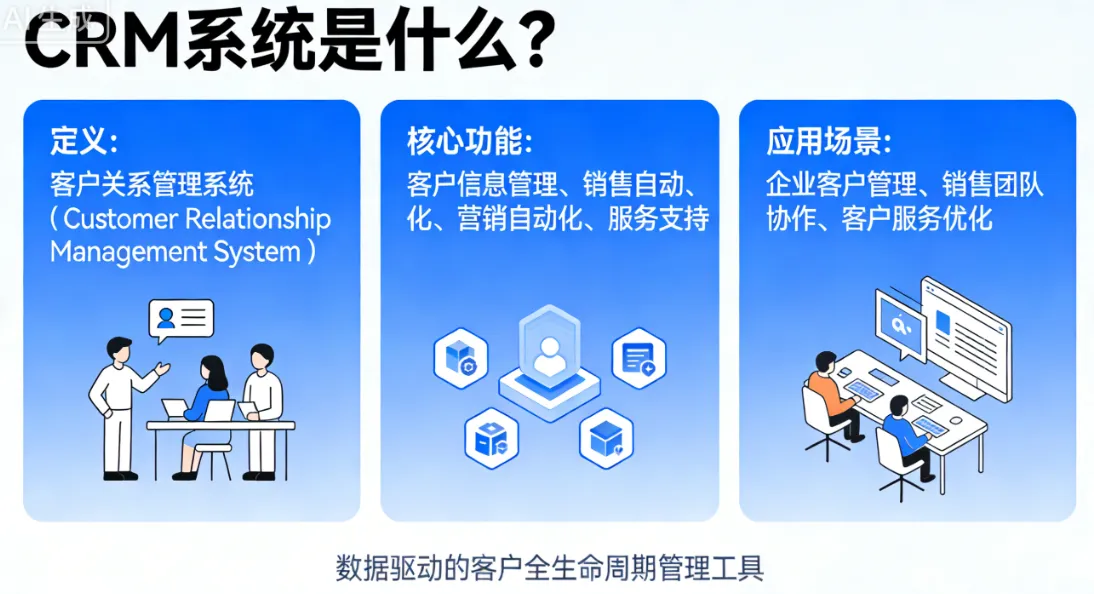
Understanding CRM must start with a cognitive revolution. In the 1980s, when the concept of "contact management" first appeared in American business literature, its mission was indeed simple: to help salespeople remember who made phone calls and who sent emails. Over the next thirty years, CRM has undergone multiple technological iterations, including sales automation, customer service systems, and computer telephone integration. Today, it has evolved into a strategic level enterprise platform that integrates artificial intelligence, big data analysis, and omnichannel collaboration. But the evolution of technology is only superficial, the real qualitative change occurs at the level of management thinking: enterprises finally realize that customers are not prey to be harvested, but value symbiotic entities that need long-term operation.
The excellent courseware of Xiamen University has a highly penetrating definition framework that breaks down CRM into an iron triangle consisting of three levels: concept, technology, and implementation. These three are indispensable and their order cannot be reversed. Concept is the soul - without the strategic determination of "customer-centric", even the most expensive software is just expensive Excel; Technology is a means - it amplifies the effectiveness of ideas, but cannot replace the existence of ideas; Implementation is implementation - translating strategy into the daily interface and decision-making basis for frontline employees. Those enterprises that equate CRM with "buying a set of software and installing it" without exception ignore the premise of concept, and ultimately the system becomes a decoration and data becomes garbage.
The core value of a CRM system can ultimately be condensed into one sentence: transforming customers from "liabilities" to "assets" of the enterprise. This is not a word game. Under the traditional ledger logic, customers are counterparties, objects of accounts receivable, and sources of after-sales service costs. In the logic of CRM, customers are digital assets - their every click, every consultation, and every repurchase are recorded, precipitated, and analyzed, ultimately feeding back into more accurate product iterations and personalized service experiences. China Merchants Bank combines CRM with big data to achieve customer lifecycle management and personalized marketing, with an average annual increase in customer activity of over 20%; 35% of Amazon's sales come directly from its CRM driven personalized recommendation engine. These enterprises have already surpassed the stage of "managing customers" and entered the new continent of "managing customers".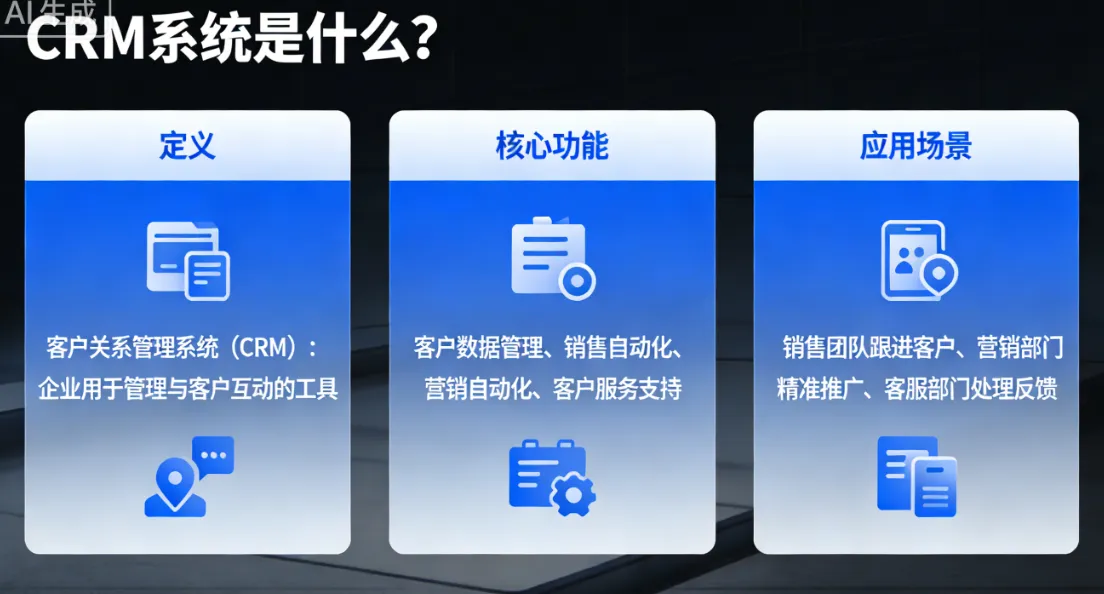
To achieve this conversion, the CRM system must complete three core tasks. Data integration is the starting point, and customer information is naturally fragmented. The sales department keeps contact information, the customer service department keeps complaint records, the e-commerce backend browses the trajectory, and the warehousing system keeps the shipping address. Without CRM, these fragments operate independently, and even 'how much did this customer spend in total' requires multiple departments to reconcile before answering. CRM will unify the cleaning, deduplication, and attribution of data scattered across various channels and touchpoints, ultimately generating a complete 360 degree customer view. Process automation follows closely behind, from lead allocation to business opportunity follow-up, from quotation generation to contract approval, from service work order distribution to satisfaction follow-up. CRM transforms these cross departmental and multi node collaborations from "people chasing people" to "system pushing people". Hainengda connects thousands of distributors worldwide through CRM, and overseas partners place orders independently through a dedicated portal. Brand policies are easily accessible with just one click, resulting in a significant increase in both policy reach rate and order efficiency. Value mining is the highest level capability and a key transition for CRM from "recording the past" to "predicting the future". Customer segmentation based on RFM model, churn probability prediction based on machine learning algorithm, and decision chain analysis based on knowledge graph - these capabilities enable enterprises to move from "retrospective review" to "pre intervention".
The practice of Zhengda Biology provides a vivid slice for understanding the evolution of CRM. This biotechnology company, with operations in 86 countries, used to rely on the system of international CRM giant Salesforce for a long time, but made a bold decision in 2023 to fully replace it with the domestic CRM platform of SalesEasy. What prompted them to make this decision was not simply cost considerations, but a judgment on the future form of CRM. In the description of the CIO of Zhengda Biotechnology, CRM is undergoing three AI driven silent revolutions: data is transforming from story materials in reports to core assets driving decisions, decisions are shifting from empirical brainstorming to scientific experiments based on AI simulations, and customer relationships are upgrading from pursuing single transactions to building lifelong partnerships. The underlying of these changes is the qualitative transformation of the CRM role from "post event recorder" to "pre alert officer".
This qualitative change has already taken shape in the daily business of Zhengda Biotechnology. When the system prompts salespeople that a customer has been paying close attention to epidemic information recently, AI will proactively suggest preparing epidemic prevention and care materials instead of directly promoting drugs; Marketing personnel can access complex data reports through voice conversations, eliminating the need for IT departments to spend time searching; AI customer service can handle about 85% of routine inquiries and predict potential issues that customers may encounter based on historical data. These scenarios reveal an ongoing trend: CRM is no longer a 'tool for people', but a 'partner for helping people think'.
The boundaries of CRM are constantly expanding. In traditional perception, CRM is the exclusive territory of the sales department, but today's leading practices have already broken this wall. LiuGong International has utilized CRM to build a digital network covering 300 distributors and 2700 branches, connecting front-end customer needs with back-end R&D data, significantly reducing information translation distortion, and achieving a strategic upgrade from "product going global" to "solution going global". Hikvision seamlessly integrates CRM with ERP, international email, call center and other systems to build an integrated marketing, sales and service platform covering more than 150 countries worldwide, significantly improving sales win rates and service efficiency. Huada Gene has successfully replaced Salesforce with domestic CRM, integrating overseas customer, asset, and laboratory information to form a digital capability covering the entire marketing, sales, and service chain, setting a benchmark for the localization transformation of biotechnology enterprises' global operations. These cases collectively point to a conclusion: CRM is evolving from a department level application to an enterprise level strategic platform, and from a tool for customer management to a hub for business collaboration.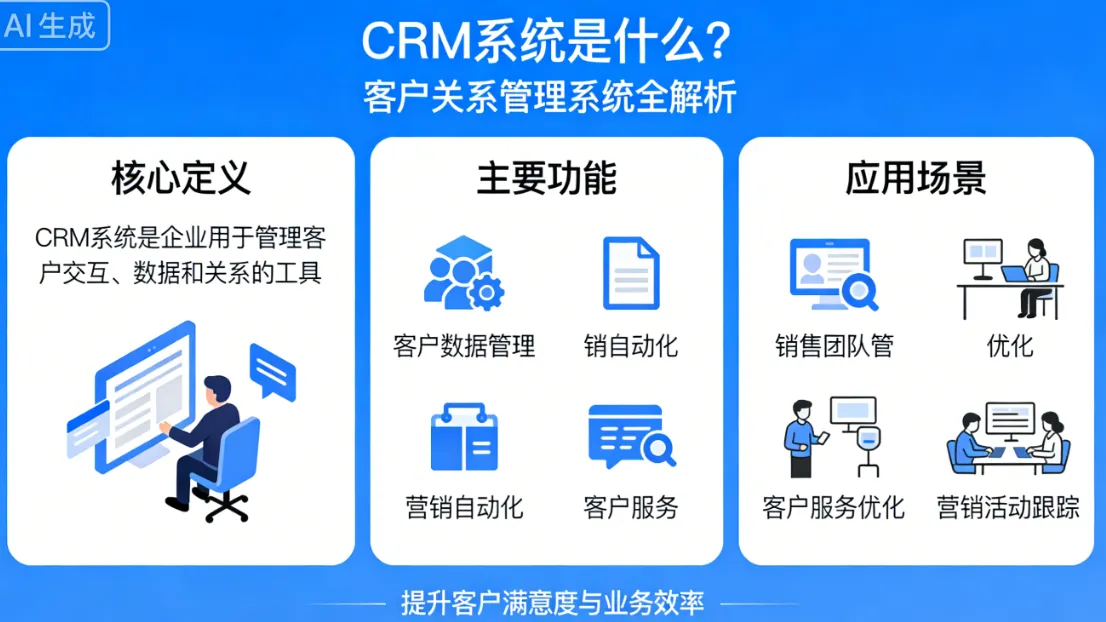
IBM's classic distinction between ERP and CRM still has reference value today: ERP optimizes internal business processes as the backend; CRM strengthens customer interaction as a front-end approach. But this boundary is melting away. When CRM and ERP are deeply integrated, sales personnel can trigger inventory verification, production scheduling, and invoice issuance in the background as soon as they create orders in the system; The finance department tracks revenue and order fulfillment in real-time, while the operations department synchronously obtains demand forecasts and resource allocation criteria. The front-end and back-end are no longer two processes of passing the baton, but the left and right legs of the same race.
At the same time, a new concept is growing on the extension line of CRM: MCR, which stands for Strategic Customer Relationship Management. Traditional CRM focuses on process standardization and is adept at handling large-scale operations for a large number of small and medium-sized customers, but it is difficult to adapt to the refined and deep cultivation needs of large customers. MCR is not a replacement for CRM, but a targeted reinforcement of its shortcomings - it helps companies invest strategic resources that match the value of 20% of their core customers: penetrating the customer's internal decision chain network, dynamically monitoring relationship health, and breaking down annual customer business plans into executable action items. The evolution from "doing business" to "doing relationships" is essentially the self iteration of CRM in the era of stock competition.
So, what exactly is a CRM system? It is the digital mapping of all customer touchpoints of the enterprise, the process integration hub of sales, marketing, and service functions, and the value conversion engine from data precipitation to intelligent decision-making. But it is also a carrier of organizational capability: when front-line sales can access customers' complete profiles and historical interaction records in real time on mobile devices, when customer service teams can predict their needs before customers speak, and when management can see the true cause of every lost order in the cockpit, this enterprise truly has a "customer-centric" digital soul. This answer is much heavier than the six words' customer management software '.