
Three major advantages of shoe production software warehouse management: visualization, first in first out, and accurate data
Among all the departments in the shoe factory, the warehouse is often the most silent and difficult to manage. The cutting workshop is urging for materials, and the warehouse says the system shows inventory; Financial month end inventory, the books and physical items never match; The quality customer complaint batch tracking, the warehouse keeper searched through six months of paper documents but couldn't find the entry record. These difficulties are not due to the warehouse keeper's lack of responsibility, but rather the traditional management model is simply unable to bear the inherent complexity of shoe warehouses - thousands of types of materials, dozens of color matrices in different sizes, subtle color differences in different cylinder numbers, and dynamically changing inventory levels. When a shoe company switches from manual ledger management to professional production software for warehouse management, the first to perceive the change is often not the management team, but the warehouse managers who shuttle the ground cows between the shelves every day. They found that finding materials no longer relies on memory, issuing materials no longer relies on hand feel, and discrepancies between accounts and reality no longer rely on luck at the end of the month. Behind this is the triple advantage of shoe production software in warehouse management: visualization, first in first out, and precise data.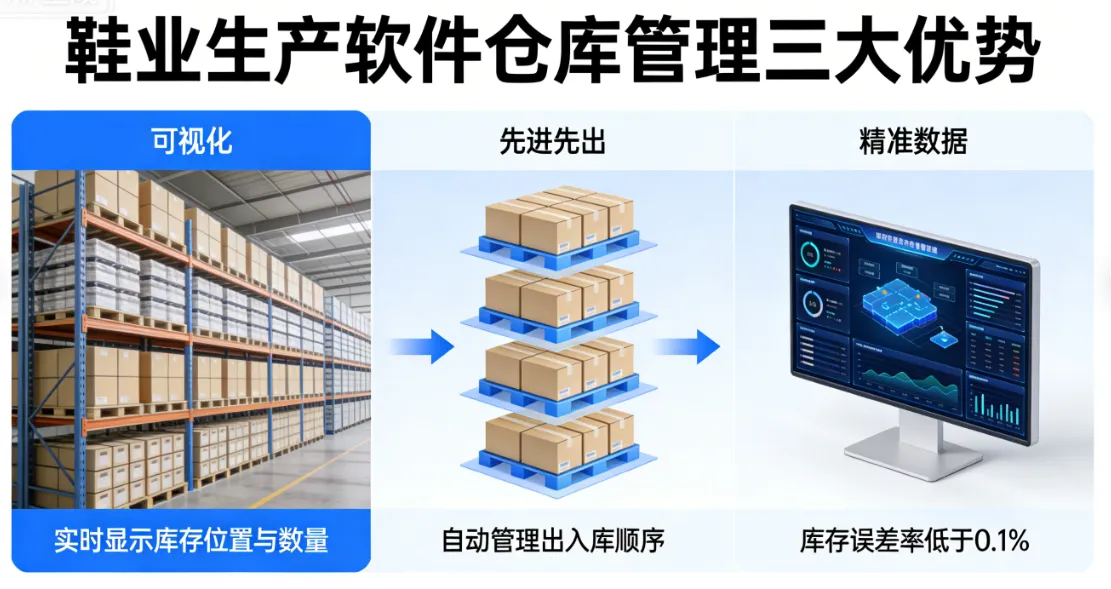
The first change that visualization brings to shoe warehouses is to shift the task of "finding things" from relying on experience to spatial navigation. In traditional shoe material warehouses, genuine leather, microfiber, mesh, sponge, rubber outsole, and EVA midsole come in different shapes and storage conditions. Warehouse managers need to remember the storage locations of thousands of materials, and newcomers can take up to six months or even longer to get started. Even experienced craftsmen may have memory biases during peak season shipments. It is common to search for a bundle of black sheepskin with a specified tank number and flip through three layers of shelves. The shoe production software maps physical shelves to a digital map by binding warehouse location codes with barcode labels. The warehouse keeper inputs the material code on the handheld terminal, and the system immediately displays the accurate location, inventory quantity, and storage time of the batch of materials, and plans the shortest picking path. After a shoe export company in Huidong, Guangdong launched software, the number of warehouse managers decreased from eight to five, and the daily picking efficiency per person increased by 1.7 times. More importantly, enterprises no longer rely on a few "live map" style old employees, and location management has transformed from personal memory to organizational assets.
The deeper value of visualization lies in resonating the warehouse's operational progress with the production pace at the same frequency. The biggest pain point in shoe production is waiting - waiting for the materials to arrive before starting work, only to realize that the model is incorrect, and stopping the production line for half an hour will result in a gap of hundreds of pairs of shoes. In the traditional mode, the workshop director can only make phone calls to urge the warehouse keeper, and the warehouse keeper can only say "we are looking" and "we will be there soon". Anxiety and bickering pervade the information black box. The shoe production software projects the warehouse operation status in real-time onto the workshop dashboard and the manager's mobile phone. Each material requisition is in the "waiting for picking", "picking in progress", or "delivered" stage, and the system automatically counts and alerts. The production director of a sports shoe factory in Jinjiang, Fujian, no longer tracks the progress of the warehouse management every morning, but opens his phone to check the "overdue material list" pushed by the system. Visualization has compressed communication costs and reshaped trust relationships between departments - workshops no longer suspect that warehouses intentionally delay, and warehouses are no longer unjustly held accountable.
First in, first out is the simplest and most difficult principle to adhere to in shoe warehouse management. Materials such as genuine leather, rubber, and glue have clear physical shelf lives. Leather stored for more than six months may become harder and darker, while EVA midsoles may deform due to prolonged stacking. However, in practical operations, warehouse keepers often prioritize using the latest batches from the upper or outer layers in order to save time, while the old batches from the bottom layer accumulate deeper and eventually become stagnant inventory. A certain men's shoe brand in Wenzhou found 31 rolls of black tire leather that had been stored for 28 months during warehouse cleaning, with a book value of 110000 yuan, which could no longer be used for mass production and could only be discounted. This loss is not due to a procurement decision error, but rather the long-term accumulation of warehouse material issuance disorder.
The shoe production software solves the first in, first out problem not through moral preaching, but through rigid interception by the system. When each batch of materials is received, the system forces the registration of the production date or receipt date, and generates a unique traceability code on the storage location label. When issuing materials, the warehouse keeper scans the material requisition form, and the system automatically assigns the earliest batch of storage locations for the material. If the user attempts to skip the recommended storage location to retrieve a new batch, the handheld terminal will issue a warning and refuse the outbound confirmation. After applying this function in a children's shoe OEM factory in Foshan, the inventory turnover days decreased from 67 days to 49 days, and the scrap losses caused by expired materials decreased by 70% year-on-year. A more profound change is that the procurement department has begun to pay attention to the stability of supplier delivery times - in the past, when suppliers delayed delivery, factories could only accept full orders, but now the system will include the delivery time achievement rate in supplier evaluations, which directly affects subsequent order allocation.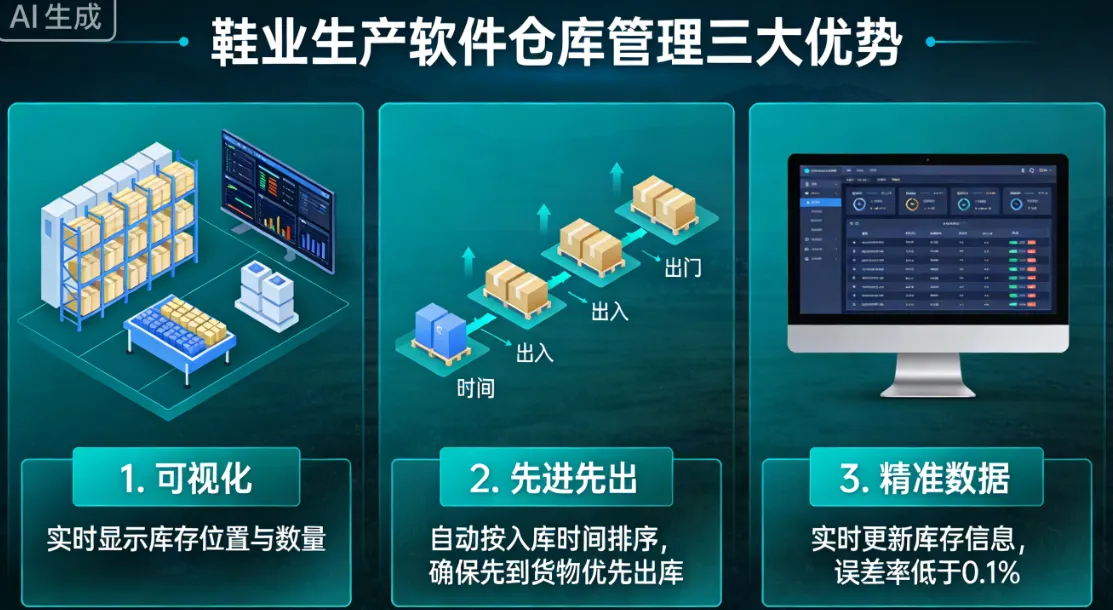
Accurate data is the heaviest and most difficult advantage that shoe production software endows warehouse management with. Under the traditional manual ledger model, it is considered natural for inventory records to not match reality. The finance department reserves 3% of the loss reserve, while the production department retains emergency procurement reserve funds. No one really cares about what the missing 3% is. But the footwear industry has already entered the era of low profit, with raw material costs accounting for more than 60% of total costs. The difference in losses between two points can eat up all net profits. Shoe production software associates barcode scanning with work orders, converting each inbound and outbound operation into traceable data events. The cutting workshop receives three rolls of fabric, and the system automatically deducts inventory and associates it with specific production work orders; The molding production line returns half a box of glue, and the system automatically increases the available inventory and records the information of the person returning the material. Month end inventory is no longer a secret battle between finance and warehouse management. Differences between system inventory and actual inventory can be traced and attributed on a transaction by transaction basis.
A sports shoe OEM company in Putian was once plagued by inventory discrepancies for a long time. The finance department and warehouse had monthly meetings and arguments over this issue, consuming a lot of energy but never eradicating the problem. In the third month after the launch of the footwear production software, the system identified abnormal patterns through data analysis: the black size 36 finished product of a popular running shoe always had 30 to 50 pairs more on paper than in actual inventory. Tracing the issuance records, it was found that the temporary workers in the packaging workshop often missed scanning when scanning the code for outbound, resulting in the system not deducting the account. The company has improved its work standards by installing fixed scanning channels at the end of the packaging line, and finished products must pass through the sensing area in full boxes before leaving the warehouse. Four months later, the accuracy of the account for this shoe increased from 83% to 99.6%. The CFO can finally confidently say that the inventory report reflects the true status of the warehouse.
The value of accurate data is not only reflected in the consistency between accounts and reality, but also in providing reliable input for procurement decisions. In the past, procurement officers used to refer to the "existing inventory" on the manual ledger for material preparation, but this number often lagged behind by three to five days, and there was simply no time to react when orders exploded during peak seasons. The inventory data of footwear production software is refreshed in real-time, and the system also has built-in safety stock warning and material demand planning algorithms. When the available inventory of a certain mesh fabric falls below the safety threshold, the system automatically pushes replenishment suggestions to the purchaser and associates the in transit orders of the material with the supplier's delivery time. After a sports equipment company in Quanzhou applied this function, the frequency of emergency procurement decreased by 60%, and the matching between fabric delivery cycle and production plan significantly improved.
The triple advantages of visualization, first in first out, and precise data are not isolated technical modules, but rather a closed loop of interlocking and mutually reinforcing capabilities. Visualization provides a basis for first in, first out execution - warehouse managers can see batch information in order to follow the first in, first out principle; The strict implementation of first in, first out ensures the authenticity and timeliness of inventory data; The continuous accumulation of precise data can also optimize warehouse layout and procurement strategies in reverse. An old factory in Chendai Town, Jinjiang, specializing in the production of vulcanized shoes, achieved its highest inventory turnover rate in its 23 year history after 18 months of software launch. The warehouse area has been reduced by nearly a thousand square meters, and the freed up space has been transformed into an e-commerce packaging area, opening up new channels for domestic sales for enterprises.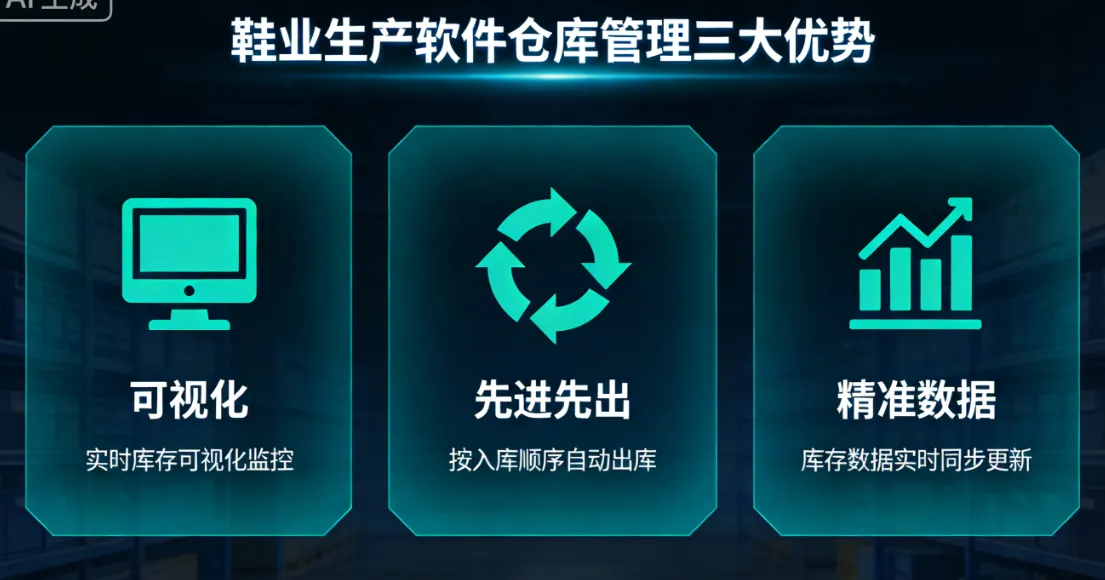
The black tire leather that has been trapped at the bottom for 28 months reflects the collective dilemma of traditional shoe warehouse management. It is not an isolated case, but a script that countless shoe factories repeat every day - invisible stagnation, unguarded batches, and mismatched accounts. The value of shoe production software lies not in its ability to make warehouses more "high-tech", but in its ability to expose these hidden disorders to the sun. When the warehouse keeper no longer relies on memory to find goods, when the finance department no longer relies on estimation to balance accounts, and when the manager no longer relies on luck to schedule production, this small warehouse is no longer a quagmire in the cost center, but has become the first checkpoint for profit protection.