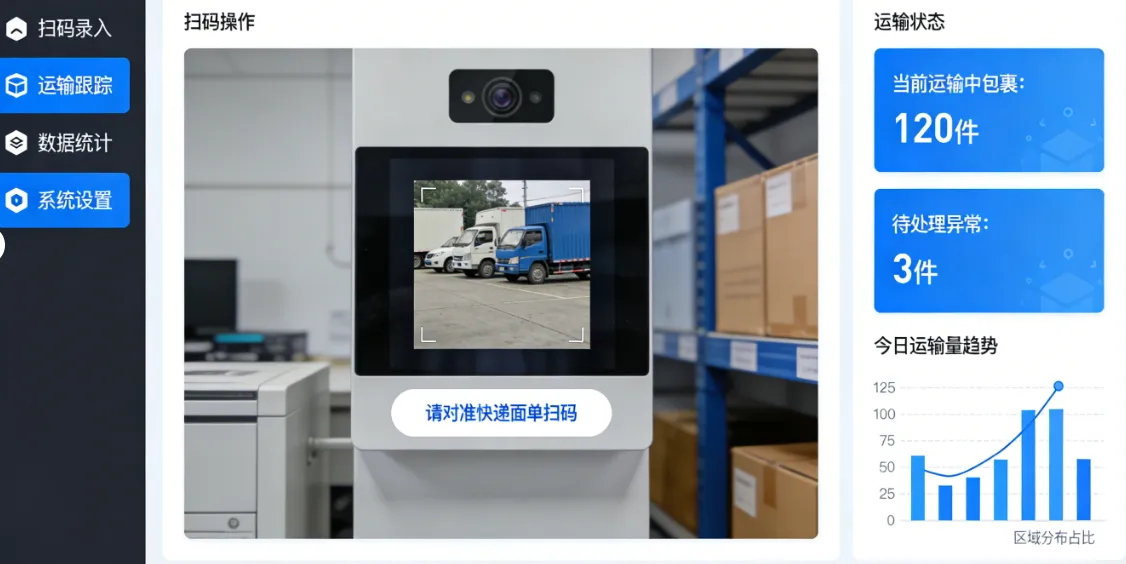
Express scanning and transportation management system software
Scanning technology: from identity identification to full process coding
Among the many technical tools for express transportation management, scanning codes is the most inconspicuous but revolutionary one. A small barcode or QR code maps packages flowing in the physical world to data nodes in the digital space that can be tracked, recorded, and analyzed. The essence of the express scanning and transportation management system software is to use the QR code action as the collection point, connect the entire chain of collection, sorting, transportation, delivery, and signing through the code as the carrier, and transform the originally black box logistics process into a transparent, real-time, and traceable digital flow. This system is not an improved optimization of traditional transportation management, but a fundamental reconstruction of the logic of express delivery operations - before the popularization of scanning technology, express delivery companies did not know where the package was, how efficient the transportation was, or who was responsible for any abnormalities. All management was based on post reporting and experiential inference. The popularization of scanning code systems has enabled express delivery companies to have real-time data views synchronized with package flow for the first time, which is the underlying infrastructure of modern logistics efficiency revolution.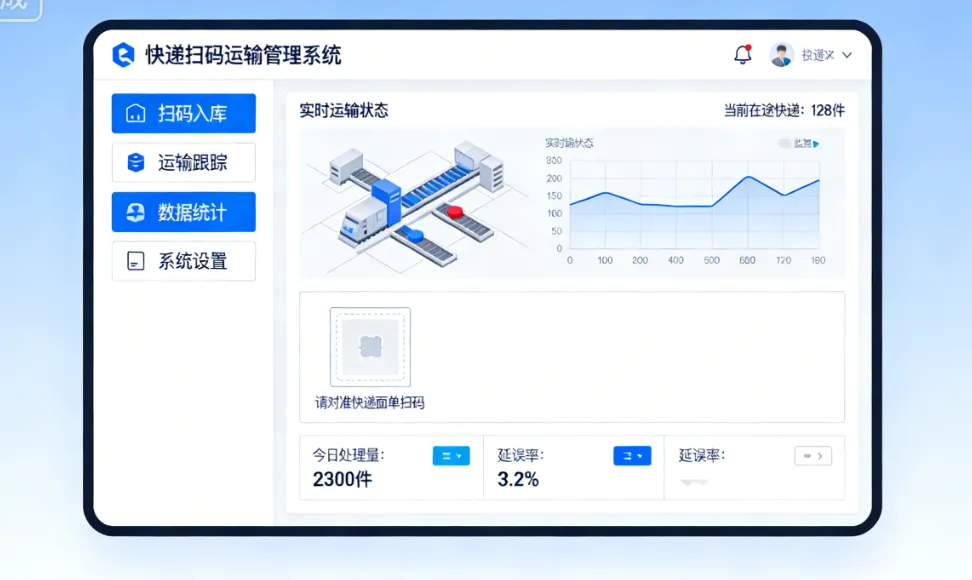
Collection and payment code: the beginning of digital identity for express delivery
The lifecycle of every express delivery begins at the moment of collecting and assigning codes. When the courier comes to pick up the package, they scan the barcode on the waybill through a handheld terminal, and the system automatically records the recipient, collection time, and collection location. This action is not only the first update of the waybill status, but also the establishment of the digital identity of the package. The system automatically calculates and pushes the first station distribution center and expected transportation path of the package based on the destination information on the waybill and the network wide transit routing rules. The collection waybill supports two modes: thermal printing and prefabricated waybill. Thermal printing instantly generates a unique waybill number and associates it with customer order information, while prefabricated waybills are pre bound to collection batches through scanning.
More importantly, the scanning data in the collection process directly triggers subsequent resource scheduling. The system predicts the cargo volume of each direction based on real-time collection volume and automatically sends suggestions for vehicle deployment or route adjustment to the transportation scheduling module; Push the estimated arrival quantity and time period to the distribution center, in order to arrange operators and grid resources in advance. After a certain express delivery company applied the intelligent scheduling of collecting and scanning codes, the on-time departure rate of mainline vehicles increased by 23%, the average waiting time for unloading vehicles decreased by 41 minutes, and the total time from the collection end to the first station distribution was compressed by nearly a quarter. Collecting and scanning codes is no longer just a record of the starting point, but a command signal that drives the entire network to collaborate.
Sorting and code recognition: visual nerves of automated assembly lines
The express distribution center is a complex work site where manpower and automation equipment are intertwined. In traditional mode, the sorter needs to visually identify the address on the waybill and determine which compartment and route the package should be directed to based on memory or a reference table. High intensity repetitive labor can easily lead to misclassification, and temporary employment during peak periods can significantly increase the error rate. The deep integration of scanning system and automated sorting equipment upgrades sorting operations from "human eye recognition" to "machine code recognition".
The package enters the automatic sorting line, and the top scanning or five sided code reading equipment completes barcode scanning at the moment when the package passes through at high speed. The system analyzes the waybill information in real time and issues a millisecond level instruction to the sorting car to pop up the grid. The package flow trajectory is simultaneously recorded - scanned by a certain device at a certain time, direction, execution status, and abnormal markers. After sorting is completed, the system automatically generates a loading list, and the driver scans the loading batch code through the mobile terminal to confirm shipment. The misclassification rate has decreased from 0.3% to 0.5% in traditional manual sorting to less than 0.02%, and the training period for new employees has been shortened from two weeks to two hours. More importantly, the duration of each package's stay at the distribution center is accurately measured, becoming the core basis for assessing operational efficiency and optimizing the process flow.
Transportation QR code scanning: continuous tracking in mobile mode
Mainline transportation is the most opaque section of the entire express delivery chain. After the package leaves the distribution center for loading, it enters the blind spots of traditional management mode - where the vehicle is traveling, when it is expected to arrive, and whether there are any abnormalities on the way, which the dispatch center finds difficult to grasp in real time. The express scanning and transportation management system combines mobile applications with vehicle terminals to incorporate the transportation process into full process visual control.
The driver scans the loading batch code through the APP to confirm the departure of the vehicle, and the system automatically establishes the association between the waybill, vehicle, and driver, and starts recording the vehicle's location trajectory. Electronic fences are set up at key nodes along the way, and event records are automatically triggered and estimated arrival times are pushed when vehicles enter the service area or approach the destination park. In the scenario of trailer transportation, the separation and re coupling of the front end and trailer are completed by scanning the code to bind and unbind the equipment, and the asset flow is clear and traceable. When the vehicle's driving trajectory deviates from the planned route, consecutive stops exceed the time limit, or the driver's fatigue duration exceeds the limit, the system automatically pushes graded warnings to both the dispatcher and the driver, supporting active intervention. After applying the transportation scanning module, a certain express delivery company reduced the average time for discovering abnormalities during transit from 3.5 hours to instant warning, and the number of customer complaints caused by delays during transit decreased by 62%.
End delivery QR code scanning: delivery confirmation and signing closed loop
Terminal delivery is the only interface between express delivery services and customers, and it is also the decisive link in perceiving service quality. The dispatcher receives the daily delivery task list through a mobile terminal, and the system intelligently sorts it according to geographical location and delivery time requirements. It supports batch calling and batch sending appointment messages. During the delivery process, the delivery personnel scan the package barcode to record the status of "arrival at the delivery station". When the customer signs for it, delivery confirmation is completed through various methods such as electronic signature, photo retention, and ID verification.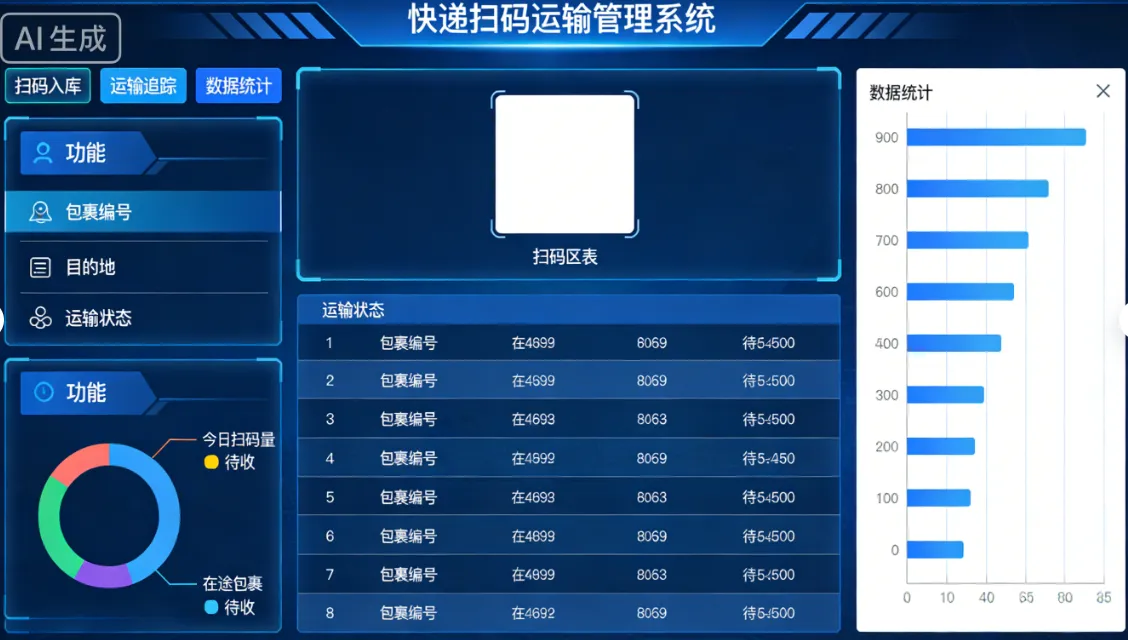
Real time receipt data is transmitted back, and the system immediately updates the waybill status to "signed for", while automatically pushing a receipt notification to the shipping customer. The abnormal delivery scenarios have been standardized - various abnormalities such as customer rejection, unknown address, inability to contact, and temporary storage at the collection point. The delivery personnel select the corresponding reasons on the APP and upload supporting images, and the system automatically triggers the return, detention, or secondary delivery process to avoid problem items being left unattended for a long time. After a certain express delivery company applied the terminal scanning module, the real-time signing information rate increased from 78% to 99%, the number of customer inquiries decreased by 71%, and the average processing time for abnormal delivery was reduced by two-thirds.
Data asset accumulation: from scanning code records to management insights
The massive scanning events generated by the express scanning and transportation management system every day constitute the most valuable data asset of enterprises. The collection time, arrival time at each node, operators at each stage, and scanning positions of each waybill are aggregated into a complete timeline and trajectory diagram. These data are not only used for single ticket queries, but also transformed into systematic management insights through aggregated analysis.
The built-in time analysis module of the system automatically calculates the standard processing time and fluctuation distribution of each distribution center, transportation route, and delivery station, accurately locating the efficiency bottleneck of the entire network. The operation quality analysis module tracks the scanning standard execution rate, misclassification rate, and missed scanning rate of each position and team, providing quantitative basis for performance evaluation and skill training. The cost analysis module links transportation costs, operating labor costs, and waybill numbers, weight, and flow direction, clearly presenting the true profitability level of each route and product. A regional express delivery company found through system data analysis that the night shift operation efficiency of a certain distribution center was significantly lower than that of the day shift. After targeted adjustments to the night shift scheduling structure and incentive plan, the overall processing capacity of the center increased by 18%, and incremental business can be undertaken without the need for new equipment investment.
Interconnection: Ecological Evolution of Scanning System
The scanning system of a single express delivery enterprise solves internal management problems, while the broader value space lies in the interconnectivity between enterprises. The popularization of electronic waybill standardization enables the systems of different courier companies to recognize the same waybill barcode. The express scanning and transportation management system has an open standard API interface that supports seamless integration with third-party applications such as e-commerce platforms, warehousing systems, enterprise resource planning systems, and customer relationship management systems. Order information is automatically synchronized from the e-commerce platform to the courier system, generating a waybill number and returning it; The warehousing system arranges outbound operations based on the collection information pushed by the express delivery system; Customers can check the logistics trajectory in real-time through the brand's order details page, without the need to repeatedly enter the tracking number on the courier company's official website. This ecological connection upgrades scanning data from internal management tools to a cross enterprise collaborative language. When the flow of each express delivery resonates with the flow of commerce, capital, and information, the scanning and transportation management system for express delivery has surpassed its tool attribute and become an important component of commercial infrastructure in the digital economy era. In this sense, every beep of scanning a barcode is not only an instruction for the flow of packages, but also a metronome for efficient collaboration in the social supply chain.