
Shuntong ERP Clothing Workshop Piece rate Salary and Production Management System - Clothing Enterprise Workshop Management Solution
The dual dilemma of clothing workshop management
The clothing manufacturing industry is a typical labor-intensive industry, and the core contradiction of its production management lies in the need to rely on the manual skills of skilled workers to ensure quality, while pursuing the ultimate efficiency under the pressure of continuously rising labor costs. This contradiction has erupted into two major management pain points at the workshop level - how to calculate piece rate wages accurately, quickly, and impressively; How to see, control, and keep up with production progress. In the traditional mode, the cutting and circulation relies on paper work tickets, and the daily completion quantity of workers is estimated visually by the team leader or manually counted. At the end of the month, it is centrally recorded and accounted for, resulting in frequent errors, omissions, and disputes; The workshop is piled up with a mountain of products, but the manager cannot tell which process this batch of orders has reached and how many more days it will take to ship. The Shuntong ERP clothing workshop piece rate salary and production management system is designed to solve this dual dilemma. It takes the clothing process route as the main line and process level data collection as the touchpoint, deeply integrating accurate piece rate salary accounting with transparent production process control, providing a complete digital solution for workshop management for clothing enterprises.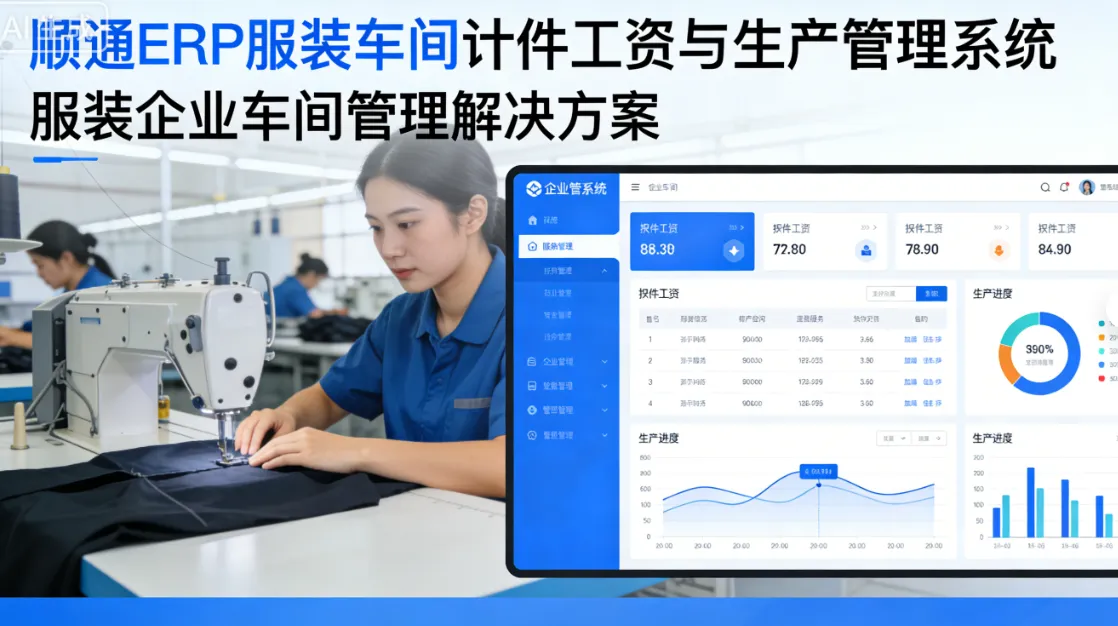
Process cost system: providing evidence for every penny
The fairness of piece rate wages depends first and foremost on the scientific formulation of labor prices. Many clothing companies are trapped in a vicious cycle of labor price competition - bosses set unit prices based on experience, workers think the unit price is too low and neglect their work, bosses are forced to raise prices temporarily when production capacity is insufficient, and skilled workers and novices work at the same price, causing dissatisfaction among senior employees. The Shuntong ERP system is equipped with a dedicated process price library for the clothing industry, covering hundreds of standard processes such as cutting, lining, sewing, edge stitching, double needle punching, bag opening, zipper loading, ironing, inspection, packaging, etc. It supports enterprises to customize cost coefficients based on equipment types, fabric characteristics, process difficulty, and working hours.
The system is linked with the working hour measurement data of the industrial engineering department. Before the new model is launched, the process engineer arranges the process flow in the system. The system automatically calculates the suggested unit price for each process based on standard working hours and labor cost coefficients, which takes effect after approval. The entire process of adjusting labor prices is traceable, and the time, reason, and approval of each change can be traced. Employees can check the current labor prices and historical change records of the processes they operate through the workshop terminal or mobile phone at any time. After a certain casual clothing enterprise applied this module, employee complaints caused by wage disputes decreased by 91%, skilled worker turnover rate decreased by 17 percentage points, and workshop directors' time for explaining wage prices and calming emotions decreased by 70%.
Process level data collection: dual real-time recording of production and quality
Clothing production is a typical discrete manufacturing process, where a finished garment goes through dozens of steps from cutting to production. In the traditional mode, after completing a process, workers either verbally report the number to the team leader or draw the correct characters on paper work tickets, resulting in data lag and difficulty in verification. The Shuntong ERP system moves production data records from "post recall" to "job synchronization" through multimodal acquisition terminals.
Each cutting package and semi-finished product is hung with RFID tags or QR code work tickets. After completing this process, workers scan the work tickets through a fixed scanning table, industrial tablet, or PDA handheld terminal in the workshop. The system automatically records the operator, process code, completion time, and qualified quantity. For scenarios that require both piece rate and quality assessment, the system supports integration with intelligent fabric inspection machines and automatic detection equipment. Qualified and defective products are classified and counted in the scanning moment. Managers can real-time monitor the real-time output, cumulative achievement, and efficiency ranking of each production line, team, and process through workshop visualization dashboards. After a clothing company imported a process level collection module, the production data was upgraded from centralized reporting before workers left work to real-time synchronization. The daily report filling time for team leaders was reduced from 1.5 hours per day to 15 minutes, and the month end salary accounting cycle was shortened from 5 days to 4 hours.
Piece rate salary automatic calculation: Say goodbye to paid nightclubs
At the end of each month, the finance and human resources departments of clothing companies have to go through a 'salary war'. The output data of thousands of workers are scattered in dozens of Excel spreadsheets, and various adjustment items such as attendance deductions, quality rewards and punishments, overtime coefficients, and full attendance bonuses are manually stacked, which can easily lead to wage disputes if not handled properly. The Shuntong ERP system has upgraded piece rate wage accounting from month end assault battles to daily assembly lines.
Real time linkage between the system and process level output collection, attendance management, quality inspection, and performance evaluation modules. After completing each scan report, the system automatically accumulates the daily piece rate wages of the processing personnel based on the corresponding labor price of the process. Rework and defective products found during quality inspection will be deducted from the corresponding output value according to preset rules. During overtime hours, the system automatically recognizes and applies the overtime coefficient specified by law or enterprise regulations. Employees can check their daily, weekly, and monthly production details and salary estimates at any time through the workshop self-service terminal or mobile app. Each income is bound to specific processes, work tickets, and inspection records. At the end of the salary accounting cycle, the system generates a one click salary detail table for all employees, automatically splits it into various salary components, and pushes it to the bank's payment system. After a clothing group applied an automatic accounting module, the salary team was reduced from 12 people to 4 people, and the on-time rate of salary payment increased from a delay of 3 to 5 days per month to arriving on time on the 1st of each month.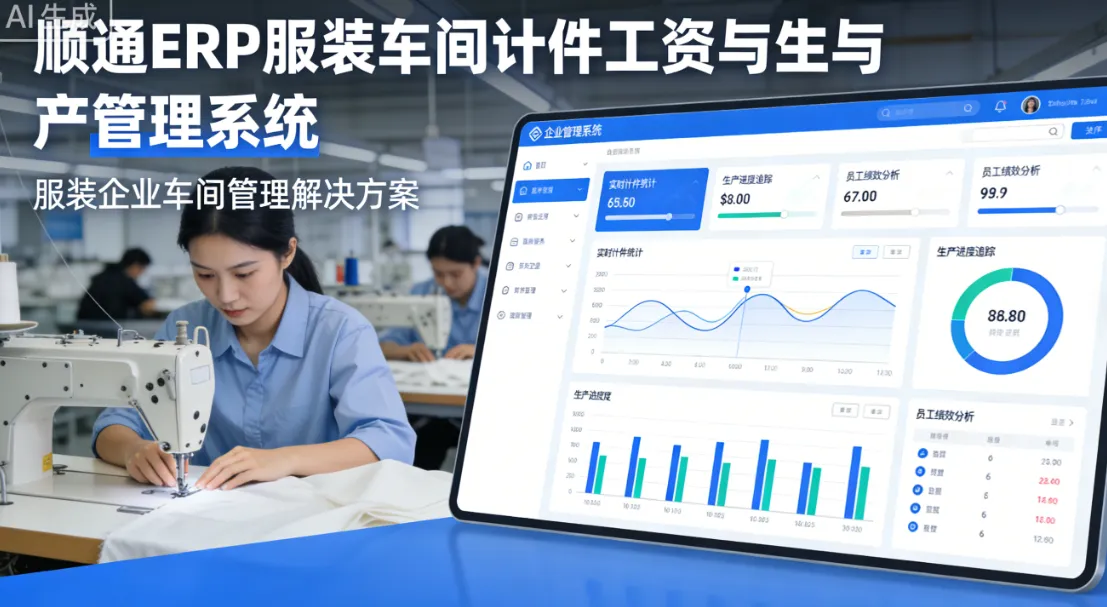
Visualization of work in progress: eliminating workshop black boxes
The biggest management blind spot in the clothing workshop is work in progress. After the order is placed, the cut pieces enter the production line like sinking into the deep sea - the manager doesn't know which process this batch of goods has reached, doesn't know if it can be completed as planned tonight, and doesn't know where the bottleneck is. The Shuntong ERP system restores the work order scanning trajectory and constructs a digital twin of the work in progress.
The system provides real-time statistics on the inventory of work in progress, dwell time, and timeout alerts for each process. When the backlog of cutting pieces in a certain process exceeds the normal turnover, or when a work order stays at a certain workstation for more than twice the standard working hours, the system automatically pushes abnormal warnings to the team leader and workshop director, prompting them to troubleshoot equipment failures, personnel absences, or process difficulties. The order level progress dashboard clearly displays the current process, completed proportion, and expected completion time of each work order in the form of a Gantt chart. Sales coordinators can accurately respond to customer delivery inquiries without frequent workshop reminders. After a certain foreign trade clothing enterprise applied the product visualization module, the order delivery rate increased from 73% to 94%, and the air freight cost decreased by 82% due to uncontrollable delivery time.
Efficiency analysis and continuous improvement
The ultimate value of Shuntong ERP clothing workshop management system lies in the accumulation of massive data generated from daily workshop operations into organizational level efficiency assets. The system automatically generates multi-dimensional efficiency analysis reports: the personal efficiency dashboard displays the average working hours, output trends, and quality fluctuations of each process for each mechanic, providing quantitative basis for skill based salary and job allocation; Clear comparison of team efficiency reveals the efficiency gap between different production lines and teams, assisting managers in identifying excellent management practices and replicating and promoting them; The order efficiency review fully restores the process flow, labor consumption, and cost composition of each order, providing historical reference for future similar product quotations.
The deeper value lies in the fact that the system driven continuous improvement cycle is no longer a sporty surprise check, but embedded in the daily management rhythm. Every Monday morning meeting, the workshop director opens the system efficiency cockpit and reviews with the team leader item by item last week's abnormalities - whether the sharp drop in production of a certain process is due to insufficient skills of new employees, and whether the high defect rate of a certain team is due to the lack of timely training on fabric batch replacement. The improvement measures will be entered into the system, and the effectiveness evaluation task will be automatically pushed two weeks later. A clothing enterprise has been using this system for three years, and the comprehensive efficiency of the workshop has increased by 37%, while the defect rate has decreased by 45%. All of these improvements have ultimately accumulated into a continuous iteration of the standard working hour library, labor price coefficient library, and process route library within the system, becoming the core competitiveness of the enterprise in coping with the trend of difficult and expensive recruitment.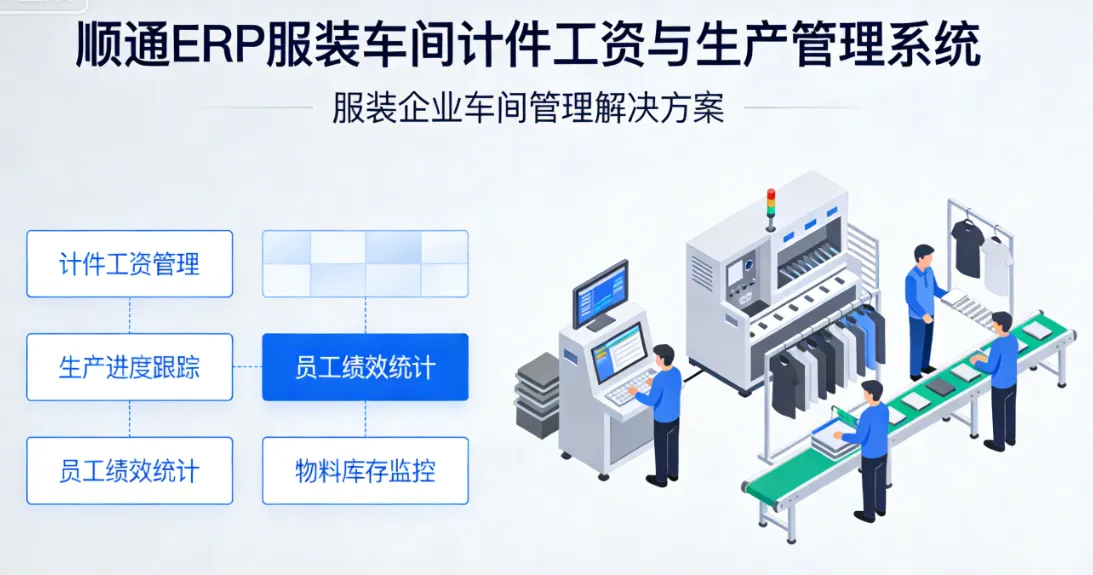
From piece rate tools to manufacturing platforms
The piece rate wage and production management system of Shuntong ERP clothing workshop not only upgrades paper work tickets to QR code scanning, but also elevates the value positioning of clothing enterprise workshop management from "cost center" to "capability center". It transforms piece rate compensation from a sensitive area of labor management competition into a transparent and trustworthy incentive mechanism, transforms production progress from a management black box into a real-time visual combat map, and transforms every step and shuttle core change of frontline workers into analyzable, optimizable, and reusable digital assets. When the birth process of every piece of clothing is fully recorded, every minute of working hours is reasonably measured, and every penny of wages has a clear source, the ancient craft of clothing manufacturing has gained unprecedented efficiency and dignity through the integration with digital technology. In an era where the demographic dividend is diminishing and order fragmentation is irreversible, such digital workshop management capabilities are evolving from a competitive advantage for excellent clothing companies to a survival baseline.