
Online Repair System Management Platform - Campus Enterprise Community Maintenance Solution
The common dilemma of maintenance management and digital disruption
Repair and maintenance reporting is a fundamental service that every organization cannot avoid, but it is also the area where management shortcomings are most concentrated. On campus, students found that the faucet in their dormitory was leaking and the light was not working, and they didn't know which phone to call; In the enterprise, employees report air conditioning malfunctions, but after reporting the issue, they are trapped in endless waiting and repeatedly urged without any response; In the community, the owner reported that the elevator was making abnormal noises during repairs, and the property management was chaotic in dispatching workers after receiving the order, making it impossible to track the progress of repairs. The common problems in these scenarios are: scattered repair entry points, opaque processes, reliance on experience for dispatching, difficulty in tracing evaluations, and lack of data accumulation. What's even more tricky is that although campuses, enterprises, and residential areas belong to the category of repair management, their organizational structure, service targets, maintenance scenarios, and assessment indicators differ significantly - schools focus on teacher and student satisfaction and centralized maintenance during winter and summer vacations, enterprises pursue work order response efficiency and cost control, and residential areas attach importance to property service quality and owner reputation. A universal repair system must be able to abstract the common logic of maintenance management and adapt to the individual needs of different business formats through flexible configuration. The online repair system management platform was born for this purpose, with the full lifecycle management of repair work orders as its core. It connects the six major links of declaration, dispatch, maintenance, acceptance, evaluation, and analysis, providing an integrated digital solution for maintenance services for various organizations such as campuses, enterprises, and communities.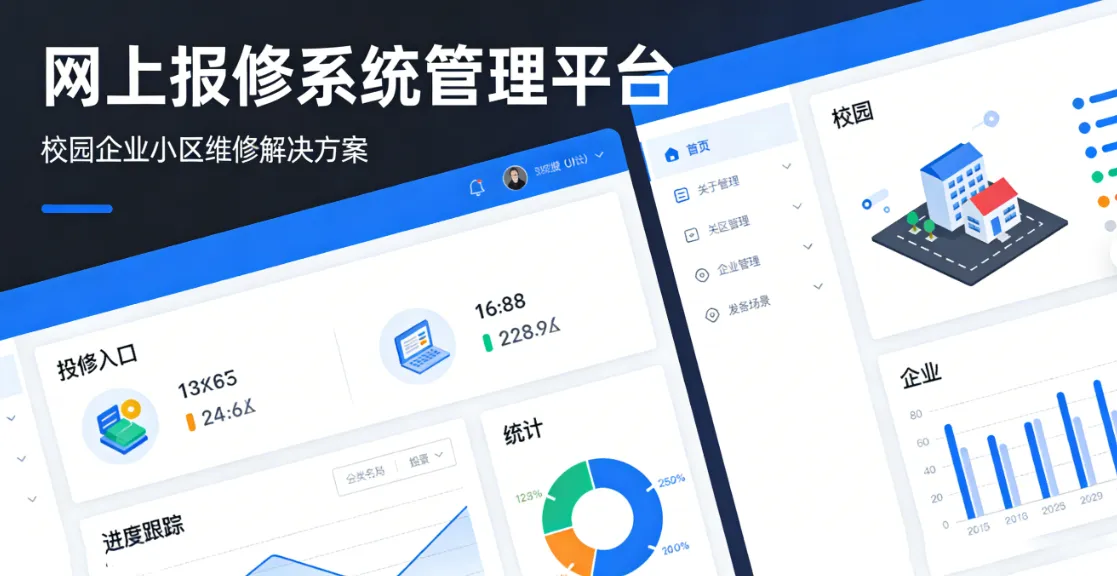
Full scenario repair access: making fault reporting as simple as chatting
The first threshold of the traditional repair mode is "finding the entrance". Campus repairs need to remember the phone number of the logistics department, enterprise repairs need to find the administrative department liaison, and community repairs need to call the property front desk landline. When the repair method is single and the entrance is concealed, a large number of sporadic faults are selectively ignored - slight dripping from the faucet can be tolerated, corridor lights do not light up and take detours until small problems evolve into major hidden dangers. The online repair system management platform has expanded the repair portal to a full scenario matrix.
The mobile terminal supports multiple channels such as WeChat, Alipay, enterprise WeChat, nail, fly book, campus APP, property APP, etc. Users can scan the room QR code or search for repair application, upload photos, voice description, and automatic location identification, and complete the declaration in 30 seconds. The PC end provides a batch input interface for logistics management personnel, suitable for scenarios such as discovering faults during inspections and tasks assigned by leaders. Intelligent terminals are deployed in the lobby of dormitory buildings, the lobby of office buildings, and the property center of residential areas. Elderly homeowners and cleaning staff without smartphones can quickly report repairs by swiping their cards or using touch screens. The traditional entry point for telephone voice repair is retained, and after the customer service representative answers the call, it is entered into the system to generate a work order flow. After applying the full scenario repair module in a certain university, the willingness of teachers and students to report repairs increased by 68%. The proactive detection rate of hidden dangers such as basement water seepage and rooftop drainage blockage, which were previously overlooked due to being too lazy to report repairs, increased by nearly three times.
Intelligent Dispatch Center: Empowering the Right People to Handle the Right Tasks
The biggest efficiency bottleneck in maintenance management lies not in taking orders, but in dispatching workers. The maintenance team is usually composed of different types of workers such as electricians, plumbers, carpenters, bricklayers, air conditioners, and weak current workers, each with different skills, qualifications, areas of expertise, current load, and geographical location. Traditional dispatching relies on the personal experience and memory of dispatchers. After receiving a repair report, they call one by one to confirm who is available and who knows how to repair it. During peak hours, work orders are backlogged and busy and idle are uneven. Owners complain that maintenance workers are late to arrive, and maintenance workers complain about low efficiency in running around.
The intelligent dispatch engine of the online repair system management platform upgrades this decision-making process from manual judgment to algorithm matching. The system establishes a complete digital file for each maintenance worker, recording their job qualifications, skill tags, service areas, historical performance, real-time location, and current work order status. When generating a new work order, the engine calculates the most suitable repair candidate in milliseconds based on multidimensional conditions such as fault category, faulty equipment, urgency level, repair location, and owner preferences - prioritizing the closest, skill matching, high availability, and leading historical praise rate. The dispatch results are pushed to the maintenance worker terminal through multiple channels such as APP, SMS, and voice call. Maintenance workers can view work order details, fault photos, owner notes, and historical maintenance records. Work orders that have not been accepted within the set time limit will be automatically upgraded and redistributed or pushed to the supervisor for intervention and scheduling according to the second best matching rule. After a property service enterprise applied the intelligent dispatching module, the average response time for work orders was reduced from 52 minutes to 18 minutes, the utilization rate of effective working hours per maintenance day increased from 59% to 81%, and the number of dispatch personnel was reduced from 5 to 2.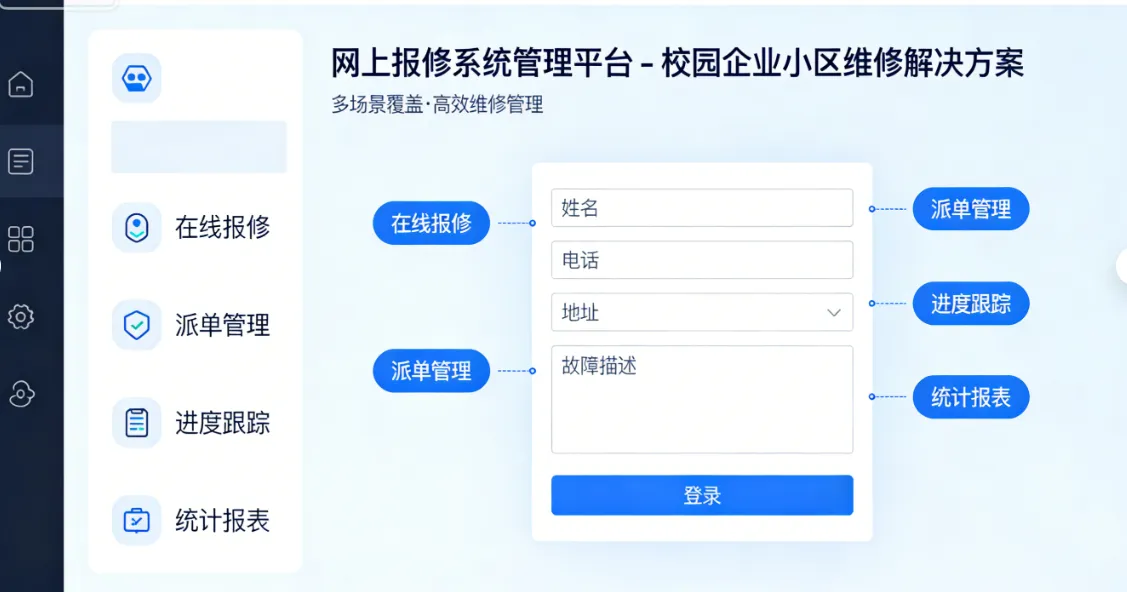
Transparent maintenance process: making waiting no longer a torment
The biggest psychological anxiety of the repair applicant comes from uncertainty - will someone take over the work order? When will the repairman come? How long will it take to fix it? In the traditional mode, the repairman can only make repeated phone calls to inquire, and the repairman is frequently interrupted during work, resulting in a loss of experience for both parties. The online repair system management platform presents the entire repair process transparently through the mobile work order execution module.
The repairman receives the work order through the APP, clicks on the "accept order" status, and instantly pushes the repair person; Click on 'departure' and the system will automatically start the navigation trajectory recording, with the estimated arrival time updated in real-time; Upon arrival at the site, click "sign in" and upload environmental photos. When the repair begins, click "start work" to start the work hour timer. If temporary parts need to be collected during the maintenance process, the maintenance worker can directly initiate a material requisition application on the APP, associate the work order number with the required part model and quantity, the warehouse administrator will receive the order and prepare the materials, and the cost budget of the work order will be deducted synchronously from the parts' outbound. When the repair is completed, the repairman uploads the completion photos, fills in the repair results, and replaces the parts details. The system automatically calculates the actual working hours and associates them with performance evaluations. The repair person can view the entire process status of the work order in real-time through the mobile phone, including dispatched, received, departed, arrived, under repair, and completed, with each node time accurate to seconds. After applying the transparent maintenance module in a certain enterprise park, the number of repair progress inquiries received by the customer service center decreased by 81%, and the employee satisfaction rating for administrative services increased from 3.4 points to 4.6 points.
Diversified evaluation and follow-up: forcing service quality improvement
Whether the repair truly solves the problem should ultimately be judged by the person reporting the repair. In the traditional mode, the repairman verbally asks "Is everything okay" after completing the task, and the person reporting the repair says "okay" and the order is considered settled. However, if the same fault is repeatedly repaired, there is a lack of closed-loop supervision of service quality. The online repair system management platform embeds service evaluations into the necessary nodes before closing work orders.
After the work order is marked, the system automatically pushes an evaluation invitation to the repair person, collecting satisfaction scores from multiple dimensions such as response speed, service attitude, repair quality, and on-site cleaning, supporting text evaluations and image evidence. For work orders with scores below the threshold, the system automatically triggers the supervisor's follow-up process. The quality inspection specialist sends a telegram to the repairman to verify the situation, and orders repairs for those with confirmed repair quality issues. The performance evaluation of the responsible person is recorded. The major complaint work order system is marked separately and pushed to the logistics manager for supervision and handling. After applying the evaluation and follow-up module to the property management of a certain community, the one-time repair rate of maintenance workers increased from 76% to 93%, and the repeated repair rate of similar faults within one month decreased by 62%. The satisfaction rating of property owners for property maintenance services jumped from 3.1 points to 4.4 points.
Asset and spare parts linkage: a data loop for maintenance and repair
Repair and asset management have long been in a state of disconnection. When equipment malfunctions, the repair work order records the fault symptoms and repair process, but the brand and model, purchase date, maintenance period, and historical repair records of the equipment are scattered in different file books and Excel spreadsheets. Maintenance workers cannot quickly understand the "medical history" of equipment, and managers cannot count which brand models have high failure rates and which equipment is approaching the critical point of scrapping. The online repair system management platform deeply integrates asset management with maintenance work orders.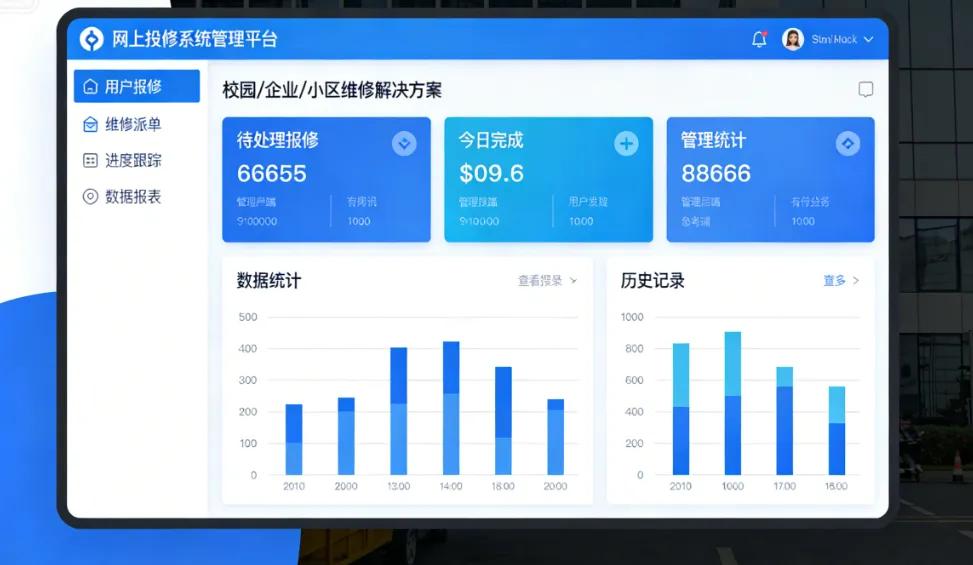
The system establishes an equipment asset archive, where each air conditioner, elevator, and street lamp is associated with a unique asset code, brand model, supplier, purchase date, maintenance period, and operation manual. When reporting a repair, the person in charge scans the QR code on the equipment nameplate or selects the faulty equipment from the asset list. The system automatically associates all historical maintenance records, past fault phenomena, and replacement parts details of the equipment. When the maintenance worker arrives at the site, they can check the technical information and past maintenance status of the equipment at any time for more accurate diagnosis. After the repair is completed, the fault symptoms, replacement parts, repair hours, and cost will be automatically added to the equipment file, forming a complete lifecycle maintenance record. After applying the asset linkage module in the logistics department of a certain school, the average diagnosis time of air conditioning failures was shortened by 42%. Based on equipment failure rate analysis, a certain model of water dispenser with frequent failures was eliminated, saving more than 100000 yuan in maintenance costs annually.
Data cockpit and decision support
The deep value of the online repair system management platform lies in transforming the large amount of fragmented records generated by daily maintenance into strategic assets for organizational facility and equipment health management. The system is equipped with a built-in business intelligence analysis engine, which automatically generates multi-dimensional management cockpits.
The fault heat map visually presents which buildings, floors, and rooms in the campus, enterprise, and community are high-risk areas for repair, assisting managers in identifying design defects, equipment selection issues, or abnormal usage intensity. The equipment failure frequency ranking accurately identifies the failure rate significantly higher than similar brand models, providing a guide for avoiding pitfalls in subsequent procurement selection. The analysis of maintenance hours and costs clearly presents the average maintenance cost and efficiency of each job type, supplier, and equipment category, supporting the performance evaluation and optimization of outsourcing service providers. The winter and summer vacation and annual maintenance plan module predicts the aging trend of equipment based on historical repair data, and the system automatically generates a preventive maintenance task list. A certain enterprise park found through system data analysis that the air conditioning repair rate in Building B has surged for three consecutive years in winter. After professional testing, it was confirmed that the design defect of the building's fresh air system was the cause. After targeted renovation, the winter air conditioning failure rate decreased by 74%, and employee workstation comfort complaints decreased by 82%. The deeper value lies in the fact that repair data is no longer just an internal ledger of the logistics department, but a digital river that flows into the entire lifecycle management of organizational assets, supporting a qualitative change from passive firefighting to proactive prevention, from experience management to scientific decision-making.
One platform, multiple scenarios, unified logic
The core design concept of the online repair system management platform is not to develop three different software programs for campuses, enterprises, and residential areas, but to abstract the common logic of maintenance management at the lowest level - who declares, who repairs, when to respond, when to complete, how good the quality is, how much the cost is, and to adapt to the individual needs of different business formats through highly configurable parametric settings. Schools can use exclusive repair channels for student apartments and centralized maintenance modes during winter and summer vacations. Enterprises can connect with asset management systems and energy consumption monitoring platforms, and residential areas can connect with real name authentication and property fee collection linkage. A set of systems, a set of data models, and a set of governance logic, carrying the maintenance management needs of different organizational forms, asset sizes, and service standards. When the repair work order is no longer an isolated fault record, but a digital hub deeply integrated with asset files, spare parts inventory, procurement budget, performance evaluation, and owner experience, the logistics maintenance department has completed the functional transition from a passive response "fire brigade" to an active planning "asset manager" - this is the most profound identity reshaping that digitalization has given to traditional logistics management, and it is also the strategic value that the online repair system management platform brings to campuses, enterprises, and communities beyond the tool level.