
Shuntong Digital Campus Information Management System
New Proposition of Educational Governance in the Digital Age
Contemporary campuses are undergoing an unprecedented process of complexity. The scale of education continues to expand, with multiple campuses, multiple stages, and multiple legal entities becoming the norm; The education model is constantly innovating, breaking through traditional classroom walls with class based teaching, hierarchical teaching, and project-based learning; As social expectations continue to rise, parents' need for information on their students' school status has shifted from "once at the end of the semester" to "real-time monitoring"; Regulatory requirements are becoming increasingly strict, and complete records are required in various fields such as student enrollment management, funding distribution, enrollment standards, and food safety. At the same time, the digitalization process of the vast majority of schools is in an awkward situation of "local first, overall lagging" - the academic system manages course scheduling and selection, the moral education system manages evaluation and operation, the general affairs system manages asset repair, and the financial system manages fee and salary. The data standards of each system are different and the interfaces are not connected to each other, forming new information islands. Managers need to export Excel files from four or five systems and manually process them for several days in order to obtain a complete portrait of the development of the five education programs for all students in the school. The Shuntong Digital Campus Information Management System was born to solve this dilemma. It takes the school's organizational structure and personnel master data as the core, integrating all campus management functions such as academic affairs, moral education, general affairs, finance, and office into a unified digital base. It builds a smart campus operating system that covers all scenarios, connects all data, and empowers all roles for primary, secondary, and vocational schools.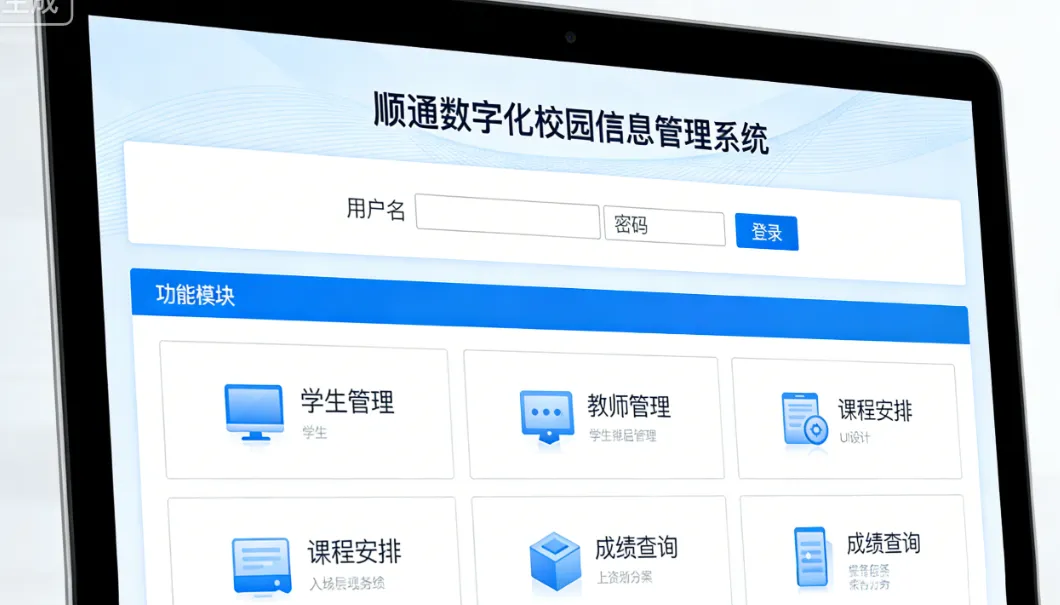
Organizational personnel master data: one-time entry, global sharing
The first threshold for a digital campus is the consistency between organizational structure and personnel information. In the traditional mode, students enter basic information into the academic system upon enrollment, then re-enter it into the moral education system, the dormitory management system, and the library system. The same student's name, ID number, class, and parents' contact information are in different formats in different systems, and are not updated synchronously - after the head teacher changes the contact information, he needs to notify eight systems to modify it respectively, and missing one will cause the home school notification to be lost. The Shuntong Digital Campus Information Management System uses organizational personnel management as the platform foundation, and all business systems share the same organizational structure and personnel files.
The system has a flexible organizational model built-in, supporting various complex school situations such as 12 year integrated system, complete secondary school, 9-year integrated system, and multi campus group education. When students enroll, the data is entered into the organization and personnel module at once, and after plagiarism verification, a unique digital identity is generated. The academic affairs system reads the identity for class allocation and scheduling, the moral education system reads the identity record for reward and punishment comments, the dormitory management system reads the identity for bed allocation, and the cafeteria consumption system reads the identity to activate facial recognition payment. When students transfer classes, advance to higher education, or graduate from school, a status change is completed in the organizational personnel module, and the class ownership, course permissions, consumption accounts, and dormitory access control of all downstream business systems are automatically synchronized and updated. After the application of this module in a twelve year integrated school, the collection time for new student enrollment information has been reduced from 15 minutes per capita to 3 minutes, and the occurrence of cross system data inconsistency has decreased by 97%. The IT department's manpower investment for account maintenance has also decreased by 70%.
Digitalization of academic administration and teaching: from course scheduling and selection to the entire academic cycle
Academic management is the core battlefield of campus informatization. The shift based teaching system completely renders the traditional fixed class scheduling logic ineffective - for the same student, the first class is in Mathematics in Class A, the second class is in English in Class B, and the third class is elective in Class C, with hundreds of students' schedules interwoven into a huge network. The intelligent course scheduling engine of Shuntong Digital Campus Information Management System reduces the mental burden of academic administrators from weeks to automated tasks generated with just one click.
The system takes teacher resources, classroom resources, lesson quotas, course constraints, and student course selection data as input variables, with the objective functions of maximizing teacher lesson balance, classroom utilization, and minimizing student scheduling conflicts. Within minutes, multiple scheduling plans are output for educational decision-makers to compare and choose from. After the scheduling results are generated, the system automatically pushes them to the teacher schedule, student schedule, class schedule, and classroom occupancy table, and synchronizes them to the home school end for parents to view. The course adjustment application is initiated online, with automatic detection of associated conflicts. After approval, the schedule is updated in real time, and all associated personnel receive change notifications immediately. The academic evaluation module supports the integration of process evaluation and summative evaluation. Classroom performance, homework completion, unit tests, and mid-term and final grades are automatically synthesized into a semester overall evaluation based on set weights, generating a student's academic development trajectory map. After applying the intelligent course scheduling and academic evaluation module in a certain high school, the course selection and scheduling cycle has been reduced from three weeks to four hours, and the academic staff has transformed from "scheduling specialists" to "curriculum planners".
Digitization of Five Education Evaluations: From Moral Education Ledger to Growth Portrait
The core proposition of the reform of educational evaluation in the new era is to expand student evaluation from a single score dimension to a comprehensive development of morality, intelligence, physical fitness, aesthetics, and labor skills. However, the biggest pain point of the Five Education Evaluation is not the concept, but the data - moral education comments scattered in the homeroom teacher's work manual, sports performance records in the track and field score sheet, aesthetic education activities exist in club activity photos, and labor education only has one volunteer service certificate left. The Shuntong Digital Campus Information Management System constructs a digital archive of the Five Education Evaluation, which aggregates fragmented growth traces into a structured literacy portrait.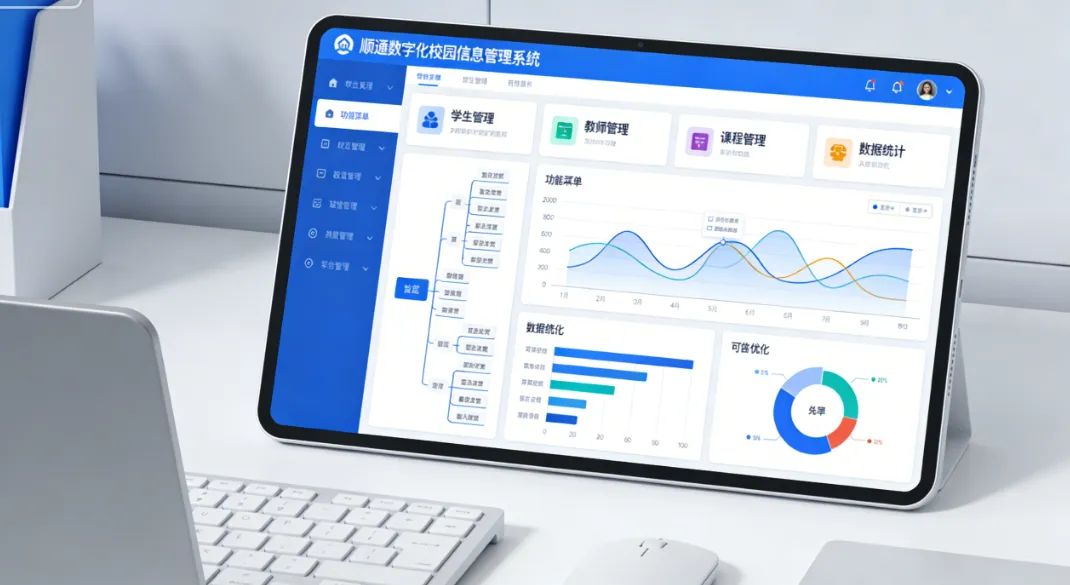
The moral education module supports the homeroom teacher to record students' daily behavior, commend and reward them, and provide disciplinary education online. The system automatically generates comprehensive quality evaluation drafts based on the semester, and the homeroom teacher can retrieve references and conduct secondary polishing. The sports module is integrated with intelligent physical testing equipment, automatically uploading test data such as 50 meter running, standing long jump, and sitting forward bending to generate trend analysis of physical fitness and health. The aesthetic education module records students' complete resumes of taking art courses, participating in club activities, and watching elegant performances. The labor education module incorporates campus duty week, community service, and household chores into the unified recognition system. At the end of the semester, the system generates a comprehensive quality development report for students based on the five dimensions of education, which parents can check through the home school end. After applying the Five Education Evaluation Module in a certain junior high school, the time for the homeroom teacher to write final comments was shortened from an average of 3 hours to 40 minutes, and parents' satisfaction with their students' campus life increased by 31 percentage points.
Home school service integration: from one-way information transmission to two-way interaction
The relationship between home and school has long been in a state of "information asymmetry" - school notifications are sent to the school's communication platform, and parents provide feedback through private messages to the homeroom teacher; Parents have no way of knowing what students had for lunch, how long they slept during nap time, or how many times they raised their hands in class; Parents who want to know about their child's recent performance in school need to wait for the teacher to communicate by phone after work. The Shuntong Digital Campus Information Management System has upgraded the home school relationship from a one-way information push to a two-way interactive platform through the integrated design of home school services.
After parents bind their student identity through the school portal or WeChat official account, they can check the school information in real time, such as timetable, homework, scores, attendance, consumption, comments, activity photos, etc., without waiting for teachers' feedback one by one. The student's leave application is initiated online on the parent end, and after approval by the homeroom teacher, it is automatically synchronized to the dormitory management, security guard, and cafeteria. The student can leave the school by showing their face on the leave application form. School notifications and announcements are accurately pushed by type, grade, and class. Parents' reading status can be checked, and important notifications will automatically send SMS reminders when not read. Parents' opinions and suggestions should be submitted online, and the system will redirect them to relevant departments for limited time processing. The progress of the processing can be tracked throughout the process. After applying the home school service module in a certain primary school, the average time for the homeroom teacher to handle parental inquiries after work decreased from 90 minutes to 20 minutes, and the satisfaction rating of parents towards the school's work increased from 79 points to 94 points.
Digitalization of logistics services: making campus operations seamless and efficient
Campus logistics is the fundamental support for ensuring education and teaching, as well as the edge zone of traditional digital construction. Asset procurement, equipment maintenance, dormitory management, cafeteria consumption, and vehicle scheduling are all isolated islands, with data barriers and unsmooth processes. The Shuntong Digital Campus Information Management System integrates logistics services into a unified platform, achieving closed-loop asset lifecycle management and repair services.
Fixed assets can be digitally managed throughout the entire process from procurement and warehousing, departmental requisition, daily inventory, depreciation provision, and disposal. Asset inventory can be completed by scanning the QR code on the mobile phone. Online repair support allows teachers and students to take photos and upload faults. The system automatically assigns orders based on the type and location of repair work, and the repair progress is visible in real-time. After completion, the repair person evaluates and confirms. The dormitory management system is integrated with intelligent access control and hot water controllers, and real-time records of students returning to bed are pushed to the homeroom teacher and parents. The cafeteria consumption system supports multi-channel payments such as facial recognition, card swiping, and QR code scanning. Parents can set consumption limits, view nutritional meal menus, and check balance and consumption details. After applying the logistics service module in a boarding school, the asset inventory cycle was shortened from two weeks to two hours, the average response time for repair orders decreased by 61%, and the number of complaints from parents about cafeteria consumption decreased by 83%.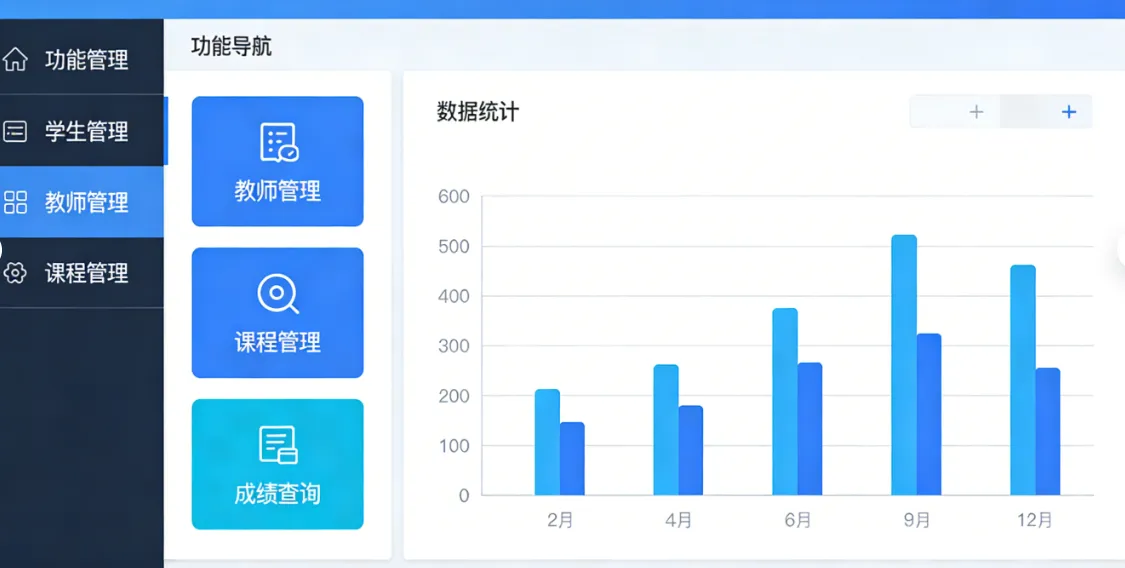
Managing the cockpit: from experience governance to data governance
The deep value of Shuntong Digital Campus Information Management System lies in transforming the massive business data generated by the daily operation of the school into strategic assets for management decisions. The system is equipped with an education management big data analysis engine, which provides dedicated data cockpits for different levels of managers such as principals, department heads, and grade directors.
The principal's cockpit displays the core indicators of the school in real time, including the number of students, the number of faculty and staff, the teacher-student ratio, the average student budget, the enrollment rate, and the excellent physical health rate. It can be used to compare and analyze various grades and classes. The implementation status of the academic cockpit monitoring course, which elective courses are popular and overcrowded, and which courses are unpopular, provides direction guidance for course development. The moral education cockpit presents the distribution of disciplinary violations, psychological assessment screening, funding recognition progress, and assists in precise assistance. Logistics cockpit statistics on water and electricity consumption trends, equipment failure frequency, and maintenance response time, supporting energy-saving renovation and asset renewal decisions. A nine-year integrated school found through systematic data analysis that its sixth grade students experienced a significant decrease in classroom concentration in May for three consecutive years. After attribution investigation, it was confirmed that the high room temperature was caused by the west sun in the classroom. After installing sunshade and insulation facilities in the summer, the number of classroom violations in the same period of the following year decreased by 54%.
Digital infrastructure empowers the essence of education
The Shuntong Digital Campus Information Management System not only upgrades paper ledgers to electronic interfaces, but also builds a digital nervous system for schools that can continuously evolve and self optimize. It allows data to flow freely between academic affairs, moral education, general affairs, finance, and home school without being separated, allowing managers to gain real-time insights into the operation status of the campus, freeing teachers from tedious affairs to return to their education profession, and allowing every shining moment in students' growth process to be recorded, seen, and valued. When technology is deeply integrated into the daily pulse of the campus in this gentle way, digitization is no longer just a decorative label for a school, but becomes the infrastructure for it to fulfill its mission of cultivating morality and educating people. In the journey from educational informatization to educational modernization, such digital foundations are evolving from innovative explorations by a few pioneers to future oriented school standard configurations.