
Why do companies need to use ERP systems? What are the functions of the footwear ERP system?
The underlying logic of using ERP systems in enterprises: from resource chaos to global optimization
A company moving from workshop style operation to large-scale operation will inevitably experience a silent management crisis. Sales have received orders, but production is unaware; The warehouse is filled with materials, and the procurement is still placing orders; At the end of the financial month, it was found that there was a discrepancy of one million between the actual account and the actual account. The root cause of these chaos is not the employees' lack of effort, but the gradual decay of information between departmental walls and the secret loss of resources in unseen places. The fundamental motivation for enterprises to introduce ERP systems has never been to simply use the previous software, but to end the chaotic state of resource mismatch and information fragmentation.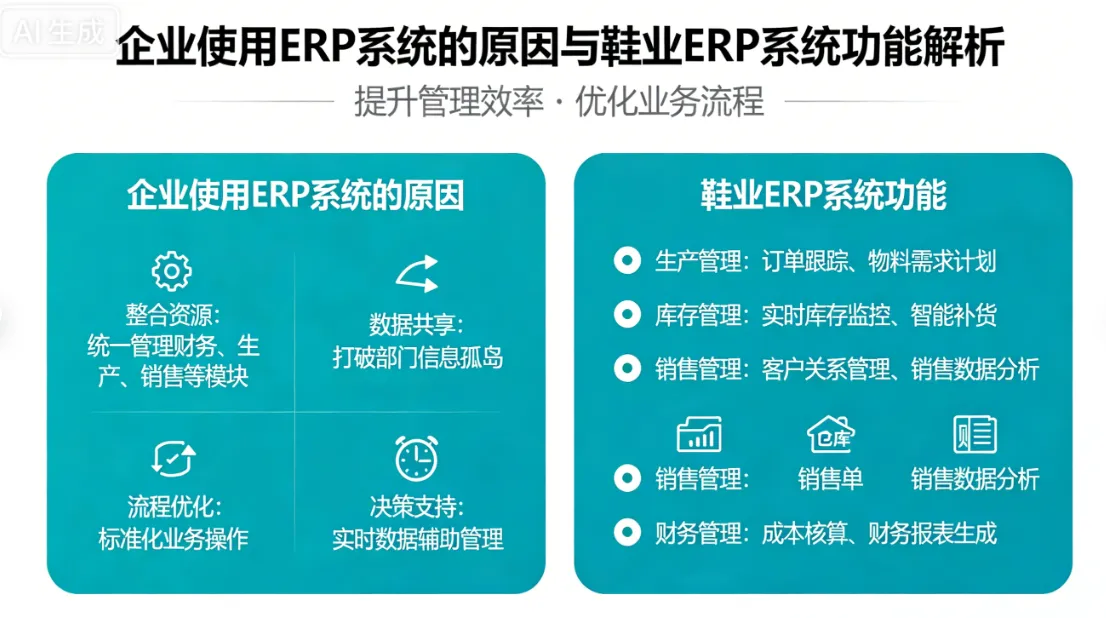
The core value of an ERP system lies in establishing an enterprise level unified platform for facts. Before the ERP was launched, the sales department had its own order ledger, the production department had its own production schedule, the procurement department had its own supplier files, and the finance department had its own accounts receivable and payable. Five sets of data, five versions, no one knows which version is true. ERP integrates all these dispersed data sources into a unique, shared, and real-time updated central database. Sales input an order, production scheduling immediately sees the newly added load, the procurement system synchronously updates material requirements, and the financial account automatically suspends accounts receivable. This is not efficiency improvement, but the reconstruction of decision-making prerequisites - when enterprise managers can engage in dialogue based on the same set of data, cross departmental collaboration truly has a foundation of trust.
The deeper driving force comes from the upgrading of resource allocation logic. Under the traditional management model, each department pursues local optima by purchasing in large quantities to lower unit prices, while ignoring the holding costs of inventory backlog; Production runs at full capacity to dilute manufacturing costs, but ignores whether the finished product already has customer orders. ERP systems integrate sales, production, procurement, inventory, and finance into a closed-loop system, forcing enterprises to move from local optimal prisoner's dilemma to global optimal system thinking. When placing a purchase order, the system automatically displays the inventory turnover days, future demand forecast, and capital occupation cost of the material. Simply purchasing at a low price may not be cost-effective from a global perspective. This shift in decision-making perspective is the most profound evolution of management philosophy brought to enterprises by ERP.
Functional architecture of footwear ERP system: professional design in response to industry specificity
The footwear ERP system is not a simplified version of a general ERP, but a specialized solution that combines industry-specific functions with general capabilities. The complexity of shoe manufacturing operations far exceeds that of ordinary discrete manufacturing industries, which determines that shoe ERP must be redesigned from the bottom data structure.
Product Data Model: Bottom level Reconstruction of 3D Matrix
The core feature of footwear products is a three-dimensional matrix composed of style, color, and size. Developing 3 color options for the same dad shoe, with 13 sizes for each color, generates 39 independent inventory units. General ERP treats each SKU as an independent file, which becomes invalid in the footwear industry scenario - purchasing orders by item, suppliers pack by color code, and sales analysis requires summarizing by item, drilling by color, and comparing by code. The data architecture of the footwear ERP system establishes a hierarchical master-slave relationship for styles, colors, and sizes at the bottom level. Purchase orders can be issued by style and color, and arrival acceptance is automatically split into color code details. Inventory reports can be infinitely drilled down by any dimension. After a certain sports brand introduced a shoe specific ERP, the efficiency of SKU management increased by 4 times, and the maintenance time of product files decreased by 70%.
Supply Chain Collaboration: Digitization of Material Futures and Capacity Locking
The footwear supply chain has distinct futures characteristics. The procurement of materials and accessories requires locking the color card number in advance. The procurement of leather materials involves a cost game of overall utilization rate, and the development cycle of substrate molds can last for several months. The footwear ERP system has a built-in color card standard library for materials, supporting multi-level mapping of Pantone color codes, customer color samples, and factory internal codes. After confirming the purchase order with the supplier, the system automatically locks the supplier's production capacity window and generates a rolling demand forecast to push upstream. In the scenario of outsourcing processing, the entire process of issuing materials, processing, semi-finished product return to warehouse, and processing fee settlement is digitized, and outsourcing manufacturers can view the status of outsourcing orders in real time through the supplier portal. After applying the supply chain collaboration module, a certain shoe company reduced the average procurement cycle of materials by 12 days, resulting in a 65% decrease in returns due to color differences.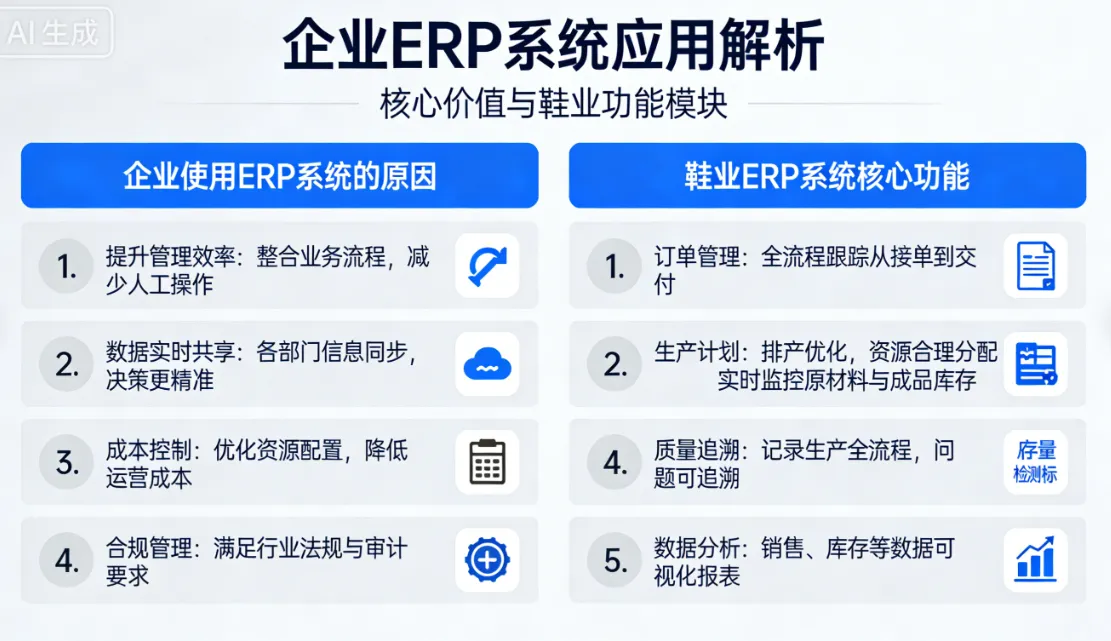
Cutting layout and utilization management: the first hurdle of cost control
The cost of leather materials accounts for over 40% of the total cost of shoe companies, and the utilization rate of cutting and typesetting is the largest cost variable. Two leather materials with the same appearance may have a difference of 15 percentage points in actual utilization due to differences in disability distribution and width shape. The footwear ERP system is integrated with cutting and typesetting software in both directions, and the knife mold diagram, typesetting scheme, leather grade, and actual number of cut pieces are automatically written back to the work order cost file. The system tracks the actual utilization rate of each order and model by supplier batch, and provides real-time alerts for excessive consumption anomalies. After applying the utilization management module, a certain foreign trade shoe enterprise increased the average utilization rate of cutting from 74% to 83%, saving over 6 million yuan in leather procurement costs annually.
Needle car process balance and piece rate compensation: digital solution for labor-intensive management
The sewing assembly line is the most labor-intensive and finely managed link in shoe factories. The footwear ERP system breaks down the process route to the process level, and each workstation is configured with standard working hours and piece rate. Workers report their work in real-time through work tickets or RFID scanning, and the system automatically accumulates daily wages based on the unit price of each process. The balance rate dashboard of the production line displays the real-time stacking of products at each workstation, and the bottleneck workstation is automatically marked in red. After applying this module in a certain vulcanized shoe factory, piece rate wage accounting has been shortened from 5 days to real-time, employee complaints caused by wage disputes have decreased by 90%, and the production line balance rate has increased from 61% to 82%.
Sulfurization and molding process monitoring: digital defense line for quality stability
The vulcanization temperature, pressure, and duration are the core process parameters that determine the quality of sports shoes. The footwear ERP system is integrated with equipment control systems such as vulcanization tanks and infrared baking lines to collect real-time vulcanization curves for each batch and compare them with standard parameters. The over threshold alarm is immediately pushed to the process engineer and quality control supervisor, and the problem batch is automatically locked and the isolation process is triggered. After applying the process monitoring module, the vulcanization failure rate of a certain children's shoe brand decreased from 3.7% to 1.2%, and customer return losses decreased by 63%.
3D inventory intelligent analysis: from SKU ocean to modifiable list
The shoe warehouse is a sea of SKUs, and managers cannot examine tens of thousands of inventory reports one by one. The footwear ERP system automatically calculates the historical sales speed, safety stock days, and current sellable time of each SKU, and dynamically labels them according to five levels of classification: "hot selling", "best-selling", "flat selling", "unsold", and "dead stock". Overdue sales will automatically push clearance tasks during the sales cycle, and scrap approval will be initiated automatically when the dead inventory reaches six months. The omnichannel inventory sharing center integrates real-time inventory from the main warehouse, stores, e-commerce, and outsourced warehouses. E-commerce automatically retrieves store inventory and generates transfer suggestions when the code is broken. After a certain women's shoe brand applied the inventory intelligent module, the overall inventory turnover rate increased by 37%, and the proportion of unsold items decreased from 34% to 19%.
Intelligent replenishment and futures ordering: demand driven flexible supply chain
The sales of futures and spot goods in the footwear industry are parallel, and replenishment decisions rely on data rather than intuition. The footwear ERP system has a built-in demand forecasting algorithm that dynamically calculates the optimal replenishment time and quantity for each SKU based on historical style sales, seasonal indices, traffic trends, and inventory depth. During the futures ordering conference, dealers place orders online and the system summarizes the ordering structure in real-time, providing input for capacity planning and material preparation. After a certain sports brand applied the intelligent replenishment module, the out of stock rate of popular products decreased by 53%, and the proportion of unsold inventory at the end of the season decreased by 21 percentage points.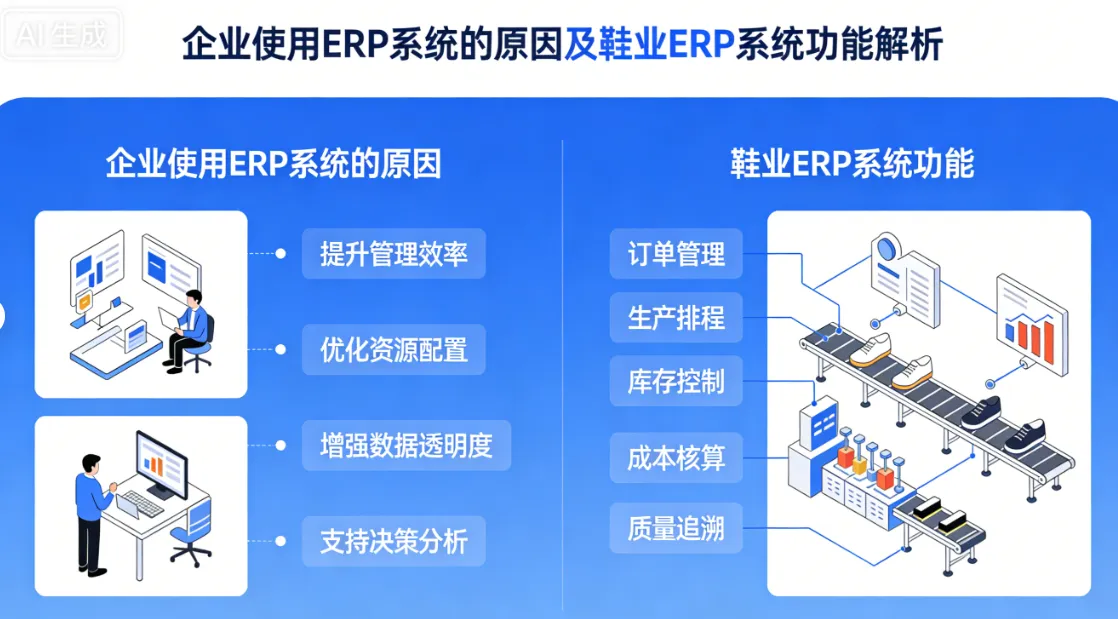
From tools to capabilities: ERP is the immune system for enterprises to cope with uncertainty
Why do shoe companies need ERP systems? The surface answer is to improve efficiency, reduce costs, and optimize decision-making. But deeper answers are hidden in uncertainty. When the trend changes suddenly, the inventory structure needs to be adjusted quickly; When overseas orders are temporarily added, the supply chain needs to respond urgently; When the core supplier suddenly stops production, alternative resources need to be immediately locked in. In these moments that test the survival resilience of enterprises, ERP systems are no longer back-end recording tools, but front-end command centers - they provide real-time, accurate, and complete resource views, supporting managers to make the right decisions under pressure. For shoe companies, the ultimate value of an ERP system is not to earn a few more points in calm times, but to prevent them from capsizing in the face of storms. This kind of resilience to cycles and impacts is the most scarce core ability in the digital age.