
How can the footwear ERP system meet industry-specific needs: collaborative optimization of supply chain, production, inventory, and sales
The complexity dilemma and collaborative proposition of shoe industry management
Shoe manufacturing is a highly underestimated area of management complexity. On the surface, it appears to have no fundamental differences from other discrete manufacturing industries - purchasing materials, organizing production, and selling finished products. However, delving deeper into business scenarios reveals that every aspect of footwear operations is embedded with unique industry genes: on the supply chain side, the same shoe type may involve several types of fabrics such as genuine leather, microfiber, canvas, mesh, etc. Each fabric has different color batches, and procurement needs to be precise to the color card number rather than a generic name; On the production end, the utilization rate of cutting and typesetting directly affects material costs, the balance of needle and cart processes determines production line efficiency, and the parameters of vulcanization or cold bonding processes affect the quality of finished products; On the inventory side, the three-dimensional matrix of styles, colors, and sizes leads to a geometric explosion in SKU quantities; On the sales side, futures ordering and spot replenishment coexist, with instant traffic from e-commerce live streaming and offline long tail dynamic sales. What's even more tricky is that these four links are not linearly connected, but interwoven in a network - sales forecast deviation directly affects the accuracy of production plans, production plan changes have a chain impact on raw material inventory, and delays in raw material delivery have a reverse constraint on sales commitment fulfillment. The core proposition of the footwear ERP system is not to achieve informatization in each link of the supply chain, production, inventory, and sales, but to build a real-time perception, dynamic response, and global optimization mechanism among the four, connecting fragmented business islands into a collaborative digital neural network.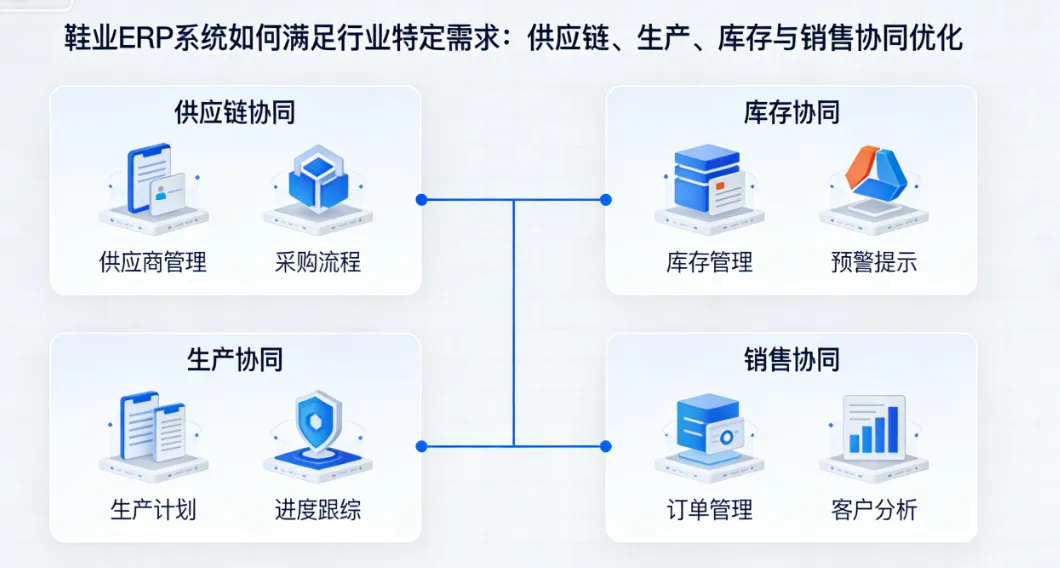
Supply Chain Collaboration: From Price Game to Capacity Partner
The traditional management model of the footwear supply chain is a typical "order game" - the brand issues a purchase order, the supplier confirms the delivery date, and both parties repeatedly tug on price, payment terms, and acceptance standards. After the order is placed, the brand owner cannot predict the supplier's production progress, and the supplier cannot know the brand owner's subsequent needs. Both parties prepare their own goods in the information black box, and ultimately the brand owner overstocks or the supplier urgently airfreight the goods.
The supply chain collaboration module of the footwear ERP system reconstructs this game relationship into a capacity partnership for data sharing. The system establishes digital archives for each core supplier, recording their dynamic performance data such as capacity load curve, historical on-time delivery rate, quality qualification rate, and price competitiveness. Brand owners will desensitize the rolling demand forecast for the next four to eight weeks and push it to the supplier portal, based on which suppliers can prepare materials and reserve machines in advance. When a formal purchase order is issued, the system automatically compares the supplier's confirmed delivery date with the required date, and triggers an overdue warning to immediately initiate renegotiation. During the supplier's shipping process, the system is integrated with the logistics platform to track the trajectory from the moment the vehicle leaves the factory. The brand's warehouse arranges the receiving personnel and storage locations in advance based on electronic shipping notifications. After applying the supply chain collaboration module, a certain sports shoe brand reduced the average procurement cycle of materials by 11 days. The production line downtime caused by material delays decreased by 73%, and the satisfaction of core supplier cooperation increased by 29 percentage points.
Production Collaboration: From Process Black Box to Production Line Mirroring
The management complexity of shoe production workshops far exceeds that of standardized discrete manufacturing industries. The utilization rate of leather materials in the cutting workshop depends on the experience of the typesetter and the skills of the knife mold arrangement; The process balance of the needle car assembly line directly affects bottleneck workstations and overall output; The process parameters such as vulcanization time and cold bonding pressure in the molding workshop can easily lead to batch opening and rework if not handled properly. In the traditional mode, production managers schedule through experience intuition, and losses have already occurred when problems are exposed.
The footwear ERP system fully digitizes and maps the production execution process. In the cutting process, the system integrates typesetting software interfaces to automatically collect typesetting utilization data for various orders, styles, and leather grades, and compares it in real-time with standard usage. Any excess or abnormal consumption is immediately pushed to the process engineer for disposal. In the needle sewing process, industrial tablets or PDA terminals are deployed at each workstation, and workers scan work tickets to complete work reporting. The system calculates the inventory of work in progress for each process, real-time efficiency of each workstation, and production line balance rate in real time. When the backlog of cutting pieces in a certain process exceeds the normal turnover, or when a work order stays at a certain workstation for too long, the system automatically pushes an abnormal warning to the team leader and recommends a bottleneck breakthrough solution based on historical data. In the molding process, the system is connected to equipment control systems such as vulcanization tanks and infrared baking lines to collect real-time process parameters such as temperature, pressure, and duration. If the threshold is exceeded, it will automatically trigger shutdown protection and record batch information. After applying the production collaboration module in a certain vulcanized shoe factory, the average utilization rate of cutting increased by 6 percentage points, the balance rate of the needle car production line increased from 63% to 81%, and the molding defect rate decreased by 34%.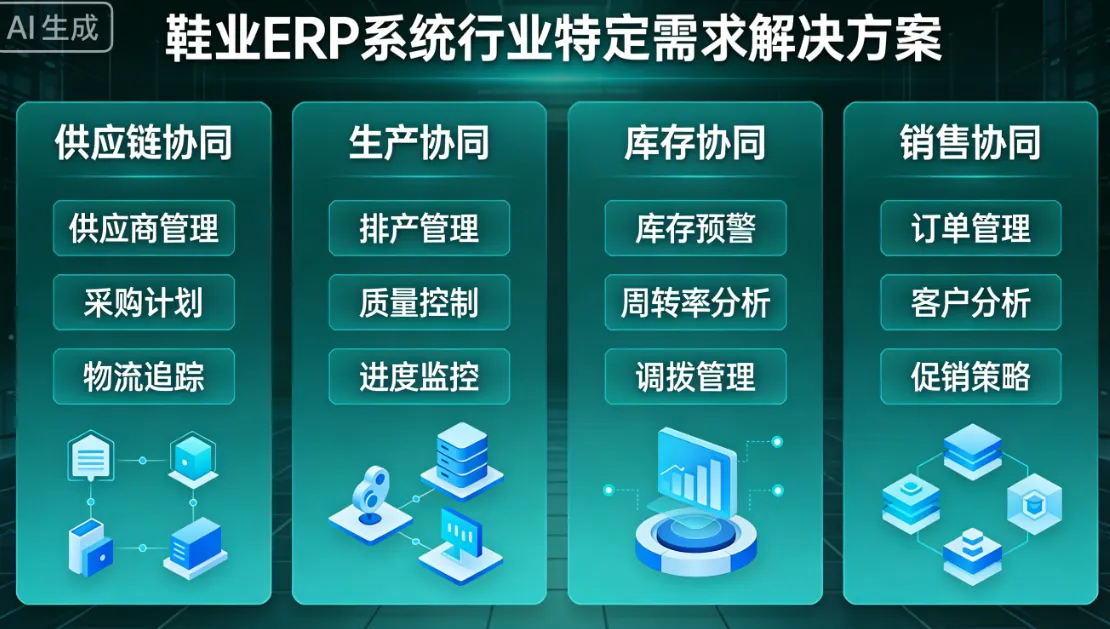
Inventory Collaboration: From 3D Explosion to Dynamic Optimization
The core challenge of shoe inventory management is the SKU index explosion caused by the three-dimensional matrix of styles, colors, and sizes. Develop 5 color schemes for a sports shoe, with 13 sizes for each color, resulting in 65 SKUs; If the brand operates 200 basic models and 100 seasonal models simultaneously, the total SKU count can easily exceed 20000. In the face of such a massive number of SKUs, traditional inventory turnover analysis loses its significance - managers cannot examine the inventory reports of 20000 rows one by one, and can only view the overall amount in a general way, drowning unsold items in the halo of explosive products.
The footwear ERP system compresses three-dimensional inventory into modifiable and optimizable management units through a multidimensional inventory intelligent analysis model. The system automatically calculates the historical sales speed, safety stock days, and current available time for each SKU, and dynamically marks them according to five levels of classification: "hot selling", "best-selling", "average selling", "unsold", and "dead inventory". Inventory warning is no longer triggered by a unified threshold, but by configuring response strategies based on classification differences - if the explosive product is below the safety stock, replenishment suggestions will be automatically generated; if the unsold product exceeds the sellable period, promotion clearance tasks will be automatically pushed; and if the dead inventory reaches six months, scrap approval will be automatically initiated. The omnichannel inventory sharing center integrates real-time inventory data from the main warehouse, sub warehouses, store warehouses, e-commerce warehouses, and outsourced warehouses. When a certain size is out of stock on the e-commerce platform, the system automatically retrieves the distribution of inventory in stores across the country and generates the optimal allocation plan by comprehensive sorting based on distance, timeliness, and cost. After a certain women's shoe brand applied the inventory collaboration module, the overall inventory turnover rate increased by 37%, the proportion of unsold items decreased from 34% to 19%, and the online transaction loss caused by missing sizes decreased by 51%.
Sales synergy: from futures fragmentation to full channel empathy
The dual track sales model of the footwear industry is the most difficult fortress to overcome in collaborative optimization. Futures orders are locked in several months in advance to ensure supply chain stability but lack flexibility; Spot replenishment pursues quick response, but tests inventory depth and supply chain responsiveness. The online and offline channels are fragmented, and e-commerce bestsellers and store bestsellers are often two stocks of the same brand, each stocking, digesting, and clearing their own inventory.
The footwear ERP system integrates sales collaboration throughout the entire process of planning, execution, and analysis. During the futures ordering conference, dealers place orders online through the system portal, and the system summarizes the futures order structure of various regions, channels, and categories in real time, providing input for capacity planning and material preparation. In the spot sales process, the system is directly connected to all mainstream e-commerce platforms, store POS systems, and live streaming platform APIs to capture real-time omnichannel sales orders. The intelligent replenishment engine calculates the optimal replenishment time and quantity for each SKU based on individual items, taking into account historical sales speed, real-time traffic trends, current inventory depth, and procurement cycle length, and automatically generates procurement suggestions or production work orders. The omni channel order routing engine automatically determines the optimal shipping warehouse based on customer delivery addresses, warehouse inventory distribution, and logistics cost timeliness, connecting e-commerce orders with store inventory. After a certain sports equipment enterprise applied the sales collaboration module, the shortage rate of e-commerce spot orders decreased by 43%, the on-time delivery rate of futures orders increased by 28%, and the overall channel gross profit margin increased by 3.7 percentage points.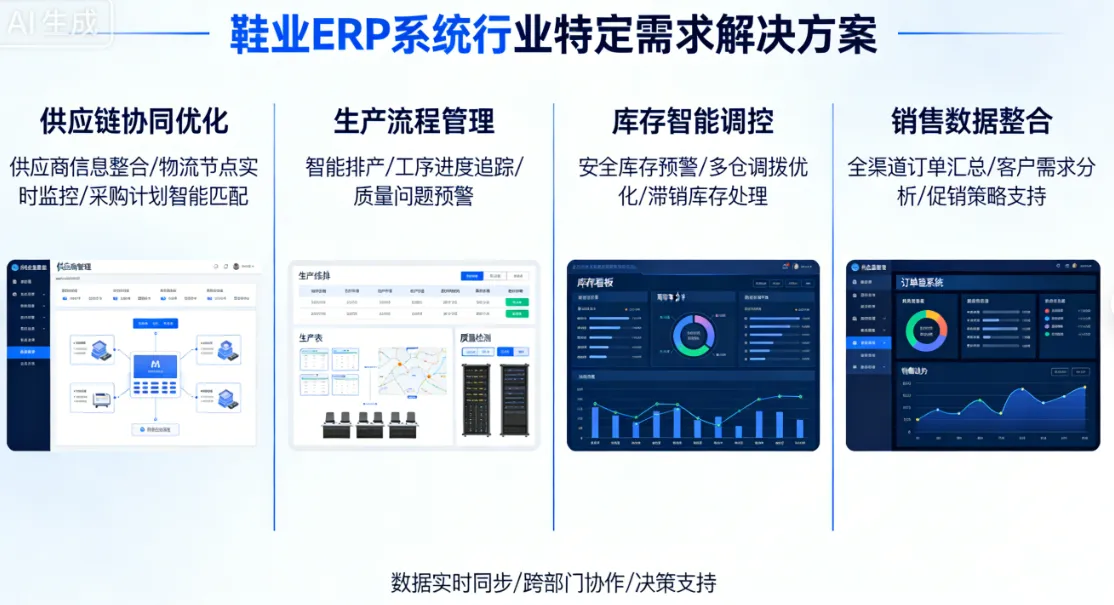
From Tools to Systems: The Collaborative Essence of Digitalization in the Footwear Industry
The essential difference between shoe ERP system and traditional inventory software lies not in the number of functional modules, but in whether it has cross link collaborative intelligence. Traditional software regards supply chain, production, inventory, and sales as four independent problem domains, providing procurement module, production module, warehouse module, and sales module respectively. Enterprises need to play the "human interface" between these four modules on their own. The footwear ERP system constructs these four links as a collaborative entity with real-time perception, automatic response, and global optimization capabilities - sales fluctuations are instantly transmitted to production plan adjustments, production schedule deviations automatically trigger supply chain follow-up, and inventory structure changes guide sales strategy corrections in reverse. When this collaborative ability accumulates into the normalized operation mechanism of the organization, shoe companies have completed the transition from the management paradigm of "departments fighting independently" to "overall system operation". In the era of accelerated fast fashion iteration and strengthened consumer sovereignty, this transition is not an option, but a necessary question for shoe companies to maintain their survival standards in the digital wave.