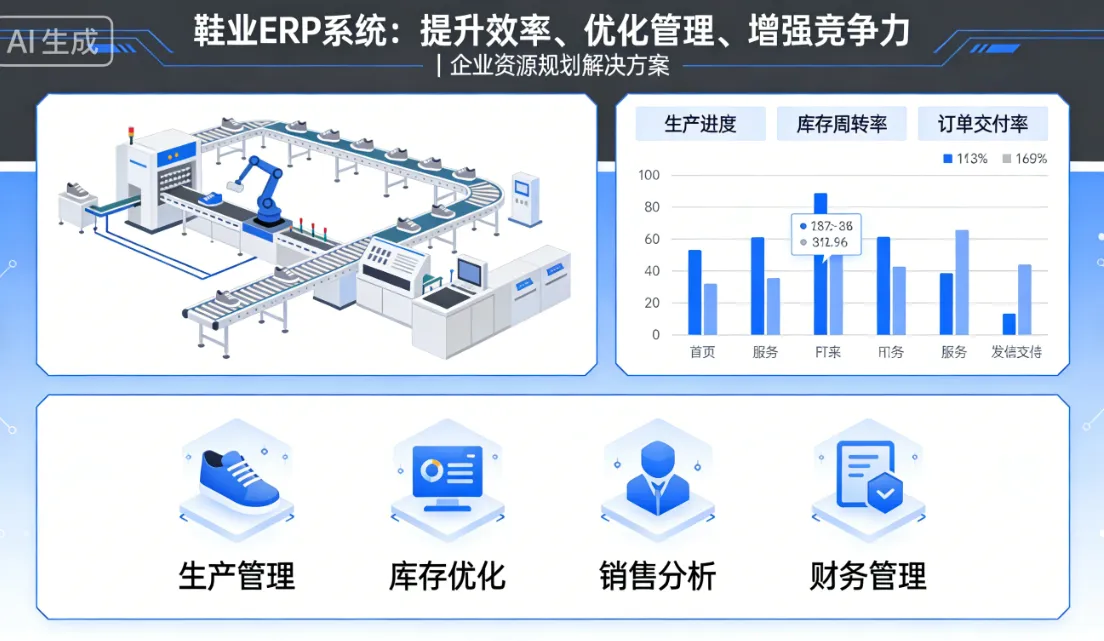
Footwear ERP System: Improving Efficiency, Optimizing Management, and Enhancing Competitiveness | Enterprise Resource Planning Solution
The essence of shoe industry competition shifts from scale dividends to management dividends
The Chinese footwear industry is undergoing a profound paradigm shift. Over the past thirty years, the core elements of industry competition have been production capacity and labor costs - whoever has more production lines and workers can take on more orders and take the initiative in price wars. However, today, the demographic dividend is accelerating its decline, and the order structure is shifting from "minimum order quantity of 10000 pairs" to "fast return for small orders". Brand owners' requirements for the supply chain are shifting from "low price" to "fast response, stable quality, and accurate delivery time". The extensive expansion relying solely on increasing equipment and expanding manpower has reached its ceiling, and the competition axis of shoe companies is irreversibly shifting from scale dividends to management dividends. In this transformation, the footwear ERP system is no longer a backend auxiliary tool, but a strategic infrastructure that determines whether the enterprise can cross the cycle.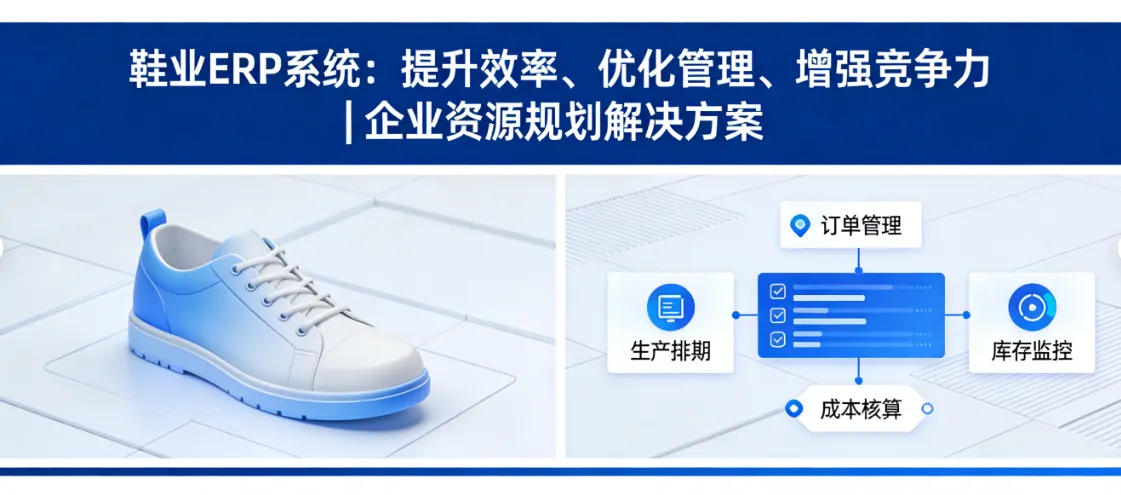
Efficiency improvement: eliminating the three major hidden wastes
There are three types of invisible waste in the shoe factory workshop that are difficult to perceive but continue to erode profits. The first type is waiting for waste. The cutting process is completed and transferred to the needle car production line. Due to process imbalance or personnel absenteeism, it accumulates for several hours at a certain workstation, resulting in a delay in the delivery time of the entire order. The second type is the waste of repeated input. Sales orders are entered once, production planners re-enter, and warehouse shipments are entered again. The same order is circulated in three systems with frequent errors but no one is responsible. The third type is cognitive waste. The team leader judges production capacity based on experience, while the boss makes stock decisions based on intuition. No one can explain the current real efficiency level and inventory structure.
The footwear ERP system collects process level data to make these three types of waste explicit, measurable, and modifiable. Every time a worker completes a process, they scan the work order, and the system instantly updates the quantity of work in progress, process hours, and personal production capacity at each workstation. The production line balance rate dashboard makes bottleneck workstations nowhere to hide, and automatically pushes warnings to the team leader's terminal if the abnormal stay exceeds 15 minutes. Cross system duplicate input has been completely eliminated, and at the moment of entering sales orders, production plans, procurement requirements, and shipping instructions are generated synchronously. The decision-making cockpit presents core indicators such as equipment comprehensive efficiency, per capita output, and order delivery rate in real-time, and the empirical management black box is penetrated by data. After 18 months of using the system in a certain sports shoe factory, the overall efficiency of the equipment increased by 23%, the average delivery cycle of orders was compressed by 11 days, and emergency air freight costs due to information lag decreased by 67%.
Management optimization: institutional solidification from rule of man to rule of law
Small and medium-sized shoe enterprises generally face a thorny intergenerational issue - the first generation of entrepreneurs relied on personal courage and industry intuition to bring the enterprise to a scale of billions of yuan, but the management system highly relies on the personal decisions of the boss and the experience inheritance of old employees. The purchaser determines the order share based on their relationship with the supplier, the production supervisor schedules the production line based on on-site shouting, and the financial supervisor manages funds based on loyalty to the boss. This "rule by man" model is highly efficient in the early stages of enterprise start-up, but its drawbacks begin to erupt when the scale crosses a critical point: the loss of key personnel leads to business shutdowns, cross departmental responsibility is passed on without anyone to judge, and gray areas breed management loopholes.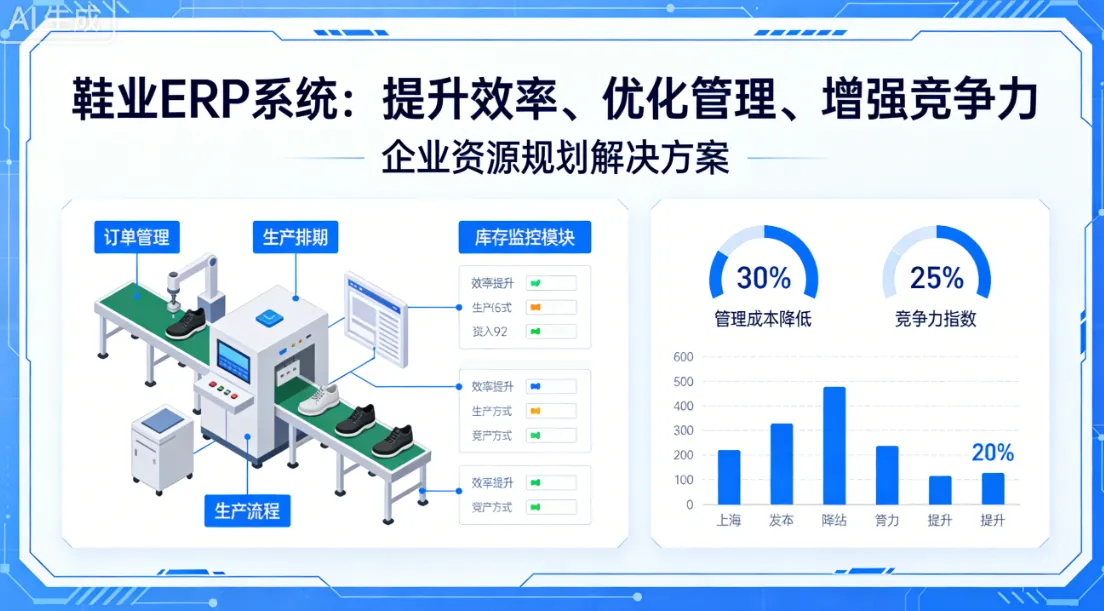
The footwear ERP system encodes the long-term accumulated management rules of the enterprise into system logic, achieving institutional solidification from "rule of man" to "rule of law". If the purchase order exceeds the limit, the price comparison process will be automatically triggered. Supplier admission requires system qualification review, and historical performance will automatically affect subsequent share allocation. The production work order progress is real-time correlated with piece rate wages, and the amount of work done earns the corresponding amount of money, without the need for team leaders to estimate at the end of the month. The cost accounting rules are automatically executed by the system, and the profit differences of the same order between different production lines, time periods, and operators are clearly distinguishable. At a management meeting after the system was launched, the second-generation successor of a certain shoe company lamented, "In the past, when my father was in the factory, everyone was busy, but no one could explain what they were busy with. Now the system tells me which line is making money, which customer is losing money, and which supplier is always delaying. I can finally make decisions without relying on my feelings
Enhancing Competitiveness: Building Demand Driven Flexible Response Capability
The highest form of competitiveness in the footwear industry has evolved from "passive order taking" to "active response". Under the traditional model, brand manufacturers place orders and shoe companies purchase, produce, and deliver in a systematic manner, squeezing profit margins layer by layer. Shoe companies with leading digital capabilities are restructuring this relationship in reverse by directly connecting their ERP systems with brand order systems to obtain rolling demand forecasts for the next three months in advance; Based on predictive data, lock in the production capacity of material suppliers and shorten the procurement cycle; Using real-time production capacity data to open up a window period for brand merchants to accept orders, shifting from passive waiting for bargaining to active bidding for orders.
Behind this flexible response capability is the restructuring of the planning system by the footwear ERP system. Material requirement planning is no longer based on static order expansion, but on dynamic predictive rolling calculations. When the daily sales of a popular e-commerce product of a certain brand suddenly accelerate, the system automatically evaluates the raw material inventory, production progress, and capacity load, and outputs whether the order can be supplemented, when it will be delivered, and the cost within a few minutes. Purchasing personnel do not need to urgently call suppliers, the system has already pushed material preparation warnings to the material suppliers. The production planner does not need to temporarily adjust the schedule, and the system has automatically inserted the supplementary work order into the optimal production line. After building flexible response capabilities, a certain footwear group increased the proportion of fast response orders from 12% of total production capacity to 41%, and the gross profit margin of fast response orders was 8.5 percentage points higher than that of futures orders.
Digitalization of goods: from dual sales to value based sales
The footwear ERP system has also opened up new paths for the release of product value. In the traditional mode, the value of shoes as a commodity is basically determined at the time of leaving the factory, and the subsequent circulation links are all cost rather than value-added. The digital capability has enabled shoe companies to explore business model innovation from "selling by pairs" to "selling by value". Each pair of shoes has a unique identifier in the system, associated with its raw material batch, production history, quality inspection report, and logistics trajectory. Brand owners can use this data to convey traceable quality trust to consumers, and high-end customization lines can charge a premium based on this. During after-sales maintenance, scanning the QR code inside the shoe can retrieve the original material information and accurately match replacement parts. After a certain outdoor shoe brand applied digital modules to its products, the efficiency of after-sales maintenance response increased threefold, the cost of handling customer complaints decreased by 42%, and the repurchase rate increased by 11 percentage points.
From efficiency tools to survival baselines
The value evolution of the footwear ERP system reflects the inherent logic of China's footwear industry upgrading. Ten years ago, it was an efficiency tool for leading companies, helping pioneers compress inventory and improve turnover. Five years ago, it was a standard management tool for large-scale enterprises, and factories lacking digital capabilities were excluded from the supplier list by brand owners. Today, it is accelerating its penetration into small and medium-sized shoe enterprises, becoming the survival baseline for regional industrial clusters. When the entire process from raw materials to finished shoes is traceable, analyzable, and optimizable, shoe companies truly qualify for dialogue with the times. Under the triple pressure of order fragmentation, factor costing, and consumer sovereignty, the threshold for this qualification continues to rise - this is a challenge and a proof of the industry's evolutionary power given by the footwear ERP system.