The Role of ERP System: Definition and Core Value Analysis
Re understand the definition of ERP
Enterprise resource planning system is one of the most abused terms in the field of enterprise management. In the marketing rhetoric of software manufacturers, it is packaged as an omnipotent digital miracle drug; In the review report of failed projects, it is once again stigmatized as a rigid and expensive numerical burden. The common lesion of these two extreme cognitions is the narrowing of ERP into a "set of software" - the number of functions, price, and implementation speed become the evaluation criteria, while its essence as a management ideology is obscured.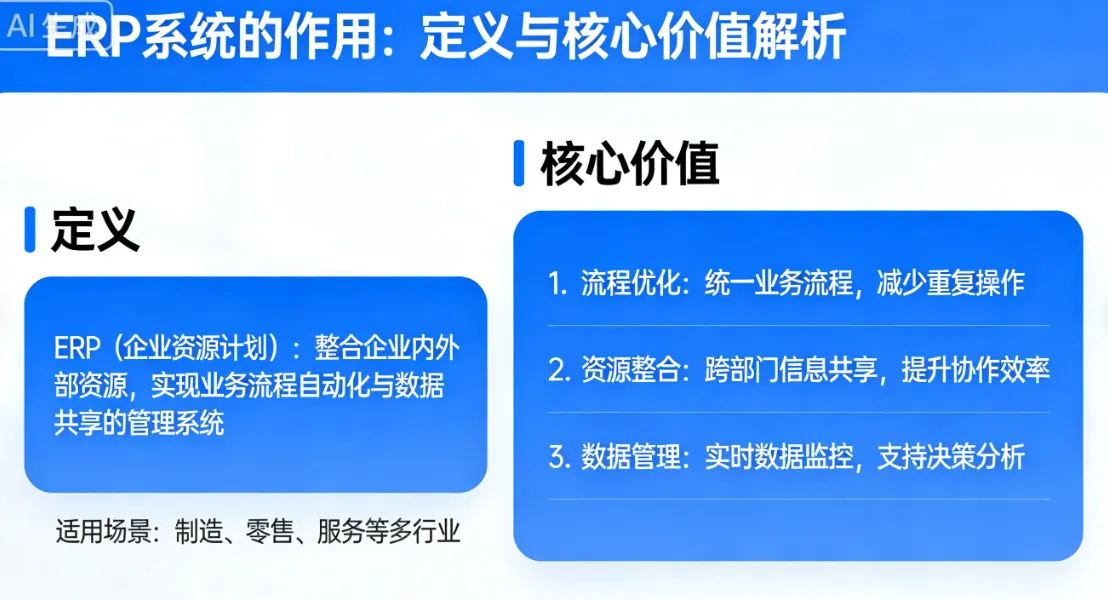
ERP is first and foremost a management philosophy, followed by software implementation. The core proposition of this management philosophy is that the enterprise is an inseparable organic whole, rather than a mechanical assembly of functional departments such as sales, production, procurement, and finance. Sales orders are not only performance vouchers for the sales department, but also operational instructions for the production department, the source of demand for the procurement department, and the starting point for accounts receivable for the finance department. Business activities that are fragmented by departmental walls under traditional management models are continuous links in the same value chain from the perspective of ERP. The mission of an ERP system is to solidify this global collaborative management philosophy into executable, measurable, and evolving enterprise operating rules through information technology.
Starting from this definition, the value evaluation criteria of ERP systems have undergone a fundamental shift. The question is no longer "how many functional modules does this software have", but "can it allow sales to see production capacity constraints in real time when accepting orders", "can it automatically compare inventory turnover when placing purchase orders", "can it allow finance to close accounts without the need for business departments to work overtime to supplement orders". The stacking of functions and the creation of value have never been equated in the context of ERP.
One of the core values: Establishing an enterprise level unified platform for facts
Small and medium-sized enterprises are bound to encounter a 'data war' during their growth process. The sales department has its own customer ledger, the production department has its own production schedule, the procurement department has its own supplier file, the warehouse has its own inventory detail ledger, and the finance department has its own accounts receivable and payable list. These five sets of data are independent of each other, have different formats, and are not updated synchronously. Monthly reconciliation becomes a cross departmental criticism meeting - sales say customers have made payments, while finance says the system cannot detect them; Production says the materials have been stored, but the warehouse says they have not received the goods; The procurement department said that the supplier has shipped the goods, but the quality inspection department said they have not received the inspection notification.
The primary core value of an ERP system is to end this state of data fragmentation. It is not about "connecting" the independent ledgers of various departments, but rather establishing a unique, shared, and real-time updated central database at the bottom level. When entering sales orders, production scheduling immediately sees the newly added load, the procurement system synchronously updates material requirements, and the financial account automatically suspends accounts receivable. The same business activity does not need to be entered five times in each of the five systems, and there is no need to spend three days each month checking the differences between the five reports. The unification of this data level not only brings about efficiency improvement, but also the reconstruction of decision-making prerequisites - when management can engage in dialogue based on the same set of data, departmental walls begin to truly loosen.
Core Value 2: Process Standardization and Best Practice Solidification
Every enterprise has a set of 'conventional' ways of doing things. Among these conventions, some are effective experiences accumulated through long-term exploration, while others are redundant links accumulated due to personnel compromise and historical inertia. The procurement application needs to go through seven levels of approval, with the third level never rejecting or reviewing it; The warehouse receipt requires three people to sign and confirm, but in reality, the last two people only check whether the first person signs or not. Under the traditional management model, process optimization highly relies on the personal courage and driving ability of managers, and improvement plans are difficult to solidify, with results often flowing away with personnel turnover.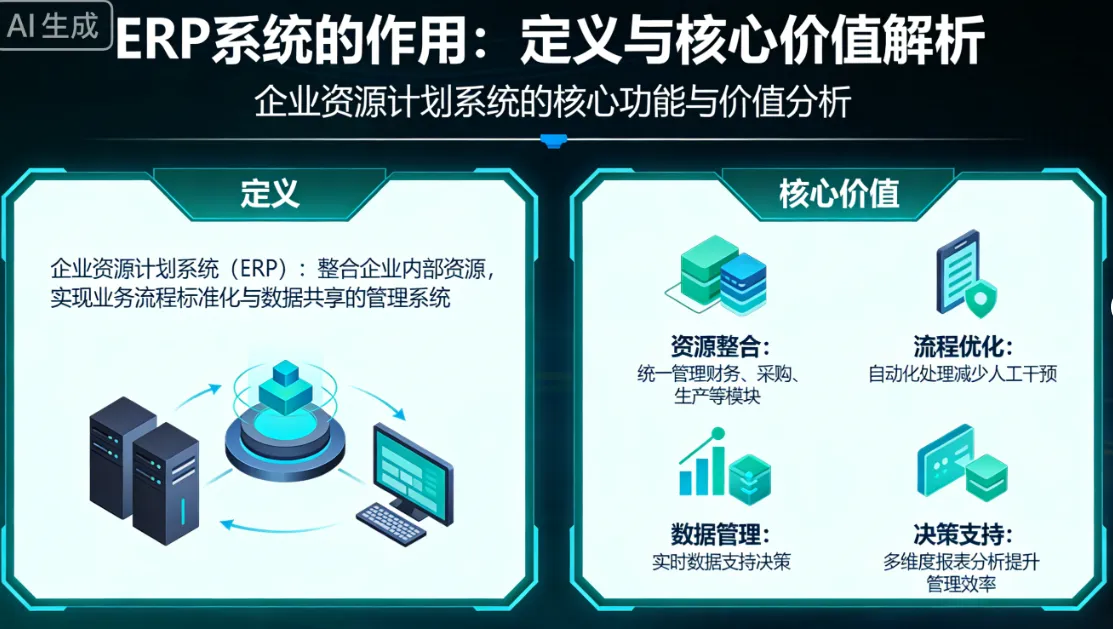
ERP systems incorporate process standardization as an embedded capability. The preset process template of the system is not an ideal model designed out of thin air by software manufacturers, but a crystallization of experience extracted from the practices of leading enterprises in the same industry. Enterprises can quickly build process frameworks that match their own business characteristics based on these templates, and can also make moderate adjustments and adaptations after fully understanding the template logic. More importantly, once a process is configured as a system rule, its execution becomes mandatory and consistent. The procurement request must go through the set approval node and cannot be skipped; The storage operation must be entered into specified fields and cannot be omitted. New employees can complete standard tasks according to system guidelines without the need for direct instruction from their mentors. The ability to solidify this process enables enterprises to have organizational memory independent of individual experience for the first time.
Core Value Three: Business and Financial Integration
Under traditional management models, there is a significant time gap between business and finance. The purchase receipt is entered by the warehouse administrator, the purchase invoice is entered by the financial accounts payable accountant, and the payment request is initiated by the purchaser. These three transactions occurred at different time points and were recorded in different systems. At the end of the month, financial personnel need to match each transaction and identify the reasons for the differences one by one. The same applies to sales shipments and revenue recognition. The e-commerce order has been delivered for seven days and the financial system is still pending approval. The fragmented state of business and finance results in the finance department constantly catching up with the business department and unable to implement real-time supervision and control over business activities.
The ERP system pre positions the financial accounting function from the finance department to the business occurrence site. At the moment of purchase receipt confirmation, the system automatically generates estimated payable vouchers according to preset rules; At the moment when the purchase invoice verification is passed, the system automatically offsets the estimated value, confirms the input tax, and updates the accounts payable. At the moment when sales and shipments are completed, the system automatically generates accounts receivable vouchers according to customer credit policies and synchronously verifies platform settlement statements. Financial personnel no longer need to match the differences of three orders one by one, nor do they need to rush to collect invoices at the end of the month. Instead, they will shift their focus to value-added functions such as cost analysis, budget monitoring, and risk warning. The essence of business and financial integration is to move the financial control nodes from the end of the month to the daily, and from the office to the work site.
Core Value Four: Global Visualization and Dynamic Allocation of Resources
Enterprise resources are always limited, and how to allocate limited resources to optimal use is the core proposition of management decision-making. Under traditional management models, resource distribution information presents a highly fragmented state. The general manager is unclear about the overall efficiency of equipment in each workshop, and cannot determine whether to purchase equipment or optimize scheduling for expanding production; The sales director is not clear about the true distribution of inventory across various channels, making it difficult to make decisions on whether to transfer goods or pre-sale due to e-commerce code interruptions; The financial director is unclear about the true gross profit of the project and cannot identify which customers are profit pillars and which are profit traps.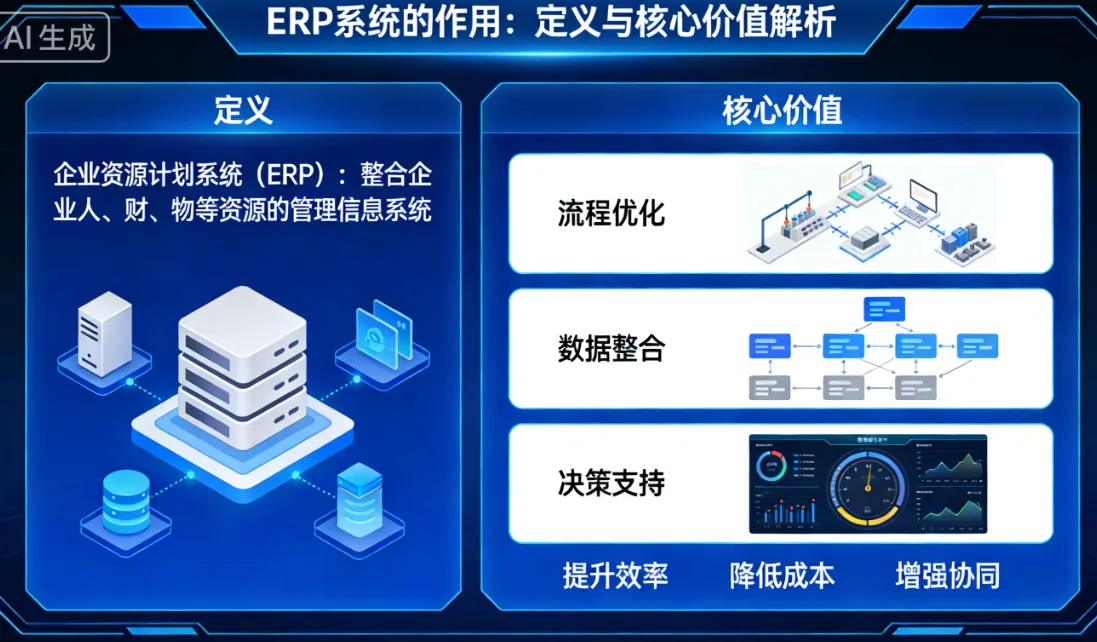
The ERP system integrates procurement, production, inventory, sales, and financial data into a unified platform, providing enterprise managers with real-time, multidimensional, and penetrable resource panoramic views. The management can access the marginal contribution and capital occupation of any product line, region, customer, or project at any time, and can drill down to specific orders, batches, and processes. This ability to visualize resources upgrades resource allocation decisions from "making decisions based on experience" to "calibrating based on data". When enterprises can clearly see the return rate of every dollar spent on inventory, the cost of idle time for each device, and the true gross profit contributed by each salesperson, the space for resource mismatch is greatly compressed.
Core Value Five: Transitioning from a Recording System to a Planning System
The essential difference between inventory management software and ERP systems lies not in the number of functional modules, but in whether the system is positioned for recording or planning. Inventory management software is good at answering "what happened in the past" - how much was sold yesterday, how much inventory is left, and how much profit was made last month. The ERP system must answer the question of 'what should happen next' - whether there will be a shortage of popular products next week, how many purchases should be made to suppliers next month, and what should be the first order stocking quantity for next season's new products.
This transition from recording to planning relies on algorithms rather than intuition. The material requirement planning engine built into the ERP system automatically calculates the future demand time and quantity of each material based on sales forecasting, current inventory, in transit procurement, safety stock, and procurement cycle. The advanced scheduling module automatically generates the optimal production line scheduling plan based on order priority, equipment capability, mold constraints, and personnel skills. The demand forecasting module outputs item level demand forecasts based on historical sales data, seasonal factors, promotional calendars, and traffic trends. When enterprises evolve from "ordering based on experience" to "planning based on data", ERP systems have undergone a qualitative change from cost items to asset items, upgrading from rearview mirrors that record history to navigation devices that foresee the future.
Conclusion: ERP is not the endpoint, but the starting point
The true value of an ERP system is never realized at the moment it goes live. Going online is just the starting point, and the release of value depends on the continuous operation, optimization, and iteration of the enterprise within the system framework. When sales receive orders, real-time delivery commitments can be made. When purchasing orders, supplier performance can be automatically compared. When production scheduling is carried out, capacity load can be dynamically balanced. When finance closes accounts, there is no need for business departments to work overtime to supplement orders. Only then can ERP systems truly be internalized from software tools into organizational capabilities. This ability cannot be obtained through purchase and must be internalized through practice - this is the essential difference between ERP projects and ordinary software procurement, and it is also the fundamental reason why it can become the cornerstone of enterprise digital transformation.