
Detailed introduction to ERP production management in clothing factories, including functions, precautions, prices, etc
The production management of the clothing industry has never been a simple progress tracking, but a multidimensional game around fabric, color, size, delivery time, and cost. Many clothing companies have invested heavily in digital transformation, but still struggle with data lag, inventory backlog, and out of control delivery times. The fundamental reason is that they equate clothing ERP with general manufacturing ERP, ignoring the unique management complexity of this industry. A truly suitable ERP system for clothing factories should have a production management module that is a digital engine capable of handling both standardization and personalization, rather than just an electronic substitute for manual reports.
The core function of clothing ERP production management is first reflected in the deep collaboration between styles and materials.Unlike the absolute precision of material lists in mechanical manufacturing, the fabric consumption in clothing production will dynamically change due to shrinkage rate, cutting arrangement, and door width utilization. A professional clothing ERP system can record the physical characteristics of fabric batches, directly converting the process sheets from the sampling stage into mass production basis, allowing the style parameters confirmed by the design studio to seamlessly flow to the procurement, cutting, and sewing workshops. This collaborative mechanism avoids batch quality fluctuations caused by experience loss and allows designers to anticipate cost impacts during the development phase.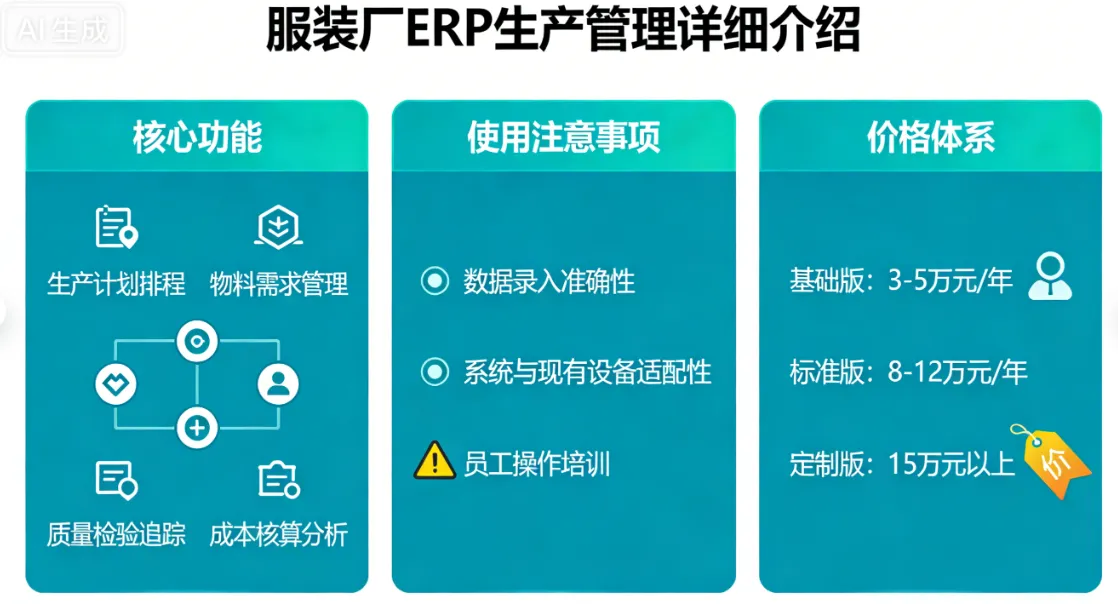
At the production planning level, the value of clothing ERP is reflected in the leap from empirical scheduling to algorithmic scheduling. In the traditional mode, production management personnel rely on memory and paper ledgers to estimate the production line load. When multiple styles are parallel, the complexity of processes varies, and the skill levels of workers are uneven, the scheduling results are often rough and difficult to execute. The new generation of production management module can integrate dozens of constraints such as equipment status, personnel skill matrix, material delivery schedule, order priority, etc., and generate executable process dispatch orders in a relatively short period of time. More importantly, this scheduling is not a static lock, but rather a rolling refresh that follows the actual progress of the workshop. When brand customers urgently add orders, the system does not simply interrupt existing production, but evaluates the chain impact of inserting orders on overall delivery time through algorithms and provides optimal production line adjustment suggestions. This flexible scheduling capability is the underlying support for clothing factories to cope with the market environment of small batches, multiple varieties, and short delivery times.
Material and accessory control is the core checkpoint of clothing production management, and also the most concealed link of cost loss.The uniqueness of clothing production lies not only in accurate inventory quantities, but also in batch traceability and color difference control. Different cylinder numbers of the same fabric may have visible color differences, and mixing them with the same batch of ready to wear clothing will result in serious quality accidents. A professional clothing ERP must support the full process tracking of fabric cylinder numbers, from linking color fastness, shrinkage rate and other testing reports during procurement and warehousing, to automatically intercepting mixed cutting of different cylinder numbers during cutting and issuing, and then being able to reverse locate the source of raw materials for problematic batches after finished products are stored. For accessories such as zippers, lace, and washing labels, the system can automatically calculate the rated usage based on the process sheet and implement quota control during the material requisition process. When the actual usage exceeds the reasonable range, the system immediately triggers an alert, exposing waste issues at the time of occurrence rather than at the end of the month inventory.
Workshop data collection and progress visualization are the nerve endings of the production execution layer. Many clothing factories are trapped in the dilemma of having workshop directors chase after goods on site even after ERP is implemented. The root cause is that the system only records the start and completion nodes, and has no knowledge of the process level progress. The deeply adapted clothing ERP needs to support multiple convenient process reporting methods, whether it is swiping cards on the workstation machine, selecting on the tablet, or scanning QR codes on the work order. The system should update the current cutting, sewing, and post-processing stages of each garment and their completion ratios in real time. When the sewing progress of a certain style lags behind the plan, the system automatically pushes a warning to the production team leader's mobile end and highlights the abnormal information on the workshop bulletin board. This transparency not only improves the delivery rate, but more importantly, shifts production management from "post event accountability" to "in-process intervention".
Cost accounting is the financial closed loop of production management and also a weak link in many clothing ERP systems. The indirect costs of clothing production are complex, and if sample development fees, equipment depreciation, quality inspection manpower, etc. are simply spread out according to production volume, it will lead to serious distortion in cost accounting, and confusion between low profit and high profit. The mature clothing ERP introduces the activity-based costing model, which can accurately track the hours, energy consumption, and auxiliary resources consumed in each process. The system can reveal that although a certain process only accounts for a small proportion of the total working hours, it consumes disproportionate indirect costs, providing data anchors for process improvement and equipment updates. A more forward-looking application is to predict the order level profit margin under different fabric schemes and delivery requirements during the order acceptance stage, assisting sales personnel in making wiser decisions in the quotation process and avoiding the trap of increasing production without increasing revenue.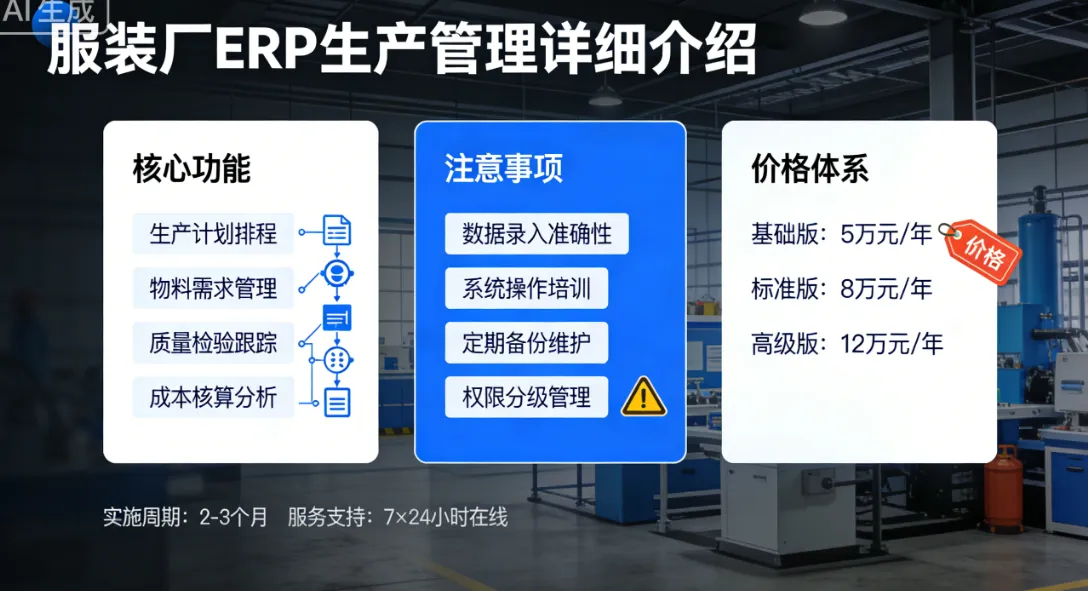
At the level of precautions, the most important thing that clothing factories should be wary of when importing ERP production management modules is "cutting feet to fit shoes".Many companies are attracted by the low-priced standard version system and only realize after going online that the system cannot handle their own unique business. Enterprises producing denim clothing need to record multiple washing processes and chemical usage, enterprises producing down jackets need filling algorithms and drilling quality inspection standards, and enterprises undertaking foreign trade orders face size standards and inspection specifications from different countries. The business process sorting before selection is not formalism. It is necessary to document the unique process nodes, exception handling procedures, and document flow habits of our factory one by one, in order to test the system's configuration flexibility and secondary development boundaries. Any supplier who claims to be "zero modification, ready to use" will find it difficult to fulfill their promises when facing clothing factories with certain complexity.
The implementation strategy should adhere to the principle of overall planning and step-by-step implementation. Production management is the most complex and departmental module in ERP, and attempting to run all functions on the first go live often leads to the project getting stuck in a quagmire. Mature experience prioritizes solving the pain points of order progress visualization and fabric quota control, which have the fastest effectiveness and relatively low difficulty in data collection, and can quickly establish team trust in the system. After the process runs smoothly and employees develop systematic work habits, we will gradually tackle advanced functions such as intelligent scheduling, full quality traceability, and fine cost accounting. At the same time, it is necessary to attach great importance to master data governance. If a unified naming convention and audit access control are not established for style codes, material codes, and process codes before going online, the system will be trapped in a data swamp after running for several months, and inaccurate and inconsistent verification will become a nightmare for daily work.
The importance of personnel training and change management is often underestimated. The age structure of frontline employees in the clothing workshop is relatively old, and their level of digital acceptance is uneven. If the training is superficial and the assessment lacks strength, the timeliness and accuracy of system input will inevitably be compromised. Successful implementation cases generally adopt a gradual promotion strategy, starting with a trial run in a model workshop, cultivating internal seed users, and attracting other teams to actively approach with visible efficiency improvements. At the same time, the standardization of system operation should be included in the performance evaluation of the team, forming a positive incentive mechanism.
In terms of price, the investment in clothing ERP production management shows a clear polarization and full lifecycle cost characteristics.The cloud SaaS model is favored by small and medium-sized enterprises with a low starting price, with annual subscription fees ranging from thousands to 30000 to 50000 yuan. The initial investment is extremely light, and the supplier bears the responsibility of server operation and version iteration. However, it should be noted that the production module of this price scheme usually only supports work order entry and daily completion reports, and cannot achieve process level scheduling and refined cost collection. For factories with an annual output value of over ten million and slightly complex production modes, it may quickly hit the ceiling.
A specialized solution for medium-sized clothing manufacturing enterprises, with a production management module that has industry depth and supports clothing specific functions such as cutting machine optimization, outsourcing processing management, and color code dimension analysis. The software license and implementation services for such systems usually range from 150000 to 300000 yuan, with an implementation period of about two to three months. Users not only pay for software functions, but also for the clothing industry management logic that suppliers have accumulated over the years. For large clothing groups or international layout enterprises, high-end solutions provide multi factory collaboration, global supply chain integration, and big data forecasting capabilities. The complete implementation investment often exceeds one million yuan, and maintenance costs of 15% to 20% of the software amount need to be paid annually.
Invisible cost is a variable that is easily underestimated in selection decisions. Many companies are attracted by initial quotes and only realize after signing that additional fees are required for implementation services, secondary development, data cleaning, and interface fees with existing e-commerce platforms or warehousing systems. A typical case is that a Zhejiang clothing factory purchased an international brand ERP with an initial quotation of 300000 yuan, and the total investment including customized development and implementation exceeded 1.2 million yuan. Therefore, in the business negotiation stage, it is necessary to require suppliers to provide itemized quotation details, clarify the unit price per person day, secondary development billing standards, and the annual operation and maintenance cost increase limit for the next few years. At the same time, it is necessary to evaluate the supplier's local service capabilities, as remote support is difficult to replace the depth of on-site service response.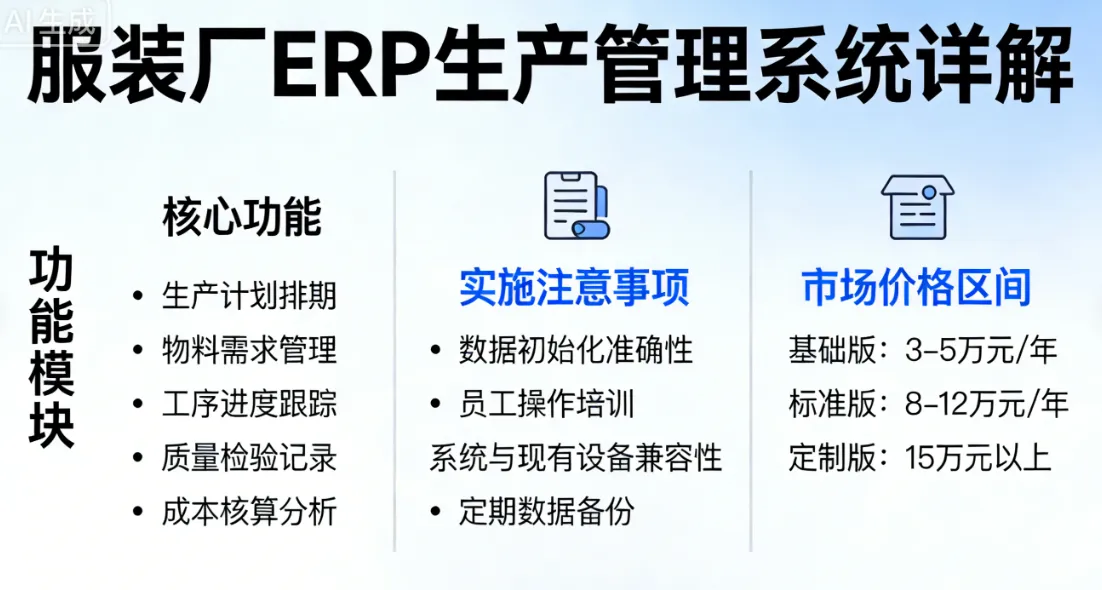
The digitization of production management in clothing factories does not have a perfect solution overnight, only dynamic adaptation through continuous iteration. Instead of pursuing the length of the feature list, enterprises should focus on the core pain points and the scalability of the system architecture when selecting models. The true value of the production management module lies not in replacing the experience of experienced craftsmen, but in weaving fragmented orders, materials, equipment, and personnel into a perceptible, predictable, and optimizable value network. When the system can answer in real-time which product is being produced on which line, how many processes are left, and whether the cost meets expectations, the flexible manufacturing capability of clothing factories truly has a digital soul. The essence of this transformation is not to purchase a set of software, but to establish a production collaboration method that uses data as the language.