
Detailed Explanation of Clothing Processing ERP System: Definition, Functions, and Advantages
In the clothing processing industry, an order often goes through dozens of processes from fabric procurement to finished product shipment, involving collaboration from multiple dimensions such as materials, equipment, labor, and outsourcing. The traditional management model relies on paper work orders, Excel spreadsheets, and WeChat communication. Information decays during transmission, progress is delayed while waiting, and costs are out of control in ambiguity. The emergence of ERP systems for clothing processing is aimed at building a digital highway between these discrete links. It is not a simple tool replacement, but a reconstruction of the production organization mode of clothing processing enterprises.
The definition of clothing processing ERP system is first reflected in its essential distinction from general ERP. The design logic of a universal ERP is aimed at industries such as mechanical manufacturing and electronic assembly. Its bill of materials is static and accurate, with each part corresponding to a specific specification and quantity. However, the material relationship in clothing processing is far more complex. Due to different fabric shrinkage rates, the unit consumption of the same garment may vary, and there may be visible color differences in the same batch of fabric due to different cylinder numbers. The craftsmanship standards of a finished garment often rely on the experience of the master rather than drawing parameters. Clothing processing ERP is a specialized system designed to handle the precision of non-standard and fuzzy standards. It takes the three-dimensional management of styles, colors, and sizes as the underlying architecture, with fabric batch tracking, process parameter inheritance, and cost production capacity matching as the core capabilities, helping enterprises transform fragmented orders into executable, traceable, and optimizable production instructions.
At the production planning level, the core value of clothing processing ERP is to move from experience based scheduling to algorithmic scheduling. The production scheduling of traditional processing plants highly relies on the personal judgment of production managers. Faced with complex constraints such as multiple styles in parallel, different process complexities, varying worker skills, and uneven arrival of materials and accessories, manual scheduling often neglects one aspect and neglects the other. A professional clothing processing ERP system can integrate dozens of dynamic variables such as order delivery priority, equipment capacity load, each team's expertise in process types, and current work in progress inventory, and generate the globally optimal scheduling plan within minutes. More importantly, this scheduling is not static locking, but rolling refresh and continuous optimization. When brand customers add urgent orders, the system does not simply interrupt the existing production line, but evaluates the chain effect of inserting orders on the overall delivery time through algorithms and recommends the optimal adjustment path. This scheduling capability transforms clothing processing factories from passive nodes of receiving orders to proactive dispatchers with capacity foresight.
Material management is the technical barrier of clothing processing ERP and also the lifeline of cost control. Clothing processing involves dozens of types of materials such as fabrics, linings, lining materials, zippers, buttons, lace, washing labels, etc. Each type of material also includes complex attributes such as color code, cylinder number, width, weight, and composition. Even more tricky is that there may be visible color differences between different cylinder sizes of the same fabric, and mixing them with the same batch of ready to wear clothing will lead to serious quality accidents. The clothing processing ERP system achieves full process cylinder number control from incoming inspection, warehouse positioning, cutting and issuing to finished product warehousing by establishing material files and batch traceability mechanisms. When the cutting workshop scans the material requisition form, the system will automatically verify whether the cylinder number of the received fabric matches the requirements of the process sheet, and intercept the mixing cylinder operation in real time. This kind of pre error prevention capability is much more economical than reworking after discovering color differences in the finished product inspection process. After implementing cylinder allocation management in ERP, the rework rate caused by color difference in a certain knitting enterprise decreased by more than 70%, and fabric waste was effectively curbed.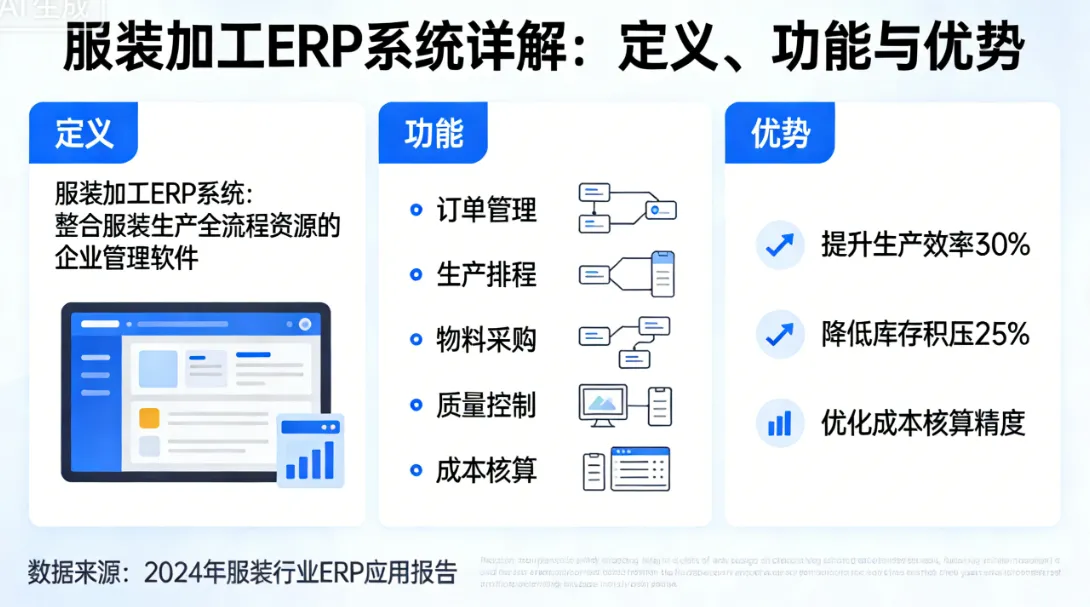
Transparency of production progress is a key battlefield for eliminating management black boxes in clothing processing ERP. Many processing plants have fallen into the dilemma of having workshop directors to chase after goods on the entire site even after entering the system. The root cause is that ERP only records the two nodes of work order start and completion, without knowing how much cutting has been completed, which process sewing has progressed to, and how many work in progress products are left in the later stages. To truly adapt to the ERP system for clothing processing, data collection points must be set up in key processes, supporting various convenient input methods such as workstation card swiping, tablet selection, and work ticket scanning. After completing a process, workers scan the code to confirm, and the system updates the process level progress of the garment in real time. Management personnel can intuitively grasp the production stage and completion ratio of each order through the Kanban board. When the progress of a certain sewing process lags behind the plan, the system automatically pushes a warning to the team leader's mobile end, and shifts the responsibility for handling the abnormality to in-process intervention. This transparency not only compresses the management radius, but also allows workers to have immediate feedback on their production efficiency, forming a self driven improvement cycle.
Standardization of processes and explicit implicit experience are another advantage that distinguishes garment processing ERP from general inventory systems. The quality stability of clothing processing highly depends on the hand feel and vision of the operators, but the experience of experienced workers is difficult to replicate, and the training cycle for new employees is long. After the loss, the process gap becomes a hidden pain for many factories. The clothing processing ERP system establishes a digital process knowledge base to convert vague requirements such as a flat neckline and a sleeve cage that cannot be lifted into quantifiable and executable process parameters such as the tension range of the collar thread, needle spacing density standards, and ironing temperature thresholds. Workers can access the corresponding process manual and even watch standard operation videos at the production terminal at any time. When the new clothing is transferred from sampling to mass production, the system directly synchronizes the process standards confirmed during the sample stage to the workshop, greatly shortening the process run in period before mass production. The explicit accumulation of this implicit experience enables enterprises to no longer overly rely on a single capable person and gradually establish organizational level process inheritance capabilities.
Cost accounting is the financial closed loop of clothing processing ERP and also the lens that drives management improvement. The traditional cost accounting method simply and roughly divides fabric, labor, and manufacturing costs according to production volume, resulting in unclear profit and loss of orders and confusion between low profit and high profit payments. The clothing processing ERP system adopts the activity-based costing model to accurately track the hours, energy consumption, and auxiliary resources consumed in each process, and collect costs by style, order, batch, or even individual product. The system can reveal that although a certain manual process only accounts for a small part of the total working hours, it consumes disproportionate indirect costs. It can also compare the differences in fabric loss of the same garment produced by different teams, providing accurate data anchors for process optimization and equipment updates. A more forward-looking application is to predict the order level profit margin under different fabric schemes and delivery requirements during the order acceptance stage, helping processing enterprises make more rational decisions in the quotation process. When enterprises can clearly understand which types of orders are earning hard-earned fees and which types of orders have real profit margins, the order taking strategy is no longer just about quantity, but a conscious selection.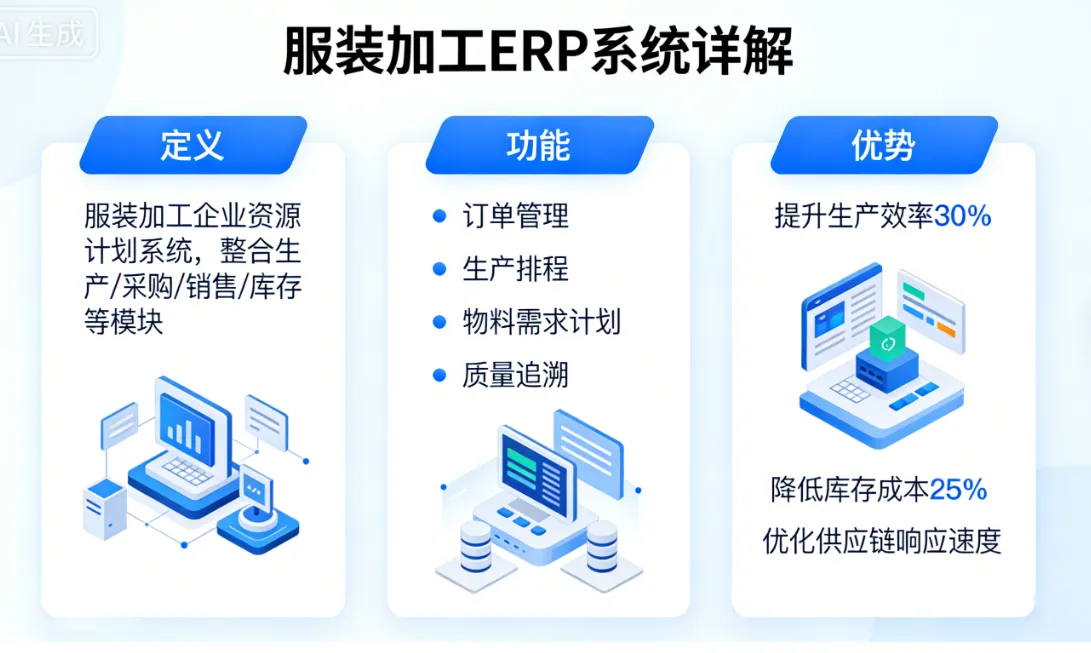
Supply chain collaboration capability is becoming a new competitive dimension for clothing processing ERP. Clothing processing is never a solitary effort of a single factory. Fabric suppliers, accessory manufacturers, dyeing outsourcing, printing and embroidery factories, and washing factories form a complex collaborative network. In the traditional mode, communication between processing plants and external partners relies on telephone, email, and WeChat, with information lag and cumbersome reconciliation. The new generation of clothing processing ERP system integrates supply chain collaboration into a unified platform, achieving procurement plan sharing, inventory visibility, and progress synchronization with suppliers and outsourcing factories. When the system automatically calculates material requirements based on the production plan, it can synchronously generate purchase orders and push them to the supplier's end. After the supplier confirms the delivery date, the system automatically updates the estimated time of arrival. After the fabric is stored, the system guides the issuance of materials according to the cylinder allocation plan and tracks the entire outsourcing process, from raw material outsourcing, processing and recycling, quality inspection to cost settlement, all statuses are clear at a glance. This end-to-end supply chain visualization transforms the outsourcing process from a black box to a transparent one, effectively supporting the on-time delivery capability of processing plants.
The implementation benefits of the clothing processing ERP system ultimately need to return to the three simple indicators of efficiency, quality, and cost. The improvement of production efficiency comes from the optimization of equipment utilization through scheduling, the compression of waiting time for process connection, and the reduction of decision-making delay for abnormal responses. The leap in quality level comes from the mandatory implementation of process standards, pre interception of material error prevention, and rapid closed-loop quality traceability. The optimization of cost structure comes from the release of funds through accelerated inventory turnover, direct savings from reduced fabric loss, and improved utilization of labor hours. These benefits are not achieved in isolation, but rather as management fruits that gradually grow after the system weaves plans, materials, processes, schedules, and costs into a digital network.
Clothing processing ERP system has never been a panacea. It cannot replace the shortcomings of enterprise management foundation, nor can it grow out of thin air in the soil of data chaos. But it is indeed a necessary hurdle for clothing processing enterprises to move from experience driven to data-driven. When an emergency order is received, the system can inform you within a few minutes whether it can be accepted, when it can be delivered, and how much it will cost to avoid losses; When a quality customer complaint occurs, the system can trace the specific fabric cylinder number, operation team, and inspection records within ten minutes; When an order is completed, the system can accurately calculate the true cost of each garment. The accumulation of these abilities constitutes the irreversible core competitiveness of processing enterprises in fierce market competition. This is not a multiple-choice question about tools, but a mandatory question about survival.