
How to choose shoe production software for enterprises? Analysis of the Three Key Points of Shuntong Footwear ERP
Enterprises often find themselves in a typical dilemma when choosing footwear production software. On the one hand, the list of functions is dazzling, from cutting scheduling to cost accounting, from barcode tracing to mobile approval, it seems that every supplier claims to be omnipotent; On the other hand, there are too many failed cases around us. After the system was launched, it was idle, the data was not matched, and employees were unwilling to use it, resulting in millions of investments being wasted. This anxiety is not without reason. The business process of the footwear industry is extremely unique, and general ERP cannot adapt, while professional footwear software has varying quality. Through the success and failure cases of Shuntong Footwear ERP in dozens of shoe companies, three underlying principles that run through the entire selection process can be clearly extracted. These three rules are not a horizontal listing of function comparison tables, but rather the lifeline that determines whether the software can take root in the shoe factory.
The first key point is industry adaptability, not multifunctionality, but functional accuracy. Many shoe companies are easily moved by large and comprehensive functional demonstrations when selecting, but they overlook whether the software truly understands the most daily and frequent operating scenarios. Shuntong Footwear ERP encountered serious resistance in a women's shoe factory in Huidong in the early days, for a very specific reason: the system does not support cylinder number management of shoe materials. The genuine leather fabrics purchased by this factory have different cylinder numbers for each batch, and the cutting workshop must strictly follow the cylinder number ratio for material distribution, otherwise there will be visible color differences in the finished shoes. Shuntong's standard products simply and roughly unify the numbering of material batches, making it impossible to distinguish the inventory location and priority of different cylinder numbers for the same material. When picking up materials in the workshop, the system showed that there was inventory, but the actual product had an incorrect cylinder number. Workers had to first pick up materials from the warehouse and then manually make notes. Half a month later, the system inventory completely disconnected from the actual product.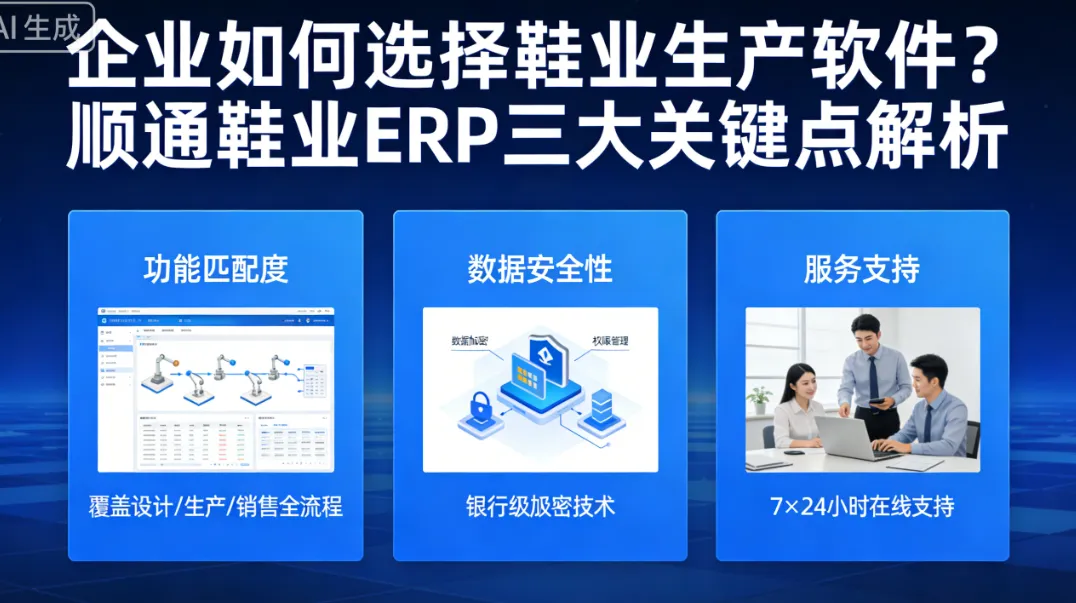
This failure made Shuntong deeply realize that the industry adaptability of footwear production software is not an abstract concept, but a precise response to a series of specific scenarios. Shuntong has restructured the material batch model in subsequent versions, embedding cylinder number, color number, width, and receipt date as independent dimensions for each inventory change. The question that enterprises should ask when selecting is not whether the system has an inventory management module, but whether the system can support the management of different storage locations for the same material with different cylinder numbers, first in first out interception, and color difference risk warning. The same problem should occur at every core business node: can the production scheduling module recognize the process sequence in which the stitching of the shoe upper must be done before the fitting of the shoe sole? Can the cost accounting module collect cutting losses and needle sewing hours according to orders? Can the quality traceability module trace the return of finished products to specific fabric suppliers and operation teams within fifteen minutes. These scenario based questions have much more filtering value than 'whether mobile approval is supported'.
The second key point is data governance capability, not software launch, but data launch. The failure of Shuntong Footwear ERP in a sports shoe OEM factory in Jinjiang, Fujian can be regarded as a textbook level negative case. This enterprise has been in operation for 18 years, and the material coding rules have evolved through three warehouse managers. The same black mesh fabric has seven different names in the system, with the procurement department using the supplier's part number, the production department using the internal abbreviation, and the finance department using the general category. During the research phase, the implementation consultant of Shuntong repeatedly emphasized the importance of data cleaning, and the business owner verbally supported it. However, in reality, only two clerks were sent to work overtime for a week to hastily organize 3000 material files. In the first month of launch, purchase orders could not be automatically associated with work orders due to material codes. When the warehouse issued materials, the system showed sufficient inventory, but the physical items did not match. Production was suspended for three days waiting for materials. When calculating costs in financial accounting, it was found that the unit consumption of the same shoe upper differed by 20% in different work orders, making it impossible to determine which data is accurate.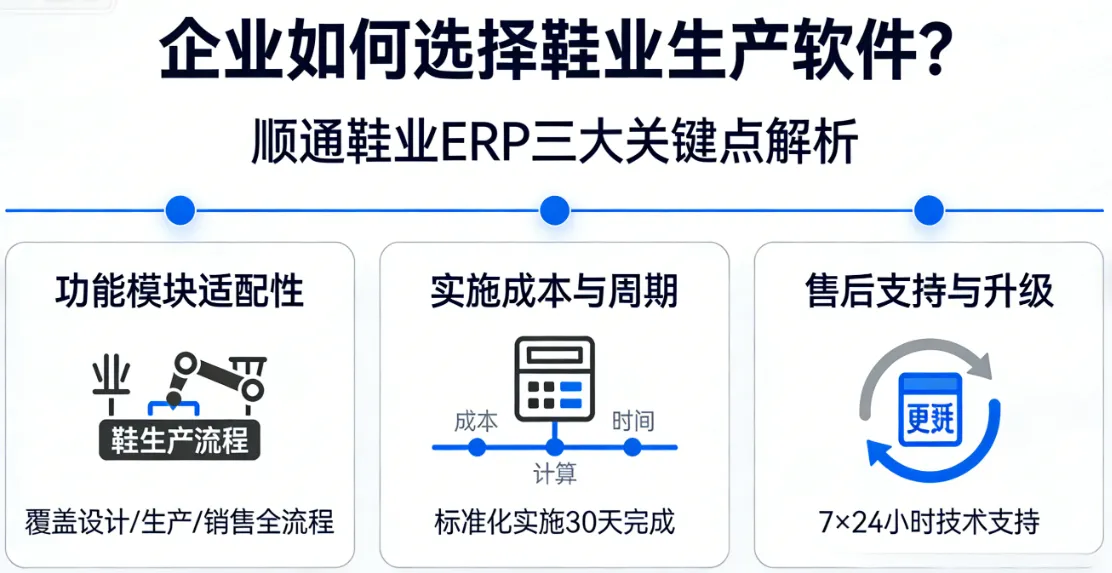
This case reveals a cruel reality: footwear production software does not automatically clean data, it only exposes the company's management arrears of the past few years to the sunlight at once. When choosing software, enterprises must evaluate both their own data foundation and the data governance methodology of their suppliers. Shuntong later summarized a set of data cleaning standard processes, from material classification, coding rules, name specifications to historical inventory counting, with clear delivery standards and acceptance tools for each node. When selecting a company, suppliers should be required to provide practical cases of data governance, rather than staying at the level of 'we have data import tools'. More importantly, business owners must be aware that data cleaning is not the responsibility of the IT department, but rather the joint responsibility of the heads of the four major business departments: procurement, production, warehousing, and finance. Who provides material classification rules, who approves code requests, and who is responsible for historical inventory differences, these permissions must be clearly assigned to individuals before the software goes live.
The third key point is to implement service and organizational change capabilities, not training operations, but reshaping habits. The implementation process of Shuntong Footwear ERP in a men's shoe brand in Wenzhou showed optimism in all early indicators: meticulous demand research, solid data cleaning, and high participation of key users. However, three months after the system was launched, the data quality began to plummet. The implementation team conducted a review and found that the root cause of the problem lies in the frontline workshop. The leader of the molding production line believes that scanning the code after each process is completed will slow down the production pace, tacitly allowing workers to work first and make up for orders later, and even saving up to one hour before the end of work for centralized input. The working hour data in the system is severely distorted, and cost accounting has lost its reference value. The finance department requires the warehouse to strictly implement the first in, first out policy, but the warehouse keeper finds it troublesome and continues to use the old habit of "picking up materials nearby". Shuntong consultants repeatedly trained on the operation steps, and all employees passed the training and examination, but they still went their own way after returning to their workstations.
This failure has redefined the boundaries of implementing services for Shuntong. Operation training can only solve the problem of whether one knows or not, but cannot solve the problem of willingness or unwillingness. Shuntong has added a "benefit association analysis" section in its implementation methodology, which clarifies the relationship between system operations and personal interests for each key position. The reason why the molding team leader resists scanning codes is because in the past, production was the source of his management authority, and the system visualized efficiency to make him feel monitored. The solution is not to strengthen training, but to include the team leader in the efficiency improvement team, use system data to help him identify production line bottlenecks, and give him the authority to adjust process scheduling. The warehouse keeper is unwilling to go first in, first out because searching for the bottom shelves increases physical exertion. The solution is not a fine, but to add a reward coefficient of "reduction of stagnant materials" in performance evaluation and synchronously purchase a batch of height adjustable picking elevators.
When selecting footwear production software, enterprises must rigorously evaluate the implementation methodology of suppliers, just like evaluating software functionality. How do they identify implicit resistance from key users? How to handle cross departmental conflicts of interest? How to link system assessment indicators with employee performance compensation? There is no standard answer to these questions, but a mature implementation team must have a mature response framework. The success of Shuntong in another shoe company in Wenzhou is precisely due to the joint development of a six-month "habit development roadmap" with the company before signing the contract, which included system operations in the job description and strongly correlated data accuracy with quarterly bonuses for department heads.
The three key points of Shuntong Footwear ERP are actually three progressive questions. Industry adaptability answers whether this software is designed for the footwear industry, data governance capability answers whether the enterprise is ready for digital scrutiny, and service and organizational change implementation capability answers whether software and the enterprise can evolve together. There is no one size fits all answer to these three questions, but each follow-up is pushing the selection decision from a superficial comparison of price and functionality to a deep match of strategy and capability.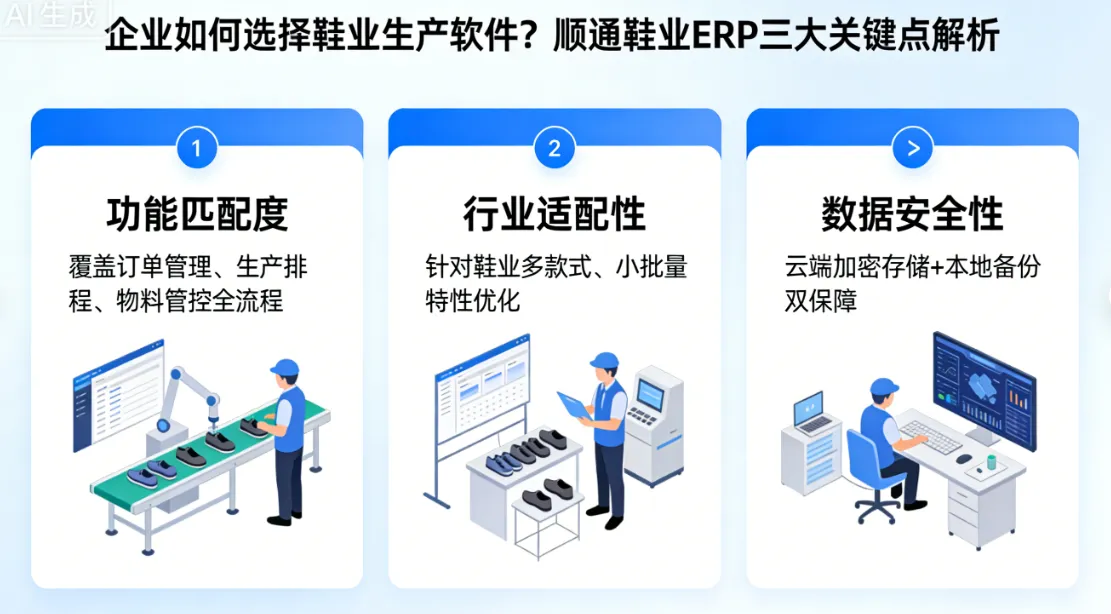
The Shuntong software, which was shelved in the corner of the warehouse with normal inventory display but no one dared to use it, is essentially the same code used by another shoe factory that also uses Shuntong and accelerates inventory turnover by 30%. The difference is not in functionality, but in whether companies choose it as a set of tools to purchase or as a starting point for management change to invest in. Choosing the right starting point will provide direction for the subsequent path.