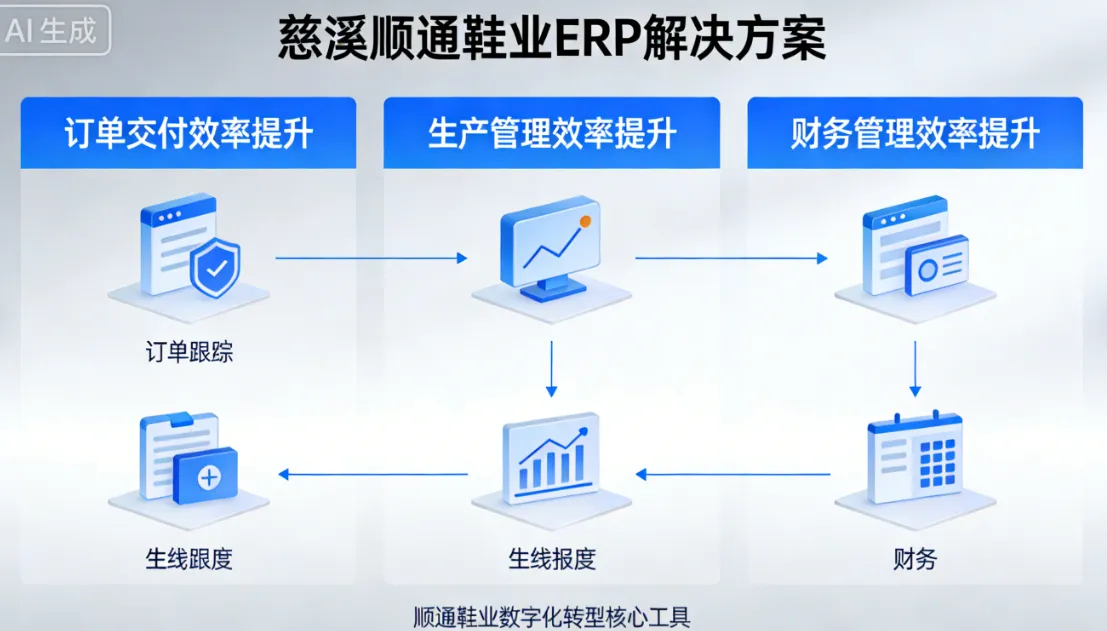
Cixi Shuntong Footwear ERP Solution: Improving Order Delivery, Production, and Financial Management Efficiency for Shoe Enterprises
In Cixi, a land with highly active private economy, the footwear industry is a typical traditional advantageous industry. However, in the past five years, local small and medium-sized shoe enterprises in Cixi have been experiencing unprecedented pressure. On one hand, Southeast Asian contract factories are crazily competing for orders with lower labor costs, while on the other hand, brand owners are compressing delivery times to less than 15 days and breaking down orders into a normal state. The owner of a women's shoe export enterprise in Cixi laughed bitterly at himself at an industry salon: taking orders now is like gambling, betting on whether the fabric can arrive on time, whether the production line can be arranged, whether there is profit at the end of the month. His predicament is not an isolated case, but a collective anxiety on the eve of digital transformation in the footwear industry in Cixi and even the entire Yangtze River Delta. The emergence of Cixi Shuntong Footwear ERP solution is an attempt to provide a practical remedy for these anxieties - it does not start from the grand narrative of intelligent manufacturing, but from the three most painful, urgent, and unavoidable daily battlefields of order delivery, production execution, and financial accounting.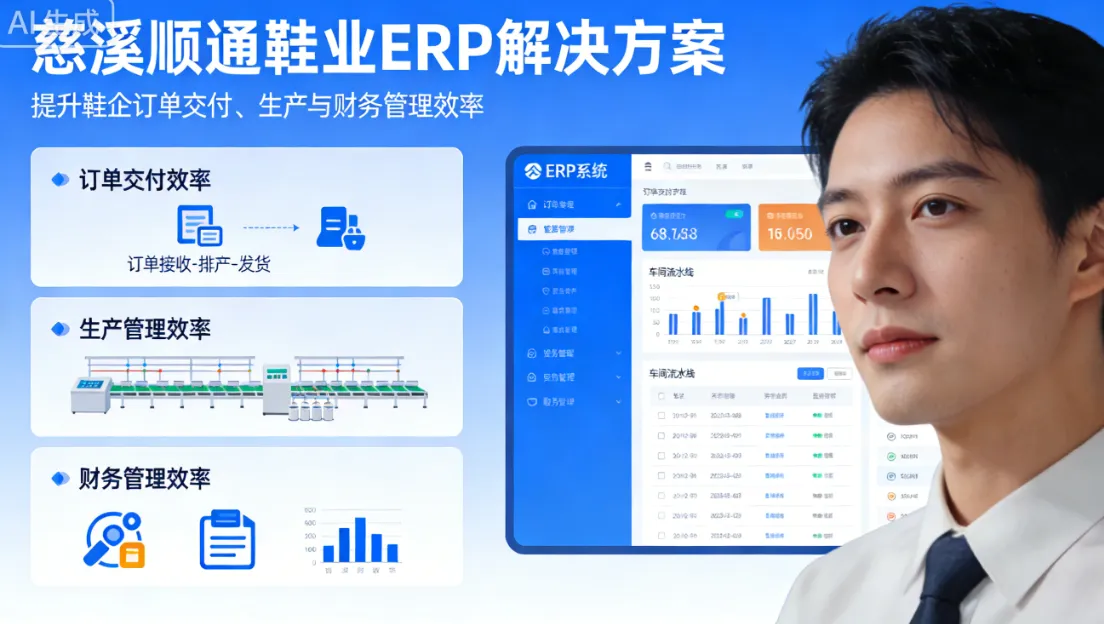
Order delivery is the most fragile trust contract between shoe companies and customers. A factory specialized in producing snow boots in Cixi had its annual framework agreement cancelled by European customers due to three consecutive delays in delivery. After a retrospective review, it was found that it was not due to the inability to keep up with the production speed, but rather a disconnect between order entry and scheduling: the sales department manually transcribed the email order into Excel, and the production manager then manually scheduled production based on Excel. When the paper purchase orders from the procurement department were circulated, the fabric supplier's scheduling period had already passed three days. The core transformation of Cixi Shuntong Footwear ERP at the order delivery level is to cut off information delays from the source. The system supports direct import of customer orders or API docking. Once the order is confirmed, it automatically triggers material requirement calculation and synchronously generates procurement suggestions and production work orders. More importantly, the delivery commitment module - when the salesperson enters the order quantity and expected delivery date, the system reads the current material inventory, in transit procurement, production line load, and mold availability in real time, and provides feedback on the promised delivery date within ten seconds. After the snow boot factory in Cixi launched this module, the order overdue rate decreased from 23% to 6%. Salespeople no longer need to chase after production managers to ask for delivery dates, and production managers can finally be freed from scheduling meetings.
The improvement of production management efficiency is broken down into two quantifiable goals in the design of the ERP system for Cixi Shuntong Footwear: the waiting time of the production line tends to zero, and the abnormal response time is compressed to the minute level. In the traditional mode, the first thing the workshop leader does every morning is to chase after materials - whether the cut fabric has been delivered, whether the auxiliary materials for the sewing machine are sufficient for half a day's use, and whether the shoe soles on the molding production line are matched with the shoe uppers. Cixi Shuntong ERP decomposes each production work order into traceable process tasks through electronic work tickets and process level reporting. After the cutting workshop completes the punching process, scan the code to confirm. The system automatically pushes the list of pending processing tasks to the needle car workshop and issues material delivery instructions to the AGV scheduling system. After a group of shoe companies in Wenzhou introduced the Cixi Shuntong solution, the backlog of work in progress between cutting and sewing decreased by 47%, and the waiting time for product line changes was reduced from 40 minutes to 12 minutes.
Abnormal response is a more fatal weakness in production management than efficiency. A injection molded shoe factory in Cixi once produced unqualified shoe soles for four hours due to a malfunction of a vulcanizing machine temperature controller that was not detected in a timely manner. It was not until the assembly in the molding workshop that the size was found to be too large that the entire batch was reworked, resulting in a direct loss of 180000 yuan. The equipment IoT module of Cixi Shuntong ERP integrates the real-time operating parameters of key equipment into the production dashboard. When the vulcanization temperature deviates from the process standard threshold, the system not only pushes a warning to the equipment department head, but also automatically locks the work order being executed by the equipment to prevent defective products from continuing to circulate. A more advanced application is the reverse intervention of quality traceability - the system identifies a strong correlation between the glue opening problem of a popular slipper and the drying time of the glue through clustering analysis of historical quality data. It automatically sets a mandatory timing lock for this process in the process route, and work orders that have been dried for less than 40 minutes cannot be transferred to packaging. This is not about holding accountable afterwards, but rather intercepting during the incident, and solidifying the experience of the old master into a systematic execution discipline.
The improvement of financial management efficiency is the watershed that sets Cixi Shuntong Footwear ERP apart from traditional inventory management software. The biggest financial headache for shoe companies is never bookkeeping, but cost accounting and reconciliation of transactions. A pair of sports shoes involves dozens of materials, and the price of genuine leather fluctuates weekly with the international auction market. Rubber raw materials are greatly affected by the crude oil market, and cutting losses vary from person to person due to the density of the cutting blades. Most shoe companies in Cixi still use the month end weighted average method, which divides all differences into total costs. The finance department works overtime for three days to calculate last month's profit, but finds that this number has no guiding significance for next month's orders. Cixi Shuntong ERP introduces an order level cost accounting model, which automatically collects the actual material requisition cost, actual labor hours, equipment depreciation, and energy consumption allocation upon completion of each production work order. After the system was launched, a children's shoe export enterprise in Cixi discovered for the first time that the actual cost of a classic sandal that they have been receiving orders for years is 12% higher than the quoted price. The crux of the problem is not the increase in material prices, but the need for manual bead decoration for this shoe type. This process has never been separately calculated for labor hours, and the actual cost has been masked by the average labor price of needle workers.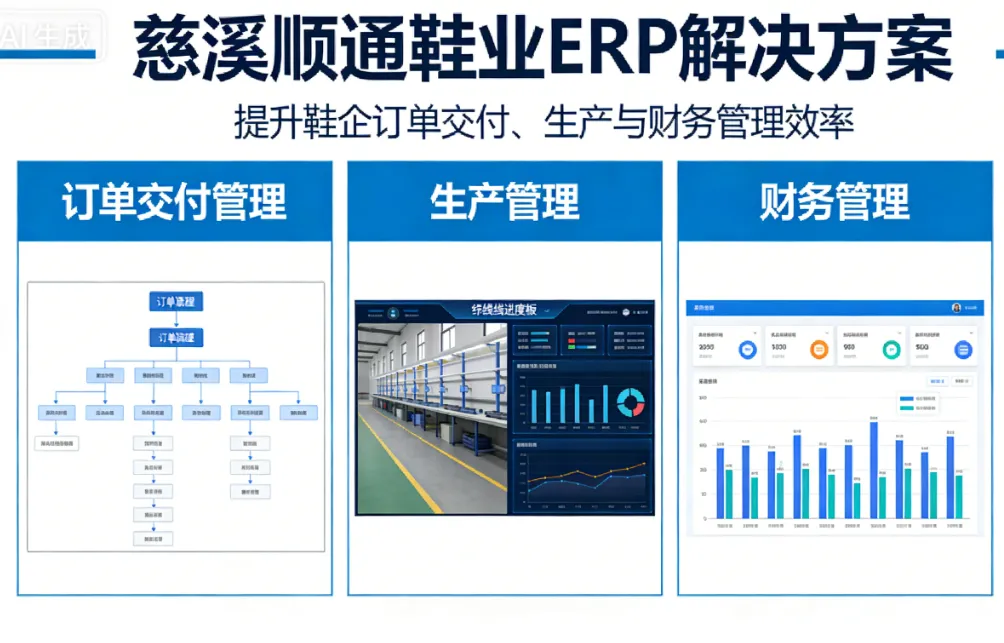
Reconciliation between transactions is another pitfall for the finance department. Shoe companies often have hundreds of suppliers, each with their own set of settlement cycles and reconciliation rules for fabrics, accessories, hardware, and packaging materials. In the traditional mode, the purchaser chased after the supplier for invoices, while the finance officer checked the warehouse receipt against the invoice. The warehouse receipt did not match the purchase order, and the dispute over the three orders consumed one-third of the finance department's manpower. The integrated design of business and finance in Cixi Shuntong ERP incorporates procurement warehousing, invoice verification, and accounts payable confirmation as closed-loop events. At the moment when the warehouse scans the code and enters the warehouse, a provisional estimate voucher is generated. When the supplier invoice is entered, the system automatically performs three order matching. Documents with differences exceeding the preset tolerance range are forcibly frozen in the payment process. After a large-scale shoe company in Cixi applied this module, the financial monthly settlement cycle was compressed from seven days to two days. The financial personnel transformed from data entry personnel to business analysts and began to have the ability to answer the most concerned questions of the management: what kind of orders, what kind of customers, and what kind of product combination are the real ways to make money.
The solution logic of Cixi Shuntong Footwear ERP always revolves around a simple core: not pursuing the length of the function list, but only pursuing the depth of the business closed loop. The three battlefields of order delivery, production execution, and financial accounting are each the most frequent, painful, and easily leveraged benefits by digital tools in the daily operations of shoe companies. When salespeople can provide reliable delivery dates before customers hang up, when workshop leaders no longer spend two hours a day chasing materials and orders, and when finance personnel are relieved from overtime reconciliation at the end of the month and start conducting profit analysis, this shoe company truly has the passport to move from experience management to data management.
The female shoe owner in Cixi, who had lost a major customer due to delayed delivery, regained her European order after using Shuntong ERP for 14 months. This time, she didn't promise a 45 day delivery as before. Instead, she opened the system and ran a material simulation, telling the customer that they could ship within 35 days. However, if they accepted a 42 day delivery time, each pair could be reduced by 0.8 dollars. The customer chose the latter. She said this was the first time in her 21 years in the industry that she felt like she had chips at the negotiation table. This chip is not the ERP software itself, but the path from order to cash that the software helped her see clearly.